Chapter 2: American Popular Music in the Nineteenth Century Pt.1
Table of Contents
“The Star Spangled Banner”
Album/Year Released:
Text written 1814; Melody composed c. 1770s
Artist/Composer
Lyrics: Francis Scott Key (1779–1843)
Melody: John Stafford Smith (attributed), “To Anacreon in Heaven”
Genre/Style
Patriotic song; broadside ballad;
Song Form
Strophic (repeated verses), no refrain
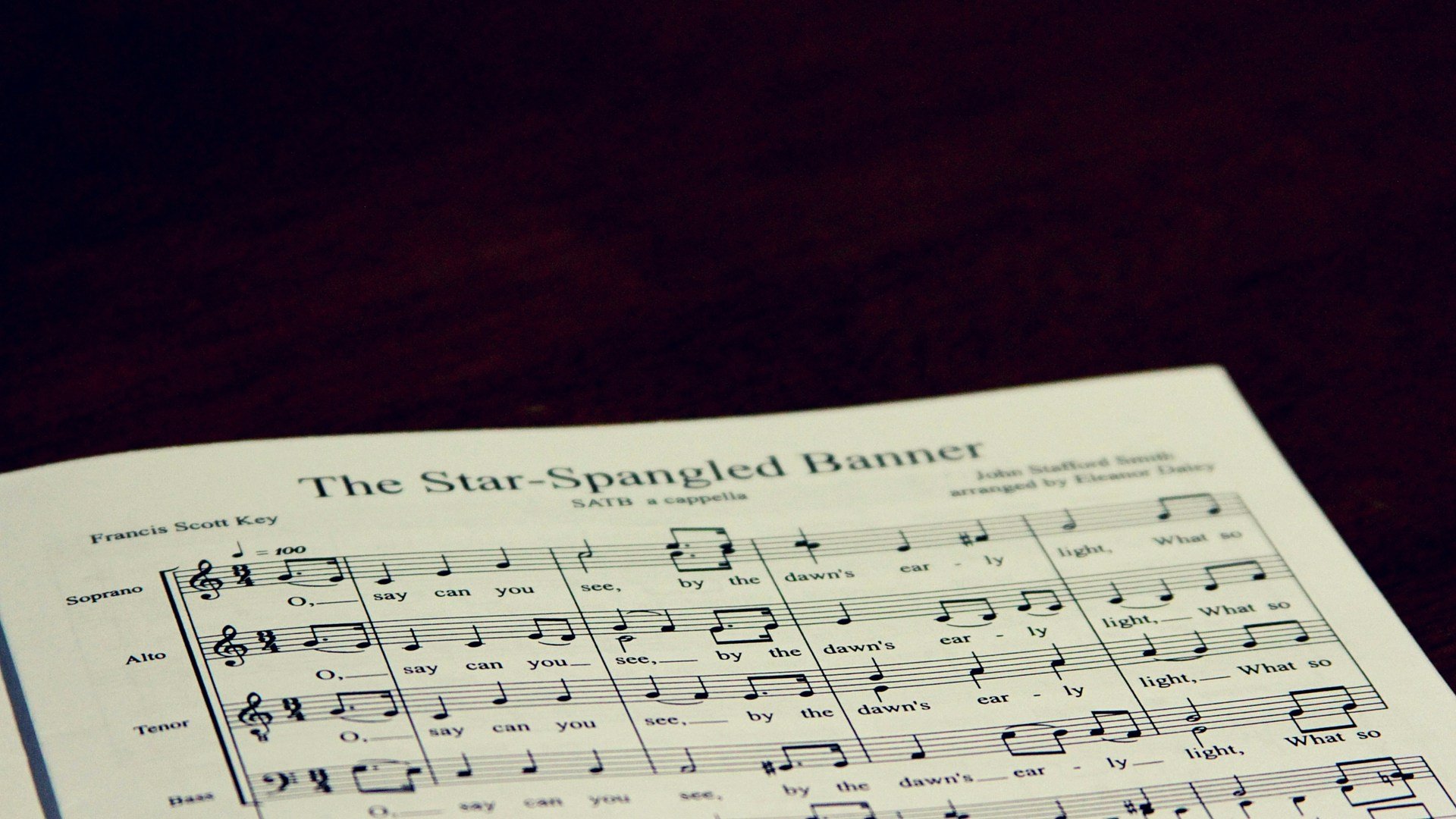
“The Star-Spangled Banner” began with the British bombardment of Fort McHenry during the War of 1812. In September 1814, Francis Scott Key watched the attack from a ship near Baltimore and saw the American flag still flying over the fort the following morning. He responded by writing a four-verse poem titled “Defence of Fort M’Henry.” The words quickly appeared in newspapers and printed copies before being paired with “To Anacreon in Heaven,” a British melody commonly attributed to composer John Stafford Smith. Using an existing tune allowed Key’s account of the battle to become a song almost immediately.
The song initially circulated through the same print culture as the broadside ballad, an inexpensive single-sheet form used for songs, political commentary, and accounts of current events. Broadsides usually supplied lyrics rather than newly composed music because singers were expected to fit the words to a melody they already knew. Copies could circulate through taverns, streets, meeting halls, and other public spaces, allowing a song to move between print and oral performance. “The Star-Spangled Banner” worked within this practice: the printed words provided the new material, while the familiar tune gave people a way to sing them.
Setting new words to an existing melody is known as contrafactum, a practice common in early American music. Contrafactum was especially useful when printed musical notation was less widely available and many people learned songs by ear. Anyone who already knew “To Anacreon in Heaven” could sing Key’s words without learning another melody. The practice helped the song move quickly from a poem describing a specific battle into music that could be performed by others.
Musically, “The Star-Spangled Banner” is strophic: each of Key’s four verses uses the same melody, without a separate chorus. Repeating the tune allows the words to carry the story from the bombardment and the sight of the flag through the later verses. The melody itself presents an unusual challenge for singers. Its range extends across roughly an octave and a fifth, requiring the voice to move between relatively low and high notes within a single verse. A melody originally written for a London gentlemen’s club therefore became the music for a song often performed by large groups of people with no formal vocal training.
Throughout the nineteenth century, “The Star-Spangled Banner” became increasingly associated with military ceremonies and patriotic public events, though it shared that role with songs such as “Yankee Doodle” and “Hail, Columbia.” Its use at military occasions grew during the late nineteenth and early twentieth centuries, long before it had any official status as the national anthem. The song also entered American sporting culture during World War I. During the 1918 World Series, a band performed it during the seventh-inning stretch as the United States was fighting in Europe. Players and spectators responded by standing and joining the performance, and baseball organizations increasingly included the song at games in the years that followed.
By the early twentieth century, Americans had been using “The Star-Spangled Banner” at public and military ceremonies for decades, but the United States still had no legally designated national anthem. Congress formally gave the song that status in 1931, more than a century after Key wrote the original poem. Its path from a printed account of the bombardment of Fort McHenry to the national anthem grew through repeated public use: people first encountered it through newspapers and broadsides, later heard it at military and civic ceremonies, and eventually came to expect it at sporting events and other public gatherings.
“De Camptown Races”
(also known as “Gwine to Run All Night” or “Camptown Races”)

Album/Year Released
Published February 1850
Artist/Composer
Stephen Foster (1826–1864)
Genre/Style
Minstrel song; American folk/Americana
Song Form
AB Form (Verse-Refrain)
Stephen Foster’s “Camptown Races,” published in 1850 and performed by Christy’s Minstrels, became one of the most familiar songs to come out of nineteenth-century blackface minstrelsy. Its short phrases and repeated “Doo-dah!” response made it well suited to the minstrel stage, where a solo performer could trade lines with the rest of the troupe. The same qualities helped the song travel beyond the theater through sheet music and informal singing. Its familiarity today, however, can obscure the racialized form of entertainment for which Foster originally wrote it.
The song describes gambling at a horse race in the fictional town of Camptown, Pennsylvania, a name that may have drawn from a place Foster knew while attending school in the region. The narrator moves through the excitement of the race while betting on a horse, giving the song the loose atmosphere of gambling and transient social life surrounding the event. References to the “Camptown ladies” leave their role uncertain and have sometimes been interpreted as suggesting women living outside respectable middle-class society, possibly including sex workers. Foster also drew from minstrel songs already circulating when he wrote the piece. Musicologist Richard Crawford, in America’s Musical Life, notes similarities between “Camptown Races” and Dan Emmett’s “Old Dan Tucker” and suggests that Emmett’s earlier song provided Foster with a model.
The lyrics place the song firmly within the racial conventions of blackface minstrelsy. Foster wrote in an exaggerated stage dialect, using spellings such as “de” and “gwine” to create a white theatrical imitation of Black speech. Such spellings were a regular feature of minstrel songs and helped performers construct the fictional Black characters expected by white audiences. Foster has sometimes been distinguished from minstrel writers who relied on more openly hostile racial caricatures, but “Camptown Races” still belonged to an entertainment business that turned distorted portrayals of African Americans into comedy.
Call-and-response gives the song much of its musical character. In call-and-response, a leader presents a phrase and another singer or group answers it. During “Camptown Races,” the soloist carries the narrative of the verses while the ensemble answers with the repeated “Doo-dah! Doo-dah!” The exchange gives the performers distinct roles and creates an easy point for others to join the song. Call-and-response has deep roots in African and African American musical traditions, making its use on the minstrel stage another example of white entertainers drawing from Black performance practices while presenting them through racial caricature.
The repeated refrain also helped “Camptown Races” survive long after the minstrel shows for which it was written. The melody could be remembered easily and fitted with new words, allowing it to circulate through informal performance as well as printed music. Later generations encountered versions of the tune in films and television, including cartoons, and in children’s music and classrooms, often without its original minstrel setting being discussed. Its continued familiarity gives the song a complicated history: a melody written for blackface entertainment became detached from that setting in later popular culture, even though the dialect, performance style, and musical borrowing of the original remain part of how the song was created.