Chapter 24: Country Rock & Southern Rock
“Hickory Wind”
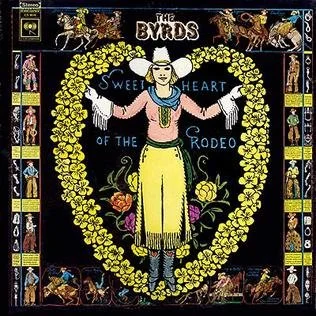
Album/Year Released
1969 (album: Sweetheart of the Rodeo)
Artist/Composer
The Byrds
Gram Parsons and Bob Buchanan
Genre/Style
Country Rock
Song Form
Stophic
“Hickory Wind” was written by Gram Parsons and Bob Buchanan during a train journey from Florida to Los Angeles in early 1968 and recorded by the Byrds for Sweetheart of the Rodeo. The song appeared as the band was moving much further into country music, with Parsons encouraging the use of Nashville musicians and country repertoire throughout the album. Although Buchanan shared the writing credit, “Hickory Wind” became closely associated with Parsons because its images of home and displacement fit subjects he returned to throughout his later work.
The song moves in a slow 3/4 meter, with three beats to each measure. The bass usually lands on the first beat while the accompaniment fills the second and third, producing the gentle sway associated with a country waltz. Rather than alternating between verses and a repeated chorus, “Hickory Wind” uses strophic form: each stanza returns to essentially the same melody and harmonic pattern. The repeated music gives the words room to change while the instrumental setting stays familiar, much like someone returning to the same memory from different points in life.The song is a slow country waltz in 3/4 meter. The bass emphasizes the first beat of each measure, while the remaining two beats create the gentle sway heard throughout the recording. There is no separate chorus. Instead, each stanza returns to essentially the same melody and chord progression, allowing the lyrics to move forward while the music circles back to familiar material. The repeated setting suits a song built around memories that the narrator cannot leave behind.
Country instruments carry much of the arrangement. Lloyd Green’s pedal steel slides between pitches and answers Parsons during the spaces between vocal lines, while John Hartford’s fiddle adds another sustained melodic voice. Parsons plays acoustic guitar and piano, with Chris Hillman on bass, Roger McGuinn on banjo, and Kevin Kelley on drums. The rhythm section stays subdued, leaving considerable space around Parsons’s voice and the steel guitar rather than using the stronger backbeat heard on the Byrds’ earlier rock recordings.
The lyrics begin with an idealized memory of the rural South: tall pines, an old oak tree, and the hickory wind that the narrator wants to call him home. The South Carolina setting is not a literal account of Parsons’s childhood; he was born in Florida and grew up largely in Georgia and Florida. The song instead constructs a remembered home that becomes more attractive as the narrator moves farther from it.
Later verses contrast those memories with adult wealth and urban life. The narrator has gained money and attention but finds little comfort in them, describing “a far away city, with a far away feel.” Each return to the hickory wind carries more weight as the song continues. Home becomes less a specific place than something the narrator associates with security and a life that now feels inaccessible.
Parsons sings without pushing toward a dramatic climax. His slow, plain delivery leaves room for the pedal steel and fiddle to answer him, and the same melody returns with each stanza. The song therefore ends much as it began, with another request for the hickory wind rather than a musical resolution.
The Byrds recorded “Hickory Wind” at Columbia’s Nashville studio on March 9, 1968. Parsons also sang it during the band’s appearance at the Grand Ole Opry later that month, reportedly substituting it for the planned performance of Merle Haggard’s “Life in Prison.” Although the song was never released as a Byrds single, its country-waltz rhythm, Nashville musicians, and rural imagery make it one of the clearest examples of the direction the band pursued on Sweetheart of the Rodeo.
“Take It Easy”
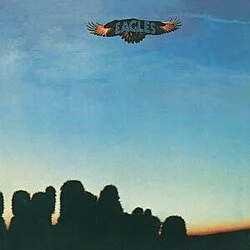
Album/Year Released
1972 (album: Eagles)
Artist/Composer
Eagles
Jackson Browne & Glenn Frey
Genre/Style
Country rock
Song Form
Verse-chorus
Released on May 1, 1972, “Take It Easy” brought country instrumentation into a rock arrangement without sounding like a conventional country recording. Jackson Browne began the song and Glenn Frey helped complete it, and the Eagles chose it as their first single and the opening track of their debut album. Recorded at Olympic Studios in London with producer Glyn Johns, the track combines acoustic and electric guitars with bass and drums, while Bernie Leadon’s banjo and the group’s close vocal harmonies give the arrangement a stronger country character.
The recording opens with broad guitar chords before the rhythm section settles into a moderate 4/4 groove. Acoustic guitar maintains a steady strumming pattern while electric guitar adds short fills around Frey’s vocal. The harmony relies largely on familiar diatonic chords—including G, C, D, E minor, and A minor—and the bass occasionally moves stepwise between them, smoothing the transitions from one chord to the next. Frey also enters with a syncopated pickup before the downbeat, giving the opening vocal phrase a slightly conversational quality rather than placing every word squarely on the beat.
Leadon’s banjo adds a different layer of rhythmic motion. At producer Glyn Johns’s suggestion, he plays a double-time part over the steadier pulse established by the drums and guitars. The faster banjo notes make the arrangement more active without changing the underlying tempo. Its bright attack is also easy to distinguish from the sustained electric-guitar lines, allowing a recognizably country instrument to occupy its own space within the rock rhythm section.
The vocal arrangement grows as the song progresses. Frey begins as the lead singer, with Randy Meisner joining in harmony during the second verse and Don Henley adding another voice as the refrain becomes fuller. The Eagles do not use harmony simply as continuous background accompaniment; additional voices enter at selected moments, making particular phrases sound broader than the solo lines around them. By the time the voices join on lines such as “Though we will never be here again,” the contrast between Frey’s solo delivery and the group harmony is easy to hear.
The form is less sharply divided than a standard verse–chorus pop song. Several long verse-like sections return to the same harmonic material, while the repeated “Take it easy” passage functions partly as a refrain within those sections rather than as a completely separate chorus. The arrangement provides much of the contrast instead. Vocal harmonies become thicker, instrumental parts enter and recede, and a guitar solo interrupts the repeated vocal sections before the song moves into its extended ending.
These details place “Take It Easy” between the country and rock traditions the Eagles were drawing from in 1972. The banjo and close harmony come from country and folk practices, while the electric guitars, drum backbeat, and studio arrangement belong comfortably within contemporary rock. Rather than separating those sounds into obvious country and rock sections, the recording lets them operate at the same time: Leadon’s fast banjo runs above a rock rhythm section while Frey and the other Eagles build the vocal harmonies around them.
“Sweet Home Alabama”
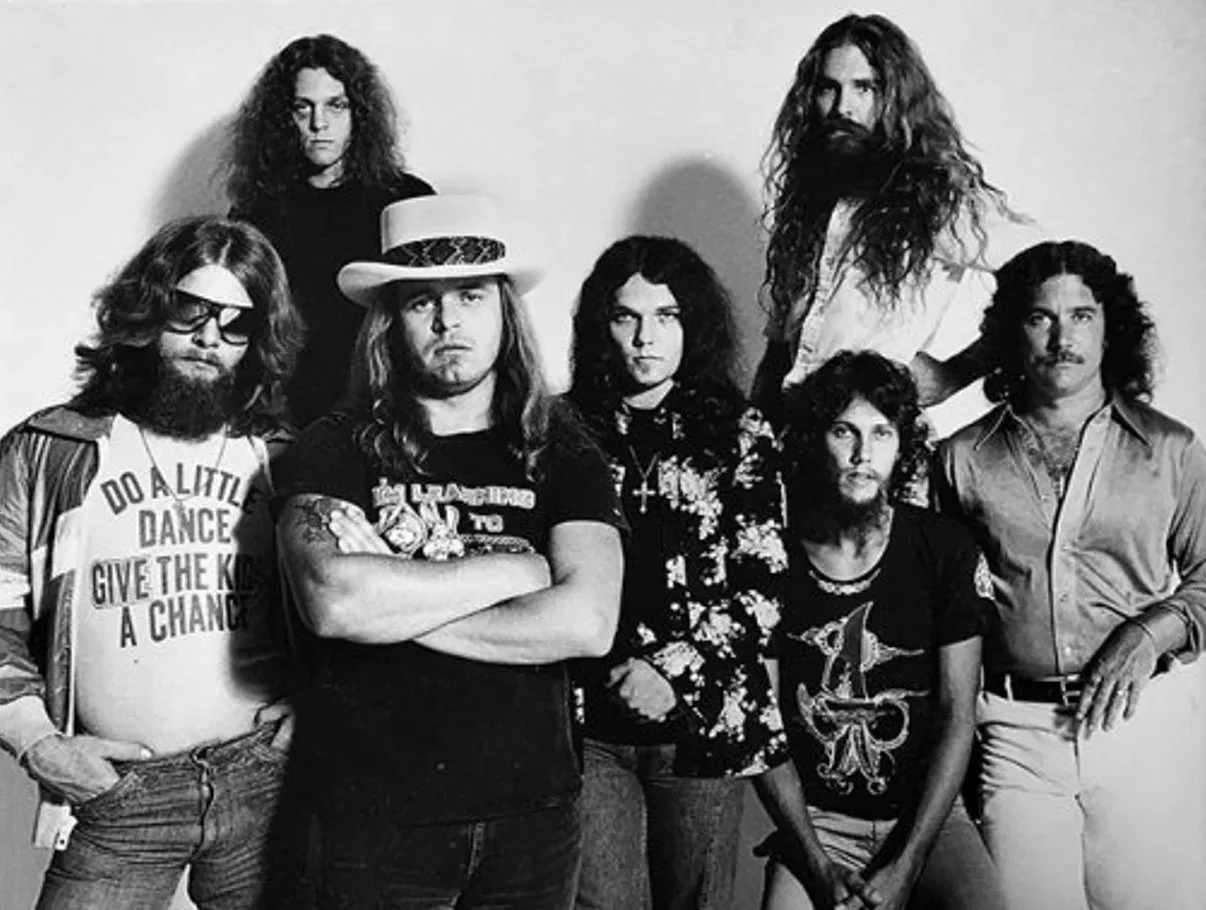
Album/Year Released
1974 (album: Second Helping)
Artist/Composer
Lynyrd Skynyrd
Ed King, Gary Rossington, Ronnie Van Zant
Genre/Style
Southern rock
Song Form
Verse–chorus with instrumental verses.
“Sweet Home Alabama” is built around one of Lynyrd Skynyrd’s most recognizable guitar riffs. Written by Ronnie Van Zant, Gary Rossington, and Ed King and released on Second Helping in 1974, the song stays in 4/4 meter and relies almost continuously on a repeating D–C–G progression. Because the harmony changes very little, movement comes from the guitars, vocal phrasing, and changes in instrumental texture rather than from new chord progressions.
Ed King plays the opening riff, combining strummed chords with short melodic figures and open strings. The part moves between rhythm and lead functions: it establishes the harmony while also supplying the melodic figure listeners recognize throughout the song. Bass and drums enter beneath it with a steady rock backbeat, while Billy Powell’s piano adds fills around the guitars. The repeating three-chord cycle continues beneath the verses and choruses, giving the entire recording a continuous groove.
The arrangement also makes use of Skynyrd’s multiple-guitar lineup without keeping every guitar equally busy. Individual parts occupy different spaces around the main riff, and the instrumental sections allow the guitarists to move further into lead playing. The solos draw heavily from blues and pentatonic vocabulary, connecting the recording to the blues-based guitar language heard throughout Southern rock. Because the D–C–G cycle continues underneath, the solos sound like extensions of the song rather than separate sections built on new harmonic material.
The form grows directly from that repetition. An instrumental introduction establishes the riff before Van Zant enters, followed by alternating vocal sections and returns to the title refrain. Instrumental breaks provide contrast between the vocal passages, and the final section continues the groove into a fade-out. The repeated phrase “Sweet home Alabama” functions as the main chorus hook, while backing vocals make each return broader than Van Zant’s more conversational verses.
That accessible chorus surrounds lyrics with a much less settled political meaning. Van Zant wrote partly in response to Neil Young’s “Southern Man” (1970) and “Alabama” (1972), songs that attacked racism in the South. Skynyrd answers Young directly, declaring that “a Southern man don’t need him around anyhow.” Van Zant objected to what he considered Young’s treatment of the South as a single place populated by people who shared the same attitudes. The response therefore begins as a defense of Southern identity against criticism from outside the region.
The following verse makes that defense harder to interpret. Van Zant refers to Alabama governor George Wallace, whose political career was closely associated with segregation, singing that “in Birmingham they love the governor” before backing singers respond with “boo, boo, boo.” He then turns almost immediately to Watergate and asks, “Does your conscience bother you?” The movement from Wallace to the Nixon scandal has produced competing readings. The Watergate reference can be heard as pointing out that political corruption was hardly confined to the South, but it can also sound like a diversion from Young’s criticism of Southern racism.
Van Zant later said that he did not support Wallace and pointed to the “boo, boo, boo” response as evidence. Other comments from people involved with the song have complicated that explanation, leaving its political position open to disagreement. The music itself offers little indication that the lyrics have entered difficult territory. The same D–C–G progression continues underneath the references to Young, Wallace, and Watergate, and the song repeatedly returns to the easily sung title refrain.
“Sweet Home Alabama” reached number eight on the Billboard Hot 100, becoming Lynyrd Skynyrd’s highest-charting single. Its three-chord riff and chorus became familiar far beyond the Southern rock audience, while the verses continued to provoke arguments about race and regional identity. Musically, the recording achieves much of its effect through repetition: D–C–G persists beneath nearly everything, giving the guitars and voices room to change while the underlying groove keeps pulling the song back toward the same familiar refrain.
“Whipping Post”
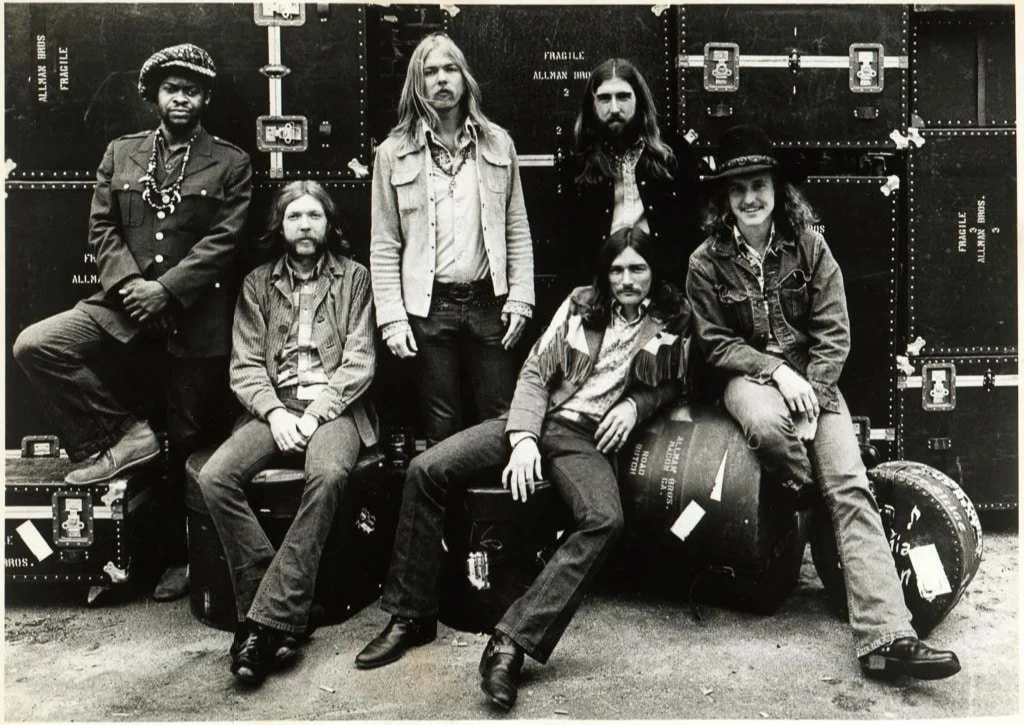
Album/Year Released
1969 (album: The Allman Brothers Band)
Artist/Composer
The Allman Brothers Band
Gregg Allman
Genre/Style
Southern rock; blues rock
Song Form
Extended form with instrumental improvisation
“Whipping Post,” written by Gregg Allman and first recorded in 1969 on The Allman Brothers Band, stands out for its atypical meter and form. The song begins with a bass riff that immediately unsettles the regular pulse expected in most rock songs. Berry Oakley plays the figure in 11/8, with the eleven eighth-note pulses commonly heard as 3 + 3 + 3 + 2. The first three groups establish a pattern, but the final group arrives one beat sooner than the ear expects, cutting the phrase short before it begins again. Gregg Allman later recalled hearing the rhythm intuitively rather than constructing it from a time signature, but its uneven grouping gives the opening its restless quality.
When the full band enters, the rhythm becomes easier to follow. The vocal sections move into a rolling compound feel, commonly heard as 12/8, giving Gregg Allman more room to stretch his vocal phrases across the beat. The contrast is important: the opening bass riff feels compressed and uneven, while the vocal sections settle into a broader pulse. Returns to the riff restore the tension before the music opens again.
The instrumentation gives each member room to move within that rhythmic framework. Gregg’s Hammond organ fills the space beneath his vocal, while Duane Allman and Dickey Betts alternate between rhythm parts, harmonized guitar lines, and individual leads. Oakley’s bass frequently behaves as a melodic instrument rather than simply reinforcing the guitar chords. Butch Trucks and Jaimoe supply the two-drummer foundation, allowing one drummer to hold the pulse while the other adds accents and rhythmic movement around it.
Harmonically, the song centers largely on A minor with a strong Dorian sound. The raised sixth associated with A Dorian gives parts of the music a different quality from a conventional minor-key blues progression. The band does not rely on a standard twelve-bar blues form. Instead, repeated riffs and modal harmony provide a framework loose enough for the musicians to extend sections without losing their connection to the song.
The original studio recording lasts a little over five minutes, but “Whipping Post” soon became a vehicle for much longer performances. On At Fillmore East (1971), the band stretches it beyond twenty minutes. The familiar vocal sections establish the song before the musicians move outward into extended improvisation. Duane and Betts take long guitar passages while the organ and rhythm section continually adjust beneath them, sometimes reducing the volume considerably before rebuilding the intensity.
The guitars do not simply take turns playing unrelated solos. A phrase from one musician can prompt an answer from another, while the bass and drums alter their playing as the solo develops. Duane and Betts can separate into individual lead parts and later meet again in harmonized lines. The two drummers likewise have enough room to vary the rhythmic density without losing the underlying pulse. As a result, the length of the performance comes from musical interaction rather than from repeating the studio arrangement several additional times.
Eventually, the band finds its way back to the material heard near the beginning. That return is part of what makes the opening bass figure so effective: after minutes of improvisation, its uneven eleven-pulse cycle is immediately recognizable. “Whipping Post” could therefore expand dramatically from one performance to another while retaining a strong point of return. The 11/8 riff gives the song its initial tension, the 12/8 vocal sections provide a broader groove, and the space between those fixed sections gives the Allman Brothers room to improvise.