Chapter 17: Soul, Motown, and Stax

Chapter 17: Introduction

In the 1950s, rock and roll developed from the fusion of African American rhythm and blues with elements of country, gospel, and pop idioms. Early rock pioneers such as Chuck Berry, Little Richard, and Fats Domino brought an electrifying musical energy and unmistakable originality to the genre. Yet by the early 1960s, as rock became increasingly commercialized and tailored to white audiences, industry practices pushed many Black musicians out of radio rotation and chart visibility. White performers, such as Elvis Presley, dominated the charts, while African American artists struggled for visibility, and only a few found success through major-label support or appearances on television programs like American Bandstand. Chubby Checker's "The Twist," for example, achieved mainstream popularity mainly due to the endorsement of TV host Dick Clark, an example of industry gatekeeping that limited Black performers’ access to television and national promotion. Even then, their images and output were tightly controlled. Others found success primarily in vocal groups that became vehicles for white producers such as Leiber and Stoller and Phil Spector, whose productions established the sound of acts like the Coasters, the Drifters, and several girl groups.
Rather than carry on in a genre that had largely distanced itself from its Black roots, many African American musicians redirected their energies toward the new sound of soul. Drawing on gospel's emotional power, rhythm and blues' groove, and jazz's harmonic sensibilities, soul music was centered on the Black experience by expressing its joys, sorrows, and resilience. Soul became an assertion of identity, resonating with the era's rising political consciousness and racial pride during the Civil Rights Movement.
The rise of soul coincided with a period of sweeping social change intertwined with mass protest, legislative reform, and state violence. In 1963, hundreds of thousands gathered in Washington, D.C., for the March on Washington for Jobs and Freedom, where Dr. Martin Luther King Jr. delivered his historic "I Have a Dream" speech. That same year, the Birmingham Campaign exposed the brutal realities of Southern segregation as televised images of police attacking peaceful protesters shocked the nation. The Civil Rights Act of 1964, signed by President Lyndon B Johnson, outlawed segregation and employment discrimination under federal law. Yet the struggle persisted. In 1965, the Selma to Montgomery marches—especially "Bloody Sunday"—called attention to the dangers faced by those demanding voting rights and led to the passage of the Voting Rights Act later that year.
Throughout the twentieth century, Black leaders articulated differing strategies for achieving racial justice that later influenced the tone, themes, and aesthetics of soul music. Booker T. Washington, a formerly enslaved educator and the founder of Tuskegee Institute (a vocational school aimed at training African Americans in skilled trades and agriculture), advocated self-reliance, economic progress, and respectability as a gradual path to racial uplift. In contrast, W. E. B. Du Bois, the first African American to earn a Ph.D. from Harvard and a founding member of the civil rights organization NAACP (National Association for the Advancement of Colored People), called for immediate full civil rights, higher education, and political activism. He framed artistic and cultural articulation as a means of political dialogue and cultural leadership in the fight for racial justice.
In the 1960s, these foundational debates on civil rights and black agency took on renewed urgency through the leadership of Martin Luther King Jr. and Malcolm X, who came to represent two contrasting visions of Black liberation. King, drawing on Christian theology and Gandhi's teachings, promoted nonviolent protest and cross-racial economic reform. He expanded this vision through campaigns such as the Poor People's Campaign. Malcolm X, however, rejected integrationist politics and advocated for a different path. Influenced by the teachings of the Nation of Islam, he promoted Black self-determination, cultural pride, and resistance, including armed self-defense when necessary. He rejected the need for white validation and urged Black Americans to reclaim and assert political autonomy and cultural self-determination. His call to secure civil rights "by any means necessary" spoke powerfully to a generation frustrated by slow, incremental change.
These differing ideologies appeared in the lyrics, vocal delivery, and production choices within soul recordings. As we will see in this chapter, Motown Records, under Berry Gordy, and Stax Records operated under distinct business structures and aesthetic priorities. Gordy envisioned Motown as a Black-owned label that would compete directly with white mainstream pop, presenting polished, elegant performers who could succeed on national and international stages. In many ways, Gordy’s vision resembled Washington's emphasis on discipline, upward mobility, and respectability. Yet even within Motown's carefully managed aesthetic, artists increasingly asserted their voices, infusing their work with calls for justice and political engagement.
Soul Music

Soul music emerged in the late 1950s and early 1960s as a distinct genre rooted in African American cultural and musical traditions. Many of soul's foundational elements came directly from the gospel music associated with the Black church. Gospel music contributed its call-and-response structure as well as vocal techniques such as melisma (singing multiple notes on a single syllable), bent pitches, and blue notes. The gospel model of a lead vocalist supported by a backing chorus carried over into soul's use of background singers and prominent vocal arrangements. Thematically, gospel's messages of perseverance, uplift, and hope remained central to soul music, even as lyrics shifted from spiritual salvation to romantic love, personal struggle, and political affirmation.
By the early 1960s, a more commercially polished, pop-influenced version of rhythm and blues began to coalesce into a subgenre known as sweet soul. This style featured moderate tempos, smooth, melismatic vocal lines, and rich background harmonies rooted in the doo-wop tradition. Many sweet soul songs were ballads, designed to showcase emotional vulnerability and romantic longing. These ballads typically employed atriplet feel—a rhythmic pattern in which each beat is divided into three equal parts—creating a lilting, swaying groove that intensified the expressive quality of the vocals and gave the music a gentle, cyclical rhythmic feel.
Unlike the more sparsely arranged textures of early R&B, sweet soul productions often featured lush orchestrations with string sections, vibraphone, and Latin-inflected rhythms in the drum parts, giving the genre a warm, sophisticated, and highly marketable sound. Sweet soul's crossover appeal crossover appeal was intentional, as producers crafted these recordings to reach Black and white audiences.
A widely circulated early example of this crossover success was Ben E. King's “Stand by Me" (1961), which merged gospel-inflected lead vocals with pop structure and orchestration. King had initially performed with the Drifters before embarking on a solo career, working closely with producer-songwriters Jerry Leiber and Mike Stoller. These collaborators played a central role in developing the sound of sweet soul through meticulous studio craftsmanship that balanced emotional richness with commercial appeal.
Sam Cooke

Often hailed as the "King of Soul," Sam Cooke (1931–1964) played a central part in forming soul’s sound and business practices. Born in Clarksdale, Mississippi, and raised in Chicago, Cooke was the son of a Baptist minister and began his singing career in the church. He joined the Highway QCs as a teenager and rose to prominence as the lead vocalist for the influential gospel group The Soul Stirrers in 1950. With them, he recorded powerful spirituals such as "Be With Me Jesus" and "Nearer to Thee," earning wide acclaim within the gospel community.
Cooke made a controversial leap to secular music in 1957. This transition was viewed by many in the gospel music community as a betrayal of spiritual values and an embrace of worldly influences. Cooke initially released his early pop singles under the pseudonym "Dale Cook" to avoid alienating his religious fan base. Yet Cooke's decision also grew out of a wider desire among Black artists to assert control over their careers and reach wider audiences. His debut hit, "You Send Me," quickly revealed his crossover potential, blending gospel-inflected melisma, smooth pop delivery, and rhythm-and-blues phrasing. Over the next eight years, he released 29 Top 40 hits, including "Chain Gang,""Cupid,""Twistin' the Night Away," and "Bring It On Home to Me." His work consistently balanced the emotional depth of gospel with the accessibility of pop, laying the foundation for what would become known as sweet soul.
Beyond his artistic achievements, Cooke was a savvy entrepreneur. In 1958, he founded Kags Music Publishing to retain ownership of his songwriting. The following year, he launched SAR Records—short for "Sam, Alex, and Roy," named after himself, his manager Roy Crain, and his business partner J.W. Alexander. SAR was one of the first Black-owned record labels in the United States and represented a bold move toward economic independence and artistic control at a time when the music industry was dominated by white executives who routinely underpaid or exploited Black artists.
Through SAR, Cooke nurtured a new generation of talent, including gospel-turned-soul performers such as Bobby Womack (with The Valentinos), Johnnie Taylor, Billy Preston, and The Soul Stirrers—Cooke's former gospel group. He used the label to give these artists creative freedom, fairer contracts, and professional development. Though SAR was short-lived—folding after Cooke's death in 1964—it created the basis for later Black-owned labels like Motown and demonstrated a model in which Black musicians controlled the performance, production, and distribution of their work.
Cooke's most enduring and politically resonant work came in 1964 with the release of "A Change Is Gonna Come." The song was inspired by personal experiences with racial discrimination, especially an incident in which he was denied a room at a whites-only motel in Louisiana. Set in 12/8 time, the song's use of a compound meter was common in this style of soul music, lending a flowing, waltz-like feel that accentuated its gospel roots. 12/8 time has four beats per measure, each subdivided into three smaller eighth notes, creating a "triple" feel within each of the four main pulses. "A Change Is Gonna Come's" communicates a sorrowful yet triumphant tone through a gospel-infused vocal delivery and lavish orchestration, capturing both the pain and hope of the Civil Rights Movement. Over time, the song circulated widely in civil rights organizing and protest contexts and was later preserved by the Library of Congress, which deemed it "culturally, historically, or aesthetically significant."
Tragically, Sam Cooke's life was cut short on December 11, 1964, when the manager of the Hacienda Motel in Los Angeles fatally shot him. The official account stated that Cooke, allegedly searching for a woman who had accompanied him to the motel, became agitated and forced his way into the manager's office, prompting her to shoot him in self-defense. However, many aspects of the case—including inconsistencies in witness accounts and the speed of the police investigation—have led to ongoing speculation and controversy. Cooke's sudden and violent death shocked the music world and left unanswered questions that still linger today.
Despite his premature death at age 33, Cooke's impact on American music and culture remains lasting and influential. As both an artist and a businessman, he bridged the sacred traditions of gospel and the secular sounds of rhythm and blues and pop. He created opportunities for future Black artists by establishing creative and financial control over his work, setting a precedent for artist independence. Cooke’s recordings addressed racial injustice in ways that resonated with the civil rights activism of the early 1960s.
Motown

In the 1960s, the city of Detroit stood at a crossroads of industrial might, cultural innovation, and mounting racial tension. As the symbolic heart of the American automotive industry, the city was home to powerful manufacturers such as Ford, General Motors, and Chrysler, which dominated the local economy and helped establish Detroit's identity as the "Motor City." These companies provided well-paying, unionized jobs that drew tens of thousands of Black migrants from the rural South during the Great Migration. For many African Americans, Detroit represented the possibility of middle-class economic security, home ownership, and upward mobility. By the middle of the 20th century, the city had become a hub of Black working- and middle-class life, where churches, mutual aid groups, and Black-owned businesses structured daily social and economic life, and contributed to an expanding sense of racial pride and self-determination.
However, Detroit's industrial prosperity masked severe racial inequalities. Banks, real estate boards, and city planners confined Black residents to overcrowded, underfunded neighborhoods due to redlining policies and discriminatory housing covenants. Schools remained de facto segregated and unequally funded, and Black workers were frequently excluded from skilled labor or supervisory positions. Although Black labor sustained Detroit’s economy, wages, access to housing, and vocational advancement remained tightly restricted. City policies, including urban renewal projects and freeway construction, often displaced Black communities, justified as infrastructure improvement and urban redevelopment, worsening housing shortages and community fragmentation.
By the early 1960s, economic decline had begun. Automation and suburbanization started to erode the manufacturing base, and white residents increasingly fled to the suburbs, taking with them tax revenue and political power. As jobs disappeared and services deteriorated, Black communities encountered rising hardship through job loss, declining social services, and housing pressure. Meanwhile, tensions with the overwhelmingly white police force became more volatile. A pattern of over-policing, harassment, and brutality deepened community resentment, particularly among younger generations who saw little improvement despite the promises of the Civil Rights Movement.
The accumulation of frustration and systemic neglect exploded in July 1967 when a police raid on an unlicensed Black-owned bar triggered five days of revolt. The Detroit Uprising of 1967, also known as the 12th Street Riot, resulted in 43 deaths, over a thousand injuries, and thousands of arrests. Entire blocks were burned, and the National Guard and the U.S. Army were called in to restore order. The uprising shocked the nation and exposed the deep racial fault lines in northern cities, challenging the myth that civil rights issues were confined to the South.
Amid the industrial heartbeat and racial tensions of 1960s Detroit, a new commercial music enterprise was developing just blocks from the city's auto plants. Detroit remained a center of Black cultural innovation, especially in music. It was in this charged social and economic environment that Motown Records rose to national prominence, offering a new model of Black-owned management with national pop distribution. In 1959—the same year that Don Kirshner launched Aldon Music in New York's Brill Building—Berry Gordy Jr., a former boxer, assembly line worker, and Korean War veteran, borrowed $800 from his family to start a record label. He rented an eight-room house at 2648 West Grand Boulevard, naming it Hitsville U.S.A., with living quarters upstairs, office space on the first floor, and a modest studio built into the garage. This house would become the nucleus of what would later be called Motown, a name Gordy coined by blending "motor" and "town" to honor Detroit's automotive legacy.
Gordy organized the label around a factory-style workflow, a concept taken from his experience working on the Ford assembly line. Influenced by Booker T. Washington's emphasis on economic self-reliance and raised with an unwavering belief in the tenets of capitalism from his middle-class upbringing, Gordy organized the company with industrial efficiency. Writers wrote, singers sang, musicians played, and producers supervised the recording process. These roles were rarely crossed. Talent was viewed as labor, paid to perform rather than to conceptualize. While this strict division frustrated many artists—leading some to leave when their contracts expired—it generated a run of charting singles during the company's early years.
Motown's first imprint was Tamla Records, followed by the official Motown label in 1961. Additional subsidiaries soon followed, including Gordy Records in 1962, Soul in 1964, VIP in 1964, Rare Earth in 1969, and Black Forum in 1970. Gordy personally trained the label's early songwriters and producers, instructing them to produce music that appealed to both Black and white audiences. His first successes came with acts such as The Miracles, The Marvelettes, Mary Wells, and Martha and the Vandellas. These performers were often discovered at open mic nights, school talent shows, and local auditions and then given contracts by Gordy.
In December 1960, Motown scored its first major hit with "Shop Around" by Smokey Robinson and the Miracles. Co-written by Gordy and Robinson, the song reached the Top Ten and established Motown as a national force. Gordy then built a powerhouse creative team that included the songwriting and production trio Holland-Dozier-Holland (H-D-H) and a world-class studio band, The Funk Brothers.
Musically, the "Motown Sound" combined gospel-derived vocal phrasing with standardized pop forms. Gordy and his team used multi-track recording to layer textures, combining orchestral instruments, tambourines, handclaps, saxophone riffs, melodic bass lines, and Latin- or jazz-influenced percussion. The songs were also built around catchy hooks—memorable melodic or lyrical phrases that repeated throughout the track, making them instantly recognizable and easy to sing along to. Motown songwriters deliberately avoided suggestive lyrics and gritty textures, crafting songs that could appeal to white teenage audiences and limiting the potential for watered-down cover versions by white pop artists that would drive revenue away from the Motown label.
By 1963, Motown's single sales in the United States were second only to RCA and CBS. The label's roster continued to grow, adding artists such as The Supremes, Stevie Wonder, Marvin Gaye, The Temptations, The Four Tops, Junior Walker and the All Stars, and later, the Jackson 5. Motown evolved from a regional operation into an international commercial label, while its publishing division, Jobete, became the most successful music publishing company in the country. By 1967, Motown had sold more singles than any other record company in the world. Approximately 75 percent of its releases had reached the Top 40, and national publications such as The New York Times and Fortune began to profile the company, solidifying its reputation as both a commercial juggernaut and a cultural milestone.
Motown's songs often focused on themes such as love, heartbreak, joy, aspiration, and other universal messages that appealed across racial and class barriers. Although the label's catalog remained largely apolitical during the 1960s, its music circulated widely across radio, television, and live performance. The music, supported by a carefully crafted public image, introduced positive Black role models to a national audience. In the midst of Detroit's economic decline and rising racial tensions, Motown presented Black performers as professionally trained, commercially successful artists. It helped bridge racial divides through music and showed the world what was possible when Black talent was given the space and support to thrive.
“Motown’s Charm School”

Motown's success was not only built on musical innovation but also on a meticulously cultivated image. Berry Gordy understood that for Black artists to achieve mainstream success in 1960s America, they had to be seen as cultured, poised, and professional in every aspect of their public presentation. To achieve this, Gordy developed a comprehensive artist development system that extended well beyond the recording studio to speech, movement, and public conduct.
Central to Gordy’s business effort was Maxine Powell, a former modeling school director whom Gordy hired to lead what became affectionately known as "Motown's charm school." Powell trained Motown performers in the finer points of social etiquette: how to make small talk at cocktail parties, how to hold silverware properly at formal dinners, how to walk, sit, speak, and dress with refinement and poise. Her goal, and Gordy's, was to prepare young artists for elite public appearances at the highest levels of society beyond concert performance. Powell famously told her students that she was preparing them to perform at Buckingham Palace or the White House.
Gordy also brought in seasoned stage professionals to elevate the musical and visual aspects of Motown's live performances. He hired Cholly Atkins, a dancer and choreographer known for his work in the legendary 1930s Cotton Club revues, to design synchronized stage routines for Motown groups. These choreographed movements became a consistent feature of the label's aesthetic, reinforcing its image of elegance and discipline. Alongside Atkins, Maurice King, a respected music director from Detroit's famed Flame Show Bar, ensured that artists were vocally prepared and musically tight. Neither would allow an act to take the stage until every detail from the harmonies to the choreography was mastered. Much of their preparation took place in the basement of the Hitsville U.S.A. building, where Motown artists rehearsed tirelessly in what became known as "Motown's finishing school," a space as crucial to the label's success as the recording studio upstairs.
The result of this rigorous training was a roster of performers who appeared classy, refined, and impeccably presented, both on and off the stage. Motown's artists projected an image of Black excellence, sophistication, and cultural pride. Motown’s presentation was a strategic and empowering response to the racial stereotypes of the time, asserting that Black performers could succeed at the highest levels of American culture on their own terms.
Motown Songwriting

Much like the Brill Building's Aldon Music, Motown operated as a highly organized creative system that brought together songwriters, producers, and performers under one roof. Guided by Berry Gordy's factory-inspired model for making hits, the label relied on small, reliable teams of writers and producers who worked closely together from start to finish. In many cases, the same individuals handled both songwriting and production duties, maintaining stylistic consistency across the recording and production process.
One of Motown's most prolific and influential songwriting and production teams was Holland-Dozier-Holland (HDH), comprising brothers Brian and Eddie Holland and their collaborator Lamont Dozier. From 1964 to early 1968, the trio was responsible for writing and producing all of The Supremes' hit singles, while also standardizing vocal arrangements and harmonic structures across releases of groups like The Four Tops and The Isley Brothers. They contributed major compositional successes to The Miracles and Martha and the Vandellas as well. Each member played a distinct role: Eddie Holland specialized in lyrics and lead vocal phrasing, Lamont Dozier focused on vocal arrangements and instrumental textures, and Brian Holland crafted the song structures and contributed to background vocals. Many of their songs used internal rhyme, alliteration, metaphor, and other poetic devices in the lyrics.
Another key songwriting duo at Motown was Barrett Strong and Norman Whitfield. Strong initially gained recognition as a singer, most notably for his 1960 hit "Money (That’s What I Want)." Norman Whitfield wrote a series of major hits for The Temptations and Gladys Knight and the Pips. Their most iconic collaboration was "I Heard It Through the Grapevine," recorded by Marvin Gaye, which became Motown's biggest hit of the 1960s.
Several distinctive musical features characterized Motown's songwriting style. One common technique was to use a portion of the chorus as the song's introduction, as seen in The Supremes'"Stop! In the Name of Love" (1965). Another hallmark was harmonic modulation. Songs would typically shift up a half step about two-thirds of the way through, adding a theatrical, dynamic lift to the final choruses. Hooks, or memorable melodic or lyrical phrases, were also central to the studio's songwriting. Unlike many pop songs of the era, Motown often delayed the arrival of the hook for the song's climactic moments, giving that section more weight.
Gordy's industrial philosophy also extended to quality control, mirroring the rigorous inspection systems employed by Detroit's automobile manufacturers, such as Ford Motor Company. Every Motown single passed through a quality control board, where it was evaluated in eight categories: title, hook, lyrics, arrangement, lead vocal, background vocal, solo, and accompaniment. If a recording did not receive at least a B-plus average score, it was not released.
Smokey Robinson

In addition to the songwriting teams Holland-Dozier-Holland and Strong-Whitfield, Smokey Robinson was among Motown’s leading songwriters and performers. Robinson was not only a talented vocalist but also a shrewd businessman and creative force behind the label's rise. When Berry Gordy launched his record company, the first group he signed was Smokey Robinson and the Matadors, who soon changed their name to The Miracles. The group’s early success proved that Gordy's system of songwriting, production, and artist development could reach a national audience.
Born in Detroit in 1940, Robison's smooth yet powerful falsetto became synonymous with Motown's soulful expression. He founded The Miracles while still in high school, originally modeling the group after other R&B groups, such as The Platters. Early on, the group struggled to find success until Robinson met Berry Gordy, who took a keen interest in developing Robinson's songwriting and production skills. After initial releases on other labels, such as End and Chess, Gordy created the Tamla label in 1959, signing The Miracles and releasing "Shop Around" in 1960—a co-write by Gordy and Robinson that became Motown's first hit and launched the label's ascent.
Recognizing Robinson's exceptional talent and business acumen, Gordy appointed him as vice president of Motown in 1961, even before the label had achieved major success. Under his leadership and creativity, The Miracles climbed to the top of the charts with dozens of hits, including five that reached the Top Ten. Smokey Robinson's contributions to Motown were multifaceted: he was a gifted vocalist, songwriter, producer, adviser, business executive, talent scout, and premier backup singer, and he also served as the company's figurehead.
Robinson’s songs from the 1960s rely on concise forms, conversational lyrics, and close coordination between vocal lines and rhythm section, with hits such as "My Guy,""I Second That Emotion,""The Tears of a Clown," and "My Girl." He also wrote and produced for other Motown acts, including the Temptations' "The Way You Do The Things You Do." The Miracles went on to achieve an impressive 39 hits on the pop and R&B charts between 1960 and Robinson's departure in 1972. Their repertoire included energetic dance tunes like "Tears of a Clown," as well as heartfelt ballads such as "You’ve Really Got a Hold on Me,""The Tracks of My Tears,"and "I Second That Emotion." Starting in 1967, their records began to be credited to Smokey Robinson and the Miracles, foreshadowing his eventual solo career. Bob Dylan once praised Robinson’s songwriting, calling him “America’s greatest living poet.”
Throughout his long tenure at Motown, Robinson was a driving force behind its creative and business successes, serving as vice president until Berry Gordy sold the company in 1988. In this role, he was instrumental in scouting new talent, overseeing artistic development, and helped orient the company's business strategies during Motown's peak years. His dual role as both a creative artist and business leader helped solidify Motown's position as one of the most successful and influential African American-owned businesses in history.
The Funk Brothers

The driving musical force behind almost every Motown hit between 1959 and 1972 was a group of Detroit-based studio musicians known as The Funk Brothers. This talented collective mainly consisted of jazz performers who found stable and lucrative work supporting Motown's prolific recording schedule. For many of them, playing at Motown was their day job, but at night, they would head to Detroit's clubs and bars to perform live jazz, blues, and R&B sets. The core members included Benny Benjamin on drums, Earl Van Dyke or Joe Hunter on keyboards, Dave Hamilton on vibraphone or lead guitar, James Jamerson on bass, and Robert White on rhythm guitar. Over time, additional key contributors included drummers Richard "Pistol" Allen and Uriel Jones, guitarists Eddie "Chank" Willis and Joe Messina, percussionists Jack Ashford and Eddie "Bongo" Brown, and saxophonists Mike Terry and Beans Bowles.
Despite their important role, the Funk Brothers were largely uncredited during Motown's heyday. Their musicianship, however, was central to the label's distinctive sound. Working in a fast-paced, factory-like environment, they were typically paid per finished recording. Although many arrangements were followed as written, the Funk Brothers often infused their own creative touches, improvising or rearranging parts to alter groove, harmony, or instrumental balance.
A key technological innovation at Motown was the adoption of multi-track recording. Motown employed two homemade eight-track tape recorders developed by a young electronics expert named Michael McClain. Motown's adoption of homemade eight-track recorders represented a major technological leap compared to other companies, which still largely used two- or four-track systems. The eight-track setup allowed producers to record the rhythm section, horns, strings, background vocals, and lead vocals at different times, layering the tracks to create a richer, more complex final product.
The musicians embraced new studio technology, which enabled overdubs and more elaborate arrangements. Motown's production aesthetics were also influenced by Phil Spector's "wall of sound," and in many Motown mixes, the lead singer was brought to the forefront, while the instruments were blended subtly into the background. To achieve a fuller and punchier rhythm, producers often used two drummers simultaneously. The band also incorporated unusual percussion instruments—such as tire irons and chains—selected in some cases to complement the lyrical themes of specific songs. The basic pulse was always prominent in the Funk Brothers' playing, often augmented by gospel-inspired handclaps, tambourines, and foot-stomping. To enhance the groove, a studio carpenter constructed a unique device by bolting together two two-by-fours with a hinge. This tool produced a sharp, crisp backbeat on counts two and four of each measure, replicating the handclaps and foot stomps rooted in gospel tradition.

Among the Funk Brothers, bassist James Jamerson remains one of the most influential figures in popular music history. Before joining Motown's legendary studio band in the early 1960s, Jamerson sharpened his skills performing in jazz clubs. Jamerson's jazz background gave him a deep understanding of harmony, melody, and rhythm, which he brought into the recording studio.
Unlike most bassists at the time, Jamerson treated the bass as a melodic and rhythmic voice rather than a background support instrument. Unlike many bassists who used picks or multiple fingers, Jamerson famously played with just one finger. He played a Fender Precision Bass, an electric bass guitar known for its warm, punchy tone, which became a key part of his signature sound. His bass lines were melodically rich, often filled with chromatic passing tones (notes that step outside the main scale, creating tension), syncopations, and improvisatory flourishes that interacted dynamically with the vocal melodies. His playing was so distinctive and detailed that it frequently rivaled the song's vocal hooks for attention.
Jamerson's work was heard on countless hits, from The Supremes to Marvin Gaye and The Temptations, and his innovative playing has influenced generations of bassists across genres. Although he received little recognition during his lifetime, Jamerson is now celebrated as a central architect of the "Motown Sound," whose approach continues to be studied and emulated by later bassists.
The Supremes

Motown Records took the concept of the girl group, already popularized by producers like Phil Spector, and elevated the form to new artistic and commercial heights in the 1960s, producing iconic ensembles like the Marvelettes, the Velvelettes, and Martha and the Vandellas. Among these groups, The Supremes, Motown's flagship girl group, achieved the highest chart success. Originally formed in 1959 as The Primettes, the group featured Detroit teenagers Diana Ross, Mary Wilson, Florence Ballard, and Betty McGlown (who was soon replaced by Barbara Martin). After a lone release on LuPine Records, they signed with Motown and adopted the name The Supremes. Early singles, produced by Smokey Robinson, failed to chart, and Barbara Martin left the group in 1962.
The group's breakthrough arrived with two major changes: Berry Gordy promoted Diana Ross to lead vocalist, replacing Ballard in that role, and paired the group with the powerhouse songwriting and production team Holland-Dozier-Holland (HDH). This creative partnership launched The Supremes into superstardom. Beginning with "When the Lovelight Starts Shining Through His Eyes" (1963), they embarked on an extraordinary run of 28 Top 40 hits. Twelve of these—including "Where Did Our Love Go," "Baby Love," "Stop! In the Name of Love,"You Can't Hurry Love," and "Someday We'll Be Together"—reached No. 1 on the U.S. pop charts.
In addition to their musical success, The Supremes set a visual standard that presented Black female performers in carefully styled attire and controlled stage movement intended for crossover television and concert audiences. Under Gordy's direction and with guidance from Motown's in-house finishing school led by Maxine Powell, the group embraced a polished and glamorous aesthetic. They wore elegant, custom-made gowns, elbow-length gloves, and perfectly coiffed hairstyles. Their poised demeanor and graceful presentation were deliberately cultivated to challenge stereotypes and position them as refined and respectable women on a global stage.
Their choreography also became iconic. Under the direction of choreographer Cholly Atkins, The Supremes performed tightly synchronized movements tailored to each song. One of their most famous routines accompanied "Stop! In the Name of Love," in which the singers froze mid-performance with a dramatic forward thrust of the hand in a stop gesture. This theatrical yet straightforward visual became a signature of their act and of the Motown era.
One of the group's early hit tracks, "Baby Love" (1964), follows HDH’s preferred structure, combining a steady backbeat, restrained harmony, and gradual textural buildup. The arrangement features a steady backbeat on beats two and four, reinforced by the rhythmic clack of the aforementioned two-by-fours hinged together. A vibraphone adds a shimmering, bell-like tone that became a hallmark of the label's lush, high-end textures. The song follows a simple verse form (no chorus), consisting of seven verses with Diana Ross on lead and Wilson and Ballard providing layered harmonies. A signature half-step modulation in the fifth verse shifts the tonal center upward by a half step, increasing tension as the song moves toward its final verses.
The Temptations

If The Supremes were Motown's flagship girl group, then The Temptations held the same distinction among the label's male ensembles, which included groups like the Four Tops and the Isley Brothers. The Temptations brought a smooth, tightly harmonized vocal style rooted in the doo-wop tradition, paired with exceptional precision in their choreography, including signature routines like the "Temptation Walk." The group was formed when Eddie Kendricks (1939–1992) and Paul Williams (1939–1973), formerly of the Primes, joined forces with Melvin Franklin (1942–1995), Otis Williams (b. 1941), and Elbridge "Al" Bryant of the Distants. Signed to Motown under its Gordy Records subsidiary, they initially recorded under the name The Elgins before Berry Gordy quickly renamed them The Temptations. Between 1962 and 1994, the group released an astounding 82 singles on the American R&B charts, with 52 crossing over to the pop charts.
In 1963, David Ruffin replaced Bryant, completing what is widely considered the group's "classic" lineup. Ruffin's gritty, emotive baritone added dramatic weight to the group's sound, balancing Kendrick's airy falsetto and Franklin's resonant bass. This vocal blend became a hallmark of their style and was expertly developed by producer Smokey Robinson.
The Temptations’ hit song "My Girl" (1965) brings together melodic bass writing, a restrained harmonic palette, and carefully layered vocals typical of Motown recordings from the mid-1960s. The song opens with one of the most recognizable instrumental hooks in popular music—a melodic line played in unison by the bass and guitar, supported by a subtle yet steady groove from the drums. This introductory riff acts as a recurring motif, intended to anchor the song's structure and draw listeners in from the first measure. The arrangement showcases a classic Motown production technique: layering textures gradually to build emotional momentum. Ruffin delivers the lead vocal supported by lush background harmonies and understated string and horn accompaniments. Midway through the track, a half-step key modulation—a hallmark of many Motown hits—elevates the song's emotional impact and sustains the momentum into the final verses. "My Girl" captures the essential qualities of the Motown sound: memorable hooks, melodic bass lines, strong lead vocals, and carefully arranged instrumentation.
Atlantic Records and Stax Records

In contrast to Motown's polished, pop-oriented sound and branding, Southern soul arose in the 1960s as a gospel-rooted alternative that emphasized passionate intensity and spiritual urgency, as well as an improvisatory vocal style. Southern soul relied on impassioned lead vocals, syncopated bass lines that emphasized off-beat rhythms, sharp staccato horn riffs, and a rhythmic foundation steeped in the traditions of the Black church. Southern soul drummers frequently used a delayed backbeat, placing snare accents just behind the beat, which created a laid-back yet driving groove. Unlike many Motown productions, Southern soul recordings were less influenced by Phil Spector's “Wall of Sound" technique. As a result, the arrangements tended to be more spacious and rhythm-forward, with fewer overdubs and a stronger sense of replicating a live performance.
To many white listeners during the 1960s, Southern soul sounded more "authentic" than the smoother, more orchestrated style of Motown. That perception, however, often rested on racialized assumptions. White audiences frequently interpreted vocal grit, emotional strain, and gospel-inspired delivery as signs of unfiltered "Blackness." Many critics and listeners framed these performers as naturally talented or spontaneous rather than technically skilled. This specific idea of authenticity reinforced long-standing stereotypes of Black musicians as emotionally intuitive but not formally trained, positioning Southern soul as more "real" and Motown as overly calculated or commercial. Black audiences, however, heard Southern soul through a different lens. Rather than seeing it as "raw," many valued it for its depth, honesty, and spiritual power. The music's expressive range—its capacity to express vulnerability and longing, as well as moments of joy or anguish—resonated deeply with listeners who recognized the complexity behind what might, to outsiders, sound like unfiltered feeling.
Southern soul flourished in regional recording centers like Memphis, Tennessee, and Muscle Shoals, Alabama. Two record labels directed their recording practices and distribution: Atlantic Records, based in New York but committed to recording artists in the South, and Stax Records, operating out of a former movie theater in Memphis. These labels cultivated a sound that was both emotionally direct and musically sophisticated, yielding a distinct counterpoint to Motown's sleek, crossover-focused production model.
Atlantic Records

Atlantic Records was founded in 1947 in New York City by Herb Abramson and Ahmet Ertegun, the son of the Turkish ambassador to the United States. Deeply passionate about jazz and blues, the founders focused on African American musical traditions and quickly found commercial success with recordings that blended elements of jazz, blues, and rhythm and blues (R&B). In 1953, Jerry Wexler—formerly a music journalist and coiner of the term "rhythm and blues"—joined the label as a producer and talent scout. Wexler signed and produced many of the artists most closely associated with Atlantic’s reputation, including Ray Charles, Wilson Pickett, and Aretha Franklin. He was a champion of the Southern soul style and distinguished Atlantic from the smoother, pop-oriented sound associated with Motown and the crooning of artists like Sam Cooke.
Under Wexler's guidance, Atlantic's catalog expanded to include artists such as LaVern Baker, Ben E. King, Esther Phillips, and vocal harmony groups like the Drifters and the Coasters. In addition to soul and R&B, Atlantic was also a significant force in modern jazz. The label recorded major figures such as John Coltrane, Charles Mingus, Ornette Coleman, Lennie Tristano, and the Modern Jazz Quartet. To accommodate its diverse roster, Atlantic launched several sub-labels, including Atco and Vortex, which supported its growing commitments to both popular music and avant-garde jazz.

Stax Records

To further develop the Southern soul sound, Atlantic Records formed a distribution and production partnership with a small Memphis label called Stax Records. The label was founded in 1957 as Satellite Records by Jim Stewart, Neil Herbert, and Fred Byler. Although the company initially focused on country and rockabilly music, it shifted toward rhythm and blues in 1960 following the success of a recording by Rufus and Carla Thomas. Following the success of the Mar-Keys' instrumental hit"Last Night," the label changed its name from Satellite to Stax Records due to a naming conflict with a California-based company. The new name was a combination of the founders' last names, Stewart and Axton. In late 1961, Stax launched a subsidiary label called Volt Records to accommodate its expanding roster of artists.
Atlantic and Stax: A Strategic Partnership
Throughout the 1960s, Atlantic Records and Stax maintained a mutually beneficial partnership that exchanged Atlantic’s national distribution for control over Stax’s master recordings. Under the terms of their agreement, Atlantic had the right of first refusal on any recordings produced by Stax. The Atlantic–Stax distribution agreement arrangement allowed the Memphis-based Stax label to concentrate on discovering and developing new talent. In return, Atlantic took on the more resource-intensive aspects of the business, including record pressing, promotional campaigns, and national distribution. These tasks would have been complex for a smaller regional company like Stax to manage independently.
Figures such as Otis Redding, Sam and Dave, Albert King, William Bell, Eddie Floyd, and Johnnie Taylor all rose to prominence through their association with Stax. The Atlantic and Stax partnership helped establish a genre whose influence continues to be heard in soul, rock, and R&B.
Booker T and the MGs
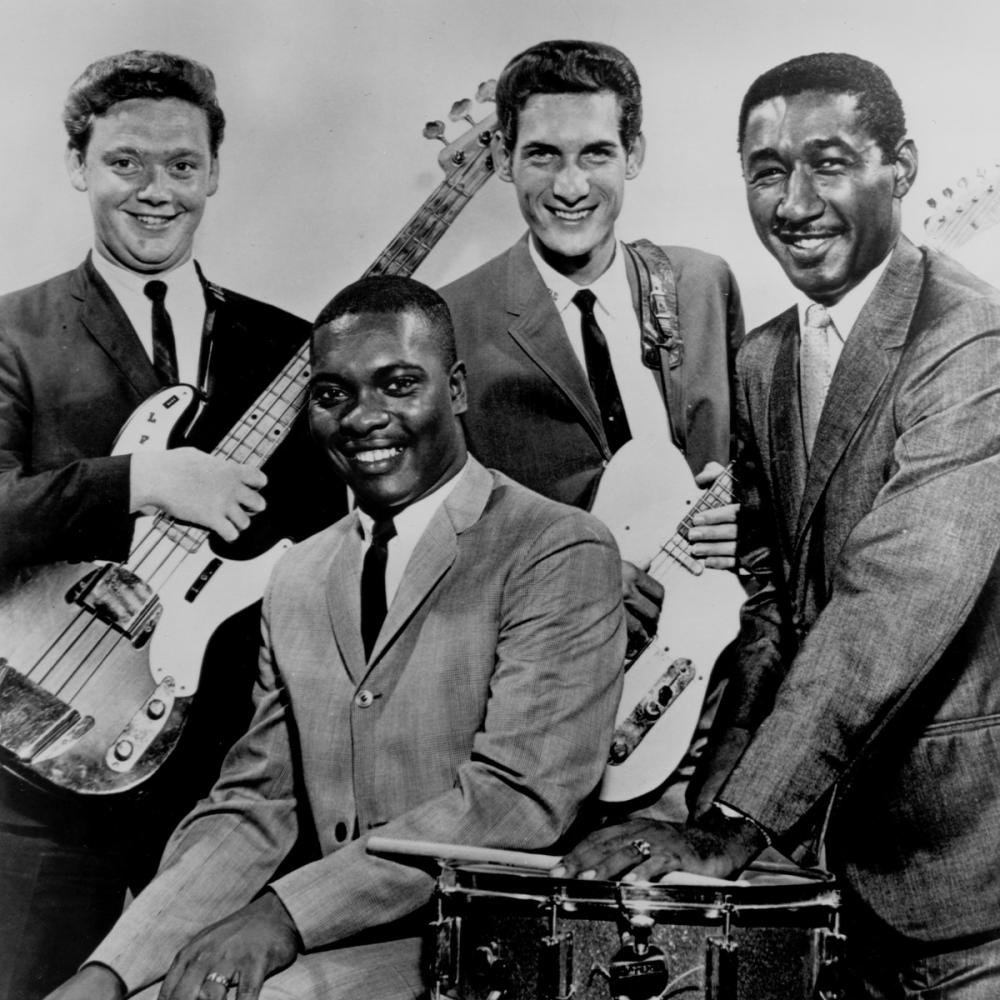
Just as Motown relied on its house band, the Funk Brothers, Stax Records depended on the talents of its own in-house ensemble, Booker T. and the MGs. This group established the rhythmic and instrumental style associated with Memphis recordings throughout the 1960s. Formed in 1962 out of the earlier group the Mar-Keys, Booker T. and the MGs became one of the most influential backing bands in American music history. They were also notable for being among the first racially integrated rock and soul groups. The band's classic lineup included Booker T. Jones on Hammond B3 organ and piano, Steve Cropper on guitar, Donald "Duck" Dunn on bass—who replaced original bassist Lewie Steinberg in 1964—and Al Jackson Jr. on drums. They were frequently joined by vocalist Isaac Hayes and the horn section from the Mar-Keys, later known as the Memphis Horns. Their contributions were central to the identity of Stax Records and as essential to its sound as the label's biggest vocal stars.
Unlike the meticulously arranged and layered tracks recorded at Motown, Booker T. and the MGs often developed their backing tracks spontaneously. Much of their work was improvised live in the studio, allowing for a raw and organic quality that became a hallmark of Memphis soul. Their rhythm section created a distinctive feel by using a delayed backbeat, in which the snare drum and rhythm guitar struck beats two and four slightly behind the pulse. This subtle lag created a sense of laid-back tension, making the groove feel as if it teetered on the edge of slipping out of time. That rhythmic looseness became a recurring rhythmic trait across Stax releases, contrasting sharply with Motown's cleaner, more polished style. Stax songs often relied on simple verse forms, with few if any choruses. Repetition and subtle variation were key, and most tracks opened with a bold horn riff before settling into the groove. Booker T. and the MGs backed a wide range of Stax artists, including Otis Redding, Sam and Dave, Wilson Pickett, Carla Thomas, Eddie Floyd, Rufus Thomas, and Johnnie Taylor.
In addition to their work as a studio band, Booker T. and the MGs also recorded under their own name. Their breakout hit, "Green Onions" (1962), originated from an impromptu studio jam and became a number-one hit on the R&B charts. They followed it with a series of successful instrumental singles, including "Bootleg" (1965), "Hip Hug-Her" (1967), "Soul Limbo" (1968), "Hang ’Em High" (1968), and "Time Is Tight" (1969). These recordings exhibited their ability to generate intricate instrumental textures, often pairing guitar and keyboard lines or featuring bass parts that acted as melodic counterpoints rather than simple rhythmic support. Booker T. and the MGs supplied the rhythmic and harmonic framework for Stax’s vocal recordings. Their grooves underpinned iconic recordings such as Otis Redding's "(Sittin’ On) The Dock of the Bay" and Sam and Dave's "Soul Man."
Otis Redding

One of the most powerful and influential voices in soul music, Otis Redding was a prolific singer-songwriter whose work helped codify the sound of Stax Records and popularize Southern soul on a national and international scale. Born in Macon, Georgia, in 1941, Redding grew up steeped in gospel music. He played drums in church groups and sang with a gospel quartet before becoming the lead vocalist for guitarist Johnny Jenkins's band, the Pinetoppers. In 1962, Redding traveled to Stax Studios in Memphis with Jenkins for a recording session. At the end of the session, he was given a chance to audition. This led to the recording of "These Arms of Mine" (1963), released on Stax's Volt subsidiary, and became his breakthrough hit.
Redding drew inspiration from artists such as Sam Cooke and Little Richard. He combined gospel-inflected vocal intensity with emotional urgency and expressive phrasing. He was known for inserting spoken or shouted words like "please," "gotta," and "baby" between sung phrases. This technique gave his performances a pleading, almost desperate quality that became a recurring feature of his ballads. Songs such as "Pain in My Heart" (1964), "I've Been Loving You Too Long" (1965), and "Try a Little Tenderness" (1966) exemplify this emotive style.
Alongside his ballads, Redding also recorded up-tempo, riff-driven tracks such as "Respect" and "I Can't Turn You Loose" (both 1965). He performed powerful covers of The Rolling Stones'"(I Can’t Get No) Satisfaction" (1966) and Sam Cooke's "Shake" (1967). Although Aretha Franklin's version of "Respect" would become the definitive recording, Redding's original 1965 rendition remains a milestone of his songwriting legacy. Over his career at Stax, he recorded more than 120 tracks, most of which featured backing by Booker T. and the MGs and the Memphis Horns rather than background singers. Redding favored horn arrangements built from syncopated unison lines resolving into harmony. He also popularized the use of horn ensemble sections as structural replacements for bridges or instrumental solos, an innovation that became a signature feature of the Stax sound.
Redding's impact reached past his recordings. In 1967, he headlined the Stax/Volt European tour and was voted the number one male vocalist in Melody Maker's annual readers' poll, overtaking Elvis Presley for the first time. That same year, he performed a historic set at the Monterey Pop Festival, backed by Booker T. and the MGs. His appearance was significant both for the electrifying reception he received and for being one of only two African American artists on the bill, the other being Jimi Hendrix. The performance introduced Redding to a broader white audience and signified a significant point in the crossover appeal of Southern soul.
Tragically, Redding died in a plane crash in December 1967, just days after the Monterey performance. At the time of his death, he had recorded a large number of new songs, including "(Sittin’ On) The Dock of the Bay." Influenced by the introspective songwriting of Bob Dylan and The Beatles, "(Sittin' On) The Dock of the Bay" song represented a stylistic shift. It was more subdued and pop-oriented than his earlier work. Initially, the song was considered too mellow for his primarily Black audience. However, it was released posthumously and became a number-one hit on both the pop and R&B charts. It also became the first posthumous number one single in U.S. history.
Aretha Franklin

Widely recognized as one of the greatest vocalists in American music history, Aretha Franklin (1942–2018) earned the title "Queen of Soul" through her commanding voice, gospel-rooted style, and a string of powerful hits that linked the sacred and secular. Born in Memphis, Tennessee, she was the daughter of Reverend C.L. Franklin, a nationally renowned preacher and Civil Rights activist known for his recorded sermons and fiery oratory. When Aretha was still a toddler, the family moved first to Buffalo and then settled permanently in Detroit, where C.L. Franklin became pastor of New Bethel Baptist Church.
Growing up in within that musically rich environment, Aretha was surrounded by towering figures in gospel and soul, including Mahalia Jackson, Clara Ward, Dinah Washington, James Cleveland, and Sam Cooke. These early influences developed her musical sensibility, especially her impassioned vocal delivery, deep emotional expression, and gospel-infused phrasing. She began singing and playing piano in church at a young age and toured with her father as a teenager. At just 14 years old, she recorded her first album, Songs of Faith (1956).
In 1960, Franklin moved to New York City to pursue a career in secular music and signed with Columbia Records, guided by legendary producer John Hammond. Columbia sought to market her as a jazz and pop vocalist in the mold of artists like Barbra Streisand, resulting in polished yet commercially inconsistent albums. Her tribute to singer Dinah Washington, "Unforgettable" (1964), stands out from her early period, but Franklin struggled to break through commercially. Although she released modestly successful tracks like "Runnin’ Out of Fools" and a cover of "Walk on By," Columbia never fully tapped into her gospel background or R&B potential.
Franklin's breakthrough unfolded in 1967 when she signed with Atlantic Records and began working with producer Jerry Wexler, who recognized the strength of her gospel and blues roots. Her debut sessions for the label took place at Fame Studios in Muscle Shoals, Alabama, a key site in the development of Southern soul. Although the session ended abruptly due to tensions involving her husband and manager Ted White, it produced "I Never Loved a Man (The Way I Love You)," which became her first major crossover hit and represented a turning point in her career.
The follow-up single was her reworking of Otis Redding's "Respect" (1967). While both versions share a basic musical structure, the arrangements differ significantly. Redding's original features a grittier, Southern soul groove with a raw, insistent rhythm, whereas Franklin's version is driven by a more upbeat, gospel-infused arrangement that emphasizes call-and-response vocals and a memorable horn section. Lyrically, a few key changes in Franklin's cover create distinct narratives around the theme of human dignity, exploring gender roles, relationships, and the meaning of "respect." According to NPR, Redding's version "reinforced the traditional family structure of the time: Man works all day, brings money home to wife and demands her respect in return."
In contrast, Franklin's version was refashioned as a declaration from a strong, confident woman who believes she has everything her man wants and does not wrong him, while demanding his respect in the form of appropriate physical attention. The iconic repeated "sock it to me" line, sung by Franklin's sisters, was a collaborative idea developed by Aretha and her sister Carolyn. The now-famous spelling out of "R-E-S-P-E-C-T" was, according to engineer Tom Dowd, Carolyn's contribution. Otis Redding famously remarked, "That little girl done stole my song," acknowledging Franklin's brilliance in making it her own. With its soulful grit, gospel power, and political resonance, Franklin's "Respect" became one of the signature recordings of the 1960s, symbolizing both the Civil Rights Movement and the emerging feminist movement.
Franklin's following two albums for Atlantic, I Never Loved a Man the Way I Love You and Lady Soul (1968), established her commercial and critical prominence. These albums included timeless hits such as"Chain of Fools," "(You Make Me Feel Like) A Natural Woman" (written by Carole King), "Think," and "(Sweet Sweet Baby) Since You've Been Gone."Franklin's music channeled the emotive power of gospel while using the language of R&B and soul. Her backup singers, often drawn from the girl-group tradition, provided a contrast to her explosive, church-inflected lead vocals.
Throughout the late 1960s and into the 1970s, Franklin became a cultural icon not only for her vocal performance but also for what it represented. She was featured on the cover of Time magazine in 1968, and her music became intertwined with the Civil Rights Movement and second-wave feminism. In 1987, she made history as the first woman inducted into the Rock and Roll Hall of Fame. Aretha Franklin's career spanned decades and genres, but her Atlantic years remain the most critically celebrated. With unmatched vocal power, interpretive depth, and musical versatility, she left an indelible mark on American music. As Ahmet Ertegun, co-founder of Atlantic Records, once said, "Aretha may be the greatest singer of our time."
Chapter 17: Conclusion

By the mid-1960s, soul music had become the most commercially visible form of African American popular music, replacing rhythm and blues and becoming one of the dominant sounds of the decade. Within this broad genre, divergent musical styles materialized. At Motown, founder Berry Gordy developed a distinct sound and image that catered to mainstream crossover appeal. Drawing from the Brill Building model of streamlined songwriting and production, Gordy built a musical empire in Detroit that combined polished vocal performances, tightly arranged studio backing, and elegant visual presentation. Every detail, from choreography and wardrobe to diction and demeanor, was carefully curated to ensure that Motown artists were not only embraced by Black audiences but also by white, middle-class America. In doing so, Gordy altered expectations for Black popular music in mainstream media.
Motown Records launched the careers of numerous legendary artists, including The Supremes, The Four Tops, Marvin Gaye, Smokey Robinson, Stevie Wonder, Martha and the Vandellas, and Michael Jackson, whose time with The Jackson 5 made him a global star. The "Motown Sound" featured melodic basslines, syncopated rhythms, call-and-response vocals, and a signature backbeat. This sound was held together by the house band, The Funk Brothers, who played on more number-one hits than The Beatles, Elvis Presley, The Rolling Stones, and The Beach Boys combined.
Meanwhile, Atlantic Records, led by Jerry Wexler, championed a grittier, gospel-infused style of Southern soul. The label produced artists like Otis Redding, Aretha Franklin, and Wilson Pickett. Although both Motown and Atlantic were based in Black musical traditions, they offered contrasting visions of soul music. Motown's style was polished and cosmopolitan, while Southern soul was raw and church-inflected. Many white audiences, especially those attracted to the countercultural ethos of the late 1960s, viewed Southern soul as more "authentic." This perception arose from both musical differences and racialized ideas about artistic legitimacy.
In 1972, Motown strategically relocated its operations from Detroit to Los Angeles, signaling a shift toward greater involvement in film and television. Motown's relocation to Los Angeles move marked the end of the label's golden era in Detroit. While some artists, such as Stevie Wonder and Diana Ross, continued to thrive, others left the company. Nevertheless, Motown's impact was already firmly established.
Today, Motown's legacy is immense. It opened access to mainstream radio, television, and national touring circuits. It played a major role in desegregating American popular music, opening doors for Black performers in mainstream media, and providing a soundtrack to the Civil Rights Movement. Its hits remain staples on radio, film, and television, and its influence is evident in genres ranging from R&B and hip hop to pop and neo-soul. Motown became a cultural force that changed American popular music and expanded opportunities for Black artists in the mainstream.
Chapter 17: Further Reading
Aria, Barbara , and Tony Turner. All That Glittered: My Life with the Supremes. New York: Birch Lane Press, 1990.
Bego, Mark. Aretha Franklin: The Queen of Soul. New York: St. Martin’s Press, 1989.
Bowman, Rob. “‘Otis Redding: R-E-S-P-E-C-T.’” Goldmine 16, no. 12 (1990): 8–14, 102.
———. “‘Stax Records: A Musicological Analysis.’” Popular Music 14 (1995): 285–320.
———. Soulsville U.S.A.: The Story of Stax Records. New York: Schirmer Books, 1997.
Davis, Sharon. Motown: The History. London: Guinness Publishing, 1988.
Fitzgerald, Jon. “Motown Crossover Hits 1963–1966 and the Creative Process.” Popular Music 14 (1995): 1–12.
Fong-Torres, Ben. The Motown Album. New York: St. Martin’s Press, 1990.
George, Nelson. Where Did Our Love Go? The Rise and Fall of the Motown Sound. New York: St. Martin’s Press, 1985.
Gillett, Charlie. Making Tracks: Atlantic Records and the Growth of a Multi-Billion-Dollar Industry. London: Sphere, 1975.
Gordy, Berry. To Be Loved: The Music, the Magic, the Memories of Motown. New York: Warner Books, 1994.
Guralnick, Peter. Sam Cooke’s SAR Records Story: 1959–1965. Abkco 2231 (1994) [disc notes].
———. Sweet Soul Music: Rhythm and Blues and the Southern Dream of Freedom. New York: Harper & Row, 1986.
Hirshey, Gerri. Nowhere to Run: The Story of Soul Music. New York: Times Books, 1984.
Robinson, Smokey, and David Ritz. Smokey: Inside My Life. London and New York: McGraw-Hill, 1989.
Romanowski, Patricia, and Mary Wilson. Supreme Faith: Someday We’ll Be Together. New York: HarperCollins, 1990.
Ross, Diana. Secrets of a Sparrow: Diana Ross Memoirs. New York: Villard, 1993.
Singleton, Raynoma G. The Untold Story: Berry, Me, and Motown. Chicago: Contemporary Books, 1990.
Slutsky, Allan “Dr. Licks.” Standing in the Shadows of Motown: The Life and Music of Legendary Bassist James Jamerson. Wynnewood, PA: Hal Leonard, 1989.
Smith, Suzanne E. Dancing in the Street: Motown and the Cultural Politics of Detroit. Cambridge, MA: Harvard University Press, 2001.
Waller, Don. The Motown Story: The Inside Story of America’s Most Popular Music. New York: Paddington Press, 1985.
Williams, Otis, with Patricia Romanowski. Temptations. New York: Ballantine Books, 1988.
Wilson, Mary. Dreamgirl: My Life as a Supreme. New York: St. Martin’s Press, 1986.
Wolff, David, and others. You Send Me: The Life and Times of Sam Cooke. New York: Delacorte Press, 1995.