Chapter 28: Disco
“Stayin’ Alive”
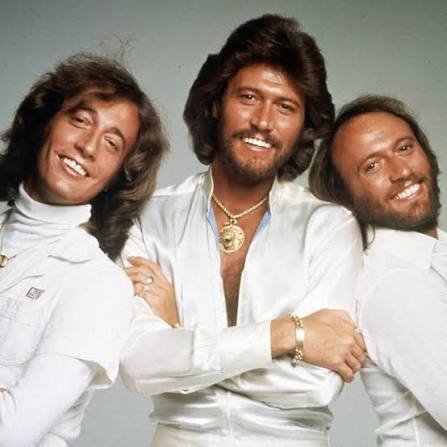
Album/Year Released
1977 (album: Saturday Night Fever: Original Motion Picture Soundtrack)
Artist/Composer
Bee Gees
Barry, Robin, and Maurice Gibb
Genre/Style
Disco
Song Form
verse–pre-chorus-chorus with a repeated bridge
“Stayin’ Alive,” released in 1977 on the Saturday Night Fever soundtrack, centers rhythm as its primary structural element. The song is in duple meter (4/4) and features a steady four-on-the-floor pattern, with the bass drum striking each beat. The unvarying pulse establishes a sense of regularity conducive to sustained dancing, rather than sectional contrast. Hi-hat patterns articulate even subdivisions above the kick drum, while the bass guitar plays a syncopated line that locks into the groove. Harmonically, the track cycles through a limited set of repeating chords, keeping rhythmic consistency and texture at the forefront.
The song adopts a verse–pre-chorus-chorus structure with a repeated bridge, although transitions are subtle and primarily driven by changes in texture rather than harmonic progression. The introduction presents a concise guitar riff that functions as a rhythmic hook, establishing the overall feel prior to the entrance of the vocals. The verses feature restrained vocal delivery, while the chorus introduces layered falsetto lines that project above the rhythm section. Strings, synthesizers, and horn parts are incorporated sparingly, serving to reinforce the groove rather than alter its direction.
Barry Gibb’s use of falsetto is central to the song’s distinctive sound. Falsetto denotes a vocal register in which the singer produces pitches above the typical modal range, achieved by reducing vocal fold contact and resulting in a lighter, flute-like timbre. In popular music, falsetto frequently serves to extend melodic range, provide contrast with lower registers, or increase intensity without raising volume. In “Stayin’ Alive,” falsetto functions as the primary vocal timbre rather than an occasional effect.
Another distinctive aspect of the recording is its drum track. The song's disco beat is built around a steady bass drum on every beat of a 4/4 measure. The four-on-the-floor kick-drum pattern is paired with consistent hi-hat subdivisions and a syncopated bass line. The effect is a predictable, continuous pulse that supports uninterrupted dancing. Rather than accenting backbeats or rhythmic variation, the disco beat prioritizes regularity and physical momentum, traits central to “Stayin’ Alive” and the genre.
Due to the unavailability of drummer Dennis Bryon, the producers constructed a loop by splicing two bars from the Bee Gees’ earlier recording “Night Fever.” The two-bar drum loop recurs throughout most of the song, offering an exceptionally stable rhythmic foundation for the era. The tempo, approximately 103 beats per minute, corresponds to natural walking speed and has subsequently been adopted in CPR training as a mnemonic device.
“YMCA”
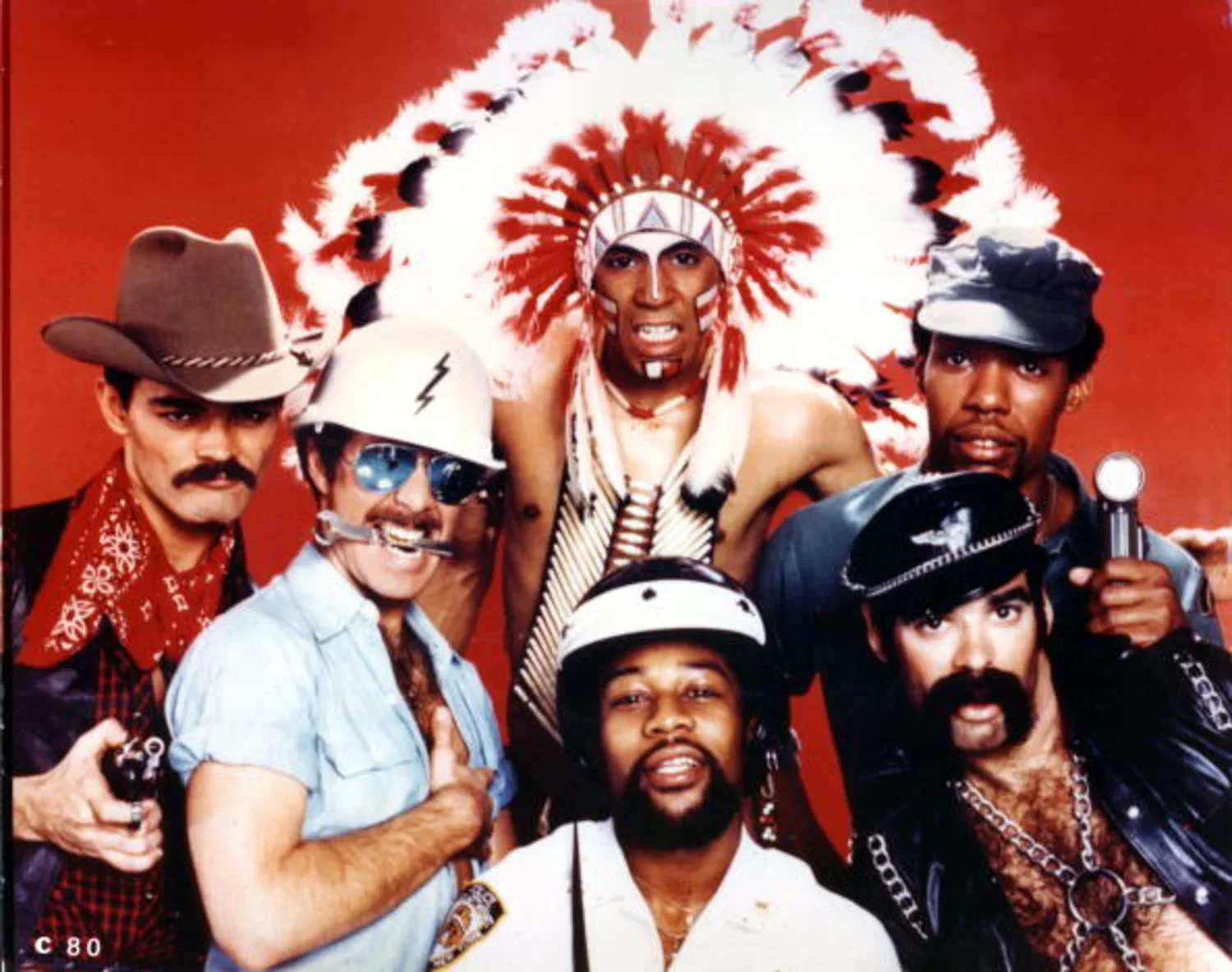
Album/Year Released
1978 (album: Cruisin’)
Artist/Composer
Village People
Jacques Morali, Henri Belolo, Victor Willis
Genre/Style
Disco
Song Form
Verse–chorus
“YMCA,” released in 1978 on Cruisin’, is built around a disco framework that supports collective participation through repetition, clarity, and physical motion. The song is in duple meter (4/4) and maintains a steady disco groove at a tempo of approximately 95 BPM, with the bass drum on all four beats and a syncopated bass line driving momentum. Rhythmic guitar emphasizes offbeats, while a prominent brass section and string synthesizers contribute to the orchestral texture typical of late-1970s disco.
Structurally, the song uses a verse–chorus form, with the chorus serving as the primary structural element rather than a contrasting section. A distinctive brass riff introduces the track and recurs throughout, reinforcing the harmonic rhythm and providing structural unity. Brass instruments dominate the timbral palette, while the arrangement incorporates strings, percussion, and backing vocals to produce a rich orchestral texture. The verses, delivered by Victor Willis, adopt a declamatory style centered on the repeated exclamation “Young man!” Background vocals then enter to support and echo the lead, while call-and-response exchanges between the lead and ensemble strengthen the song’s participatory character.
The lyrics of “YMCA” depict the organization as an inclusive social environment that provides shelter, recreational activities, and companionship. Although the text may be interpreted as promotional or aspirational, it has also been widely understood within gay culture as alluding to the YMCA’s reputation as a cruising and hookup site. Producers Jacques Morali and Henri Belolo intentionally incorporated coded fantasy and double entendre to appeal to disco’s gay audience, even as the group’s public image and reception became increasingly mainstream. However, Victor Willis has consistently denied that the song was conceived as a gay anthem, asserting that expressions such as “hang out with all the boys” were common in Black vernacular during the 1970s. Nevertheless, he has acknowledged that the lyrics can support multiple interpretations and has indicated no objection to LGBTQ audiences embracing the song.
Beyond the recording, “YMCA” became closely associated with a group dance in which participants form the letters Y, M, C, and A with their arms during the chorus. The arm-letter choreography originated spontaneously during a 1979 appearance on American Bandstand, when host Dick Clark replayed the song, and the audience initiated the gestures. Willis replicated the movements onstage, and the routine was soon integrated into the group’s performances.
“Love to Love You, Baby”
Album/Year Released
1975 (album: Love to Love You Baby)
Artist/Composer
Donna Summer
Donna Summer, Giorgio Moroder, and Pete Bellotte
Genre/Style
Disco
Song Form
Vamp-based form with verse–chorus elements
“Love to Love You, Baby” diverges from radio-oriented pop by adopting an extended, loop-based structure rooted in disco club practices rather than broadcast conventions. Initially issued in the Netherlands as “Love to Love You,” it gained attention at private parties hosted by Casablanca Records head Neil Bogart, who encouraged Moroder to expand it into a long-form version. The song is in 4/4 meter and is anchored by a persistent bass drum pulse, which sustains the groove throughout its extended duration. Electric bass, wah-inflected guitar, layered percussion, and early synthesizer textures create a continuous rhythmic and harmonic field with minimal chordal movement. Rather than presenting contrasting sections such as verse and chorus, the track develops through gradual changes in texture, density, and dynamics, including the addition and removal of instruments, shifts in register, and variations in vocal intensity.
Donna Summer’s vocal performance integrates into the groove rather than serving as a prominent melodic line. Sustained tones, breathy timbres, and improvised erotic moans replace conventional lyric-driven development, positioning the voice as a timbral and rhythmic component within the track’s looping structure. Summer recorded the extended vocal improvisations within a dimly lit studio, producing the intimate sounds that became the track’s most recognizable feature. Some radio outlets refused to play the song because of its explicit character, and the BBC counted twenty-three simulated orgasms in the final recording. The composition centers on a recurring hook composed by Summer, accompanied by verses constructed over a descending chromatic bass pattern. This chromatic tetrachord, a series of four notes separated by three intervals, generates a sense of motion without harmonic resolution and produces a continuous descending effect that ultimately returns to its starting point. The same chromatic motif recurs in transposed and layered forms within the strings and backing vocals, supporting the impression of perpetual movement whilst maintaining harmonic stasis.
The album version exceeds sixteen minutes and occupies the entire first side of the record, representing one of the earliest disco hits intentionally designed as an extended dance track. Although radio edits later condensed the piece to standard single length, the extended version was integral to its influence in club settings. Giorgio Moroder and Pete Bellotte developed the track through improvisational studio sessions, gradually layering piano, synthetic flute, synthetic strings, and various keyboard timbres around the original refrain. Following an early fade-out, the bass line persists alone before the reintroduction of instruments, leading to a mid-track breakdown in which the beat temporarily drops out, and synthesizers become prominent. The vocal part subsequently returns with elevated intensity, followed by additional repetitions of the initial material.
“Love to Love You, Baby” set a template for the 12-inch disco single and for later electronic dance genres that stress repetition, immersion, and duration over narrative song form. Summer’s vocal improvisations supplied much of the melodic and structural content that producers later organized into the final track. The result is a recording that treats groove, timbre, and cyclical motion as the primary musical forces, anticipating later developments in house, techno, and other loop-centered dance traditions.