Chapter 18: The British Invasion
“I Want to Hold Your Hand”
Album/Year Released
Recorded 1963 (single, UK)
Artist/Composer
The Beatles; John Lennon & Paul McCartney
Genre/Style
Pop Rock
Song Form
Verse-Chorus with Bridge based on the 32 bar form
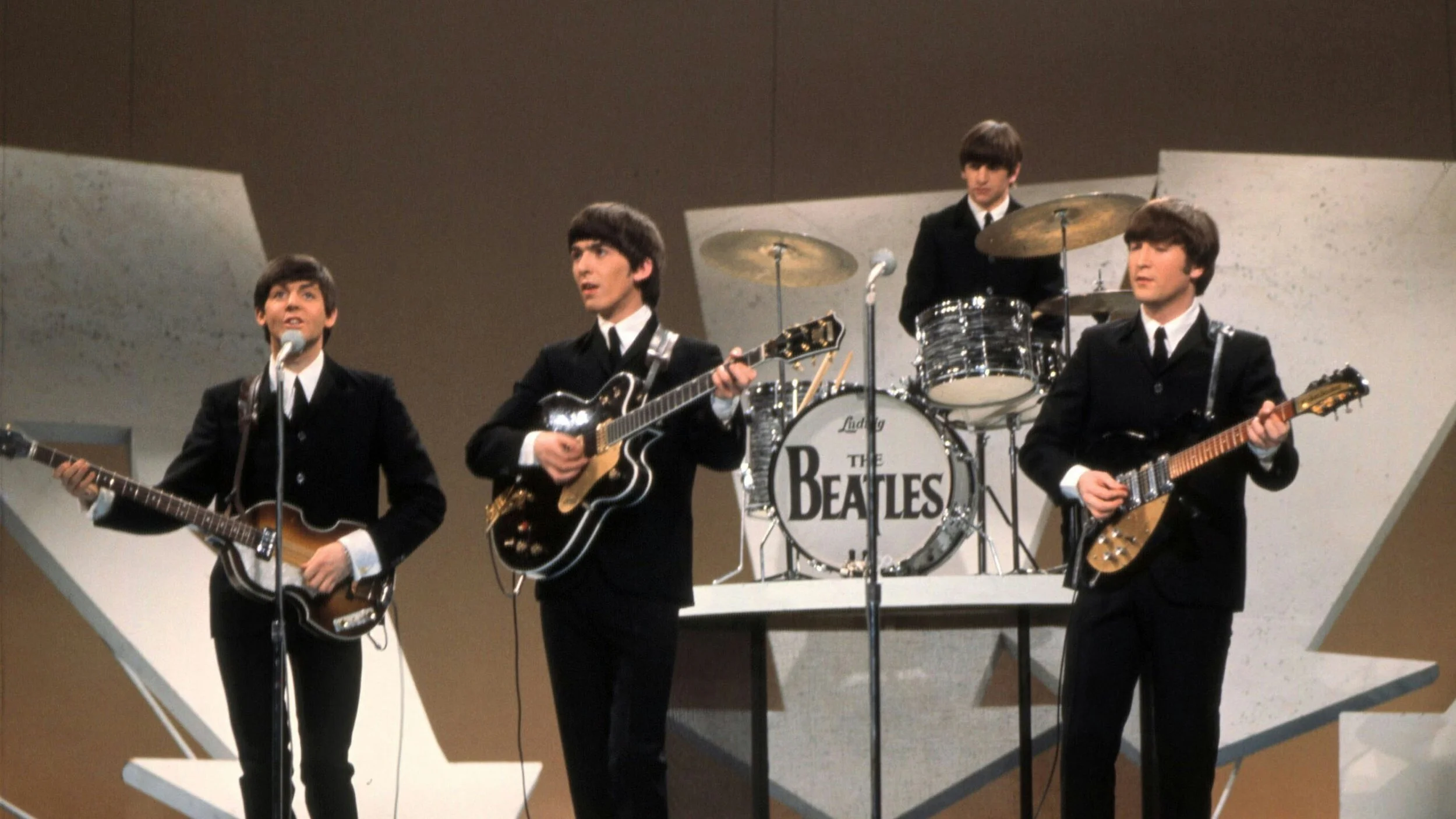
“I Want to Hold Your Hand” (1963) represents the Beatles’ early pop-rock style. It is built around a steady 4/4 meter with a clear backbeat on beats 2 and 4. The song uses a verse–chorus design based on a modified 32-bar form, with two bridges connected by an intervening verse. Instead of a single lead singer, John Lennon and Paul McCartney alternate and combine their voices. They often sing in unison or close harmony. Their vocal lines move largely in parallel thirds and sixths, producing a blended sound. The Lennon-McCartney vocal sound became a central feature of the group’s early recordings.
The instrumental lineup is characteristic of the Beatles’ standard early lineup: Lennon plays rhythm guitar and sings, McCartney plays bass and sings, Harrison plays lead guitar, and Ringo Starr plays drums. All four contribute handclaps as overdubs. Harrison’s guitar parts are based on chord progressions and short riffs, reinforcing the harmony rather than offering extended solos. The drums keep a consistent pulse, using minimal fills that reinforce the backbeat.
Harmonically, the song is in G major. It uses chord patterns common to Tin Pan Alley and Brill Building songwriting. Much of the material moves among I, V, and vi harmonies. Tension is created by secondary dominants, which are dominant chords that briefly point to a chord other than the tonic. They often use accidentals that are not in the key and add a sense of anticipation before it resolves to its target chord.
The song was released in the United Kingdom on November 29, 1963. The single sold heavily in advance and quickly reached the top of the charts. Meanwhile, in the United States, a Washington, D.C., disc jockey aired an imported copy, giving the song radio exposure and prompting strong listener response. As a result, Capitol Records moved up the release date, and the song entered the Billboard Hot 100 on January 18, 1964. It reached number one by February 1 and stayed there for seven weeks. The single became the Beatles' first American chart-topper and helped initiate the British Invasion.
“Yesterday”

Album/Year Released
Recorded 1965 on Help!
Artist/Composer
The Beatles; Paul McCartney
Genre/Style
Baroque pop; ballad
Song Form
AABA (32-bar standard) with Bridge
“Yesterday” (1965) uses an AABA 32-bar form associated with Tin Pan Alley ballads. The song is in 4/4 meter, but its slow tempo and flexible phrasing give it a conversational, lyrical feel instead of a strict rhythmic drive. Paul McCartney performs as a solo vocalist, accompanying himself on acoustic guitar, with a string quartet added later. The limited instrumentation focuses attention on melody, harmony, and text rather than ensemble interaction.
The song’s tonal center is F major, though McCartney tuned his guitar down a whole step and fingered the chords as if in G. The opening phrase begins on an F chord with the third omitted, then moves through Em7, A7, and D minor. The opening chord progression quickly shifts attention from the major tonic to the relative minor, delaying a clear sense of tonal arrival. Musicologist Alan Pollack describes this as a compositional strategy Lennon and McCartney used frequently, where harmonic resolution is postponed rather than immediately confirmed. The verse melody spans seven bars instead of the typical eight, creating slight asymmetry that adds variety within the familiar song form.
The bridge, or “middle eight,” begins on Em7 and moves through A major, D minor, and B♭ before resolving back to F major. Secondary dominants play an important role in these transitions, including A7 as V/vi and G7 as V/V. Instead of resolving G7 as expected, the harmony moves to B♭, producing a descending chromatic line: C, B, B♭, A under the title lyric. The descending chromatic harmonic motions contribute to the song’s subdued and unsettled character without abrupt key changes.
The string quartet—two violins, viola, and cello—was recorded separately and marked one of the Beatles’ earliest uses of session musicians. George Martin proposed the arrangement, and McCartney agreed if the players used little or no vibrato. The writing for strings closely follows the vocal phrasing rather than serving as an independent layer. Notable details include a low cello line linking the two halves of the bridge, a viola descent leading back into the verse, a sustained high A in the violin over the final verse, and the use of an E♭ as a lowered seventh during the bridge. Several of these elements have been attributed directly to McCartney rather than Martin.
The song originated from a melody McCartney recalled dreaming about while staying at the Asher family home at 57 Wimpole Street. Unsure whether the tune was original, he played it for friends to confirm it was unfamiliar. Early working lyrics used the placeholder title “Scrambled Eggs.” The words developed their final form during the filming of Help! and later, while McCartney was traveling in Portugal, where he settled on the title and opening lines. Although some listeners have connected the lyrics to McCartney’s early loss of his mother, he has stated that this association was unintentional.
When performed live, “Yesterday” was played in different keys depending on the context. McCartney sang it alone with orchestra on The Ed Sullivan Show, while full-band versions in G major were used during tours in 1965 and 1966. The song was never released as a single in the United Kingdom, partly due to concerns about its departure from the group’s established image, but it became one of the most frequently broadcast songs in American radio history.
“Eleanor Rigby”
Album/Year Released
Recorded 1966 on Revolver
Artist/Composer
The Beatles; Paul McCartney
Genre/Style
Baroque pop; orchestral rock
Song Form
Verse-chorus with instrumental interludes
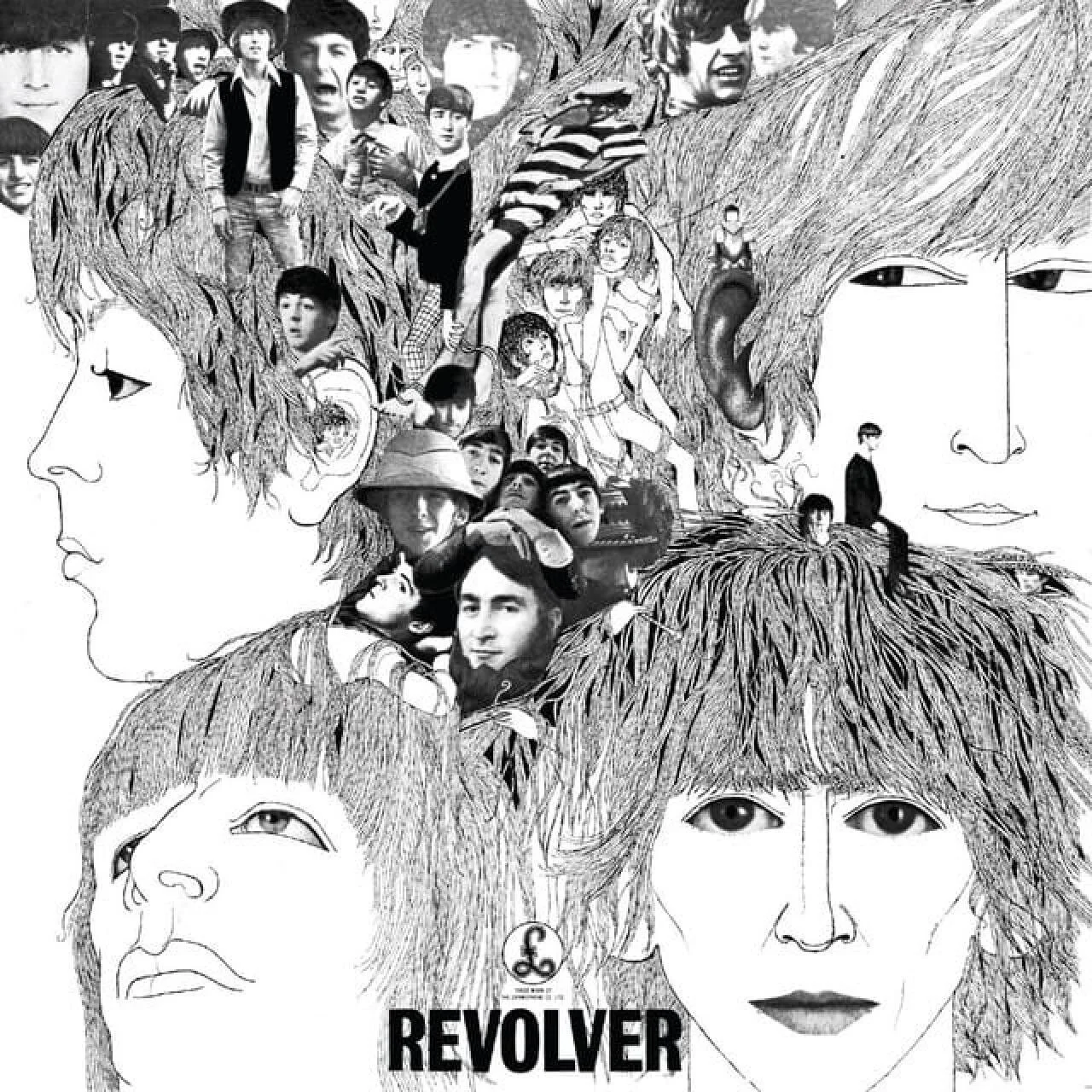
“Eleanor Rigby” (1966), from Revolver, breaks from the Beatles’ earlier guitar-driven style by relying almost entirely on voices and strings. Paul McCartney sings the lead, with John Lennon and George Harrison providing backing vocals. The string section features four violins, two violas, and two cellos. The song reached number one on singles charts in several countries, and also signaled a shift toward studio-centered composition and narrative songwriting in the Beatles’ work. There is no drum kit, bass guitar, or electric guitar. Instead, the accompaniment is a double string quartet arranged by George Martin. The string parts, recorded in short, sharply articulated phrases, interact with the vocals, complementing the song's verse-chorus pattern. Instrumental string interludes separate sections and reinforce the narrative flow, linking the arrangement and structure.
The tonal center is E minor, with much of the harmony using modal mixture. In Western music theory, modes are ordered pitch collections formed by fixed interval patterns within the octave. They can be understood as rotations of the diatonic collection, where the same seven pitches produce different modal structures depending on which pitch functions as the tonal center. These interval patterns influence melodic emphasis and harmonic behavior. Unlike major–minor tonality, modal organization does not depend on leading-tone resolution or dominant–tonic function. Stability comes from repeated emphasis of the final, pedal points, or limited harmonic motion, producing a sense of tonal center without goal-directed progression.
The chord motion of Em–C implies the harmonic character of the Aeolian mode. Meanwhile, the vocal melody often introduces Dorian elements, especially the raised sixth (C♯). Notably, the opening vocal harmony starts over a C sonority before shifting to E minor on the lyric “lonely people.” Throughout the verses, the melody alternates between C♯ and C natural, creating modal tension. In the refrain, the viola traces a descending chromatic line—D, C♯, C, B—mirroring the downward pull of the text. Overall, these harmonic and melodic details add to the song’s restrained but unsettled tone.
Lyrically, the song presents a third-person narrative about isolation and social detachment. McCartney avoids first- and second-person address. He frames Eleanor Rigby and Father McKenzie as observed figures, not participants in a personal relationship. Eleanor’s solitary routines and unnoticed death are paired with a priest continuing his rituals without a congregation. The narrator remains distant, acting more as a storyteller than a confessional voice. The setting is mid-1960s Britain, a period of declining religious authority and lingering postwar anxiety. These themes appear through everyday scenes, not explicit commentary.
“Tomorrow Never Knows”
Album/Year Released
Recorded 1966 on Revolver
Artist/Composer
The Beatles; John Lennon
Genre/Style
Psychedelic rock; experimental studio production
Song Form
Through-composed with looped textures
Departing from verse-based songwriting and conventional harmonic motion, “Tomorrow Never Knows” (1966), released on Revolver, unfolds in a steady 4/4 meter. Rhythmic interest comes almost entirely from repetition rather than contrast. Ringo Starr’s drum part maintains an unbroken pulse, recorded with close microphones and heavy compression so the kit sounds dense and nearly continuous, closer to a loop than a conventional rock groove. The tambourine reinforces this pulse without signaling formal divisions, contributing to a feeling of temporal suspension.
Instead of a chord progression, the track is organized around a sustained pitch center. A drone—a continuous or frequently reiterated pitch that remains constant beneath changing surface events—anchors the entire texture on C. This sustained tonal reference places the piece in C Mixolydian, with melodic material circulating around the drone rather than moving through functional harmony. Drawing on Indian classical practice, George Harrison uses a tambura, a long-necked string instrument designed to produce a continuous harmonic resonance rather than melody. The tambura’s open strings create a buzzing, overtone-rich backdrop that reinforces the drone and blurs the boundary between harmony and texture, supporting the song’s static yet immersive sound world.
Melodic activity occurs mainly in the vocal line and in the upper layers of the tape collage. Lennon’s vocal stays within a narrow range and often repeats single pitches before moving by small intervals. For example, phrases such as “turn off your mind” repeat the E. Later lines introduce stepwise motion that briefly touches B♭, creating a momentary clash with the C drone. The repeated pitches and stepwise melodic motion replace harmonic change as the main source of tension. The lyrics are drawn directly from Timothy Leary's LSD manual, The Psychedelic Experience. The lyrics abandon rhyme and narrative development, functioning more as a sequence of instructions than a story.
The structure is continuous rather than sectional, developing through changes in texture and density. Tape loops, prepared mainly by McCartney and contributed to by all four Beatles, introduce fragments of sound that fade in and out across the track .A loop is a piece of magnetic tape of variable length, on which a sound was recorded and which was taped together at each of its extremities. Played back on a tape recorder, the tape loop ran indefinitely.” The tape loops include sped-up voices, instrumental fragments, and reversed recordings. Each runs on its own loop length. Five loops were fed live into the mixing console and manually balanced during the mix. The final version becomes a performance in itself. Lennon’s vocals were routed through a Leslie speaker, producing a rotating, filtered sound. The Leslie speaker effect matches the static harmony and reinforces the sense of suspension.
Recorded at Abbey Road in April 1966, “Tomorrow Never Knows” uses the studio as a compositional tool rather than a space for documenting a live performance. The song features no chord changes and relies on drones. Layered tape construction puts sound manipulation at the center of the design. Within the context of Revolver, the track closes the album by setting aside earlier pop structures. It favors sustained tone, repetition, and studio-controlled texture.
“(I Can’t Get No) Satisfaction”

Album/Year Released
Recorded 1965 (single, UK)
Artist/Composer
The Rolling Stones
Mick Jagger & Keith Richards
Genre/Style
Blues- Rock
Song Form
Verse-Chorus
“(I Can’t Get No) Satisfaction,” recorded in May 1965 at RCA Studios in Hollywood, became the Rolling Stones’ first number-one hit in the United States and remains one of their most iconic songs. The track opens with a guitar riff, a short, repeated melodic figure that serves as both a hook and a rhythmic anchor, played by Keith Richards through a Maestro fuzzbox. The fuzz effect, a type of high-gain distortion, heavily clips the guitar signal, turning it into a square wave and producing a thick, buzzy, sustaining tone. In contrast to overdrive or conventional distortion, which emulate the sound of overdriven tube amplifiers, fuzz produces a raw, intense saturation, often likened to the sound of a broken speaker. The Maestro fuzzbox was crucial in imparting the riff with its aggressive character. Richards initially intended to re-record the track with a horn section performing the riff. The arrangement gradually introduces bass, drums, and acoustic guitar over the guitar line, while subtle chord changes provide harmonic support.
The song employs a steady 4/4 meter, with Charlie Watts accentuating beats two and four. Its verse-chorus structure enables the recurring presence of the central riff. Harmonically, the composition is anchored in E major but incorporates notes from the E mixolydian scale, occasionally flattening the third and seventh degrees to create a blues-inflected tension. Mick Jagger’s vocal delivery alternates between ironic commentary and frustrated exclamation in the verses, escalating to a more forceful, half-sung, half-yelled style in the choruses, where the guitar riff returns.
The lyrics express frustration with commercialism, societal expectations, and sexual desire. The song critiques media-driven consumer culture and alludes to the difficulties of celebrity life, such as the pressures of touring and the ambiguous lyric about “trying to make some girl,” which generated controversy. Some listeners and radio programmers interpreted this line as a sexual reference, reinforcing the song’s provocative reputation. During its initial release, the combination of sexual suggestiveness and social critique unsettled certain audiences, and in the United Kingdom, the track was initially broadcast only on pirate radio stations.
The success of the song established the Rolling Stones as a raw and edgier alternative to the Beatles’ polished pop sound. It also contributed to the rapid sellout of the Gibson fuzzbox by the end of 1965. Over subsequent decades, “(I Can’t Get No) Satisfaction” has retained its status as a landmark in rock music, recognized for its innovative use of fuzz and its direct, rebellious tone. In 2006, the song was added to the National Recording Registry of the Library of Congress, becoming the first and, to date, only Rolling Stones recording included in the Registry.
“My Generation”

Album/Year Released
1965 (single, UK) also released on My Generation (1965)
Artist/Composer
The Who: Pete Townshend
Genre/Style
Mod rock
Song Form
Simple verse (each verse has a refrain)
“My Generation,” recorded in October 1965 at IBC Studios in London, became an anthem for British youth rebellion and a landmark statement of mod culture. The song opens with a driving guitar riff—a repeated melodic figure that serves as both a hook and a rhythmic anchor—played by Pete Townshend, using power chords that emphasize the root and fifth to produce a strong, aggressive sound suited to rock. Townshend also used guitar feedback, a technique in which the amplified signal resonates back through the pickup, creating sustained, sometimes distorted tones. The rhythm section, anchored by John Entwistle’s prominent bass and Keith Moon’s aggressive, off-beat drumming, propels the song in a steady 4/4 meter while introducing unreliability and tension. Structurally, the track follows a verse-chorus pattern, but it also incorporates extended instrumental passages and a coda in which Townshend’s feedback and Entwistle’s bass engage in a call-and-response interplay.
“My Generation” is notable for featuring one of the first bass solos in rock history. Entwistle’s solo, played on a Fender Jazz Bass strung with nylon tapewound strings, demonstrates both technical skill and melodic inventiveness, providing a counterpoint to Townshend’s simple guitar lines while strengthening the song’s driving rhythm. The instrumental foundation includes two guitar parts: a basic track supplemented by overdubs, including Townshend’s furious feedback in the coda. The song modulates from its opening key of G up to C, passing through A and B♭, and Townshend’s guitars were tuned down a whole step for the recording. Moon’s drumming punctuates the coda, with the song breaking into bursts of guitar feedback instead of resolving cleanly on the tonic.
Vocally, the track uses call-and-response, a form of musical dialogue in which Roger Daltrey shouts lines such as the famous “Hope I die before I get old,” with Townshend and Entwistle's backing vocals echoing or responding. Daltrey’s stuttered delivery, inspired by blues singer John Lee Hooker and possibly evoking the amphetamine-driven energy of the mod scene, heightens the song’s edgy, rebellious attitude. Lyrically, “My Generation” distills youthful frustration, challenging society's expectations and authority, while its melodic contours, harmonies, and instrumental aggression foreshadow the emergence of punk rock.