Chapter 13: Rock and Roll Pt. 1

Chapter 13: Introduction

During the 1950s, American society underwent political, cultural, and technological changes that reoriented everyday life. At the start of the decade, Senator Joseph McCarthy's anti-communist campaign contributed to widespread fear and suppression that constrained public speech and artistic work. Congressional hearings focused on "un-American activities," leading to the blacklisting of writers, musicians, and entertainers who had been involved in left-leaning groups or causes during the 1930s, 1940s, and 1950s. Tensions of the Cold War increased with the outset of the space race, with the Soviet launch of Sputnik in 1957 and the creation of NASA in 1958 as the United States and the Soviet Union competed for technological and symbolic dominance. Within the United States, infrastructure expanded rapidly. The Interstate Highway Act of 1956, signed by President Dwight Eisenhower, encouraged suburban growth, highway travel, and daily reliance on automobiles. These new roads made intercity travel more affordable and accessible, which increased long-distance travel and routine commuting. By 1959, the admission of Alaska and Hawaii as the 49th and 50th states established the current fifty-state configuration.
In the context of these political pressures and technological changes, American popular music changed in structure, audience, and circulation. The early 1950s saw the merging of several musical traditions, including rhythm and blues, gospel, country, and boogie-woogie, which formed the basis of what would be called rock and roll. Rock and roll spread rapidly through a new social category that grew up during this period: teenagers. Many of these teenagers were born just before or during World War II and came of age in a dramatically transformed America. After the war, returning soldiers and their families embraced a renewed emphasis on domestic stability, economic security, and traditional family life. Parents, eager to provide their children with the comfort and joy they had missed during wartime, focused on raising them in a way that emphasized their children's sense of comfort, leisure, and material stability. Yet many teenagers found this lifestyle stifling, offering little room for self-expression, and soon discovered that their newfound spending power gave them a means to assert their identity.
The postwar environment fostered the rise of a consumer-oriented youth culture. With families experiencing new levels of financial security, in part due to the rising G.I. Bill of Rights, many teenagers had access to disposable income through allowances or part-time jobs. For the first time in American history, young people were a powerful and distinct market demographic. Businesses quickly recognized the economic potential of this group and began creating products tailored explicitly to teenage tastes and aspirations. Fashion, food, magazines, and especially music were all marketed with teenagers in mind.
Film studios and record companies circulated images of teenage rebellion, romance, and dissatisfaction. Films like Rebel Without a Cause, starring the charismatic actor James Dean, portrayed youthful alienation, rebellion, and the search for belonging, themes that resonated strongly with a generation caught between parental expectations and their own desires for self-formulation. Teenagers fashioned distinct styles of dress, slang, dance, and musical taste, favoring performers whose lyrics and styles addressed teenage frustration and desire. Rock and roll became central to this exchange, and by the end of the decade, record labels and radio stations marketed it on a national scale. By the 1960s, many young people were directly involved in making and promoting the music themselves.
Advancements in technology supported the growth of youth consumer culture. Magnetic tape recording, developed in Germany during World War II, enabled more affordable, higher-quality recording outside traditional studio settings. This helped open the door for smaller, independent record labels. At the same time, the 45 RPM vinyl single gained popularity as a compact and cost-effective format, soon becoming a staple of the popular music industry. A competition between the CBS and RCA record labels contributed to the format's adoption, as it allowed each company to sell more units, and the record's A-side and B-side structure became a standard for radio programming and jukebox selections.
Music consumption changed significantly during this period, driven in part by developments in broadcasting. The transistor radio, developed in the late 1940s and introduced commercially in the early 1950s, allowed people to listen to music on the move. It quickly found a place in homes and public spaces, but perhaps more importantly, in automobiles. As drama and comedy moved to television, radio schedules shifted toward continuous music programming. This transition gave rise to the Top 40 format, a system in which radio stations played the forty most popular songs in heavy rotation. The number forty was meaningful as it matched the record capacity of the Wurlitzer jukebox, a coin-operated music machine commonly found in diners, soda shops, bowling alleys, and other popular teen hangouts. With just a few coins, users could choose from a rotating selection of records and hear their favorite songs through built-in speakers. The jukebox became a central feature of youth social life, allowing teenagers to participate directly in the music culture of the moment in public and social spaces. As the Top 40 format mirrored jukebox playlists, it strengthened the connection between teen listening habits and the evolving strategies of commercial radio. Energetic disc jockeys, promotional contests, and the frequent replaying of hits all worked together to create a feedback loop between youth preferences and industry programming.

While rock and roll emerged as a powerful cultural symbol during this time, it is worth remembering that the genre drew on earlier styles and included a wide range of musical influences. It grew from an amalgamation of earlier styles, drawing on traditions such as blues, gospel, country, and rhythm and blues. It was also not the first genre designed to appeal to young audiences, nor the first to bring together Black and white musical influences. Much like earlier commercial labels such as "Tin Pan Alley," "Hillbilly," and "rhythm and blues," the term "rock and roll" operated as both a marketing tool and a musical classification. Its meaning developed through a combination of industry strategy and audience response, rather than from any single musical identity.
Fender Instruments

By the early 1950s, not only were musical styles evolving, but the tools used to create them were also undergoing significant changes. Central to this innovation was the Fender Musical Instruments Corporation, founded by Leo Fender (1909–1991) in Fullerton, California. Fender revolutionized electric instrument design and production, helping to give rock and roll and related genres a sonic identity. Unlike traditional guitar manufacturers who relied on handcrafted, hollow-body designs, Leo Fender embraced mass production and solid-body construction, making high-quality instruments more obtainable and durable for working musicians.
In 1950, Fender introduced what would become the first commercially successful solid-body electric guitar: the Fender Esquire. Solid-body guitars use a single slab of wood rather than a hollow chamber, which reduces feedback at high volume. Central to the electric guitar's sound are its magnetic pickups—devices that convert the vibration of the steel strings into an electrical signal, which can then be amplified and modified through tone controls. The Esquire was quickly refined and renamed the Broadcaster, and finally, in 1951, it was rebranded as the Telecaster. The Telecaster's minimalist design, bolted-on neck, and bright, cutting tone made it ideal for the rhythmic precision and sharpness needed in country, blues, and early rock and roll. Its affordability and reliability gave everyday players access to professional-quality gear, and its sonic characteristics became central to the developing rock and country idioms of the decade.

In 1954, Fender released the Stratocaster, which built on the success of the Telecaster and took electric guitar innovation even further. With a contoured body for player comfort, three single-coil pickups for a wider range of tonal possibilities, and a synchronized tremolo system (often referred to as a "whammy bar"), the Stratocaster quickly became a favorite among musicians seeking tonal versatility. The Stratocaster has remained one of the most popular electric guitar models and has been played by musicians across genres for nearly 70 years.

Leo Fender's interest in industrial design and American car culture substantially influenced the design of his instruments. A fan of hot rods and the streamlined design of postwar automobiles, Fender borrowed visual cues from mid-century car design, most notably the Ford Thunderbird, a popular model for the growing Hot-Rod culture in Southern California. The Stratocaster's original finishes, including custom colors like Fiesta Red, Lake Placid Blue, and Surf Green, were inspired directly by car paint swatches. Its chrome hardware, sleek contours, and futuristic curves echoed the aesthetic of 1950s automotive design, giving the instrument a visual appeal that matched its sonic innovation. Fender's design philosophy aligned with a larger trend in postwar American culture that extolled consumer goods as symbols of modernity, style, and youth.

Fender's impact on the sonics of rock and roll did not stop at the guitar. In 1951, the company introduced the Precision Bass, a groundbreaking instrument that fundamentally transformed the role of the bass guitar in popular music. Previously, bassists relied on large, heavy acoustic upright basses that struggled to compete with the volume of amplified guitars and drums in live settings. The Precision Bass, with its solid body, magnetic pickups, and fretted fingerboard, allowed for more articulate playing with improved intonation and could be played horizontally like a guitar. Crucially, the Precision Bass was also significantly more affordable and lighter than traditional upright basses, making it available to a broader range of musicians and popular across a plethora of genres.

Fender also played an important role in the development of amplification technology. An amplifier, or amp, is an electronic device that boosts the electrical signal from an electric instrument—like a guitar or bass—and sends it to a speaker so it can be heard at higher volumes. Amplifiers not only make instruments louder, but they also affect their tone, imparting character and texture to the sound. In 1953, Fender introduced its line of "Tweed" amplifiers, so named for their tan, tweed-covered cabinets. These amps were prized for their warm, natural overdrive and dynamic response, making them favorites among blues, country, and early rock-and-roll musicians. When these amps were pushed to high volumes, they produced growling, saturated tones that helped contribute to the gritty aesthetic of 1950s rock and roll music.

A few years later, in 1959, Fender added a new innovation to its amplifiers: the standalone spring reverb unit. This device simulated the ambient reflections of a room or hall by using metal springs to create a reverb effect. The resulting sound was perfect for the surf rock genre and for adding expressive depth to electric guitar tones more broadly. Before the advent of spring reverb units, reverb was created using either natural acoustic spaces or mechanical devices. Recording studios captured natural reverb by playing sound into large rooms or echo chambers with reflective surfaces, then blending the ambient sound with the original recording. Plate reverb, introduced in the late 1950s, used large metal plates to simulate reverb electronically, but was bulky and expensive. Echo chambers, special rooms designed to produce reverberation, were also standard in major studios. These methods were adequate but limited to studios on account of their size and cost. Fender's spring reverb brought this effect into a compact, affordable unit that could be used directly in guitar amplifiers. The introduction of spring reverb expanded the sonic palette of popular music and contributed to the textured, spatial soundscapes that became hallmarks of both live and studio performances.
Alan Freed

As radio expanded its reach and the Top 40 format was popularized in the early 1950s, the disc jockey gained greater control over what music attained national audiences. Among the most prominent of these broadcasters was Alan Freed (1921–1965), a Cleveland-based radio personality widely credited with expanding white teenage audiences' access to rhythm and blues records. Freed began his radio career in Akron, Ohio, in 1946, and by 1951, he had relocated to Cleveland. There, he persuaded station managers to let him host a late-night program devoted to rhythm and blues—a style of music that, at the time, circulated largely within Black communities and segregated commercial networks.
Adopting the on-air moniker "Moondog," Freed launched The Moondog Show, which featured rhythm and blues records marketed under a new label: "rock and roll." Although the term had existed as African American slang for sexual activity since at least the 1930s, Freed repurposed it to market records drawn from rhythm and blues and gospel-derived dance music already circulating among Black performers. It remains unclear whether Freed fully understood the term's original connotations or deliberately embraced them to generate excitement among his youthful listeners. His strategic use of the term as a branding tool helped popularize the music among white teenage audiences and gave the burgeoning genre a name that resonated with a generation eager for fresh forms of expression.
Freed's influence on the music industry extended beyond the airwaves. He organized concerts and managed artists such as Charles Brown, the Moonglows, the Orioles, and the Dominoes—Black performers who had often been excluded from mainstream exposure. These events frequently drew racially integrated audiences, a significant and often controversial development during a time of widespread segregation. However, Freed was often a shrewd and ethically questionable businessman. In 1953, his promotion of a concert at Cleveland's Public Auditorium led to a widely publicized controversy when Freed oversold the event, issuing approximately 18,000 tickets for a venue with a capacity of only 9,000. The resulting overcrowding led to the cancellation of the concert and prompted police intervention, during which several audience members were arrested. The event demonstrated both the explosive popularity of rock and roll and the deep anxieties it stirred regarding race, youth, and public space.
In 1954, Freed moved to New York City to join station WINS, bringing with him the term "rock and roll" and expanding his audience in the country's largest media market. He continued to feature African American performers on his programs despite resistance to integration. In 1957, a television program he sponsored was canceled after footage aired of Black teenage singer Frankie Lymon dancing with a white girl—an image that triggered backlash from conservatives and led sponsors and station executives to withdraw financial support.
Alan Freed deployed various promotional tactics to boost the sales of rock and roll records, some of which were controversial and legally questionable. Like many disc jockeys of the era, he accepted payments from record labels in exchange for guaranteed airplay, a practice known as payola. In one notable case, Freed was credited as co-author of Chuck Berry's breakthrough single "Maybellene" as part of an arrangement to promote the song on his Cleveland radio program. Freed’s repeated airplay helped push “Maybellene” to the top of the rhythm and blues charts and number five on the pop charts, aiding its crossover success and helping to erode racial barriers in music consumption.
Chuck Berry (see Chapter 12), often hailed as the "father of rock and roll," was instrumental in forging the genre's sound and broadening its appeal. As noted in the last chapter, his songwriting explored themes central to the lives of mid-twentieth-century teenagers—cars, romance, rebellion, and school—conveying the spirit and aspirations of a generation coming of age amid rapid social change. Berry's witty and articulate lyrics stood out sharply from the often simplistic or nonsensical language found in many early rock songs. Musically, Berry placed the electric guitar at the center of rock performance, positioning the guitar as a lead instrument that engaged in a musical dialogue with the vocals. His use of the call-and-response pattern, where the guitar mimics or responds to the vocal lines, is reminiscent of similar exchanges in jazz. This is evident in songs such as "Johnny B. Goode," "School Days," and "No Particular Place to Go," effectively creating a duet between voice and guitar.
Several of Berry's guitar introductions became standard reference points for later rock guitarists. For example, the distinctive intros to "Back in the U.S.A.," "Roll Over Beethoven," and "Johnny B. Goode" have become foundational riffs in rock guitar vocabulary. His solos often featured double-note playing, while his rhythmic accompaniment alternated chords in a style akin to rock piano patterns, both of which introduced techniques that later guitarists regularly adopted.
Most of Berry's hits followed the standard 12-bar blues structure, yet his stage presence was uniquely his own. Berry's animated style included his famous "duck walk," a low-knee, striding motion across the stage that became his trademark. Unlike many of his contemporaries, Berry continued to use the same formal structures and guitar vocabulary throughout his career, resisting pressures to alter his sound for greater appeal in the pop market.
Both Alan Freed's promotional influence and Chuck Berry's artistic innovations helped establish rock and roll as one of the major musical genres and cultural phenomena of the twentieth century..Their work increased the presence of Black performers and styles on national radio playlists, creating shared listening spaces across racial lines within segregated markets. However, Freed's career was ultimately derailed by legal troubles stemming from payola investigations. In 1962, he was indicted and convicted in a federal case examining the ethics of pay-for-play practices—a subject that will be explored in greater detail in a later chapter. Although Freed remained an important cultural figure throughout the 1950s, his influence waned significantly after the scandal, and he died in 1965 from kidney failure. Despite the controversies surrounding his later years, Freed's contributions to the development, marketing, and popularization of rock and roll remain foundational to American music history.
Little Richard
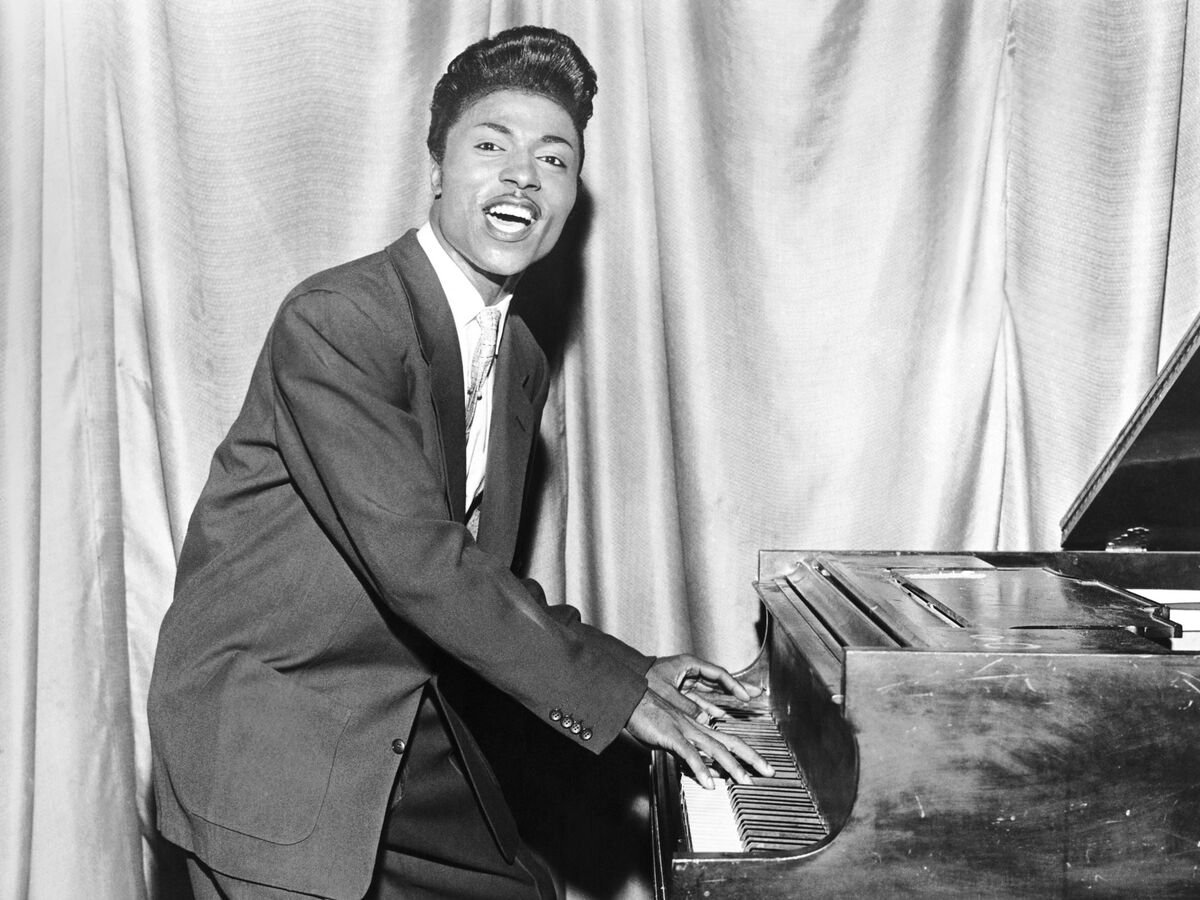
One of the central performers in early rock and roll was Richard Wayne Penniman, better known by his stage name, Little Richard (1932–2020). Raised in a religious household in Macon, Georgia, he began singing gospel music in church, where he adopted gospel-based shouting, melisma, and rhythmic phrasing. These gospel techniques were carried directly into his popular secular recordings.
Little Richard's breakthrough came in 1955 with the release of "Tutti Frutti," a song that epitomized the energy and excitement of early rock and roll. Featuring a fast-paced rhythm, percussive boogie-woogie styled piano, and his signature vocal exclamation—"a wop bop a loo bop a lop bam boom"—the song stood apart from the more reserved pop standards of the time. It introduced a raw, urgent sound that resonated across racial lines, accelerating its spread across radio formats. Although "Tutti Frutti" peaked at number 21 on the pop charts and number two on the R&B charts, it sold around 500,000 copies and was quickly covered by artists such as Elvis Presley and Pat Boone.
Musically, Little Richard's style was typified by his pounding piano, shouted vocals, and falsetto "woos." His subsequent hits, including "Long Tall Sally,”"Rip It Up,” "Ready Teddy," and "Good Golly Miss Molly," followed a similar energetic blueprint, often based on the 12-bar blues structure but imbued with his unique intensity. His frenetic performance style, characterized by shouting, dancing, gyrating, and profuse sweating, made him a symbol of the wild, unrestrained reputation rock and roll was developing. Little Richard’s theatricality, coupled with his flamboyant appearance of sequined suits, heavy makeup, and a styled pompadour, projected an androgynous, glamorous image that challenged contemporary norms of gender and sexuality. Richard had previously performed in drag during the late 1940s under the name "Princess LaVonne." As he gained popularity, he incorporated styles and practices from the drag tradition into his performances, and his stage presence influenced numerous artists, including James Brown, Prince, David Bowie, and Elton John.
Little Richard's stated personal identity was complex and often conflicted. Throughout his life, he made a series of declarations regarding his sexual identity, at times identifying as gay, bisexual, or omnisexual, and at other times renouncing these identities altogether. Due to both his personal background and his Pentecostal upbringing, Little Richard's stance on sexuality often shifted, especially during periods of renewed religious commitment. In the 1970s and 1980s, he temporarily left the music industry to become a traveling evangelist and spoke out rather publicly against homosexuality, even as his appearance and stage persona continued to defy conventional gender expectations and borrow from drag practices.
In 1957, at the height of his fame, Little Richard abruptly renounced his music career to pursue religious study and preaching. He briefly married and attended Bible college, but eventually returned to music in the early 1960s. By the late 1960s, Little Richard's career suffered from his struggles with drug and alcohol dependence. Despite attempts at comebacks in the 1970s, his personal difficulties and tragedies led him to embrace religion again later in life. Looking back at his career, Little Richard once stated:
“I felt that my singing was like… Billy Graham giving a message. I gave a message in song to help people... to know the way... I decided to come back and teach goodness in this business. To teach love, because music is the universal language.”
He also expressed concerns about the direction of rock music in later years, describing some modern styles as "demonic" and opposed to spiritual values.
While Little Richard may not have claimed to own the crown of "king of rock and roll," he remains one of the genre's most dynamic and prominent pioneers. His blend of gospel-inspired vocals, rhythmic innovation, and flamboyant showmanship affected later performers across rock, funk, and glam styles. His recordings circulated widely and directly inspired later performers, from Elvis Presley and Buddy Holly to Jimi Hendrix and Janis Joplin. His gospel-influenced vocal style, rhythmic piano techniques, and charismatic performances captured the restless spirit of postwar youth culture. Late in life, he credited divine providence for his influence: "I have God to thank that I’m a living legend and not a dead one."
Fats Domino

Antoine "Fats" Domino (1928–2017) was a central figure in the movement of rhythm-and-blues recordings into the early rock-and-roll market. A singer, pianist, and songwriter, Domino brought the rich jazz and boogie-woogie musical traditions of his hometown of New Orleans into the national spotlight with a restrained vocal delivery and steady piano patterns that differed sharply from performers such as Little Richard.
Raised in a musical family, Domino left school at age 14 to work in a factory by day and play clubs by night. He soon joined the band of trumpeter Dave Bartholomew, a New Orleans bandleader, arranger, and producer. Bartholomew would become Domino's producer, arranger, and songwriting partner. Their collaboration, recorded under the Los Angeles-based independent label Imperial Records, resulted in a string of hits that mixed Domino's gospel and blues roots with a rhythmic vitality that appealed to both Black and white audiences.
Domino's first major R&B hit,"The Fat Man" (1950), has been treated as an early rock-and-roll recording because of its tempo, backbeat emphasis, and piano-driven texture. It features his signature boogie-woogie piano style built on repeated left-hand figures and accented right-hand lines, a swinging rhythm section, and a memorable falsetto wah-wah solo—a vocal technique that approximated the sound of a harmonica. The song employed a modified eight-bar blues structure, which Domino often favored over the more typical twelve-bar form. "The Fat Man" draws on New Orleans rhythmic motifs and piano-led ensemble writing while using features later associated with rock-and-roll recording practice.
By the mid-1950s, Domino had placed more than a dozen hits on the R&B charts. His first major crossover success came with "Ain’t That a Shame" (1955), which reached No. 1 on the R&B chart and broke into the Top 10 on the pop chart. Although a more “sanitized” cover version by the white singer Pat Boone climbed even higher on the pop charts, Domino's original version remained one of his most frequently replayed recordings of the decade. Throughout the second half of the decade, Domino continued releasing a string of hits, including "I’m in Love Again,”"I’m Walkin’,”"Blue Monday,”"Whole Lotta Loving," and his most successful single,"Blueberry Hill."
Domino's 1956 version of "Blueberry Hill"—a Tin Pan Alley standard previously made famous by the Glenn Miller Orchestra in the 1940s—reached No. 2 on the pop charts and topped the R&B charts. With "Blueberry Hill,” Domino illustrates a change in how rhythm and blues recordings entered the pop market: rather than modifying his style to fit pop conventions, he made mainstream audiences embrace his rhythm and blues stylings. His full-throated vocals, New Orleans accent, and relaxed groove replaced the crooning and refined diction that had long characterized pop music. In doing so, Domino brought rhythm-and-blues performance practices into formats already familiar to pop listeners.
A similar musical formula underpinned his hit "My Blue Heaven" (1956), another reworking of a 1920s Tin Pan Alley tune. These reinterpretations of earlier standards, performed with Domino's rhythmic bounce and piano-driven arrangements, became part of a wider industry trend: updating old pop favorites with a modern rock beat to meet the demand for fresh material.
Domino maintained a similar approach to tempo, piano texture, and vocal delivery across his major recording years. Unlike the overtly theatrical performances of Little Richard, Domino's stage presence was calm and approachable. He famously remained seated at the piano, permitting the music to speak for itself without the flamboyant gestures or onstage antics of some of his peers. Domino’s restraint, along with his affable personality and nonthreatening image, contributed to his broad crossover appeal.
Cover Versions of Rock and Roll
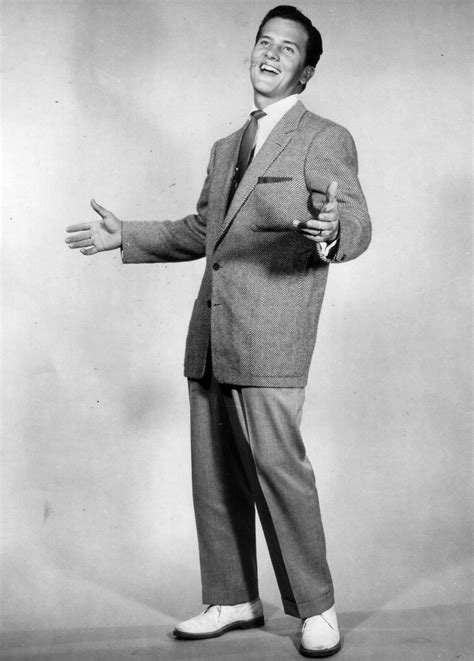
As rhythm and blues gained popularity among teenagers in the early 1950s, songs by artists like Little Richard and Fats Domino captivated young listeners with their energetic delivery and suggestive lyrics that relied on sexual suggestion and humor, which many adults viewed as inappropriate for radio broadcast. Tracks such as Little Richard's "Tutti Frutti" with its jaunty line, "I got a girl named Sue, she knows just what to do," and Big Joe Turner's "Shake, Rattle, and Roll," featuring the lyric, "You’re wearin’ those dresses, the sun comes shinin’ through / I can’t believe my eyes, all of this belongs to you," represented a bold and irreverent style that appealed with youth culture. While many of these artists had crossover success with young white listeners, these same qualities alarmed many parents, broadcasters, and record executives, who viewed the content as too risqué for mainstream white audiences.
Compounding these anxieties were persistent racialized stereotypes, such as the "Stagger Lee" myth, which cast Black men as defiant, hypersexual, and predatory figures, particularly to white women and white society at large. Such myths, rooted in racism, were often invoked by police departments, school boards, and religious groups, who drew on racial stereotypes to justify surveillance and censorship. When Muddy Waters sang "I Just Wanna Make Love to You," Black audiences understood it as part of a tradition of blues humor, wordplay, and the celebration of desire. White listeners, unfamiliar with these cultural codes, often interpreted the same songs as menacing or corrupting, reinforcing fears of social disorder. This gap in interpretation fueled parental and institutional efforts to censor rhythm and blues, and later the rock and roll that emerged from it.
In response, white artists and record labels began releasing cover versions of rhythm-and-blues songs originally performed by Black musicians. Although a cover version typically refers to any re-recording of an existing song, in this context, these renditions served a more deliberate function: to repackage Black musical innovations in a form deemed more appropriate and commercially viable for white listeners.
Pat Boone became the most prominent figure associated with the cover trend and was one of the most commercially successful artists of the 1950s, second only to Elvis Presley in terms of chart dominance. Over the course of the decade, Boone sold nearly 50 million records and charted 38 Top 40 hits. His popularity was largely built on polished, toned-down versions of rhythm-and-blues songs originally written and performed by Black artists. Stylistically, Boone embodied a softer, more conservative vision of 1950s popular music. His clean-cut image, wholesome persona, and relaxed vocal delivery provided an alternative to the rebellious energy of performers like Little Richard or Chuck Berry. His versions of "Ain’t That a Shame,”"Long Tall Sally," and "Tutti Frutti" stripped away the sexual innuendo of the original recordings, replacing them with smooth, restrained performances that appealed to white middle-class audiences and radio stations.
Boone’s recordings followed label practices that redirected Black repertory toward white pop markets through a more "acceptable" performance for mainstream white consumers. While Boone's interpretations lacked the rhythmic intensity and vocal grit of the originals, they introduced these compositions to audiences and radio stations that were otherwise hesitant—or outright unwilling—to feature recordings by Black musicians. Boone himself acknowledged the racial and cultural implications of his early career. "I like to say I was the midwife at the birth of rock and roll," he once remarked. "In fact, there was no such thing as rock and roll. It was called ‘race music,’ and the artists were limited to their own stations and charts." While his statement recognizes the Black origins of the genre, it also points to the systemic barriers that limited many Black performers' access to broader markets. Boone's commercial success often came at the expense of the original artists: many received little recognition or compensation, while his covers reached mass audiences and earned significant profits.
Boone's critics have long argued that his career exemplifies cultural appropriation, capitalizing on the artistic labor of Black musicians while benefiting from racial privilege in a segregated music industry. While there is truth to this critique, it is also historically accurate to note that Boone's recordings helped bring rhythm and blues compositions into broader circulation at a time when systemic racism severely limited the reach of Black performers. In this way, Boone's legacy is complex: he was a key figure in the popularization of rock and roll, but his success also illustrates the racial inequalities embedded in the music industry of the era. Boone's career helps illuminate how issues of race, representation, and cultural ownership were—and continue to be—deeply woven into the fabric of American popular music.
Bill Haley

Bill Haley (1925–1981) is often remembered as one of the first performers to introduce rock and roll to a national audience. While his claims to have invented the genre were unequivocally false, he played a major role in introducing it to mainstream consumers. Haley began his career as a country performer and radio disc jockey, known for a distinctive yodeling style. His early band, The Four Aces of Western Swing, later evolved into The Saddlemen, performing mostly country material. However, Haley and his band frequently incorporated R&B covers into their sets, disguising the style enough to avoid alienating traditional country audiences. Haley’s early stylistic experimentation preceded his later emphasis on rhythm-and-blues material.
In 1951, Haley recorded a cover of Jackie Brenston and Ike Turner's "Rocket 88," a song widely considered a foundational rock-and-roll track. While his version did not achieve significant commercial success, it was enthusiastically received by teenage audiences, particularly white listeners unaccustomed to hearing this style in mainstream venues. Sensing the music's crossover potential, Haley rebranded his group as Bill Haley and His Comets and began to focus more explicitly on R&B-inspired material.
Haley's breakthrough arrived with his 1954 recording of "Rock Around the Clock," a high-energy number originally cut by Sunny Dae and the Knights. Initially receiving little attention, the song exploded in popularity after it was featured in the opening credits of the 1955 film Blackboard Jungle, a gritty drama about teenage rebellion. The film's association with youthful defiance gave the song cultural significance well beyond the charts and linked it to public debates about teenage behavior and authority. "Rock Around the Clock" peaked at number one on the pop charts in July 1955 and remained in the Top Ten for 40 weeks, ultimately becoming one of the best-selling singles of the decade.
That same year, Haley had another major hit with "Shake, Rattle, and Roll," a cover of Joe Turner's raucous R&B original. While Turner's version featured risqué lyrics like "You're wearin' those dresses, the sun comes shinin' through," Haley's rendition altered the line to "You're wearin' those dresses, your hair done up so nice," softening the sexual overtones to suit more conservative listeners and radio stations.
Musically, Haley drew on multiple traditions. His background in country and western brought certain rhythmic and instrumental techniques, particularly in his guitar and vocal phrasing, while his R&B influence, especially from bandleader Louis Jordan, was evident in his use of shuffle rhythms and horn-driven arrangements. Producer Milt Gabler, who had previously worked with Jordan, applied similar production techniques to Haley's recordings, helping to craft a sound that was both familiar and fresh to 1950s audiences. The band's instrumental setup was conducive to this hybrid style. In addition to country instruments like steel guitar, the group included drums and saxophone, elements associated with R&B and jump blues. This blend of styles allowed Haley and his Comets to reach audiences across the three major music markets of country, R&B, and pop, mirroring the genre-blurring ethos of early rock and roll itself.
Following the success of "Rock Around the Clock," Haley released several more hits, including "Dim, Dim the Lights" (1955), one of the first so-called "white" records to appear on the R&B charts, as well as "See You Later, Alligator" and "Corrine, Corrina." He also starred in the 1956 film Rock Around the Clock, one of the earliest examples of the teen rock musical and a harbinger of future pop-culture synergies between music and cinema.
However, despite his contributions within the genre, Haley's popularity began to diminish by the late 1950s. At nearly 40 years old, with a receding hairline and a clean-cut image, Haley lacked the rebellious charisma necessary to fully embody rock and roll's youth culture. While he helped break down barriers between musical genres and racial markets, he ultimately could not serve as the long-term face of the rock revolution. That role would soon be filled by a younger, more electrifying performer: Elvis Presley, whose rise in the mid-1950s shifted the center of rock and roll's energy and appeal.
Sun Records

Before turning to Elvis, it is important to understand the musical landscape of the South and the role played by Sam Phillips (1923–2003), one of the most visionary figures in American popular music. He began his career as a disc jockey in Muscle Shoals, Alabama, before relocating to Memphis, Tennessee, where he worked as an announcer and engineer at local radio stations. Motivated by a desire to document the rich musical life of the South—particularly the vibrant, often overlooked world of African American blues—Phillips opened the Memphis Recording Service in 1950. His motto, "We Record Anything—Anywhere—Anytime," described a studio policy that placed few stylistic or racial limits on who could record.
The Memphis Recording Service operated in a segregated region where most commercial studios excluded Black musicians. Artists such as B.B. King, Howlin' Wolf, Rosco Gordon, and Little Milton recorded there, attracted by Phillips's willingness to treat them seriously as artists and to help bring their music to a larger audience. These early recordings were typically leased to larger, Chicago-based labels like Chess and Modern Records, which had the distribution power that Phillips lacked at the time. One of the most important of these early sessions was Jackie Brenston and His Delta Cats' "Rocket 88" (1951), a song many music historians cite as one of the first true rock-and-roll records.
Recognizing the creative and commercial potential of this music, Phillips decided to stop leasing his masters and, in 1952, established his own label, Sun Records. Phillips developed a distinctive tape-delay echo effect known as slapback, which involved feeding the recorded sound back into the mix with a slight delay—typically around 100 to 200 milliseconds—creating a quick, percussive echo. He was also strongly dedicated to discovering talent that could appeal across racial lines. Phillips's long search for an artist with broad crossover potential ended in 1953, when a young truck driver named Elvis Presley paid for a few minutes of studio time to record a gift for his mother. Intrigued by Presley's voice and style, Phillips invited him back for further sessions. In 1954, Phillips recorded Presley singing a blues tune, "That’s All Right,"paired with a country B-side, "Blue Moon of Kentucky." Backed by guitarist Scotty Moore and bassist Bill Black—and notably lacking a drummer—these early recordings blended rhythm and blues with country in a way that sounded entirely new. Later writers labeled this genre rockabilly, and Presley's rise soon followed.
Elvis Presley

Elvis Presley (1935–1977) remains one of the most iconic and influential figures in the history of American popular music. Born in Tupelo, Mississippi, into a working-class family, Presley encountered a diverse array of musical influences from an early age. He grew up listening to white gospel music in Pentecostal churches, as well as rhythm and blues on the radio, country-and-western tunes, and postwar pop crooners like Dean Martin. At the age of eight, he won a talent contest singing the country ballad "Old Shep," foreshadowing the genre-blending style that would subsequently distinguish his career.
In 1948, Presley and his family moved to Memphis, Tennessee, where they lived in a federally funded housing project. Attending a predominantly lower-income high school, Presley remained somewhat of an outsider. He stood out for his ostentatious clothing, love for Black musical styles, and slicked-back ducktail hairstyle—traits that aligned him more closely with Black and lower-class white youth cultures than with mainstream white middle-class norms. Though an average student, Presley was admired for his musical performances at school events, which showcased an intimate connection to a broad spectrum of musical traditions, including R&B, Black and white gospel, bluegrass, western swing, country, and pop.
In 1953, shortly after graduation, while he worked as a truck driver and harbored dreams of becoming a movie star, Presley visited the Memphis Recording Service (which also housed Sun Records) to make a recording as a gift for his mother. Marion Keisker, Sam Phillips's secretary, was present and later introduced Presley to Phillips. Phillips, who had recorded several Black R&B and country artists, had long sought a white artist who could capture the essence of Black music. As he famously put it, "If I could find a white man who had the Negro sound and the Negro feel, I could make a billion dollars."
After signing Presley to Sun Records in July 1954, Phillips paired him with guitarist Scotty Moore and bassist Bill Black. The trio produced a series of groundbreaking singles built from blues phrasing and country instrumentation. These stripped-down recordings, often lacking drums, combined elements of country, R&B, and gospel in a style later dubbed rockabilly. Despite being marketed as a country act, radio programmers struggled to place his records within existing genre categories. Some white radio stations even refused to play his records, mistakenly assuming he was Black.
Presley was billed as "The Hillbilly Cat" and "The King of Country Bop," monikers that stressed his unusual hybrid style. His energetic stage presence and sexually suggestive dance moves captivated teenage audiences and unnerved more conservative listeners. His image—a mix of rebellious fashion, racially ambiguous musicality, and defiant sensuality—challenged existing norms and generated fervent fan responses, especially from young women.
Elvis Presley and Colonel Tom Parker

By 1955, Presley had released five singles on Sun Records, and his career was gaining traction through personal appearances across the South and on the nationally broadcast Louisiana Hayride radio show. His popularity in the country music realm grew rapidly; he was voted the number-one "up-and-coming" country-and-western artist in a Billboard disc jockey poll. That same year, Presley's career took a pivotal turn when an eccentric and savvy promoter named Colonel Tom Parker (1909-1997), with a background in carnivals and a hidden past as an undocumented immigrant from the Netherlands, took over as his manager. Parker quickly orchestrated the sale of Presley's contract from Sun Records to the major label RCA Victor for $40,000 (roughly $482,000 in contemporary value), a sum far above the typical recording contract at the time.
Under RCA, Presley began working with producer Chet Atkins to craft a more polished, pop-friendly sound. In 1956, Presley released a string of blockbuster hits, including"Heartbreak Hotel," "Don’t Be Cruel," and "Hound Dog." The latter, initially recorded by Big Mama Thornton and written by Jerry Leiber and Mike Stoller, was radically altered in Presley's rendition. While Thornton's original was gritty and sexually charged, Presley's version featured sanitized lyrics that appealed to mainstream sensibilities—a hallmark of white covers of Black R&B songs during the era. Despite the alterations, Presley's version of "Hound Dog" became a landmark rock-and-roll success, spending 11 consecutive weeks at number one while topping the pop, country, and R&B charts simultaneously.
Colonel Parker’s aggressive marketing guided Presley's multimedia career by cultivating his image as an unprecedented cultural phenomenon. Drawing on his background in traveling carnivals and promotion, Parker arranged major television appearances, signed lucrative merchandising deals, and secured Presley roles in Hollywood films, expanding his reach well beyond the music industry. Parker effectively turned Presley into a brand, capitalizing on every aspect of his public persona. He licensed Elvis-branded products ranging from clothing to cosmetics, and even launched the now-famous "I Hate Elvis" buttons—cynically cashing in on fans and detractors alike by owning both sides of the cultural conversation.

However, Parker's management came at a steep cost. He often claimed as much as 50 percent of Presley's earnings—far above the industry norm—and strictly limited Presley's public appearances to increase demand. These tactics, while effective in maintaining Presley's mystique and market value, also led to an isolating and grueling work schedule. Combined with the strain of constant visibility, a relentless film production schedule, and increasing personal pressures, these factors contributed to Presley's growing dependence on prescription drugs and to his gradual retreat from public life.
Sales of Presley's records during this period reached unprecedented heights. "Heartbreak Hotel" sold over a million copies within months of release. The double-sided single "Hound Dog"/"Don’t Be Cruel" sold more than three million copies in one year. In several cases, both the A and B sides of many of Presley's singles reached the Top 10, a rare feat at the time. "Don’t" and "I Beg of You," "One Night"/"I Got Stung," and "A Fool Such As I"/"I Need Your Love Tonight" all charted highly. Even as late as 1960, "Are You Lonesome Tonight?" reached all three major Billboard charts.
Presley continued to draw from both country and R&B influences throughout his early RCA years. He covered hits such as Joe Turner's “Shake, Rattle, and Roll," Lloyd Price's “Lawdy Miss Clawdy," the Orioles' "Crying in the Chapel," and multiple Little Richard tracks, including"Tutti Frutti,”"Long Tall Sally," and "Ready Teddy." He also interpreted country classics like Carl Perkins's “Blue Suede Shoes" and even ventured into pop standards like Rodgers and Hart's “Blue Moon."
Elvis on TV

Presley's explosion into national stardom was further fueled by the emerging power of television, which transformed him from a regional sensation into a national cultural icon. In 1956, under the guidance of his manager, Colonel Tom Parker, Presley secured a series of high-profile television appearances that both amplified and provoked criticism of his public image. His first nationally broadcast performance on The Milton Berle Show caused a media firestorm. When Presley launched into an unrestrained version of "Hound Dog," abandoning his guitar and engaging in exaggerated hip-swiveling and full-body movements, it scandalized conservative critics while thrilling teenage fans. Some commentators denounced the performance as vulgar and morally corrupting, fueling a broader cultural panic over rock and roll's perceived threat to social norms.
In an effort to temper Presley's provocative style, The Steve Allen Show presented a comically restrained version of Presley's act. Dressed in a tuxedo and instructed to sing "Hound Dog" to an actual basset hound dressed in formalwear, Presley appeared visibly uncomfortable. The performance, while widely watched, was staged more to mock rock and roll than to celebrate it. However, the most famous attempt to "sanitize" Presley came on The Ed Sullivan Show. Although Sullivan had initially vowed never to book Presley, the singer's growing popularity and commercial potential forced a change of heart. During his third and final appearance in January 1957, the show's producers famously filmed him only from the waist up in an attempt to obscure his pelvic movements. Presley's charisma remained undiminished, and his performances drew record-breaking viewership and increased national fascination.
Presley's career quickly expanded into feature films, beginning with Love Me Tender (1956), followed by Jailhouse Rock(1957) and King Creole (1958). These productions blended musical performances with dramatic storytelling, thereby extending his appeal to moviegoers. However, in 1958, at the height of his popularity, he was inducted into the U.S. Army, which temporarily paused his explosive career. Two life-altering events occurred during his service: the death of his mother, Gladys Presley, which Elvis later described as the greatest tragedy of his life, and his meeting with Priscilla Beaulieu in Germany, whom he would eventually marry.
Upon returning in 1960, Presley resumed his career with G.I. Blues, which capitalized on his image as a returning soldier. Over the next decade, he appeared in 33 films, most of them formulaic, teen-oriented musicals. Although many were commercially successful, they received little critical acclaim. Presley longed for more serious, dramatic roles, but Parker kept his acting career closely tied to his musical persona and mass-market appeal.
As rock and roll evolved in the 1960s—with the onset of the British Invasion, Motown, and psychedelic rock dominating the charts—Presley's presence on the singles charts began to decline. From approximately 1962 to 1968, he withdrew from live performances and was rarely seen in person, except in his films. During this time, however, he found commercial and critical recognition for his interpretations of gospel music, releasing critically acclaimed albums such as His Hand in Mine (1960) and How Great Thou Art (1967), the latter of which won him a Grammy Award. He increasingly withdrew from public life, surrounding himself with a close circle of confidants known as the "Memphis Mafia," and spent much of his time at his Memphis estate, Graceland.
In 1967, Presley married Priscilla Beaulieu, and their daughter, Lisa Marie Presley, was born the following year. That same year constituted a resurgence in his career with the airing of a televised comeback special on NBC in December 1968. The comeback performance reintroduced Presley as a commanding live performer and reinvigorated interest in his music. Now enticing both his original fanbase and a new generation, he launched a new era of touring under Parker's management.
Colonel Tom Parker skillfully marketed Presley throughout this period, securing a highly profitable Las Vegas residency and organizing national tours that brought Presley to both major cities and smaller markets often bypassed by other major acts. A high point came in 1973 with Aloha from Hawaii via Satellite, the first global satellite broadcast of a live concert. The show was seen by an estimated one billion people, evidence of Presley’s continued global visibility.

Despite this resurgence, Presley's personal life and health were deteriorating. His marriage to Priscilla ended in divorce in 1973, and he became increasingly dependent on prescription drugs. His weight fluctuated dramatically, driven by cycles of restrictive dieting and substance use. The pressures of constant touring, combined with his personal struggles, took a toll on both his physical and mental well-being. Elvis Presley died on August 16, 1977, at the age of 42, from heart-related complications likely exacerbated by years of drug abuse. His death shocked the world and signified the end of an era. Shortly afterward, his posthumously released recording of "My Way," originally made famous by Frank Sinatra, became a best-selling single.
Public interest in Presley’s career expanded after his death. Millions of albums have continued to sell, many repackaged in new formats. His life and music have been the subject of countless biographies, documentaries, and academic studies. Graceland, his home in Memphis, was opened to the public and has since become a major tourist destination, drawing over half a million visitors annually. More than four decades after his death, Elvis Presley remains one of the most iconic and impactful figures in American cultural history.
Chapter 13: Conclusion

The rise of early rock and roll in the 1950s was inseparable from the innovations of Black rhythm and blues artists whose music established the basis for the genre. Yet, as the term "rock and roll," popularized by disc jockey Alan Freed, gained currency, it often rebranded Black musical traditions in a way that made them more accessible to white audiences. The rise of white performers covering R&B hits shows both the commercial power of this music and the racial inequities embedded in the American music industry. While artists like Pat Boone offered polished, less provocative renditions of Black songs that appealed to mainstream sensibilities, others, most notably Elvis Presley, channeled the unbridled energy and emotional immediacy of R&B more directly, helping to launch rock and roll into the mainstream of culture.
Presley's success, driven by a synthesis of country, gospel, and blues traditions and amplified through television, stood for a seismic generational shift. His performances simultaneously thrilled youth audiences and unsettled cultural gatekeepers, capturing the tensions and contradictions at the heart of rock and roll's early years. Meanwhile, the industry dynamics surrounding cover versions, television censorship, and audience reception magnified the complex intersections of race, commerce, and popular taste of the period.
As Presley transitioned to RCA Victor at the end of 1955, Sun Records founder Sam Phillips turned his attention to cultivating other newer performers. Artists such as Johnny Cash, Carl Perkins, and Jerry Lee Lewis would carry forward the momentum of early rock and roll by fusing country and R&B styles into a hybrid form known as rockabilly. In the next chapter, we will explore the development of rockabilly and examine how these performers expanded the sonic and cultural possibilities of rock and roll during its formative years.
Chapter 13: Further Reading
Belz, Carl. The Story of Rock. New York: Dell Publishing, 1969. 2nd ed., 1972.
Boone, Pat. Pat Boone’s America: 50 Years. Nashville: Thomas Nelson, 2006.
Coleman, Rick. Blue Monday: Fats Domino and the Lost Dawn of Rock ’n’ Roll. New York: Da Capo Press, 2007.
Crouch, Kevin, and Tanja Crouch. Sun King: The Life and Times of Sam Phillips, the Man Behind Sun Records. London: Omnibus Press, 2010.
Dannen, Frederic. Hit Men. New York: Vintage Books, 1990.
Escott, Colin, and Martin Hawkins. Good Rockin' Tonight: Sun Records and the Birth of Rock ’n’ Roll. New York: St. Martin’s Press, 1992.
Farren, Mick, and Pearce Marchbank. Elvis in His Own Words. London: Robson Books,1977.
Gillett, Charlie. The Sound of the City: The Rise of Rock and Roll. New York: Pantheon Books, 1996.
Greil Marcus. Mystery Train: Images of America in Rock ’n’ Roll Music. New York: E.P. Dutton, 1975. Revised and enlarged ed., 1982.
Guralnick, Peter. Careless Love: The Unmaking of Elvis Presley. Boston: Little, Brown,
1999.
—. Feel Like Going Home: Portraits in Blues and Rock ’n’ Roll. New York: Doubleday, 1971.
—. Last Train to Memphis: The Rise of Elvis Presley. Boston: Little, Brown, 1994.
Hopkins, Jerry. Elvis. New York: Stein and Day, 1971.
Kirby, David. Little Richard: The Birth of Rock ‘n’ Roll. New York: Continuum, 2009.
Marsh, Dave. Elvis. New York: Penguin Books, 1982.
Palmer, Robert. Rock ’n’ Roll: An Unruly History. New York: Harmony Books, 1995.
Shaw, Arnold. Honkers and Shouters: The Golden Years of Rhythm and Blues. New York: Macmillan, 1986.
White, Charles. The Life and Times of Little Richard. New York: Omnibus Press, 1984.