Chapter 22.1: Epilogue to Psychedelic Rock
History of American Pop Music: Chapter 22.1
Death of the Hippie
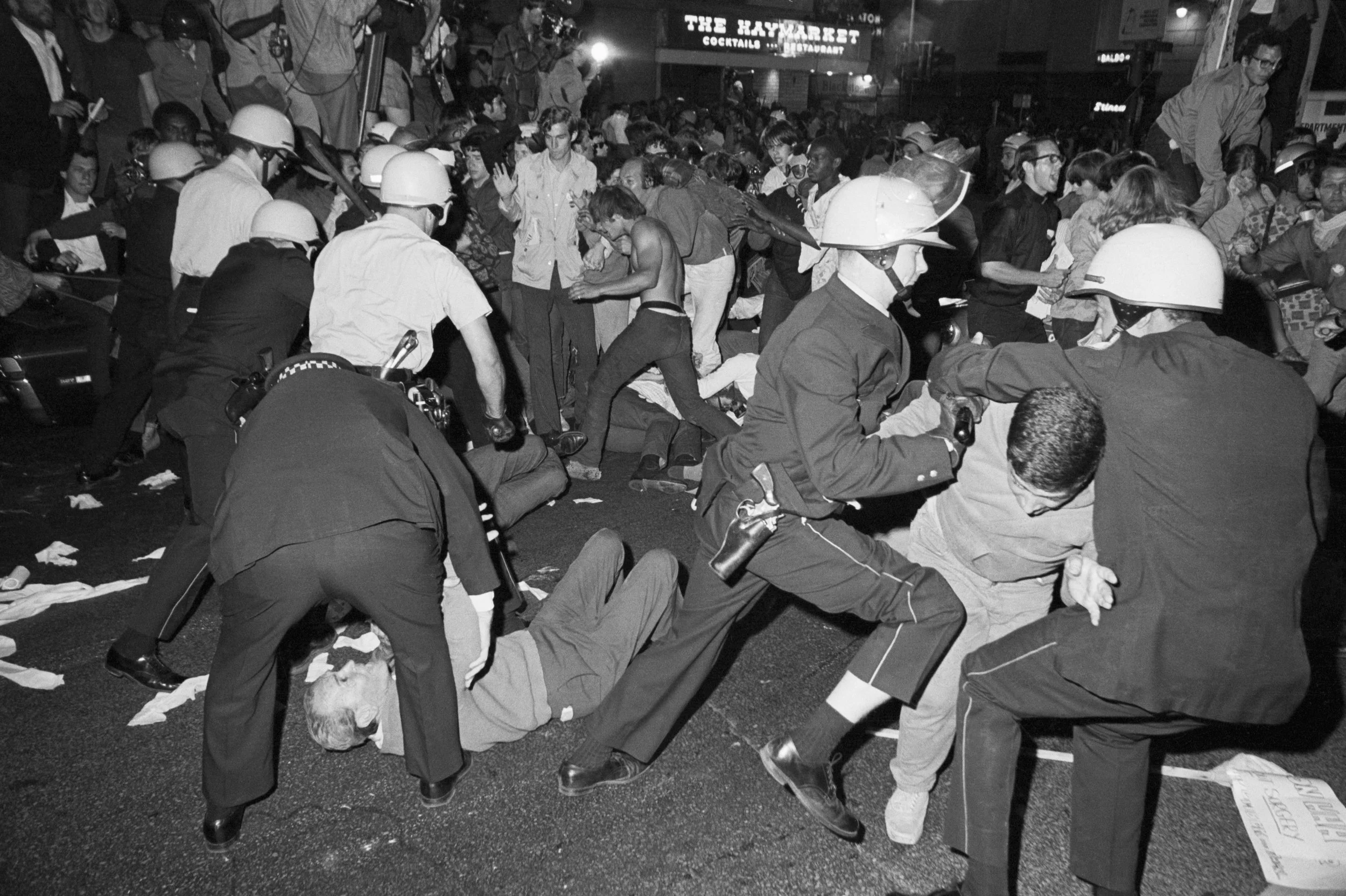
As the 1960s drew to a close, the counterculture’s hopeful vision of societal transformation began to unravel amid escalating violence, political turmoil, and growing disillusionment. The Vietnam War continued to claim thousands of young American lives, sparking fierce protests in cities and on campuses across the country. The war’s brutality and the government’s opaque justifications eroded public trust and deepened social unrest. One of the most notorious flashpoints occurred at the 1968 Democratic National Convention in Chicago, where clashes between young demonstrators and police unfolded live on television. The images of bloodied protesters and aggressive police tactics shocked the nation, symbolizing a fracturing social order and revealing the limits of peaceful dissent.
That same year witnessed the assassinations of two monumental figures in the struggle for social justice: Martin Luther King Jr. in April and Robert F. Kennedy in June. King’s death represented the loss of a moral leader who had inspired nonviolent civil rights activism, while Kennedy’s assassination silenced a presidential candidate committed to racial equality and ending the war. These tragedies devastated the progressive movement, creating a leadership vacuum and deepening feelings of despair and anger among activists.
Politically, the election of Richard Nixon in 1968 signaled a conservative backlash against the progressivism and social upheaval of previous years. Nixon’s campaign emphasized “law and order,” appealing to what he called the “silent majority” — those disillusioned with Johnson’s progressive Great Society programs and critical of the counterculture’s challenges to traditional authority. In this tense climate, militant groups like the Weather Underground (originally the Weathermen) gained prominence. Inspired by Bob Dylan’s lyric, “You don’t need a weatherman to know which way the wind blows,” in the song "Subterranean Homesick Blues,”the Weather Underground embraced violent tactics, including bombings and riots, as direct action against the government — a stark departure from the earlier ideals of peaceful protest.
Several entwined factors fueled this sense of decline, particularly in the Haight-Ashbury. The “Summer of Love” in 1967, which drew tens of thousands to the district, overwhelmed the community. The influx included sincere idealists alongside opportunists and tourists, leading to overcrowding, resource shortages, and social tensions. Violence increasingly marred the countercultural landscape as biker gangs like the Hells Angels infiltrated the Haight scene and engaged in intimidation and criminal acts that escalated local violence. Meanwhile, heroin and other potent drugs became more common, increasing addiction and harming health in some communities. Intense media scrutiny, which had initially spread enthusiasm, soon became intrusive and sensationalist, exposing the movement’s contradictions and inviting widespread criticism.
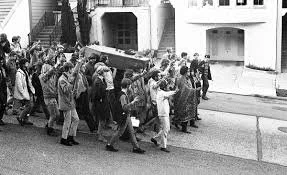
The fracturing counterculture was made visible on October 6, 1967, with the “Death of the Hippie” march in San Francisco. Organized by activists who believed the original ideals of peace, love, and community had been betrayed, the event staged a mock funeral procession through the city. Participants carried a coffin labeled “Hippie is Dead,” symbolizing the demise of authentic hippie culture. This public mourning, only weeks after the Summer of Love, also served as a sharp critique of the movement’s commodification, as its symbols, fashion, and music were appropriated by mainstream consumer culture for profit. The hippie image, once a radical challenge to corporate capitalism, had become a marketable lifestyle, diluting its revolutionary potential.
The Beatles Break Up

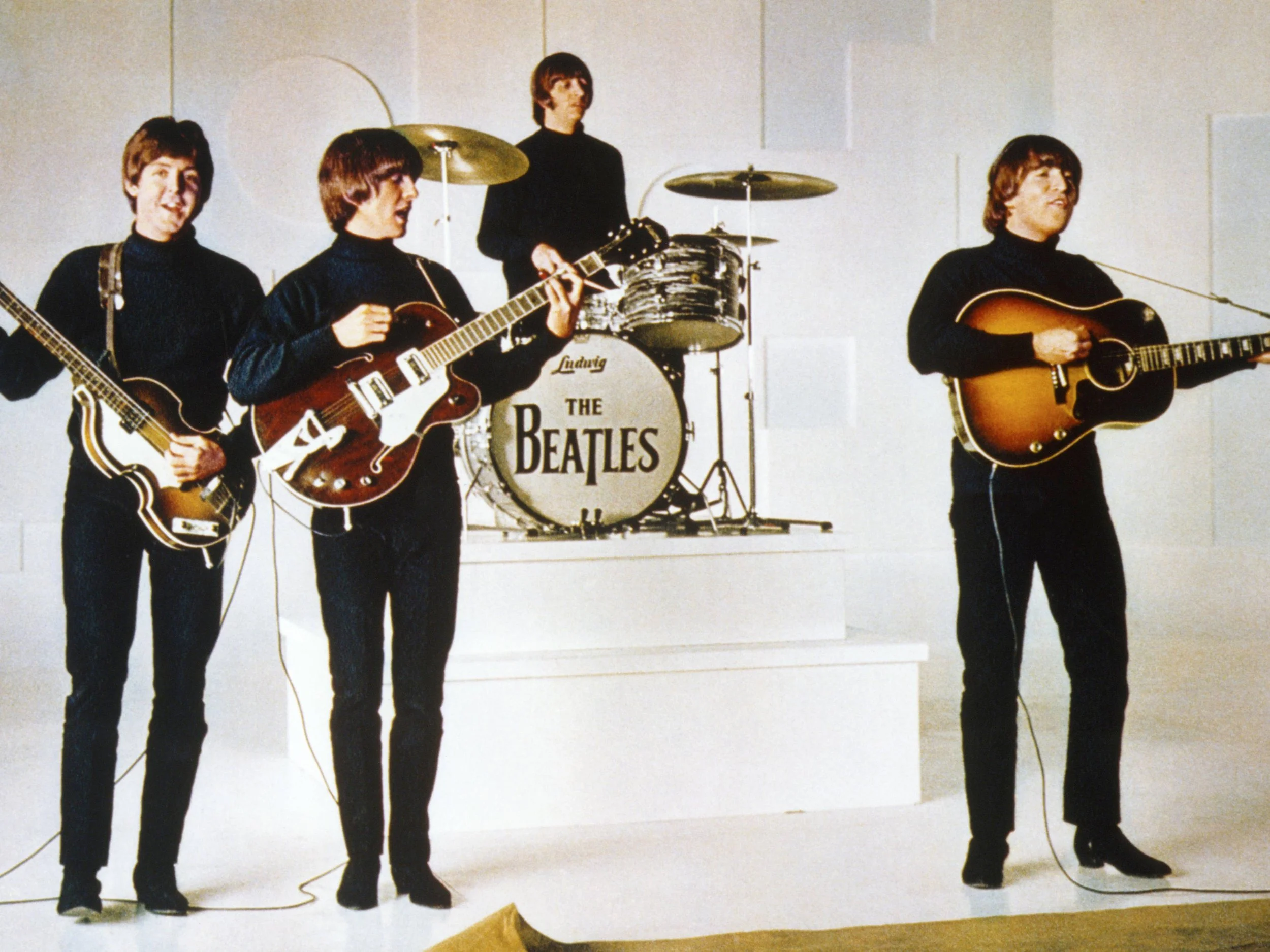
By 1969, the Beatles were operating under sustained personal, financial, and creative strain, even as their commercial success showed no sign of slowing. John Lennon became increasingly involved in conceptual art and multimedia work after his 1966 meeting with Yoko Ono at the Indica Gallery. Their relationship redirected Lennon's priorities and daily working habits, pulling his attention away from the band's internal rhythms and toward a more overtly confrontational public presence. As their partnership became visible, hostility followed. John and Yoko were heckled in public, and racist and sexist abuse circulated widely in the press and private correspondence. Many fans, unsettled by Lennon’s changing artistic direction and personal life, turned against him. Ono’s presence in the studio during 1968 intensified this backlash, exposing deep-seated gendered and racial anxieties surrounding the band’s image. Lennon’s divorce from his wife Cynthia, finalized later that year, severed his connection to his earlier domestic life and placed him more fully within Ono’s avant-garde circles.
Simultaneously, the band’s internal stability declined after the death of manager Brian Epstein in 1967. In his absence, the Beatles sought to manage their own affairs through Apple Corps Ltd., established in early 1968 as a multimedia company intended to support music, film, art, fashion, and experimental projects. Apple was conceived as both a business and a cultural initiative, providing a space for creative work outside traditional commercial constraints. However, the company suffered from a lack of financial oversight and clear leadership. Its open-door policy resulted in a continuous influx of proposals, many of which were impractical, and employees were hired without defined roles, leading to unchecked spending. As financial losses increased, disagreements over how to restore control deepened existing divisions within the group. Lennon, Harrison, and Starr supported Rolling Stones manager Allen Klein, attracted by his aggressive management style and his claims that he could stabilize Apple’s finances, while McCartney opposed his appointment. McCartney’s refusal to sign Klein’s contract left him isolated. The ensuing legal disputes continued into the 1970s, long after the band had ceased to function as a unified group.

During this period, each Beatle began directing his energy toward separate projects. Paul and Linda McCartney married in March 1969 in a small, private ceremony at Marylebone Registry Office in London. John Lennon and Yoko Ono married in Gibraltar and immediately incorporated their relationship into a public anti-war campaign. Their Bed-Ins for Peace in Amsterdam and Montreal turned their hotel rooms into sites of daily press coverage, with journalists visiting as the couple remained in bed, dressed in white and surrounded by signs reading “Hair Peace” and “Bed Peace.” The campaign culminated in the release of “Give Peace a Chance,” which tied Lennon’s domestic life directly to his public anti-war statements. In April, Lennon and Ono continued this series of conceptual performances with "Bagism," holding a press conference while enclosed in a cloth bag to challenge visual prejudice and focus attention on ideas rather than appearances. Meanwhile, George Harrison became more deeply engaged with Indian spirituality and increasingly frustrated by the limited opportunities for his songwriting within the band. Ringo Starr, feeling marginalized, struggled with confidence and had already briefly left the group during the White Album sessions, illustrating the extent of internal mistrust.
As these personal trajectories diverged, disagreements over lifestyle, politics, and creative direction became harder to contain. By the middle of 1969, it was clear that the Beatles were no longer functioning as a collective in any sustained way. Sensing the growing distance, McCartney attempted to restore a sense of common purpose by proposing a return to live performance. Various possibilities were discussed, including an ambitious concert in India, alongside plans for a new film project. These ideas eventually converged on a more modest solution: filming the process of recording a new album. Sessions began in a large, impersonal London studio, which became the basis for the Get Back project and, ultimately, the band’s final act together.
However, the late hours, the cold, uninviting studio environment, and mounting friction within the band made progress difficult. Long hours of recording yielded little finished material, and frustration grew. Disheartened, the Beatles chose to put this project on hold. The unfinished Get Back recordings would later evolve into the Abbey Road and Let It Be albums, as well as the documentary film Let It Be, which depicts both the creative journey and the band's internal struggles.
One of the most notable developments on Abbey Road is George Harrison's growth as a songwriter. While his contributions to the White Album had shown significant promise, it was with "Something" and "Here Comes the Sun" that Harrison matched Lennon and McCartney in compositional ambition and visibility. "Something" features sophisticated harmonic progressions, including a distinctive, memorable cadence, along with tempo shifts that add to its emotional depth. It quickly became a classic, covered by numerous artists. "Here Comes the Sun" also showcases Harrison's skillful use of shifting accents in the chorus and a change of meter during the instrumental break, creating a bright and optimistic tone. These two tracks remain among the most beloved songs on the album.
Simultaneously, John Lennon was pursuing two distinct musical directions. He delved further into avant-garde and experimental work with Yoko Ono while also reconnecting with traditional rock and roll. "Come Together," the album's opening track, draws on stripped-down, blues-influenced rock, with Lennon's lyrics maintaining their characteristic ambiguity. "I Want You (She's So Heavy)" is a lengthy, intense composition that builds tension through heavy riffs and electronic effects. The song concludes abruptly, leaving a sense of unresolved tension that persists until the listener intervenes by lifting the needle or flipping the record.
Abbey Road concludes with a medley that weaves together several shorter pieces into a continuous suite, punctuating the Beatles' collective creativity at its height. The sequence begins with "You Never Give Me Your Money," in which Paul McCartney guides the listener through shifting tempos and tonal characters, with lyrics focused on uncertainty. This leads into "Sun King," a tranquil track by John Lennon, conceived as a companion to "Here Comes the Sun." The medley continues with "Mean Mr. Mustard," "Polythene Pam," and "She Came in Through the Bathroom Window," followed by "Golden Slumbers," a lullaby-like ballad by McCartney that explores themes of rest and return. The suite progresses into "Carry That Weight," featuring the full band and building emotional and musical momentum through bold instrumentation and layered vocals. The medley culminates in "The End," a celebratory farewell featuring a brief drum solo by Ringo Starr and alternating guitar solos by McCartney, Harrison, and Lennon. "The End" encapsulates the Beatles' enduring themes of love, reconciliation, and unity, giving a sense of closure amid the band's increasing fragmentation.

The climax of the Get Back project was the unplanned rooftop concert on January 30, 1969, held atop the Apple Corps headquarters at 3 Savile Row in London. The surprise rooftop concert lasted approximately 42 minutes and became the Beatles' final public concert. Despite tensions and struggles behind the scenes, the band delivered an energetic set that included renditions of "Get Back" and "Don't Let Me Down." Passersby on the street below gathered to listen, and the impromptu show even caught the attention of the London police, who eventually asked the band to end its performance due to noise complaints, which prematurely ended the band's last live performance.
By 1970, the Beatles' dissolution was inevitable. McCartney announced his departure and initiated legal proceedings to dissolve the partnership. Each member pursued an independent path. Harrison released All Things Must Pass, an ambitious triple album that showcased the extensive material he had developed during his time with the band and included the popular track "My Sweet Lord." Starr achieved consistent success with accessible solo albums and acting roles.
After the breakup, Paul McCartney proved the most commercially consistent Beatle. Working closely with Linda, he formed Wings and released a string of successful albums, including Ram (1971) and Band on the Run (1973). From Red Rose Speedway onward, his releases regularly topped the charts. McCartney also moved easily between musical worlds, collaborating with artists such as Stevie Wonder, Michael Jackson, and, later, Kanye West and Rihanna, adapting his melodic style to new settings while remaining a central presence in popular music well into the twenty-first century.
John Lennon’s post-Beatles career took a distinctly political and personal direction. After relocating to the United States in 1971, he and Yoko Ono became prominent advocates for peace and social justice, drawing substantial government scrutiny and facing a prolonged deportation battle. Musically, Lennon adopted a minimalist approach on Plastic Ono Band, combining stark arrangements with direct emotional expression. Imagine (1971) followed, achieving broader appeal and producing a title track that became one of the era’s most recognized anthems. By the mid-1970s, Lennon withdrew from public life to focus on his family after the birth of his son, Sean. His return with Double Fantasy in 1980 presented a more tranquil outlook on domestic life. However, this renewed creative phase ended abruptly in December 1980, when Lennon was shot and killed outside his New York apartment by Mark David Chapman, a troubled fan who had obtained Lennon’s autograph earlier that day. Lennon’s death sent shockwaves worldwide and brought a sudden end to a career whose work has continued to circulate through recordings, activism, and public memory.
By the dawn of the 21st century, the Beatles had sold over 113 million albums in the United States alone, making them the best-selling recording artists in history. Their 2000 compilation album 1, which brought together all of their number-one singles, became their 19th album to top the charts. By 2001, it had sold more than 20 million copies worldwide, reaffirming the band's enduring popularity across generations.
More than five decades after their breakup, the Beatles continue to appeal to audiences worldwide. Their music—characterized by timeless melodies, innovative studio techniques, and groundbreaking songwriting—remains a touchstone for artists across genres. Beyond their commercial success, the Beatles left a lasting imprint on American popular music and culture, influencing everything from sound and production to fashion, film, and social attitudes.
In the broader context of the late 1960s, the Beatles’ breakup coincided with broader political and cultural shifts. The decade, which began with optimism, experimentation, and collective aspiration, ended amid political violence, disillusionment, and fragmentation. The assassinations of Martin Luther King Jr. and Robert Kennedy, the escalation of the Vietnam War, and the inability of many countercultural movements to achieve lasting structural change altered the cultural landscape. Psychedelic idealism gave way to introspection, cynicism, and withdrawal. The Beatles’ final years exemplify this broader shift: communal creativity gave way to isolation, utopian ambitions faltered under practical constraints, and shared vision gave way to individual pursuits. Their breakup not only marked the end of a band but also coincided with the conclusion of a period when popular music briefly embodied collective hope.
Charles Manson
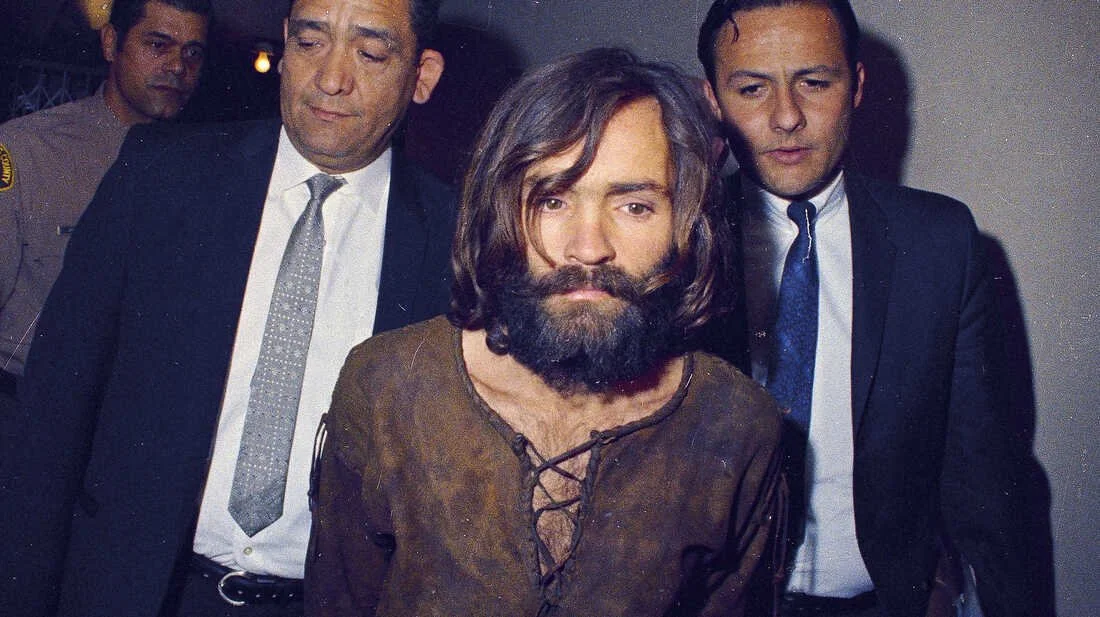
But perhaps nothing stained the image of the 1960s counterculture more profoundly than the crimes of Charles Manson. Born in Cincinnati, Ohio, in 1934, Manson was raised primarily by a single mother. He spent much of his youth moving between juvenile detention centers, reform schools, and, later, adult jails, which contributed to his troubled adulthood. In the mid-1960s, Manson relocated to San Francisco, where the burgeoning countercultural scene attracted young people searching for freedom and new ways of living. Manson sought to carve out a career as a musician, drawing on folk and psychedelic influences, though his talent was limited and his ambitions largely unfulfilled. More importantly, while in the Haight, he began to take advantage of young runaways and developed a devoted following of young women and men, whom he called “the Family.” Manson used charisma, manipulation, and psychological control to cultivate a quasi-religious cult. He imposed strict obedience and created a belief system that combined elements of mysticism, anti-establishment ideas, and apocalyptic prophecy.
Inspired by the free love philosophy flourishing in Haight-Ashbury during the Summer of Love, Manson began preaching his own philosophy—a confusing blend drawn from sources like the science fiction novel Stranger in a Strange Land, the Bible, Scientology, Dale Carnegie’s self-help teachings, and the music of the Beatles. He may also have borrowed ideas from the Process Church of the Final Judgment, whose members believed that Satan would be reconciled with Jesus at the end of the world to judge humanity. Manson specifically targeted emotionally insecure and socially marginalized individuals, manipulating them into submission to his religious teachings.
Manson used LSD extensively with his followers, including underage members of the Family, as a tool to break down resistance and reprogram their minds to submit to his will and his unconventional sexual practices. Family member Paul Watkins testified that Manson encouraged group LSD trips while taking lower doses himself to “keep his wits about him,” explaining that “Charlie’s trip was to program us all to submit.” By April 1968, Manson had attracted approximately twenty followers in the Haight, but he soon moved to Los Angeles to pursue his goal of becoming a famous musician on the same level as the Beatles.
Though his ties to the music world were tenuous, they were notable. Manson famously connected with Dennis Wilson, the drummer of the Beach Boys. Wilson was intrigued by Manson’s music, lifestyle, and, most importantly, the women in the group. He invited Manson and some of his followers to stay at his home for a time. The Beach Boys recorded a reworked version of one of Manson’s songs, originally titled “Cease to Exist,” which they released as “Never Learn Not to Love,”though Manson received no credit. Manson was also connected to record producer Terry Melcher, who had worked with the Byrds and was the son of actress Doris Day. Manson attempted to secure a recording contract through Melcher but was unsuccessful.
The Family established a base at Spahn Ranch, an isolated, run-down former movie set in the California desert. Manson and his followers moved there in August 1968 after being evicted from Wilson’s residence. The ranch had previously been used for television and Western films but was in decline by the late 1960s, generating income primarily by selling horseback rides. Female Family members did chores around the ranch and, on Manson’s orders, sometimes had sexual relations with the nearly blind 80-year-old owner, George Spahn. In exchange, Spahn allowed Manson and his group to live at the ranch rent-free.
In August 1969, five days before the Woodstock festival began, Charles Manson orchestrated a series of brutal murders that shocked the nation and irrevocably stained the image of the hippie movement. On the night of August 8, his followers entered a house at 10050 Cielo Drive in Los Angeles, which had once been the home of record producer Terry Melcher. There, they murdered actress Sharon Tate—who was eight months pregnant with filmmaker Roman Polanski’s child—along with Jay Sebring, a 35-year-old celebrity hairstylist and Tate’s friend; Abigail Folger, heiress to the Folgers coffee fortune; Wojciech Frykowski, a friend of Polanski’s; and 18-year-old Steven Parent, a visitor at the property. In a chilling act, the word “PIG” was scrawled in Tate’s blood on the front door, a brutal symbol of the horrific crimes. The following night, Manson’s followers also killed grocery store owner Leno LaBianca and his wife Rosemary in their home and again spelled out messages in their blood.
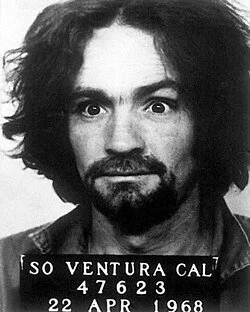
The Manson trial captivated the nation, becoming one of the most sensational legal proceedings of the era. On July 24, 1970, the first day of testimony, Charles Manson appeared in court with a large “X” carved into his forehead. He declared himself “inadequate and incompetent to speak or defend [himself],” symbolically marking his separation from “the establishment’s world.” In the ensuing days, many female defendants and other members of the Family adopted the identical “X” on their foreheads, turning it into a chilling symbol of their collective defiance.
On August 4, despite strict court precautions, Manson flashed the jury a copy of a Los Angeles Times front page emblazoned with the headline “Manson Guilty, Nixon Declares.” The newspaper headline was a direct reference to President Richard Nixon’s recent public condemnation of what he saw as the media’s glamorization of Manson. Judge Charles Older later ruled that the headline did not unduly influence the jury. The following day, in a coordinated act of protest, the female defendants stood and announced there was no point in continuing the trial as the President had supposedly rendered a verdict.
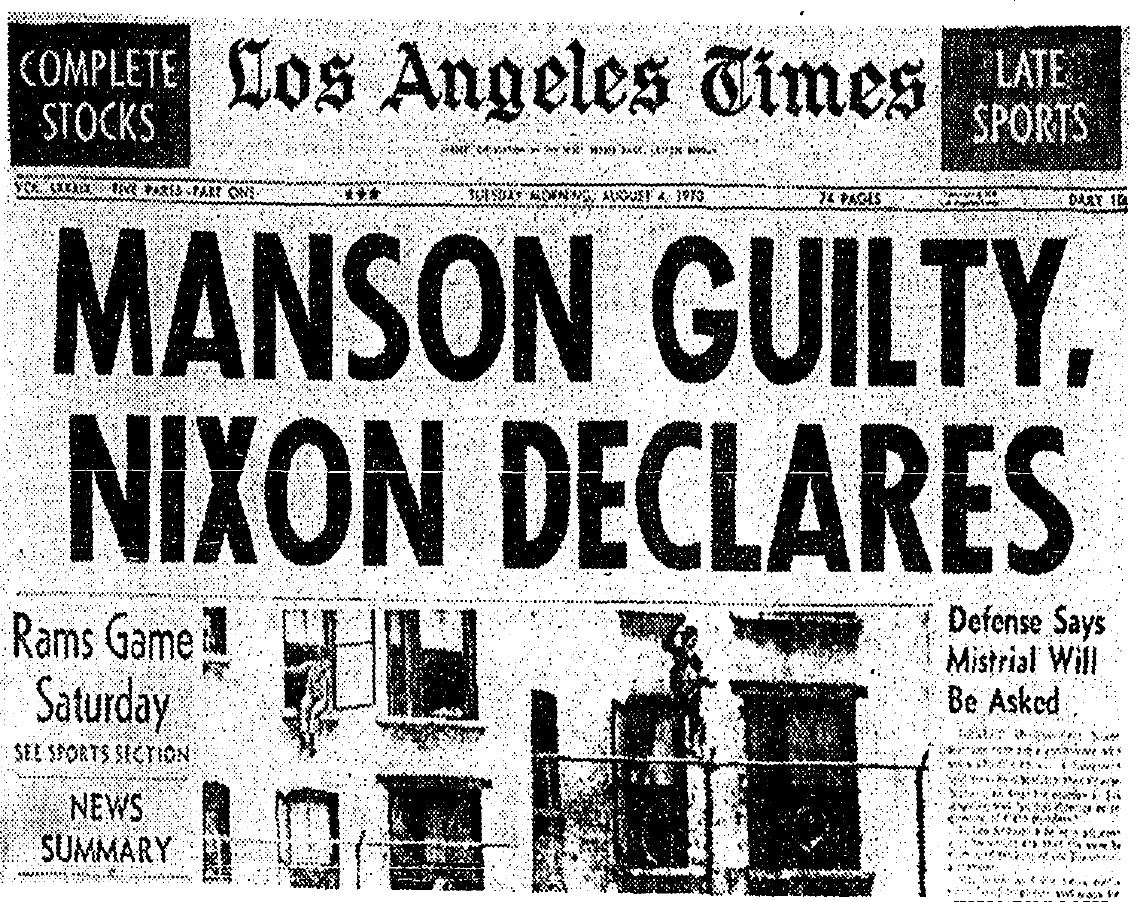
Ultimately, Charles Manson and several key members of the Family were convicted of first-degree murder and conspiracy to commit murder for their roles in the Tate-LaBianca killings. The trial resulted in convictions on nine counts of first-degree murder, but authorities suspect the Manson Family was involved in at least a dozen additional murders. Manson himself claimed responsibility for numerous other killings.
Manson’s motives were deeply tied to his distorted reading of contemporary culture and music, particularly the Beatles’ White Album. He believed the album contained coded messages explicitly meant for him and the Family, predicting an imminent apocalyptic race war he called “Helter Skelter.” According to Manson’s delusions, this war would erupt as Black Americans rose to overthrow the white population. However, he believed their supposed inability to govern themselves would force them to turn to Manson and his followers for leadership. Manson further imagined that the Family would survive this chaos by hiding in a secret underground city beneath Death Valley, accessible through a hidden hole. After the war ended, the Family would emerge as the last remaining whites, destined to rule over the devastated society. The murders committed by his followers were intended to spark this race war and accelerate the societal collapse, a plan that drew on apocalyptic passages from texts such as the Book of Revelation.
Manson’s distorted vision of “Helter Skelter” was closely tied to his belief that the White Album contained hidden messages specifically meant for him and the Family. He identified songs like “Sexy Sadie” with Family member Susan Atkins, whom he had already nicknamed “Sadie Mae Glutz” before the album’s release. As a former prostitute, Atkins embodied the rebellious and sexually uninhibited spirit of the song’s character. In “Rocky Raccoon,” Manson focused on the reference to “Gideon’s Bible,” interpreting it as a biblical prophecy tied to Black empowerment and the anticipated rise of Black Americans. “Happiness Is a Warm Gun” was taken as a call for Blacks to arm themselves for the coming conflict, while “Blackbird” was read as a direct summons for a Black uprising against white oppression. The album’s title track, “Helter Skelter,” symbolized the violent and chaotic race war Manson expected, with its lyrics about falling to the bottom and rising again representing the Family’s plan to emerge from an underground hideout after the violence subsided. “Piggies” referred to the white establishment, and its violent imagery eerily mirrored the gruesome details of the LaBianca murders, including the use of forks and knives. The avant-garde “Revolution 9” held particular significance for Manson; its repeated “Number 9” motif, alongside sounds of pig squeals and gunfire, was interpreted to evoke apocalyptic visions of a violent overthrow of white society.
Manson gave the world a terrifying image of an “evil hippie”—a figure who, despite being substantially older than most members of the youth counterculture, outwardly resembled them with his long hair, scruffy beard, and casual, bohemian attire. The uncanny similarity made his crimes all the more shocking, as they pierced the optimistic veneer of the peace-and-love movement. The brutality of the killings, coupled with the chilling spectacle of Manson’s cult-like control over his followers—who carried out his horrific orders with unquestioning obedience—exposed the dark potential for chaos and destruction within a movement that had once promised liberation and harmony. The events also seemingly confirmed widespread societal fears about the dangers of LSD and the hedonistic excesses of the counterculture, casting drug use and the movement’s freewheeling ethos in a more menacing light. The Manson murders marked a grim turning point, signaling the end of the era’s innocence and the disintegration of many of its hopeful dreams. The cultural rupture that followed left America fractured and cynical, as these violent events dispelled naïve notions of a peaceful revolution and exposed the complexities and contradictions of the countercultural moment.
Manson’s ties to the music industry further amplified his cultural notoriety. n the decades that followed, Manson became a disturbing point of reference for many musicians, particularly during the 1990s alternative rock and industrial rock movements. Artists often invoked his image as a symbol of cultural decay, media sensationalism, rebellion, or simply for shock value. The adoption of the surname by the industrial rock artist Marilyn Manson (see Chapter 37) is perhaps the most visible example, but references to Manson appeared across rock, metal, punk, and industrial music. These invocations rarely celebrated Manson or his actions. Instead, they treated him as a cultural shorthand for the collapse of the utopian ideals associated with the 1960s and the lingering fascination with the violence that seemed to bring that era to an end. His image became detached from its original historical context and circulated as part of a broader marketplace of rebellion, where invoking notorious figures could generate publicity and signal opposition to mainstream values. The continued fascination with Manson points to a broader cultural appetite for controversy and transgression within the entertainment sphere, while also demonstrating how the violence associated with the end of the 1960s remained embedded in the American imagination.
The Altamont Free Concert
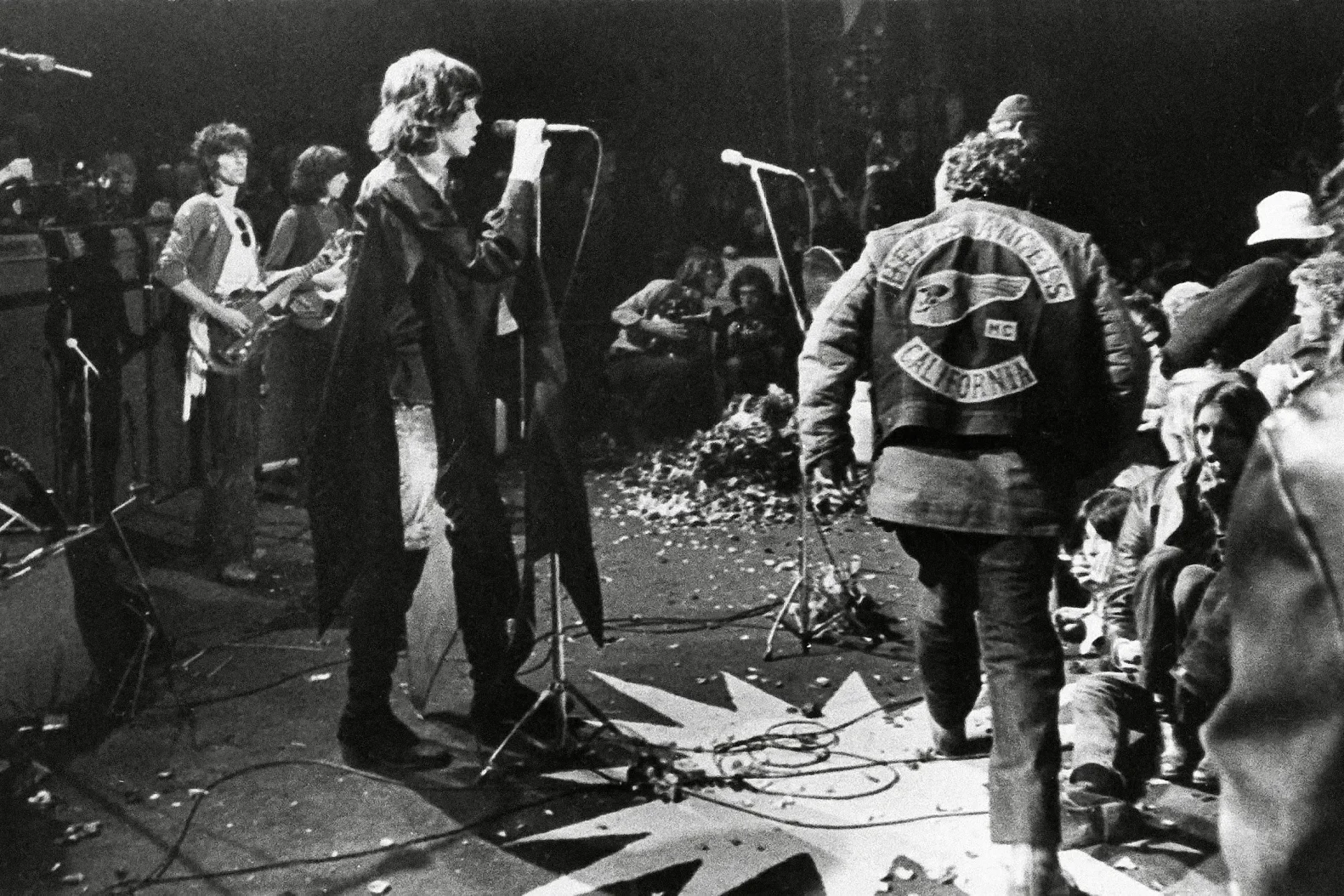
Several months after the Manson murders, the fading hopes of the 1960s mainstream countercultural movement were dealt another blow at the Altamont Free Concert. In stark contrast to the hopeful atmosphere and communal performances of Woodstock earlier that year, Altamont came to embody the darker, chaotic underbelly of the late 1960s counterculture. Billed as “Woodstock West,” the event was intended to recapture Woodstock’s magic and unity on the West Coast, drawing crowds based on the festival’s legendary reputation. Instead, it exposed deep fractures in planning, security, and the festival’s commitment to peace-and-love ideals. What was supposed to be the triumphant finale to the Rolling Stones’ American tour became a tragic spectacle, signaling the growing disillusionment and unrest overshadowing the decade’s once-radical optimism.
The Rolling Stones themselves were struggling financially and increasingly plagued by negative publicity throughout their tour. Ticket prices were unusually high, and the band’s habit of arriving hours late frustrated audiences and fueled bad press. The tour was being filmed for a hoped-for documentary, adding pressure for a memorable conclusion. Inspired by the success and positive energy of Woodstock in New York, Mick Jagger envisioned a similar free outdoor concert on the West Coast: an event to revive the spirit of the era and serve as the tour’s grand finale.
Originally planned for San Jose State University, the festival was canceled after the university declined to host another large event so soon after a prior festival. Organizers then moved the venue to San Francisco’s Golden Gate Park, but a scheduling conflict with a 49ers football game forced yet another change. The final location was settled just two days before the concert date: Altamont Raceway near Livermore, California, about 40 miles southeast of San Francisco.
This last-minute shift created a cascade of logistical problems. Essential facilities such as portable toilets and medical tents were scarce or nonexistent in certain areas, and parking was severely limited despite the estimated 300,000 people who showed up. However, the performance stage posed an even greater challenge. Unlike the usual elevated platforms, Altamont’s setup sat just three feet above the ground, directly amid the crowd. The low position made it impossible to control the increasingly rowdy audience. With only two days to prepare, adjustments were not possible.
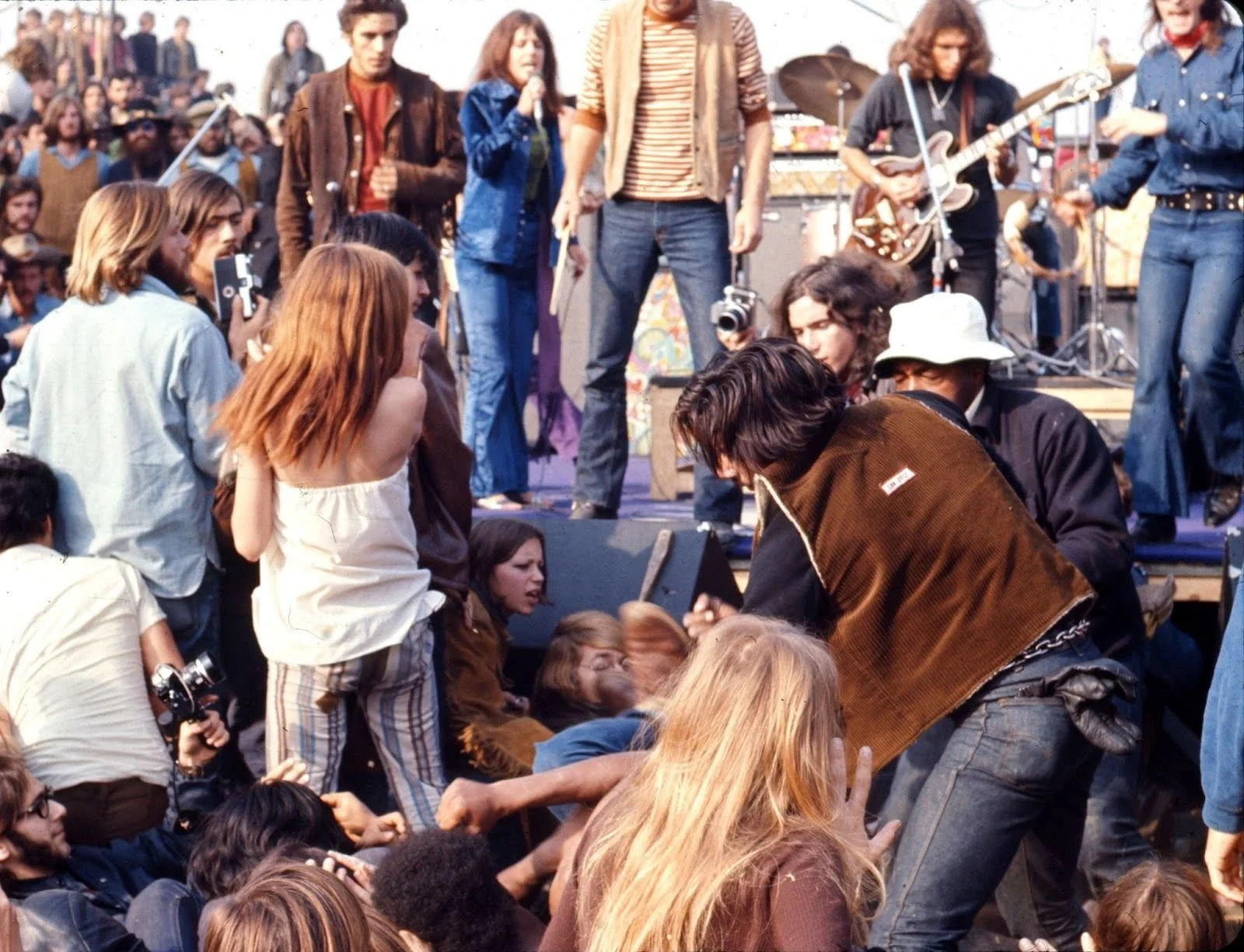
For security, the Rolling Stones enlisted the Hells Angels motorcycle club, led by Oakland chapter head Ralph “Sonny” Barger. Though notorious for their violent reputation, the Hells Angels had previous ties to the counterculture through their involvement with Ken Kesey’s Acid Tests and other events. Rather than paying them money, the Stones compensated the Angels with beer. Armed with lead-weighted pool cues, the Angels were tasked with maintaining order—a crude and intimidating method that ultimately contributed to chaos.
From early on, the combination of massive crowds, inadequate facilities, and rough security fueled violence throughout the day. The Hells Angels used their pool cues against unruly attendees, photographers, and even some performers. Marty Balin, lead singer of Jefferson Airplane, was knocked unconscious while trying to intervene in a scuffle between the Angels and the crowd. The violence incident prompted Jefferson Airplane’s guitarist, Paul Kantner, to sarcastically thank the Angels for the attack, which led to a confrontation when Angel Bill Fritsch took the microphone to argue with him.
The Grateful Dead, scheduled to perform between Crosby, Stills, Nash & Young and the Rolling Stones, decided to leave after hearing about the violence, citing the rapidly deteriorating security situation. By the time Crosby, Stills, Nash & Young performed, the unrest had reached near-riot levels. After the crowd, possibly accidentally, toppled one of the Angels’ motorcycles, the Angels’ aggression intensified and even targeted the performers. When the Rolling Stones finally took the stage, lead singer Mick Jagger pleaded several times for calm amid the chaos, but the violence continued.
When the Rolling Stones finally took the stage, the tension was palpable. During their performance of “Sympathy for the Devil,” fighting erupted near the front of the stage. Mick Jagger twice halted the show to plead with the crowd to calm down, while Keith Richards threatened to intervene personally. The violence culminated in the fatal stabbing of Meredith Hunter, an 18-year-old Black teenager who was carrying a gun and reportedly under the influence of methamphetamine. When Hunter brandished his weapon near the stage, Hells Angels members attacked him with knives and beat him severely, leading to his death—an incident captured in the documentary film Gimme Shelter.
Unaware of the severity of the situation, Jagger called for medical assistance, simply stating, “Someone’s been hurt.” Despite the turmoil, the band pressed on, concerned that stopping might provoke further unrest. They completed “Sympathy for the Devil” and moved on to the calmer “Under My Thumb.” At the end of the set, Jagger even surprisingly expressed gratitude to the Angels for their help before the band quickly departed by helicopter. In addition to Hunter’s murder, several other deaths occurred during the festival: two young men were killed after being run over by a car while sleeping on the ground, another drowned in an irrigation ditch, and one more was seriously injured after jumping from an overpass.
The aftermath of Altamont deeply shocked the rock community and the wider public. The event, intended as a celebratory end to a tour and a symbol of the counterculture’s vitality, instead became a grim symbol of its unraveling. Gimme Shelter exposed the dark realities behind the festival’s facade, with graphic footage that magnified the tragic breakdown of peace and goodwill. Even Rolling Stone magazine suggested the Rolling Stones bore partial blame for the event’s tragic outcome, citing poor planning and ill-advised security choices.
Altamont is widely regarded as the violent end of 1960s idealism. Critic Richard Brody argued that the festival shattered the Rousseauian dream: the belief that, free from societal constraints, young people would spontaneously create a gentler, more loving social order. Instead, the massacre, beatings, and chaos at Altamont dismantled any remaining hope for a peaceful revolution. The tragedy left a lasting imprint on American cultural memory, notably inspiring veiled references in Don McLean’s song “American Pie.” The song’s fifth verse contains symbolic nods to Altamont, including mentions of “Jack Flash” (a reference to San Francisco), “the Devil,” and an “angel born in Hell.” Though McLean neither confirmed nor denied the song’s connection to Altamont until years later, the event has been widely interpreted as marking the symbolic death of the era’s innocence. In the broader context of the song, Altamont is seen as the culmination of a series of cultural losses that began with the 1959 plane crash killing Buddy Holly, Ritchie Valens, and the Big Bopper—a period when life seemed to be “heading in the wrong direction” and “becoming less idyllic.” Ultimately, Altamont acts as a stark contrast to Woodstock. It exposed how the era’s utopian hopes collided with harsh realities, unveiling how quickly peace and love could give way to violence and fear. The concert became a symbol of the counterculture’s unraveling and the fading dream of an alternative, harmonious society.
In the years following, the counterculture’s decline accelerated. The deaths of iconic musicians Jimi Hendrix, Janis Joplin, and Jim Morrison between 1970 and 1971—linked to substance abuse—came to symbolize the movement's spiral into excess. The Beatles’ breakup in 1970 further symbolized the fracturing of the cultural unity they had once represented. The collective ideals of the 1960s, once filled with promise for social change and transformation, gave way to nihilism. Even with ongoing political activism, many saw little chance for change and grew increasingly skeptical of the movement’s prospects.
As conservative politics gained momentum and the liberal values that had underpinned the counterculture waned, the radical aspirations of the 1960s came to seem not only unattainable but dangerously naive. A sense of resignation settled in as many accepted that the world was unlikely to change and that the revolutionary dreams of their youth were slipping irrevocably away. The post-60s cultural shift had tremendous effects on popular music, steering it away from the idealistic and politically charged anthems of the 1960s toward more fragmented, introspective, and commercially driven styles in the decades that followed. Perhaps the song “The Pretender” by Jackson Browne best encapsulates this disillusioned mood. The song tells the story of a man who has betrayed his ideals for material comfort, trading youthful dreams for the shallow rewards of suburban life. The lyrics depict him as a “fraud” or “pretender,” resigned to chasing money and status despite knowing what has been lost. Written in the mid-1970s, the song captures a wider cultural mood of cynicism in the aftermath of Watergate, when political scandal and economic stagnation deepened doubts about progress and change that continued to influence popular music in the decades that followed.
Why Have We Spent So Much Time in the 1960s?
(For further reading, see Chapter 22)
Across the last eight chapters, we have examined the 1960s in detail because of the extraordinary influence the decade exerted on popular music. Cultural, political, and technological developments changed what popular music could be, how it was made, and who it reached. That influence has remained unusually durable, affecting both the sound and business of music for decades afterward.
Another reason for the book's extended focus on the 1960s is the sheer durability of the music produced during this period. Many songs from the 1960s have become what the industry calls evergreens—tracks that, like the evergreen plants from which they take their name keep their leaves across seasons, continue to flourish long after their initial release (Think of The Beatles’ “Hey Jude,” The Beach Boys’ “Good Vibrations,” or Aretha Franklin’s “Respect”). These songs remain central to popular culture and relevant to new generations.
The decade also brought major changes to the music industry's structure. Independent and local scenes flourished, from San Francisco’s psychedelic rock community to Detroit’s Motown empire. Amateur musicians could form bands, cut singles, and reach audiences with a speed and ease that had not been possible before. Subcultures began to exert their own musical influence, often outside the control of major labels, creating distinct sounds and styles tied to geography, politics, and identity.
Technological innovation had significant effects. Phil Spector’s "Wall of Sound" demonstrated new possibilities for the recording studio by layering instruments and voices into an immersive sonic texture. Meanwhile, The Beach Boys’ Pet Sounds pushed the boundaries of arrangement, harmony, and studio experimentation, showing how pop music incorporated complex arrangements and harmonies typical of classical composition while still appealing to broad audiences.
The 1960s also encouraged unprecedented genre blending. Folk merged with rock in Bob Dylan’s electrified performances, jazz-influenced psychedelic improvisations, and R&B shaped the sound of the British Invasion. These genre hybrids grew out of broader cultural exchange, combining folk, rock, jazz, and R&B influences while illustrating the eclectic musical tastes of a generation drawn to both personal identity and collective ideals.
One key reason for our extended focus on the decade is that the 1960s gave birth to what became known as the hippie aesthetic—a countercultural ethos that prized artistic authenticity, communal values, and the belief that music could be a tool for social change. Yet this countercultural spirit was quickly commodified. By the early 1970s, the visual symbols and sonic markers of the hippie era—tie-dye, peace signs, guitar-driven anthems—were being packaged and sold to mass markets even as the original countercultural movement was dismissed by many as politically and socially untenable. Festivals, once meant as gatherings for alternative communities, were replicated in corporate-sponsored events. The ideals that once seemed to challenge the mainstream became part of it, a process seen in everything from the marketing of Jefferson Airplane records to the way brands adopted psychedelic typefaces for advertising campaigns. The sound, style, and imagery of the era were repurposed for commercial gain, but in the process, they became woven into the DNA of mainstream popular music.
The 1960s occupy so much space in this book because they occupy so much space in popular music itself. The decade’s artistic innovations, industry developments, and cultural shifts continued to influence genres ranging from arena rock to punk and hip-hop. Even today, musicians incorporate sounds and techniques developed in the 1960s, showing the decade’s continuing influence on contemporary music.