Chapter 5: The Blues
“Sweet Home Chicago”
Album/Year Released
Recorded 1936; released 1937
Artist/Composer
Robert Johnson (1911–1938)
Genre/Style
Rural blues; Delta blues
Song Form
12-bar blues
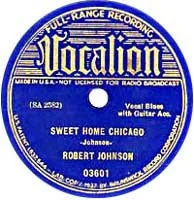
“Sweet Home Chicago” was recorded by Robert Johnson in November 1936 during his first recording session in San Antonio, Texas, and released in 1937. Despite recording only twenty-nine songs, along with a small number of alternate takes, before his death at age twenty-seven, Johnson remains one of the most influential figures in American blues history. His recordings helped establish the Delta blues style and exerted a lasting influence on later blues, rock, and popular musicians.
The song draws heavily on earlier blues traditions. Its melody can be traced to earlier recordings, including “Honey Dripper Blues,” “Red Cross Blues,” and “Kokomo Blues,” with Kokomo Arnold’s work as a direct model. Johnson had explored similar melodic material in his own song “I’m Going to California.” “Sweet Home Chicago” is a reworking of this shared blues vocabulary rather than a completely new composition. The practice of melodic borrowing draws from the oral and communal nature of blues tradition, where songs evolve through adaptation rather than fixed authorship.
“Sweet Home Chicago” also connects to the broader context of the Great Migration, when millions of African Americans moved from the rural South to northern cities for economic opportunity and social mobility. Although Johnson rarely traveled north, Chicago in the song is a symbolic destination rather than a literal one. In the song the city represents movement, possibility, and escape from hardship, serving as an imagined space of opportunity within the blues narrative.
Musically, Johnson uses a driving guitar rhythm paired with a high, intense vocal delivery that often approaches a near-falsetto register. Unlike Kokomo Arnold’s recordings, Johnson does not use bottleneck slide guitar here. Instead, he adapts rhythmic patterns from boogie-woogie piano and translates them onto acoustic guitar. Johnson's adaptation of boogie-woogie rhythms lets the guitar serve as both a rhythmic engine and a melodic partner to the voice.
“Sweet Home Chicago” is built on the 12-bar blues, a foundational structure in American music. The 12-bar blues form uses a repeating twelve-measure harmonic pattern based on three primary chords: tonic (I), subdominant (IV), and dominant (V). Each verse follows the same cycle, creating a predictable framework that supports expressive variation in melody, rhythm, and lyrics. Typically, the form moves from the tonic to the subdominant, returns to the tonic, then goes through the dominant before resolving back to the tonic. Johnson uses the final measures of each cycle as a turnaround, a brief musical gesture that leads back to the beginning and propels the song forward.
Stylistically, “Sweet Home Chicago” exemplifies the rural blues style, often called Delta blues. The performance features a solo voice with acoustic guitar and no other instruments. Johnson’s guitar blends steady rhythmic accompaniment with short melodic fills, creating the impression of multiple musical layers from a single performer.
A central characteristic of the rural blues style is call and response between voice and guitar. Johnson often sings a vocal line and answers it with a short guitar phrase, creating a musical dialogue that mirrors speech. His vocal delivery is flexible and expressive, using slides, bent pitches, and rhythmic freedom to heighten emotional intensity. The lyrics follow the typical blues AAB pattern, where a line is sung, repeated, and then answered by a concluding line. The AAB lyrical structure aligns with the 12-bar form, reinforcing repetition while allowing for subtle shifts in emphasis and meaning.
“Crazy Blues”
Album/Year Released
Recorded 1920; released 1920
Artist/Composer
Mamie Smith (1891–1946), vocals
Composed by Perry Bradford (1893–1970)
Genre/Style
Urban blues
Song Form
12-bar blues
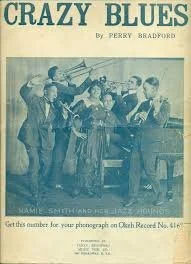
“Crazy Blues” was performed by Mamie Smith with Perry Bradford’s orchestra and released later that year by Okeh Records (catalog number 4169-A). The recording is historically significant as the first blues record by an African American singer to achieve major commercial success. Its popularity demonstrated the economic viability of so-called “race records” and played a decisive role in establishing urban blues as a dominant style in the recording industry of the 1920s.
Unlike rural, or Delta, blues, which developed in the southern United States and typically featured solo voice and guitar, urban blues emerged in northern cities such as Chicago and New York. In these urban settings, African American musicians blended folk blues traditions with popular dance music, jazz influences, and more formal ensemble arrangements. “Crazy Blues” exemplifies this urban style. Mamie Smith’s vocal performance is accompanied by a small ensemble including piano, cornet, and banjo, creating a fuller and more polished sound than solo rural blues recordings.
The song’s lyrics focus on intense personal emotion and romantic distress, themes characteristic of urban blues narratives. The text follows the familiar blues AAB lyrical pattern, where a line is sung, repeated, and then answered with a concluding line that provides resolution or emphasis. In “Crazy Blues,” the narrator describes emotional suffering from mistreatment and abandonment, expressing sleeplessness (“I can’t sleep at night”), loss of appetite (“I can’t eat a bite”), and deep sadness over being treated unfairly. As the song unfolds, the narrator affirms her continued love despite this mistreatment, and the lyrics culminate in references to death and violence before ending with the declaration, “Now I’ve got the crazy blues.”
These themes resonated strongly with African American audiences, particularly women, who purchased the record in large numbers. For many listeners, “Crazy Blues” was one of the first times the emotional experiences and perspectives of Black women were expressed and circulated widely through commercial recordings. The song’s success showed that these stories had both cultural significance and commercial appeal.
While the song’s structure is similar to that of rural blues, it is interpreted differently in an urban context. Perry Bradford originally wrote the piece for theatrical performance, so the song features blues choruses within non-blues verses rather than a continuous string of twelve-bar cycles. The rhythm section maintains a steady 4/4 duple meter, often accented to support a danceable groove, and the ensemble instruments add rhythmic drive and textural depth that contrast with the sparse textures of Delta blues.
Several stylistic features distinguish “Crazy Blues” as an example of urban blues. The ensemble accompaniment replaces the solo guitar texture of rural blues with a richer, orchestrated sound. Mamie Smith’s vocal delivery is controlled and expressive, featuring a wide melodic range and subtle inflections rather than the rougher timbres often associated with rural blues singing. The steady meter, rhythmic patterns support and the overall style blends folk-blues idioms with elements of vaudeville, jazz, and commercial popular music. The recording is a landmark in both musical history and the American recording industry, signaling a new era in the commercialization and spread of African American music.
“St. Louis Blues”
Album/Year Released
Published 1914
Artist/Composer
W.C. Handy (1873–1958)
Genre/Style
Arranged Blues
Song Form
Blues with extended form: combination of 12-bar blues and tango-style sections
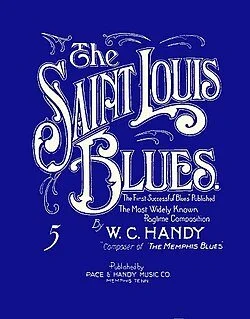
“St. Louis Blues,” composed by W. C. Handy in 1914, is one of the most important early arranged blues compositions and played a central role in bringing the blues into national popular culture. Handy, often called the “Father of the Blues,” was instrumental in translating regional African American folk traditions into written music that could circulate widely. Unlike earlier rural or urban blues songs, often performed by solo singers with minimal accompaniment, “St. Louis Blues” was conceived as an arranged composition, designed for performance by multiple instruments and, eventually, orchestras. It was among the first blues songs to succeed as a pop song and remains a foundational work in the repertory of jazz musicians.
Handy drew inspiration for the song from his travels throughout the American South and from the music of local Black performers he encountered. His goal, as he later explained, was “to combine ragtime syncopation with a real melody in the spiritual tradition.” Rather than relying on a single repeated structure, “St. Louis Blues” unfolds through multiple complementary and contrasting strains, a design more closely related to classic ragtime than to earlier folk blues. Handy's ambition to combine ragtime and blues led some musicians to question its status as “true” blues. In reference to the song, guitarist T-Bone Walker famously remarked, “You can’t dress up the blues,” suggesting that while “St. Louis Blues” was fine music, it departed from the rawness of traditional blues practice.
Formally, the song is unusual and highly innovative. Its verses follow the now-familiar twelve-bar blues pattern in common time, with three lines of lyrics in an AAB structure where the first line is repeated and the third provides a response. These blues verses are contrasted with a sixteen-bar bridge written in a habanera rhythm, often described as a tango-like feel. Jelly Roll Morton later referred to this rhythmic element as the “Spanish tinge,” while Handy called it tango. The habanera bridge introduces a contrasting rhythmic feel, often perceived as a 12/8 subdivision, that sharply differentiates it from the straight duple pulse of the blues sections.
By combining traditional twelve-bar blues elements with sections in a tango-derived rhythm, Handy created a hybrid form that allowed for expressive vocal writing and sophisticated instrumental accompaniment. The song’s publication coincided with a period when blues music was increasingly being written down, arranged, and adapted for larger ensembles, helping to bridge the gap between folk tradition and commercial popular music. The hybrid structure made “St. Louis Blues” especially adaptable to a wide range of performance contexts, from vaudeville stages to concert halls.
As an example of arranged blues, “St. Louis Blues” illustrates a distinct approach to blues composition. The vocal melody follows traditional blues phrasing and often uses the AAB lyrical pattern, while the instrumental writing assigns specific roles to trumpet, trombone, piano, and rhythm section. These instruments provide interjections, counter-melodies, and harmonic support that go beyond simple accompaniment. The inclusion of tango-like sections adds rhythmic contrast and variety, while the arranged orchestration allows multiple musical lines to operate simultaneously. The combination of multiple independent instrumental lines creates creates a layered texture that approaches polyphony while still preserving the underlying blues harmonic language. Handy's arranged approach distinguishes “St. Louis Blues” from rural Delta blues, which typically centers on solo voice and guitar, and even from early urban blues recordings such as Mamie Smith’s “Crazy Blues,” which, though arranged for small ensemble, are generally simpler in texture and form.