Chapter 7: Swing and Big Bands
“Old Man Blues”

Album/Year Released
Recorded 1931; released 1931
Artist/Composer
Duke Ellington (1899–1974)
Genre/Style
Big band jazz
Song Form
Multi-Strain: AABBACCDD, (March-derived ragtime form)
“Old Man Blues,” composed and recorded by Duke Ellington and his orchestra in 1931, uses a 32-bar song form based on the chord progression of Jerome Kern and Oscar Hammerstein II’s “Ol’ Man River” from the Broadway show Show Boat (1927). Instead of an earlier multi-strain format, the piece moves through multiple choruses of the same 32-bar form. Each chorus acts as a verse that supports ensemble statements and improvised solos. Ellington’s use of a repeated 32-bar form follows a broader shift in jazz around 1930 toward standardized popular song structures such as AABA and ABAC, replacing the shorter strains and repeated trios of earlier repertoire.
Ellington’s primary compositional focus in “Old Man Blues” is orchestration and tone color. He treats the orchestra as a collection of distinct instrumental voices, assigning melodic and accompanimental material to specific instruments to highlight timbral contrasts. Trumpets, trombones, clarinets, saxophones, and piano appear both individually and in combination, with frequent shifts in register, dynamics, and texture across choruses. The changes in tone color provide variety within the repeated structure.
A key element of Ellington’s sound palette in this piece is the use of plunger mutes in the brass. A plunger mute is a handheld rubber mute, adapted from a sink plunger, that is moved in front of the bell to partially open and close the sound. The plunger mute technique lets players inflect notes with speech-like qualities, producing bends, wah-wah effects, and subtle changes in articulation. In “Old Man Blues,” plunger-muted trumpet and trombone lines contrast with open brass and reed passages, reinforcing Ellington’s emphasis on individualized instrumental timbres.
Harmonically, “Old Man Blues” is a contrafact, where a new composition is written over the chord progression of an existing song. Ellington reworks the harmonic progression of "Ol' Man River" by adding and altering chord tensions, inserting passing harmonies, and using substitutions while preserving the 32-bar framework. The practice of writing contrafacts had precedents in early New Orleans jazz and became more common through the 1930s.
Form, harmony, and orchestration in “Old Man Blues” together show Ellington’s approach to composition during this period. The repeated song form provides structural consistency, while changes in tone color and instrumental texture guide the listener from chorus to chorus, emphasizing the central role of timbre in Ellington's writing for jazz orchestra.
“Lester Leaps In”
Album/Year Released
Recorded 1939; released 1939
Artist/Composer
Lester Young (1909–1959), tenor saxophone
Count Basie (1904–1984), orchestra leader
Genre/Style
Kansas City Jazz
Song Form
32-bar AABA form
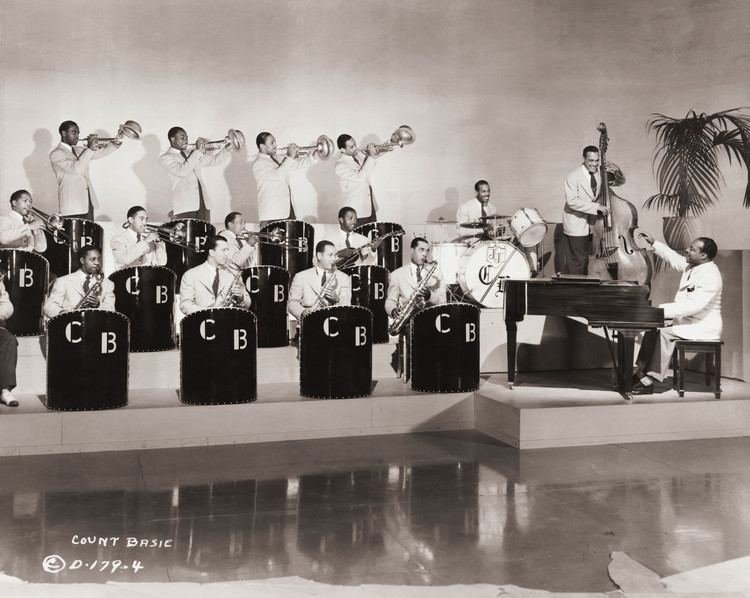
“Lester Leaps In” was recorded in 1939 by the Count Basie and the Kansas City Seven and features tenor saxophonist Lester Young. The piece is a contrafact based on the 32-bar AABA form of George Gershwin’s “I Got Rhythm.” These harmonies, called “rhythm changes,” were widely used by jazz musicians for their clear structure and adaptability for improvisation. Young’s composition uses this form while keeping the groove-oriented, riff-based style of Kansas City jazz.
The Kansas City style for which Count Basie became renowned emphasized repetition, a sustained swing feel, and improvisational virtuosity rather than tightly arranged ensemble writing. In “Lester Leaps In,” short riffs in the horns and rhythm section create a consistent backdrop for soloists to improvise. The arrangement remains open and understated, allowing the performance to develop through player interaction rather than fixed orchestration. The open, riff-based style of Kansas City jazz contrasts with earlier New Orleans and Chicago styles, which often used denser textures or collective polyphony.
The rhythm section is central to the Kansas City style, especially through comping and timekeeping. Comping refers to the way harmonic instruments, such as the piano and guitar, provide rhythmic and harmonic support for a soloist. In this recording, Count Basie’s piano comping is sparse, using brief, strategically placed chords instead of continuous accompaniment. These chords respond to the soloist’s phrasing, accenting rhythmic ideas and leaving space between musical gestures.
The drummer further reinforces the groove through hi-hat subdivision, articulating beats two and four to create the swing pulse. The steady hi-hat subdivision anchors the groove, allowing the bassist and pianist to add syncopation and variation. The hi-hat’s consistency supports the soloist’s flexible phrasing, ensuring rhythmic stability even as melodic lines stretch or contract against the beat.
Most jazz performances follow a head–solos–head structure, in which the main theme is stated at the opening, followed by improvised solos over repeated harmonic cycles, and concluded with a return to the head. In “Lester Leaps In,” however, the performance departs from this expectation. After the initial presentation of the theme and the solo choruses, the piece does not close with a full restatement of the head. Instead, it continues through extended improvisatory passages, punctuated by full-band hits and riffs that imply the main melody rather than restating it directly.
Lester Young’s solo shows rhythmic displacement and motivic variation. Some phrases enter on the beat, while others are delayed by an eighth or quarter note. When melodic ideas repeat, they are often repositioned against the meter, creating subtle shifts in emphasis. Young's rhythmic phrasing shows just how vital the relationship between the soloist and the rhythm section was in the stylings of Kansas City jazz.
“Sing Sing Sing”

Album/Year Released
1937 studio recording;
1938 live Carnegie Hall performance
Artist/Composer
Benny Goodman (1909–1986), clarinet and bandleader, Louis Prima (1910–1978), composer
Genre/Style
Swing; big band jazz
Song Form
Riff-based structure with extended improvisation
“Sing, Sing, Sing” was composed by Louis Prima in 1936 as a vocal tune with a simple riff-based structure. Early recordings featured lyrics and were performed by vocal groups such as the Andrews Sisters. The song entered the big band repertory and was adapted instrumentally by bandleaders, including Fletcher Henderson. However, its most enduring association is with Benny Goodman, whose performances turned it into an extended instrumental showcase in the late Swing Era.
Big band jazz emerged in the 1930s alongside commercial dance orchestras, radio, and the recording industry. Ensembles were typically divided into sections: saxophones, trumpets, trombones, and rhythm. They combined arranged parts with improvised solos. Recordings were usually limited to about three minutes per side of a 10-inch 78-rpm record, so most big band arrangements were compact, with brief solos and clearly defined sectional writing. Goodman’s “Sing, Sing, Sing” departed from this norm, extending the piece into evolving, concert-style performances.
Goodman’s 1937 studio recording lasted 8 minutes and 43 seconds, filling both sides of a 12-inch 78-rpm record. His 1938 Carnegie Hall performance extended to roughly 12 minutes, with spontaneous solos and a flexible structure. These versions show how big band music could move beyond dance accompaniment toward concert presentation, emphasizing sustained groove, improvisation, and sectional interplay.
Although originally intended as a vocal feature for Helen Ward, the piece gradually shed lyrics as instrumentalists developed it into an instrumental showcase. Musicians added passages, altered form, and quoted other tunes, including Chu Berry’s “Christopher Columbus.” The composition became a framework for collective development, driven by rhythm and texture rather than harmonic complexity.
Structurally, “Sing, Sing, Sing” is not based on a standard 12-bar blues or 32-bar song form. It is built on repeating rhythmic and melodic riffs anchored by Gene Krupa’s tom-tom drum pattern, which serves as a structural marker throughout the performance. A riff is a short, repeated motif or figure in the melody or accompaniment of a musical composition, often serving as the rhythmic and melodic backbone of a song. The ensemble enters with the main riff, passed between reed and brass sections in call-and-response exchanges. Improvisation unfolds in layers rather than discrete choruses. Goodman’s clarinet solos float over riff-based backgrounds while horns punctuate phrases. Krupa adds drum fills that extend or redirect sections, effectively blurring the line between accompaniment and soloing. Later sections feature tenor saxophone and trumpet solos over reduced instrumentation, thinning the texture before rebuilding toward climactic ensemble passages.
The prominence of the drum kit in Goodman’s version illustrates a broader shift in big band jazz. Rhythm sections moved from supporting roles to structural elements, driving the piece's pace, energy, and overall design. Through its extended length, open-ended form, and emphasis on riff-based development, Goodman’s “Sing, Sing, Sing” shows how big band jazz balanced arranged structure with improvisational freedom, illustrating how performers reinterpret and extend a composition in real time.