Chapter 15: Teen-Targeted Pop Music in the Early '60s
“The Twist”
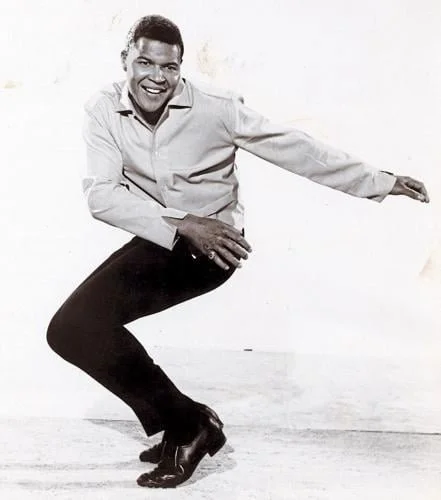
Album/Year Released
Recorded 1960
Artist/Composer
Performed by Chubby Checker (Ernest Evans, 1941–)
Written by Hank Ballard
Genre/Style
Rock and roll; rhythm and blues
Song Form
Verse-Chorus
“The Twist” is a dance-oriented rock and roll song built on a steady 4/4 meter, a pronounced backbeat, and a consistent rhythmic pulse that supports continuous bodily motion. Emphasis on beats two and four creates a strong groove, making the song easy to follow physically and placing rhythm ahead of melody. These features emphasize the song’s primary function as accompaniment for dancing rather than storytelling.
The song was written and first recorded by Hank Ballard and the Midnighters in 1958 and released as the B-side to “Teardrops on Your Letter.” Ballard’s version drew on earlier blues traditions where the term “twist” already appeared as slang for bodily movement, and the recording achieved moderate commercial success, reaching the lower ranges of the Billboard pop and R&B charts between 1959 and 1960. The song reached a much wider audience after Chubby Checker recorded a cover in 1960. Checker’s recording hit number one on the Billboard Hot 100 in September 1960 and returned to the top in January 1962, making it the only non-seasonal American recording to reach number one in two separate chart runs. Over time, it became one of the highest-ranking songs in Billboard chart history, later surpassed only by newer releases decades later. Checker also released follow-ups like “Let’s Twist Again,” which helped extend the dance’s popularity, especially outside the United States.
The Twist dance is an example of open dancing, where participants dance individually rather than in contact with a partner. Dancers typically stand with feet about shoulder-width apart, often with one foot slightly forward, and arms bent at the elbows and held away from the body. Movement centers on rotating the hips, knees, and torso as a unit, with the feet pivoting or grinding against the floor, compared to putting out a cigarette. The upper body sways and turns while hips swivel from side to side as if rubbing oneself with a towel. The dance draws on movement practices from West African traditions and dances developed among enslaved communities in the American South.
Because open dancing does not require partners to coordinate steps, the Twist could be performed in crowded spaces and adapted easily by dancers of different ages and skill levels. “The Twist's” solo dance style was more palatable for television audiences and aligned with the broader movement toward making popular music and dance more socially acceptable for mainstream America. By removing physical contact, "The Twist" reduced any overtly sexual connotations, making it suitable for family-friendly programming. The dance's accessibility and broad social acceptance fueled its rapid spread and encouraged other solo dance styles in the early 1960s.
“Take Good Care of My Baby”

Album/Year Released
Recorded 1961
Artist/Composer
Bobby Vee;
Written by Carole King & Gerry Goffin
Genre/Style
1960s teen pop
Song Form
Strophic with Bridge and extended introduction
“Take Good Care of My Baby” uses early-1960s pop production practices through a full studio arrangement of drums, bass, guitars, and orchestral strings. The instrumentation creates a smooth, even texture. Strings sustain the harmonic background, while the rhythm section keeps a consistent pulse. The song is in 4/4 meter and follows a strophic form that presents repeated melodic material with the title of the song situating each verse.
The song was written by Carole King and Gerry Goffin and gained widespread attention through Bobby Vee’s 1961 recording. While searching for material for Vee, producer Snuff Garrett heard a demo by King and saw the song as a strong candidate. After discussing it with publisher Don Kirshner, Garrett decided an introductory verse would help lead more clearly into the main section. Garrett met with King, and the new verse was written and added to Vee’s version. The addition of the introductory verse follows common Brill Building practices, where songs were often adapted to fit a specific performer and recording context.
“Take Good Care of My Baby” demonstrates the stylistic priorities of early-1960s teen pop, including a clear vocal delivery, regular phrasing, and an arrangement that supports the song’s melodic structure, including a mid-song upward key change that refreshes the tonal center while maintaining continuity with the surrounding material. The upward modulation provides contrast without altering the song’s overall character. The steady rhythm, familiar harmonic patterns, and organized instrumentation place the song in a transitional period between late-1950s rock and roll and more studio-oriented pop styles of the early 1960s.