Chapter 40: Country Music in the 80s and 90s
“Streets of Bakersfield”
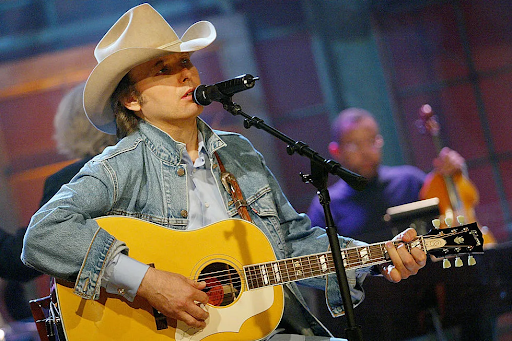
Album/Year Released
1988 (album: Buenas Noches from a Lonely Room)
Artist/Composer
Dwight Yoakam & Buck Owens
Homer Joy (composer)
Genre/Style
Neotraditionalist country; Bakersfield sound; polka-influenced rhythm
Song Form
Verse–chorus
“Streets of Bakersfield,” released in 1988 as a duet between Dwight Yoakam and Buck Owens on Yoakam’s album Buenas Noches from a Lonely Room, is a prime example of the Bakersfield sound, a subgenre of country music that originated in California during the 1950s. The Bakersfield sound contrasts with the smoother Nashville sound by emphasizing twangy Fender Telecaster guitars, pedal steel, and a pronounced backbeat. The track uses a polka-like 2/4 meter, which imparts a lively, danceable quality. Yoakam and Owens alternate vocals in a call-and-response format. The instrumentation combines traditional country elements with Mexican influences, particularly through Flaco Jiménez's prominent accordion playing, which reinforces the song's polka character. Their collaboration revitalized Owens’ career and established Yoakam as a central figure in the neotraditionalist movement, which sought to restore the twang, traditional instrumentation, and straightforward songwriting associated with earlier country music following the pop-oriented trends of the 1980s.
Originally composed by Homer Joy and first recorded by Owens in 1972, “Streets of Bakersfield” adheres to a traditional verse-chorus structure characteristic of country music, featuring an instrumental introduction, narrative-driven verses, and a memorable, repetitive chorus. The song begins with instrumentation that often foregrounds electric guitar or accordion to establish tempo and mood. The verses narrate the protagonist’s journey to Bakersfield, depicting a quest for opportunity and personal freedom, as illustrated by the lyrics: “I came here looking for something I couldn’t find anywhere else / I don’t want to be nobody, just want a chance to be myself,” and “I’ve done a thousand miles of thumbing / And I’ve worn blisters on my heels / Trying to find me something better here on the streets of Bakersfield.” The chorus articulates a critique of judgmental outsiders: “You don’t know me but you don’t like me / You say you care less how I feel / But how many of you that sit and judge me / Ever walk the streets of Bakersfield?” In the latter portion, the narrator recounts being jailed in San Francisco and sharing a cell with an intoxicated man. He takes the man's $15 but leaves the man's watch and house key, giving the narrator a mixture of self-interest and restraint.
Yoakam’s interpretation imbues the song with a distinct Tex-Mex character, setting it apart from Owens’ original by emphasizing accordion rhythms, brisk guitar lines, and an energetic honky-tonk tempo. The instrumentation blends electric guitars, pedal steel, bass, drums, and accordion to produce layered textures. Vocally, the duet alternates between Owens’ classic country timbre and Yoakam’s brighter neotraditional style, creating a conversational dynamic that elevates the storytelling.
“Friends in Low Places”
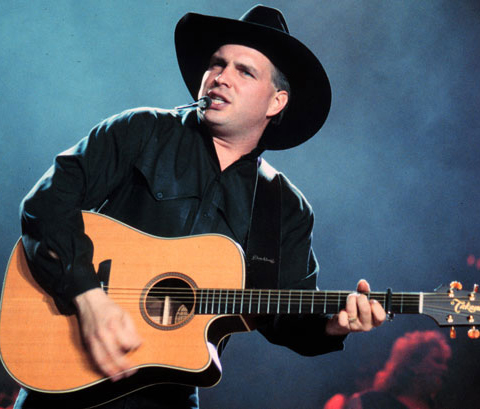
Album/Year Released
1990 (album: No Fences)
Artist/Composer
Garth Brooks
Dewayne Blackwell, Earl Bud Lee (composers)
Genre/Style
Modern country; country-pop
Song Form
Verse–chorus
“Friends in Low Places,” released in 1990 on Garth Brooks’ album No Fences, is a modern country song that incorporates pop elements to reach a wider audience. The arrangement incorporates acoustic guitar, pedal steel, fiddle, bass, and drums in a consistent 4/4 meter, with a backbeat on beats two and four that establishes a steady, danceable rhythm. Brooks delivers the lyrics primarily syllabically, occasionally employing melisma to intensify emotional expression. The chorus features the now-iconic hook, “I’ve got friends in low places,” with emphases on select words that introduce playful tension between low and high notes, giving the line a conversational, expressive quality. Written by DeWayne Blackwell and Earl “Bud” Lee in 1989, the song narrates the experience of a man attending his ex-girlfriend’s wedding in boots, taking the groom’s champagne, delivering an inappropriate toast, and ultimately looking for solace with his “friends in low places,” a narrative that communicates defiance, humor, and camaraderie.
Brooks was initially approached to record a demo soon after the song’s completion, but scheduling conflicts with his debut album postponed the recording until the production of No Fences. Upon the album’s completion, producers identified the song’s commercial potential and selected it as the lead single. The track received the Academy of Country Music’s Single of the Year award in 1990 and the same distinction from the Country Music Association in 1991. Its exploration of working-class identity and irreverent humor appealed to Middle American audiences and attracted listeners beyond traditional country music through the inclusion of rock-influenced electric guitar elements. Instrumentally, the song begins with an acoustic guitar arpeggio on a progression that continues throughout the verses. The first chorus introduces the full band and encourages audience participation, while a brief electric guitar solo with pedal steel accents bridges the first chorus and second verse. The second verse reduces the instrumentation, emphasizing Brooks’ vocals and rhythmic delivery, before building again toward the repeated choruses. The outro reiterates the chorus multiple times, with the band joining in, and background sounds of beer cans opening and cheering create a communal, celebratory atmosphere.
Structurally, the song follows a verse–chorus form, while its melodic and harmonic simplicity allows audiences to sing along. Brooks’ phrasing and dynamic inflection in the chorus contribute to nuanced storytelling, with low notes on “low,” “beer,” and “social” contrasted by rising inflection on “chases” and “graces,” which may represent the emotional fluctuations of relationships and personal experience. Although thematically related to other Brooks songs about love and heartbreak, such as “The Dance,” “Friends in Low Places” sustains an upbeat, humorous tone that makes it well suited to group singing and live performance. The song has become a staple of Brooks’ repertoire, regularly performed and sung in country music venues, demonstrating his range as a performer and the lasting appeal of its lyrical narrative and melodic elements.