Chapter 21: Psychedelic Rock
“White Rabbit”
Album/Year Released
1967 (album: Surrealistic Pillow)
Artist/Composer
Jefferson Airplane
Grace Slick
Genre/Style
Psychedelic rock
Song Form
AABA, with large-scale crescendo
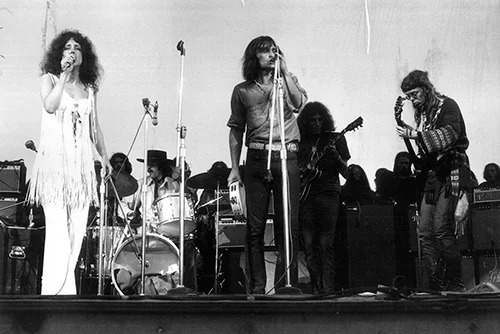
“White Rabbit,” written by Grace Slick and recorded by Jefferson Airplane in 1967, became one of the most recognizable recordings of the San Francisco psychedelic scene. The song appears on Surrealistic Pillow after Slick left her previous band, The Great Society, in 1966. She described writing it after an LSD experience while repeatedly listening to Miles Davis’s Sketches of Spain, especially his interpretation of Concierto de Aranjuez. The influence of Sketches of Spain is clear in the song’s modal language, rhythmic restraint, and long-form dynamic rise. Heavy electronic reverberation on the vocals adds to the dreamlike atmosphere, while the lyrics draw directly from Alice’s Adventures in Wonderland and Through the Looking-Glass, using those images to parallel psychedelic perception.
Instead of a verse–chorus pattern, the song develops as a single continuous arc that builds steadily toward a climactic ending. The melody moves devoid of clear sectional breaks, supported by a gradual increase in volume, density, and vocal range. Slick’s vocal delivery starts in a restrained, almost spoken register and ascends steadily, paralleling the music's escalating intensity and the surreal, hallucinatory imagery of the lyrics.
The song's rhythmic foundation rests on a repeating bass ostinato. An ostinato is a short musical figure that repeats persistently throughout a passage, anchoring the music while other elements change above it. In “White Rabbit,” the bass ostinato stays constant for most of the song, creating a hypnotic pull that reinforces the impression of inevitability as the arrangement grows louder and more forceful.
The repeating ostinato is paired with a bolero rhythm in the bass and snare drum. A bolero is a slow, steady dance rhythm of Spanish origin, distinguished by a repeated pattern that supports a long, controlled buildup. Here, the snare gives a military-style pulse while the bass traces a circular pattern, adding to the song’s Spanish character and forward motion. The use of the Phrygian mode, commonly associated with flamenco and Spanish music, further strengthens the song's Spanish character.
Although the song follows an AABA design, the sections feel less like contrasting blocks and more like stages within a single expanding process. Each return of the A section grows in intensity, while the B section increases harmonic tension before the final return drives toward the climax. The structure is formed by a large-scale crescendo, a slight tempo acceleration, and the steady addition of instruments, including electric guitars that shift from muted accompaniment to distorted emphasis near the end.
The song lasts about two and a half minutes, yet within that brief span it sustains an unbroken increase in intensity. It opens quietly with bass and snare outlining the bolero rhythm, then layers in guitars, drums, and vocals with growing force. By the final section, Slick’s voice reaches its highest register as the band arrives at a dramatic peak, closing the piece with a feeling of release after sustained tension.
“That’s It for the Other One”
Album/Year Released
1968 (album: Anthem of the Sun)
Artist/Composer
Grateful Dead
Genre/Style
Psychedelic rock
Song Form
Multi-sectional, non-linear
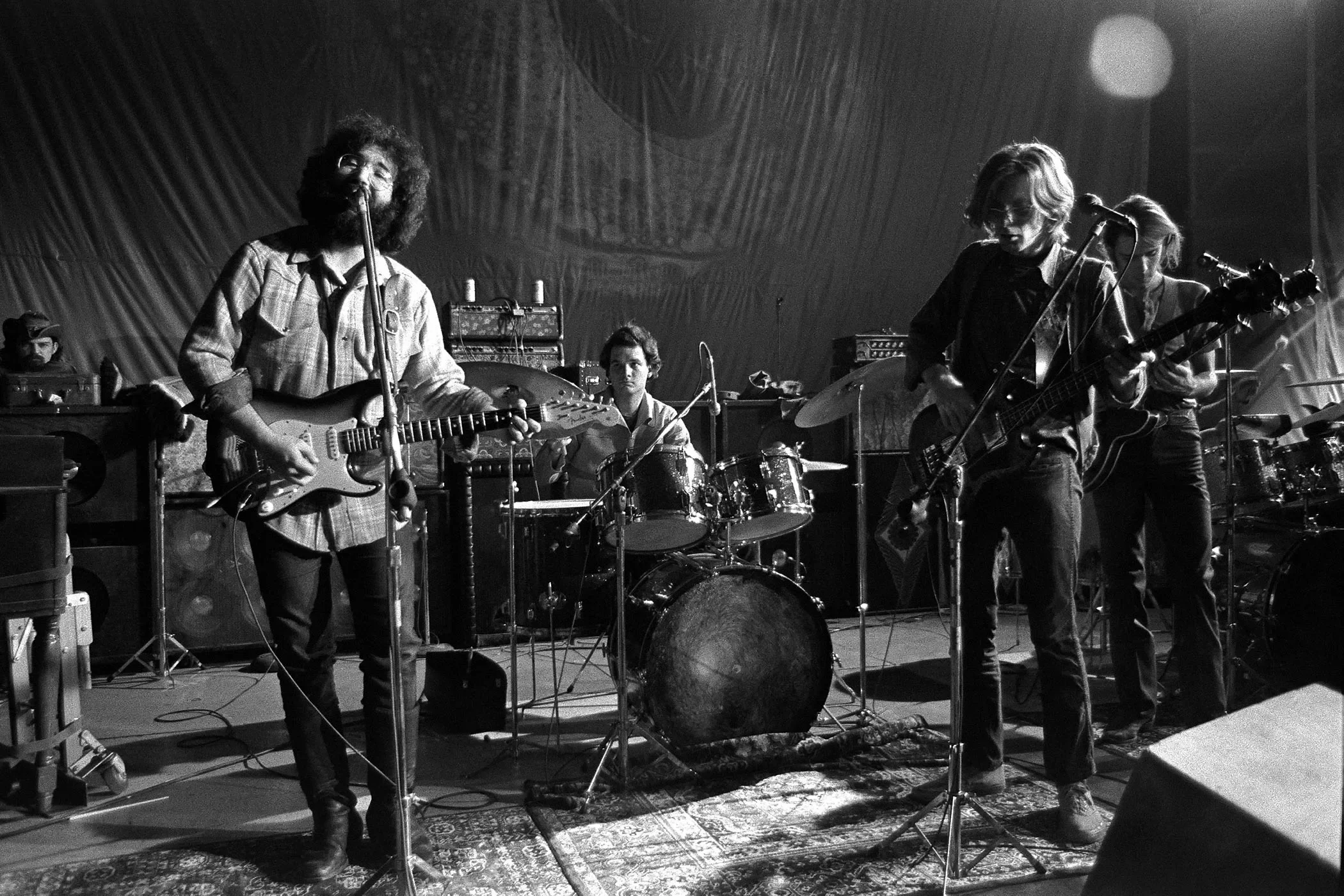
The Grateful Dead’s “That’s It for the Other One” is a large-scale psychedelic suite recorded in 1968 that departs sharply from standard pop-song construction. Rather than relying on a repeating verse–chorus layout, the piece unfolds through a series of connected sections that shift in tempo, meter, tonal center, and texture. These changes create a disorienting, exploratory quality that mirrors the experimental aims of the San Francisco psychedelic scene.
The work combines clearly written passages with extended improvisation. Improvisation is music created during performance rather than fixed in advance. Instead of following a strict script, the performers respond to one another in real time, developing melody, rhythm, texture, and length as the music unfolds. In “That’s It for the Other One”—and in many of the Dead’s tunes—improvisation appears as open-ended instrumental jams, where organ, electric guitar, bass, and percussion interact freely while maintaining a loose sense of direction.
Meter contributes to the song’s unsettled character. While much of the music is in 4/4, passages in 3/4 and moments without a clear meter interrupt the flow. These shifts heighten the feeling of instability, especially during transitions between sections, and reinforce the hallucinatory atmosphere created by electronic effects and studio manipulation.
“That’s It for the Other One” is a composite work made up of four interconnected sections:
“Cryptical Envelopment”
“Quadlibet for Tenderfeet”
“The Faster We Go, the Rounder We Get”
“We Leave the Castle”
“Cryptical Envelopment,” written and sung by Jerry Garcia, opens the suite and later returns, framing the work. “Quadlibet for Tenderfeet” functions as a transitional jam, with audible shifts between studio and live recordings. “The Faster We Go, the Rounder We Get,” written by Bill Kreutzmann and Bob Weir, became a staple of the band’s concerts, often lasting far longer than its studio length. Its lyrics, "There was cowboy Neal at the wheel of the bus to never ever land,” reference Ken Kesey’s bus and its driver, Neal Cassady, who died in 1968. A moment of metric irregularity on the line “Comin’ around in a circle” musically suggests confusion before the music cycles back toward familiar material. “We Leave the Castle,” written by Tom Constanten, closes the suite with an experimental studio piece featuring prepared piano and electronic manipulation; this section was never performed live.
The album version blends studio recordings with live material, demonstrating the group’s interest in blurring boundaries between composition and performance. The piece concludes with extended instrumental passages driven by electronic effects and spontaneous interaction, emphasizing the Grateful Dead’s preference for musical exploration over concise formal closure.