Chapter 9: Country Western Music
Chapter 9: Introduction
The evolution of country and western music in the early 20th century developed under conditions of economic collapse, environmental disaster, large-scale migration, and war. The Great Depression, beginning in 1929, devastated rural and working-class communities across the United States. For many Americans living in the agricultural heartland, economic hardship was compounded by environmental catastrophe. During the 1930s, the Dust Bowl, a series of severe droughts and dust storms, ravaged the Southern Plains, turning once-productive farmland into a barren wasteland. Entire families were uprooted as crops failed, livestock died, and rural life became unsustainable.
The dual crisis of economic and environmental collapse sparked one of the largest internal migrations in United States history. Hundreds of thousands of Americans, many of them white Southerners from Texas, Oklahoma, Arkansas, and Kansas, fled westward toward California or northward to urban industrial centers such as Nashville, Detroit, Chicago, and Atlanta. These displaced communities brought their cultural traditions with them, including folk ballads, gospel harmonies, and string band sounds that would form the backbone of early country music. For migrants longing for familiarity, these songs circulated as reminders of home, offering a way to hold on to it while forging new lives in unfamiliar places.

Record producers first labeled these musical styles "hillbilly music," a term used to sell rural Southern music to urban audiences, particularly in the North. Though popular, the term was soon recognized as both limiting and derogatory. By the 1940s, the industry had adopted the label "country and western," later shortened to simply "country." The music drew from diverse sources, including Appalachian fiddle tunes, Anglo-Celtic folk songs, religious hymns, and cowboy ballads. Yet it remained grounded in rural storytelling, capturing hardship, heartbreak, faith, love, and religion.
Radio accelerated the spread of country music and expanded its audience beyond regional boundaries. The first commercial radio station, KDKA in Pittsburgh, began broadcasting in 1920. By 1922, more than 500 stations were operating across the country, including nearly 90 in the southern United States. Unlike phonograph records, which many working-class families could not afford, radios were accessible through installment plans and brought music directly into people's homes. Radio stations were overwhelmingly white-owned, and ownership patterns strongly influenced what reached the airwaves.. While "hillbilly music" found a prominent place on the airwaves, race records—music by and for Black audiences—remained largely dependent on phonograph sales and were underrepresented in early radio broadcasting.
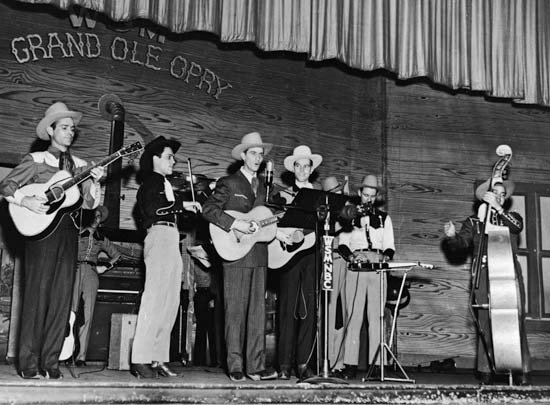
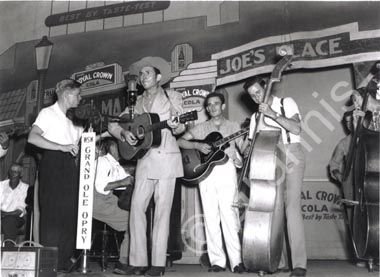
One of the most influential programs in popularizing country music was the Grand Ole Opry, which began airing from Nashville in 1925. It quickly became a Saturday night ritual, broadcasting live performances to millions of listeners across the South and Midwest. For Southerners who had migrated to cities in search of work, programs like the Opry provided a cultural lifeline to their rural roots.
By the 1930s and 1940s, country music had also found a place in Hollywood. Films featuring the "singing cowboy" archetype, popularized by stars such as Gene Autry and Roy Rogers, introduced the genre to a national audience. Their blend of wholesome storytelling, western imagery, and sentimental balladry helped expand the cultural footprint of country and western music far beyond its Southern origins.
Meanwhile, a grittier, more urban strain of country music took hold in working-class bars and dance halls across the South and Southwest. Known as honky-tonk, this style was identified by electrified instruments, hard-edged lyrics, and emotionally raw performances. No figure embodied the honky-tonk subgenre more powerfully than Hank Williams, whose songwriting distilled personal pain into lyrics about loss, loneliness, and instability. Songs such as "Your Cheatin' Heart" and "I’m So Lonesome I Could Cry" captured the voice of postwar America with devastating clarity.
As we will explore in this chapter, country music’s development from a regional folk tradition into a nationally celebrated genre was influenced by geography, media technology, population movement, and popular imagery. What began as a regional expression of southern white identity grew into a national genre, one that remains central to American popular music across the mid-twentieth century.
The Earliest Country Music

The roots of country music can be traced to Anglo-American folk traditions that developed in the southern United States, particularly in the Appalachian Mountains and the rural flatlands of the Southeast. These musical practices were carried to America by British, Scottish, and Irish immigrants and passed down orally through generations. Featuring fiddle tunes, ballads, religious hymns, and dance music, the early folk repertoire supplied repertoires later incorporated into country recording practice. For much of the 19th and early 20th centuries, early American folk music remained largely regional and uncommercialized, performed in homes, churches, and at local social gatherings.
Yet the history of country music cannot be understood without recognizing the central role of African American musical traditions in developing its sound and expressive character. Enslaved Africans and their descendants brought to the Americas distinctive rhythmic practices, melodic phrasing, and performance techniques, as well as instruments such as the banjo, whose origins lie in West Africa. These elements circulated widely within southern performance settings through genres including blues, spirituals, field hollers, and work songs, all of which contributed characteristic rhythms, vocal inflections, and thematic concerns rooted in their lived experience.
African American blues circulated widely across racial boundaries and appeared in the repertoires of both Black and white musicians, influencing the vocal delivery, harmonic language, and storytelling emphasis that would become hallmarks of country music. Gospel hymns, particularly those composed or popularized during the revival movements of the late nineteenth century, further sharpened the genre’s spiritual and melodic vocabulary. Country musicians also drew on the tradition of topical ballads, which documented local events, often focusing on tragedy or violence, as well as on work songs, including those associated with cowboy culture in the Southwest. In addition, early country performers borrowed freely from other popular styles of the period, including jazz, showing a fluid musical exchange that crossed racial and stylistic boundaries and helped characterize the genre’s early development.
In rural communities across the South, musical exchange between Black and white musicians was more common than the commercial record industry often acknowledged. Black musicians frequently performed in local string bands, played guitar and banjo alongside white counterparts, and helped popularize many songs that would later be recorded and marketed under white names. However, the early country music industry, fashioned by the racial divisions of the Jim Crow South, frequently segregated artists and audience markets by race. The racial division between Black and white music markets was reinforced by record companies, who marketed Black music as "race records" and white music as "hillbilly records," despite the often shared musical sources and similar performance styles.
Much of this early "hillbilly music" was instrumental, focused on fiddle, banjo, and guitar playing, and featured danceable rhythms, simple harmonies, and familiar folk melodies. It resonated with rural Southern audiences, many of whom were hearing their own regional customs represented in commercial recordings for the first time.
Ralph Peer

More than any other individual, Ralph Peer (1892–1960) helped move country music from a regional and rural tradition into a nationally recognized and commercially viable genre. As a recording director, talent scout, and music publisher, Peer helped launch the careers of some of country music's most influential early figures and influenced recording practice, repertoire selection, and publishing structures in the American popular music of the 20th century.
Peer began his recording career in New York City, working with Okeh Records, where he supervised the landmark 1920 recording of Mamie Smith's “Crazy Blues," the first major hit by a Black female artist. Its success exposed an untapped market for what would become known as race records, which were targeted at African American audiences. The commercial success of "Crazy Blues" led Peer to explore other underrepresented regional musical traditions, including those of white rural Americans. However, unlike folklorists who documented traditional music for academic preservation, Peer was spurred by the potential for profit.
In 1923, Ralph Peer traveled to Atlanta, Georgia, where he recorded Fiddlin' John Carson, a local performer known for his homespun style and strong regional following. At first, Peer was skeptical; he reportedly found Carson's singing unrefined and was primarily interested in recording his fiddle playing. However, Polk Brockman, the manager of a local phonograph department, convinced Peer to record both Carson's vocals and instrumentals, even offering to purchase 500 copies in advance. He recorded "The Little Old Log Cabin in the Lane" and "The Old Hen Cackled and the Rooster's Going to Crow," both of which sold out quickly, prompting a second order of 500 more. The unexpected success of the recording changed Peer's perception of what he had once considered unsophisticated and unmarketable music, and convinced him that such recordings could sell in large numbers.
At the time, most early hillbilly recordings emphasized instrumental performances, and few artists were recognized primarily as vocalists. One notable exception was Riley Puckett, a blind guitarist and singer, who recorded "Rock All Our Babies to Sleep" in 1924. This track is widely regarded as the first recorded example of yodeling in country music—a vocal technique that involves rapid, repeated shifts between the normal chest voice and a higher-pitched falsetto, creating a distinctive, expressive break in the voice often used for melodic embellishment. The emphasis on instrumental pieces began to change with the success of Fiddlin' John Carson, whose 1923 recordings demonstrated the commercial appeal of vocal tracks and helped establish singing as a central component of country music.
By 1927, Peer had left Okeh and joined Victor Records, where he began assembling a roster of talent for new recordings. He founded his own publishing firm, the Southern Music Publishing Company Inc., in 1928 to promote and control the rights to the music he discovered. Peer retained copyright ownership of all the songs he recorded and was often listed as a co-author, allowing him to collect royalties from both sales and licensing.
In August 1927, Peer organized a field recording session in Bristol, Tennessee, which would become known as the "Big Bang of Country Music." Advertising in local newspapers and setting up a temporary studio, he invited regional performers to audition. Among the dozens of acts he recorded, two would become foundational figures in country music history: the Carter Family and Jimmie Rodgers.
Peer's influence extended far beyond country music. In the late 1930s, he traveled to Central America, where he recorded regional songs and released them into the international market, anticipating what would later be known as world music. Over the course of his career, Peer published hits for a wide range of artists, including Glenn Miller, Bing Crosby, Buddy Holly, and Little Richard. His company, now called Peermusic, remains a significant force in global music publishing under the leadership of his son, Ralph Peer II.
The Carter Family

The Carter Family occupies a central place in the history of country music. Their recordings and legacy established many of the early genre’s sounds, images, and emotional qualities, canonizing the repertory and performance practices for subsequent generations of performers.
Originating from Maces Spring, Virginia, the group consisted of A.P. Carter, his wife Sara Dougherty Carter, and his sister-in-law Maybelle Carter, who married A.P.'s brother in 1926. In 1927, the trio traveled to Bristol, Tennessee, to audition for Ralph Peer, who was scouting rural talent for Victor Records. This historic session, often called the "Big Bang of Country Music," produced the Carter Family's first commercial recordings and launched their decades-long career.
Between the late 1920s and early 1940s, the Carter Family recorded approximately 300 songs for major labels including Victor, Columbia, and Decca. Their repertoire included sacred hymns, traditional folk tunes, and original compositions that contained subjects of family, faith, heartbreak, and loss. Songs such as "Keep on the Sunny Side" (1928), "Worried Man Blues" (1930), and "Can the Circle Be Unbroken" (1935) have become enduring staples of both country and gospel music. Many of their religious songs drew from fundamentalist Christian traditions. At the same time, their secular work often explored personal sorrow and social hardship—core themes that recalled the legacy of earlier American singing groups like the Hutchinson Family Singers and continue to resonate in today's country music.
Musically, the Carters built a sound strongly anchored in Appalachian tradition. Sara sang soprano, Maybelle sang alto, and A.P. provided bass or baritone vocals, producing a three-part harmony style later adopted by Southern gospel trios. Maybelle Carter emerged as an innovative figure and one of the earliest female guitar heroes in American music. She developed the "Carter Scratch," also known as "Carter Family picking," a groundbreaking technique in which the thumb plays the melody on the bass strings while the fingers brush rhythm chords on the treble strings. The Carter Scratch technique, heard in songs like "My Honey Lou" and "Wildwood Flower," revolutionized the guitar's role in country music, elevating it from a background rhythm instrument to a lead melodic voice. Her influence can still be heard today in the playing of countless country, folk, and bluegrass guitarists, including artists like Doc Watson, Chet Atkins, and modern performers such as Gillian Welch and Molly Tuttle.
A.P. Carter played a central role in sourcing and developing the Carter Family's repertoire, often traveling through rural Appalachia in search of old hymns, folk ballads, and traditional songs. He was sometimes accompanied by his wife, Sara, or a local musician to help him remember or perform the songs. While Carter adapted many of these works for recording, he frequently copyrighted them under his own name or listed himself as co-writer even when the material was clearly drawn from long-standing oral traditions. The practice of copyrighting or claiming co-authorship of traditional songs helped secure royalties and build a sustainable music business, but it also elicits significant questions about ownership and the appropriation of collective folk heritage. One notable example is "Can the Circle Be Unbroken?," an adaptation of the Protestant hymn "Will the Circle Be Unbroken?" in which Carter altered the lyrics and arrangement but based the song on a preexisting religious standard.
The Carter Family's story was not without personal drama. A.P. and Sara Carter's marriage grew increasingly strained during the 1930s, in part due to A.P.'s frequent absences on song-collecting trips and the emotional distance that developed between them. Sara eventually fell in love with A.P.'s cousin, Coy Bayes. After years of tension, Sara and A.P. divorced in 1936. Despite their separation, the group continued to perform and record together professionally for several more years. After the group officially retired in 1943, Maybelle Carter carried the family tradition forward by forming a new act with her three daughters: Helen, Anita, and the youngest, June Carter. Known as "Mother Maybelle and the Carter Sisters," the group brought the Carter sound into the modern era and eventually achieved national fame. June Carter, in particular, would become a star in her own right, both as a performer and as the wife and creative partner of Johnny Cash.
Jimmie Rodgers

The second significant discovery Ralph Peer made during his 1927 Bristol Sessions was Jimmie Rodgers (1897–1933), an artist who would become the first true star of country music. While the Carter Family projected the image of a God-fearing rural household, Rodgers personified the itinerant working-class man of the early 20th century, a nomadic figure identified by hardship and longing.
Born near Meridian, Mississippi, Rodgers grew up in poverty. His mother died when he was four, and he spent much of his youth moving from job to job with his father, who worked on the railroad. Rodgers acquired an in-depth comprehension of Southern working-class life, drawing inspiration from African American railroad workers around him whose 12-bar blues structures, rhythmic work songs, and instrumental techniques created a lasting imprint on his musical style and taught Rodgers chord progressions, rhythm patterns, and vocal styling. Rodgers began performing wherever he could, such as on street corners, in vaudeville shows, and even in blackface minstrel acts, which were common at the time.
In 1923, Rodgers was diagnosed with tuberculosis, an illness that would shadow him for the rest of his life. With his health deteriorating and railroad work no longer sustainable, he turned his focus entirely to music. In 1927, he auditioned for Ralph Peer in Bristol, Tennessee. Peer was so impressed with Rodgers that he invited him to New York City, where Rodgers went on to record a string of hits for Victor Records. His first major release,"Blue Yodel #1," also known as "T for Texas," became a million-selling record, catapulting him to national fame.
Rodgers's music blended traditional Southern folk with the blues-inflected lyrical themes he had absorbed during his time on the railroad. He sang about hard living, heartbreak, rambling, and drinking—themes that would become central to country music for decades to come. He was also one of the first artists to popularize yodeling in country music. Though yodeling had been used by hillbilly musicians before, Rodgers made it a signature element of his vocal style, as heard in "Sleep, Baby, Sleep" and across his series of twelve "Blue Yodel" recordings for Victor.
Rodgers's early fame came not solely from his recordings, but also from his appearances in vaudeville shows, radio programs, and modest regional tours. However, his poor health made it difficult for him to tour extensively or promote his work in person. Despite these limitations, he remained incredibly prolific in the studio. He continued recording until 1933, completing his final session in New York just days before his death from tuberculosis at the age of 35.
Rodgers's influence on the development of country music cannot be overestimated. He was a model for the "singing cowboy" image later embodied by Gene Autry, and his blend of folk, blues, and popular song created a new, distinctly American musical identity. His recordings established a precedent for what country music could sound like and what it could talk about. When the Country Music Hall of Fame and Museum was established in 1961, Jimmie Rodgers was among the first three inductees, along with Fred Rose and Hank Williams.
The Rise of Radio

As we saw in our discussion of Swing Music, in the 1920s, radio evolved into one of the most potent forces in American life, changing how people accessed news, entertainment, and especially music. As stations spread across the country, broadcasters quickly learned how to expand their reach. One method involved building high-powered transmission towers capable of sending signals across hundreds of miles. Some stations, known as "clear channel" stations, were granted exclusive frequencies by the government. Without nearby competitors on the dial, these stations could be heard across multiple states. Others set up powerful transmitters just across the border in Mexico, avoiding U.S. regulations entirely. These "border blaster" stations could send their signals deep into the American heartland, sometimes reaching as far as the Midwest.
A second and even more effective strategy was the creation of national radio networks. In 1928, NBC became the first to link dozens of local stations together using telephone lines, making it possible to air the same program simultaneously across the country. The new national radio network model made it easier to produce, distribute, and control programming from a central location, often a studio in New York City. It also allowed individual stations, called affiliates, to broadcast both national content and their own local shows. These innovation national radio networks and affiliated stations made radio a truly national medium and established organizational models later adopted by television and talk radio.
Radio promoted popular music by broadcasting live performances to large audiences during the 1930s and 1940s. Before streaming, records, or even jukeboxes, many Americans first heard new songs through live broadcasts. Music publishers worked behind the scenes to get their songs played on air, knowing that a single radio performance could launch a tune into national popularity. For singers and bandleaders, performing on the radio was also a way to build a following and book more lucrative gigs.
At that time, most radio music was performed live. Recorded music was rarely used and, in fact, was considered misleading. Many people believed that playing a record on the air was inherently dishonest unless clearly stated. As a result, many stations hired full-time musicians and studio bands to provide live music throughout the day. Even when national programs filled much of the schedule, local bands were still needed to fill gaps between shows and to perform on smaller regional broadcasts.
Musicians' unions, especially the American Federation of Musicians (AFM), fought hard to keep live music on the air. They feared that the growing use of pre-recorded music would eliminate jobs for performers. In the 1940s, the union launched a major campaign to restrict the airplay of recorded music on the radio, successfully defending the role of live musicians in the industry—at least for a time.
Importantly, radio brought music directly into people's homes, much like records did, shifting music listening from primarily public spaces such as dance halls, theaters, and churches to more private, domestic settings. The shift from public to domestic listening helped reorient the way Americans experienced music, making it a more intimate and personal part of daily life.
Marketing and Consuming Hillbilly Music

The Great Depression, which began in 1929, brought the American economy to a standstill, and the music industry suffered alongside it. Just two years earlier, Americans had purchased over 100 million phonograph records. By 1932, that number had collapsed to just six million. With widespread unemployment and shrinking incomes, even records that sold for a dime became unaffordable luxuries. Countless small record companies, including those that had pioneered hillbilly and race music, went out of business. Larger record companies, such as Columbia and Victor, were forced to consolidate, restructure, or drastically scale back their operations. Meanwhile, network radio surged in importance, offering free music and entertainment to a public that could no longer afford records.
The collapse hit African American communities with particular severity, nearly wiping out the race record market. Black-owned record labels, music publishers, and even the first Black film studios shut down in the early 1930s. Surviving record companies focused on a shrinking group of established artists and abandoned field recording expeditions. As a result, only a few Black musicians, especially those affiliated with mainstream, jazz-influenced dance orchestras, continued to receive recording opportunities. These artists, often featured in major label catalogs, were exceptions in an industry that otherwise sidelined many African American performers.
Although hillbilly music also faced declining sales, it proved more resilient. While the overall number of records sold fell, hillbilly recordings claimed a growing share of the market, reaching 25 percent by 1930. Ironically, the Depression helped formalize country music as a commercial genre. Its most successful performers signed lucrative advertising deals, landed recurring radio spots, and even appeared in Hollywood films. One major hit from this era was Billy Hill's 1933 recording of "The Last Roundup," a romantic cowboy ballad that sold over 100,000 copies and crossed over into the pop charts. The song helped establish Western music's popularity and paved the way for cowboy stars like Gene Autry and Roy Rogers, whom we will discuss later in this chapter.
While popular music in the early 20th century typically avoided references to social or economic issues, the Depression brought a dose of realism into some corners of the industry. Tin Pan Alley and Hollywood continued to offer escapist fantasies of wealth and glamour, but country and blues musicians increasingly portrayed the harsh realities of working-class life. They sang about poverty, displacement, failed farms, and broken families. Dust Bowl ballads captured the devastation caused by both economic collapse and environmental catastrophe across the Plains. Songs about Southern textile and coal workers, whose attempts to unionize were often met with violence, carried political weight as they explicitly addressed labor conflict, displacement, and state violence. These musical narratives gave voice to communities excluded from the promises of prosperity and offered both comfort and a sense of shared struggle. One of the most powerful voices in this tradition was Woody Guthrie, whom we will explore in a later chapter.
As hillbilly music commenced it’s developed in the 1920s and 1930s, its growth was deeply influenced by emerging technologies, most notably the radio. Just as recordings had helped bring rural sounds to national audiences, radio became a powerful tool for reaching listeners in both urban and remote communities. One of the most influential programs of the era was the National Barn Dance, broadcast from WLS in Chicago. On April 19, 1924, WLS aired its first live country performance from the mezzanine of the Sherman Hotel. The enthusiastic audience response prompted the station to launch the weekly WLS Barn Dance, soon renamed the National Barn Dance. It became a beloved cultural staple and a gateway for country music into American homes.
By 1932, the show had moved to the Eighth Street Theatre in Chicago to accommodate its growing popularity. A year later, NBC picked it up for national syndication, extending its influence coast to coast. The National Barn Dance helped launch the careers of country stars like Gene Autry, the singing cowboy, as well as radio comedians and entertainers such as Amos' n' Andy, Fibber McGee and Molly, and George Gobel. Programs like this helped link the gap between local folk traditions and modern mass media. By broadcasting live fiddle tunes, gospel harmonies, and cowboy ballads directly into American homes, radio made country music part of everyday life, even for families without a phonograph or access to live performances. In this way, radio was far more than a promotional platform. It connected migrants with familiar repertoires, while unifying rural and urban listeners, and helping country music evolve into a national tradition. The expansion of national radio broadcasting prepared audiences for even more influential programs, such as the Grand Ole Opry, which would soon emerge as the genre's most iconic broadcast.
The Grand Ole Opry

No institution has done more to embody, promote, and preserve commercial country music than the Grand Ole Opry. What began as a regional radio broadcast in the 1920s has grown into a national symbol of country music tradition and remains the longest continuously running radio program in American history. The Opry began as the WSM Barn Dance, launched in 1925 by George D. Hay, a seasoned radio producer who had previously worked with the WLS team in Chicago. After being hired as station director at WSM, a powerful Nashville-based station, Hay set out to bring live music programming to Southern audiences. The show aired on Saturday nights and initially featured old-time string bands, fiddlers, and folk musicians, many of whom performed live in the studio. The program followed NBC's Music Appreciation Hour, a broadcast of European classical music conducted by Walter Damrosch. One evening in 1926, Hay introduced the program with a now-famous line:
"For the past hour, we've been listening to music taken largely from grand opera, but from now on we will present the Grand Ole Opry."
The name was a playful jab at opera, and it stuck. From that moment on, the Grand Ole Opry became the flagship broadcast of country and western music, quickly attracting a devoted regional and national following.
The Opry popularized rural Southern music by offering weekly national exposure to performers who otherwise lacked access to large broadcast audiences. Regular appearances on the program introduced performers such as Roy Acuff, Hank Williams, Bill Monroe, and Minnie Pearl to audiences beyond their regional circuits. Its popularity also cemented Nashville's reputation as the center of the country music industry, ultimately earning the city the nickname "Music City." As the genre evolved, the Opry kept pace, featuring artists from various genres, including bluegrass, honky-tonk, gospel, and modern country, on its stage. It moved from WSM's modest studio to larger venues, including the Ryman Auditorium and later the Grand Ole Opry House, where it continues to host live audiences and broadcast performances to millions of listeners across radio and television. Today, the Opry continues to draw live audiences and reaches millions through national radio and television broadcasts.
ASCAP, BMI, and Music Licensing

Since its founding in 1914, the performance rights organization (PRO) ASCAP had tightly controlled the licensing of songs for public broadcast, holding rights to approximately 90 percent of all music played on the radio by the late 1930s (see Chapter 3). It represented the interests of Tin Pan Alley composers such as Irving Berlin, Cole Porter, and the Gershwins, and it largely excluded genres like hillbilly, blues, gospel, and other styles associated with rural Southern and Black musicians. ASCAP was frequently locked in disputes with major radio networks, including NBC, CBS, ABC, and Mutual, over royalty payments and licensing fees. As profits from radio broadcasting soared during the big band era, ASCAP intensified its legal and financial pressure on the networks, demanding a greater share of their revenue.
In response, the networks launched BMI as an alternative licensing agency. Unlike ASCAP, BMI adopted an open-door policy, welcoming songwriters and performers working outside the commercial mainstream, particularly rural Southern musicians, Black blues artists, and others whom ASCAP had previously ignored. BMI provided copyright protection, published recognition, and royalty payments to these marginalized artists, allowing them to receive royalties, credit, and legal protection for broadcast use of their work that had long been denied.
The conflict between ASCAP and the radio networks reached a breaking point in 1941 when ASCAP called a strike, revoking broadcast rights for all music in its catalog. This revocation instantly removed much of the popular big band repertoire from radio, including many theme songs and arrangements. Radio programmers scrambled to fill the gap, and BMI-affiliated artists seized the opportunity. Early BMI catalogs drew more heavily on regional repertoires and newly written material than on established big band hits. Radio stations usually relied on nineteenth-century popular songs, classical music adaptations, or hastily written new material. In some cases, the licensing war reached absurd extremes. Jazz musicians known for quoting familiar melodies in solos were forced to write out and submit those solos for network approval to avoid infringement. However, the stations found a workaround to these rights issues by hiring regional country artists. As a result, country, folk, and blues music—genres that had previously remained regional—were suddenly broadcast to national audiences.

At the same time, another major disruption remodeled the music industry. In 1942, the American Federation of Musicians (AFM), led by president James Caesar Petrillo, called a nationwide strike against record companies. The union demanded that musicians receive a share of royalties from records played on the radio and on jukeboxes, which then numbered over 400,000 nationwide. Although many musicians opposed the strike, fearing it would harm their long-term prospects, Petrillo persisted. For more than a year, no major record company released instrumental recordings. Already facing wartime shortages of shellac, the material used to create records, the industry turned its focus to vocalists and non-union talent. Because vocalists were not yet recognized as musicians by the union, they could still record, and this gave country and blues singers an unexpected advantage.
Country musicians, many of whom were not members of the AFM, filled the vacuum. The strike reduced competition from established orchestras, allowing country and blues performers greater radio exposure. Moreover, a wave of new record companies, such as Capitol Records in Los Angeles, was formed during this period, many of them keen to sign artists from outside the traditional big-band circuit. Independent labels specializing in country music sprang up in cities like Nashville, Cincinnati, and Los Angeles, all of which had growing populations of Southern migrants and an appetite for regional sounds.
By the time the major labels like Columbia and Victor settled with the AFM in 1944, patterns of radio programming and record production had already changed. Swing bands, unable to sustain their visibility during the ban, were beginning to fade, and newer styles were on the rise. Meanwhile, labels like Decca and Capitol had gained momentum by signing hillbilly and R&B artists and resuming instrumental recordings ahead of the major firms.
BMI became the home for most country-and-western musicians in the 1940s and beyond. The organization played a crucial role in legitimizing country songwriting as a professional craft, enabling artists to secure royalties and copyright protection for their work. BMI’s formation reduced ASCAP’s control and changed how country, western, and R&B music entered postwar commercial markets in the postwar era.
Roy Acuff

During the 1930s and 1940s, a combination of catastrophic events, as stated earlier in this chapter, including the Great Depression, the Dust Bowl, and the lingering effects of World War I, triggered one of the largest internal migrations in American history. Millions of white Southerners, many of them displaced farmers or laborers, left rural communities in search of jobs and stability in cities such as Nashville, Atlanta, Detroit, and Chicago. As these migrants began new lives in city centers across the North and Midwest, they brought their musical traditions with them, helping to fuel a growing demand for what was increasingly known as country and western music.
Roy Acuff came to represent the appeal and values associated with the country and western style. Often hailed as the "King of Country Music," Acuff rose to prominence in the 1930s and became a household name through his regular performances on the Grand Ole Opry, where he eventually became one of its central figures. His songs often addressed patriotism and moral instruction through sentimental narrative, speaking to many working-class Americans. His vocal style was clear, direct, and straightforward, a sharp contrast to the yodeling technique popularized by Jimmie Rodgers. Acuff focused on the lyrics and message of each song, making his music accessible to a wide audience.
One of his most popular songs, "The Great Speckled Bird," is a religious ballad that uses metaphor to explore themes of faith and redemption. The song blends traditional hymn-like lyricism with instrumental techniques borrowed from African American blues, including the bottleneck slide guitar. Acuff’s stylistic fusion demonstrates the complex cultural exchange in the American South and reveals how both white and Black musical traditions contributed to country music. His music resonated with the core values of his audience while also influencing the sound of country music in the mid-twentieth century.
Gene Autry

One of the most widely recognized figures in the history of country and western music was Gene Autry (1907–1998), known to millions as "America's Favorite Singing Cowboy." Unlike many country musicians who rose to fame through recordings and live performances, Autry became a household name primarily through his success in film, radio, and later television.
During the Depression era, many country musicians adopted the image of the cowboy as an alternative to the often stigmatized "hillbilly" stereotype. The romanticized figure of the Western cowboy, popularized after World War I through dime novels, cowboy song collections, and silent films starring actors like Tom Mix, offered a more heroic and aspirational model. In American cultural imagination, the South typically evoked religious tradition and moral conservatism, while the West symbolized freedom, movement, and the future. As country artists sought broader appeal from the 1930s through the 1950s, the term "western" increasingly replaced "hillbilly," and performers embraced cowboy hats, boots, and stage names like "Tex" or "Slim." The cowboy image has continued to circulate in later country marketing and performance, visible in the branding of modern artists such as Garth Brooks or Blake Shelton.
Autry began his career in the early 1930s, recording music in New York and gaining popularity as a regular performer on the WLS National Barn Dance in Chicago, where he was billed as "Oklahoma's Singing Cowboy." His rising fame caught the attention of Sears, Roebuck and Company, which began promoting his records under its Silvertone label. Sears also marketed a wide array of Gene Autry-branded merchandise, including songbooks, guitar instruction manuals, and the famous "Round Up" guitar, through its mail-order catalog. Autry’s early fusion of music, marketing, and merchandise brought together recording, merchandise, and mass marketing under a single performer brand that would later become standard in the entertainment industry.
In 1934, Autry traveled to Hollywood for a screen test, launching a film career that would make him the era's most famous singing cowboy. He starred in nearly 100 films, including the science fiction western serial The Phantom Empire (1935), which blended frontier mythology with futuristic fantasy and helped cement his cowboy persona. These films celebrated the mythic West while showcasing Autry's musical performances, reinforcing the "western" half of country-and-western music as a core part of the genre's identity.
Autry's influence extended well beyond the movie screen. From 1940 to 1956, he hosted a popular weekly radio show on CBS, Gene Autry's Melody Ranch. The show promoted his personal code of ethics, famously articulated in his "Ten Cowboy Commandments," which encouraged honesty, patriotism, and respect. His cowboy image was both adventurous and morally upright. His horse, Champion, became so beloved that he starred in his own radio program.
Autry also embraced television, launching The Gene Autry Show on CBS in 1950, which brought cowboy culture into millions of American homes. Beyond performance, Autry ventered into media ownership, acquiring multiple radio and television stations across Southern California. His business ventures even extended into professional sports. From 1961 to 1997, Autry was the founding owner of the California Angels baseball team, now known as the Los Angeles Angels. He thus evolved from entertainer to media entrepreneur, contributing to the infrastructure of country music’s postwar expansion.
Gene Autry's unique blend of music, media savvy, and moral branding helped popularize country and western music during the mid-twentieth century and expanded the genre’s presence across film, radio, television, and consumer markets. He also paved the way for other singing cowboys, including Roy Rogers, and helped embed the cowboy as a mythic American figure. His success across entertainment, broadcasting, and business made him one of the most influential and diversified entertainers of his generation.
Subgenres of Postwar Country and Western Music

After World War II, country and western music experienced a dramatic surge in popularity, fueled by shifting demographics, technological advancements, and a growing appetite for homegrown entertainment among both rural and urban audiences. By 1949, more than 650 radio stations across the United States were regularly broadcasting live country performances, placing live country performances in regular rotation on stations outside the South. The postwar boom gave rise to several influential subgenres, each introducing new vocal techniques, instrumental timbres, and regional sensibilities that would influence country music for decades to come.
One significant technical change in this period was the adoption of the lap steel guitar and its more mechanically advanced cousin, the pedal steel guitar. First developed in Hawaii and introduced into American popular music in the early 20th century, the lap steel guitar appeared regularly in honky-tonk and country ballads of the 1940s and 1950s. Played horizontally with a steel bar slid across the strings, the instrument produced sweeping glissandos and nuanced pitch bends. The introduction of pedals and knee levers on the pedal steel guitar enabled performers to alter the pitch of individual strings mid-note, augmenting the vast emotional and harmonic range of the style. This capability mimicked the sound of a human voice and evoked both longing and emotional vulnerability. The pedal steel guitar's glissandos and pitch-bending capabilities made it ideal for country songs centered on romantic heartbreak and loneliness.
Honky-Tonk
Honky-tonk music developed in bars, roadhouses, and dance halls across Texas and the Southwest during the 1940s and 1950s. Built for noisy, often chaotic environments, honky-tonk was loud, gritty, and emotionally direct. The loud, electrified honky-tonk sound found a receptive audience among working-class listeners at the end of the workday. Its raw, electrified sound replaced earlier acoustic string-band textures, using amplified instruments to create a louder, more modern overall sound.
The typical honky-tonk ensemble featured amplified instruments suited to rowdy venues: fiddle, steel guitar, lead electric guitar, upright or electric bass, piano, and vocals. The steel guitar, in particular, appeared prominently within the genre, its sliding tones and weeping glissandos capturing the emotional weight of heartbreak and loss.
Vocals in honky-tonk were intentionally unrefined. Singers used vocal cracks, blue notes, and melismas—stretching a single syllable across multiple pitches—a technique drawn from African American blues. The blending of country and blues sensibilities lent honky-tonk its signature emotional grit.
Lyrically, honky-tonk tackled themes that had often been avoided in more polished country styles: alcohol, infidelity, loneliness, poverty, and broken relationships. Artists such as Hank Thompson, Ernest Tubb, Kitty Wells, Hank Snow, and George Jones recorded extensively within the honky-tonk style and reached wide audiences, crafting a sound that was as emotionally piercing as it was musically innovative. Wells, in particular, broke gender barriers with hits like "It Wasn’t God Who Made Honky Tonk Angels," offering a woman's perspective in a genre often dominated by male voices.
Country Crooning
In contrast to the raw, electrified energy of honky-tonk, country crooning developed as a smoother, more pop-oriented style aimed at reaching a broader, more urban audience. Influenced by pop and jazz vocal traditions, country crooners emphasized warm, intimate delivery, sentimental lyrics, and sophisticated production, such as that used by crooners like Bing Crosby. The country-crooning style softened country music's rural edge and placed country recordings on both country and pop charts.
The most iconic figure in this movement was Eddy Arnold (1918–2008), known as "The Tennessee Plowboy." Arnold rose to fame in the late 1940s with heartfelt ballads featuring his conversational tone, emotional restraint, and smooth phrasing. Between 1947 and 1954, he dominated the country charts and crossed over into pop with eleven Top 40 hits, including "Make the World Go Away" and "Bouquet of Roses." His records often featured lush orchestration with strings, piano, and backing vocals, distinguishing him from traditional country ensembles centered on steel guitars and fiddles.
Arnold's success brought country music into the living rooms of middle-class suburban families and urban listeners who might otherwise have dismissed it as too rural or unsophisticated. He was also an early adopter of television, using the medium to cultivate a polished, likable image that resonated with postwar America's ideals of gentility and upward mobility.
However, Arnold's crossover appeal came with criticism. Many traditionalists saw his music as too slick and accused him of abandoning country's roots. Despite that criticism, later performers adopted similar vocal and production approaches to those of Patsy Cline, Jim Reeves, and Glen Campbell, proving that country could thrive within mainstream popular music.
Bluegrass
At the same time, a more traditionalist movement was emerging in the form of bluegrass, drawing on Appalachian string-band repertoires and older ballad sources. Bluegrass musicians sought to preserve what they considered the purest roots of Southern music, drawing heavily from Scots-Irish fiddle tunes, gospel harmonies, and folk ballads. The style features fast tempos, extended instrumental solos, and close vocal harmony. Bill Monroe, often referred to as the "Father of Bluegrass," was the genre's central figure. His band, The Blue Grass Boys, gave the style its name. Unlike honky-tonk or country crooning, bluegrass remained strictly acoustic, featuring banjo, fiddle, mandolin, upright bass, and guitar, often avoiding percussion altogether. Bluegrass remained separate from amplified commercial styles as a genre rooted in tradition, instrumental virtuosity, and regional pride—a topic we will explore in greater depth in the next chapter.
Hank Williams

Among all the stars of the postwar honky-tonk era, none shone brighter—or burned out faster—than Hank Williams (1923–1953). Often regarded as the most influential country singer after Jimmie Rodgers, Williams elevated hillbilly music into a mainstream phenomenon, gaining a massive following during his brief but unforgettable career. With his mournful voice, plainspoken lyrics, and emotionally direct delivery, he became country music's first true superstar.
Born in rural Alabama in 1923 to a poor sharecropping family, Williams was immersed in a wide range of musical influences from a young age. He listened to artists like Roy Acuff and Ernest Tubb, but he also drew deeply from African American blues traditions. A major influence in his musical development was Rufus "Tee-Tot" Payne, a Black bluesman who taught Williams songs and guitar techniques. In addition to blues, Williams’s musical style was deeply influenced by the music of fundamentalist Baptist churches, which gave him a lasting connection to gospel traditions.
Williams began performing as a teenager in local bars and on radio stations in Montgomery, Alabama. By the age of sixteen, he had earned the nickname "The Singing Kid" and hosted his own local radio show. Soon after, he formed his backing band, the Drifting Cowboys, and began touring extensively throughout Alabama and the surrounding region. His breakthrough came with regular appearances on the Louisiana Hayride, a popular live music program broadcast from KWKH in Shreveport, Louisiana. The show served as a launching pad for many emerging artists and ultimately brought Williams to the attention of Grand Ole Opry talent scouts.
In 1949, following the runaway success of his recording of"Lovesick Blues," Williams was invited to join the Grand Ole Opry. Although the song was originally written by Tin Pan Alley composers Irving Mills and Cliff Friend and had been recorded by others, Williams's version—featuring his trademark vocal cracks, melismas, and heartfelt phrasing—turned it into a definitive hit and catapulted him into national stardom.
Between 1947 and 1952, Williams released a series of enduring hits that remain central to the country music canon such as “Move It On Over” (1947), “I’m So Lonesome I Could Cry” (1949), “Hey Good Lookin’” (1951), “Cold, Cold Heart” (1951), and “Your Cheatin’ Heart” (1952) Williams’s music blended the raw emotional intensity of honky-tonk with the melodic simplicity of Southern folk and the lyrical directness of blues. He often said his songs were expressions of real feeling, explaining,
“When a hillbilly sings a crazy song, he feels crazy. When he sings 'I Laid My Mother Away,’ he sees her laying right there in the coffin.”
His ability to tap into universal emotions of heartbreak, regret, and longing made his songs resonate deeply with listeners across class and regional lines. These were all traditional country themes that Williams helped to codify in the mainstream American consciousness, giving the genre a lasting emotional and lyrical blueprint.
However, Williams's personal life was marred by pain, addiction, and instability. He suffered from a congenital spinal disorder, which left him in constant physical pain and led to his dependence on alcohol and prescription painkillers. While capable of electrifying live performances when sober, Williams often missed shows or performed poorly due to intoxication. His behavior eventually led to his dismissal from the Grand Ole Opry in 1952; after this, he returned to the Louisiana Hayride.
Tragically, Williams died of heart failure in 1953, just short of his 30th birthday, while en route to a concert. The official cause of death was a heart attack, brought on by years of substance abuse and deteriorating health. Despite his short life, Hank Williams left a towering legacy. His signature look, wearing a Stetson and a frilly jacket, and his songs became templates for generations of country artists. His emotional honesty and unfiltered vulnerability captured the very essence of the genre. In 1961, he was among the first inductees into the Country Music Hall of Fame, alongside Fred Rose and Jimmie Rodgers. His music continues to inspire not only country artists, but also rock, folk, and blues musicians who see in Williams a pioneer of American storytelling through song.
Chapter 9: Conclusion

With the rise of radio, film, and licensing organizations like BMI, early country-and-western musicians gained powerful new platforms to reach national audiences. Programs such as the Grand Ole Opry demonstrated the commercial viability and cultural staying power of the genre, helping country music grow from a regional tradition into a regular presence within American popular culture.
The Great Migration of Southern Americans to northern and urban areas during the Great Depression and World War II broadened the audience by concentrating listeners in industrial cities. As transplanted Southerners settled into industrial cities, they created concentrated listening markets where familiar songs about home, heartbreak, faith, and survival resonated deeply.
Musically, early country artists drew heavily from Anglo-American folk traditions, including modal harmonies, acoustic string instrumentation, and storytelling ballads. Yet they also incorporated elements of African American music, including blue notes, melismatic phrasing, rhythmic syncopation, and expressive timbres, often acquired through informal mentorship and everyday cultural exchange in the South.
Media-savvy stars like Gene Autry, Roy Rogers, and Hank Williams helped secure the genre's place in the mainstream. Autry and Rogers popularized the singing cowboy through film and radio, while Williams, with his raw emotional delivery and lyrical depth, gave honky-tonk music a voice that continues to influence generations of country artists.
By fusing regional musical traditions with new forms of mass communication, early country and western artists created a uniquely American genre—circulated between rural and urban markets while adapting older repertoires to new media. Their work preserved folk memory while adapting it to modern life, giving voice to the everyday experiences of ordinary people. In doing so, they helped country music grow into a national—and eventually global—form of popular expression.
Chapter 9: Further Reading
Atkins, John. The Carter Family. London, 1973.
Berry, Chad, ed. The Hayloft Gang: The Story of the National Barn Dance. Urbana, IL: University of Illinois Press, 2008.
Dunkleberger, A. C. King of Country Music: The Life Story of Roy Acuff. Nashville, TN: Guaranty Press, 1971.
Escott, Colin, George Merritt, and William MacEwen. Hank Williams: The Biography. 2nd ed. New York: Little, Brown, 1995.
George-Warren, Holly. Public Cowboy No. 1: The Life and Times of Gene Autry. New York: Oxford University Press, 2007.
Green, Archie. “Hillbilly Music: Source and Symbol.” Journal of American Folklore 78 (1965): 204–28.
Green, Douglas B. Singing in the Saddle: The History of the Singing Cowboy. Nashville, TN: Country Music Foundation Press, 2002.
Greenway, John. “Jimmie Rodgers: A Folksong Catalyst.” Journal of American Folklore 70 (1957): 231–34.
Kahn, Edward. The Carter Family: A Reflection of Changes in Society. PhD diss., University of California, Los Angeles, 1970.
Kienzle, Rich. Southwest Shuffle: Pioneers of Honky-tonk, Western Swing, and Country Jazz. New York: Routledge, 2003.
Laird, Tracey E. W. Louisiana Hayride: Radio & Roots Music Along the Red River. New York: Oxford University Press, 2005.
Malone, Bill C. Don’t Get above Your Raisin’: Country Music and the Southern Working Class. Urbana, IL: University of Illinois Press, 2002.
Malone, Bill C., and Jocelyn R. Neal. Country Music U.S.A. 3rd ed. Austin, TX: University of Texas Press, 2010.
Neal, Jocelyn R. Country Music: A Cultural and Stylistic History. New York: Oxford University Press, 2013.
Peterson, Richard A. Creating Country Music: Fabricating Authenticity. Chicago: University of Chicago Press, 1997.
Peterson, Richard A., and Russell David Jr. “The Fertile Crescent of Country Music.” Journal of Country Music 6 (1975): 19–27.
Porterfield, Nolan. Jimmie Rodgers: The Life and Times of America’s Blue Yodeler. 2nd ed. Urbana, IL: University of Illinois Press, 1992.
Rosenberg, Neil V. Bluegrass: A History. Urbana, IL: University of Illinois Press, 1985. 2nd ed., 2005.
Tichi, Cecelia. High Lonesome: The American Culture of Country Music. Chapel Hill: University of North Carolina Press, 1994.
Wolfe, Charles K. A Good-Natured Riot: The Birth of the Grand Ole Opry. Nashville: Country Music Foundation Press, 1999.
———. Classic Country: Legends of Country Music. New York: Routledge, 2001.
———. “The Birth of an Industry.” In The Illustrated History of Country Music, edited by Patrick Carr, 33–75. Garden City, NY, 1979. Repr. New York, 1995.
Wolfe, Charles K., and Ted Olson, eds. The Bristol Sessions: Writings about the Big Bang of Country Music. Jefferson, NC: McFarland, 2005.
Zwonitzer, Mark, with Charles Hirshberg. Will You Miss Me When I’m Gone? The Carter Family and Their Legacy in American Music. New York: Simon & Schuster, 2002