Chapter 33: Pop, Rock, and Heavy Metal in the 1980s
Chapter 33: Introduction
By the early 1980s, the sound of mainstream rock had begun to shift. The rebellious guitar styles that had dominated the previous decade gave way to a sleeker and commercially oriented form of pop rock. Studio technology and accessible synthesizers allowed musicians and producers to craft songs with brighter textures and precise arrangements for radio and television. Record companies increasingly favored artists who could move easily between rock and pop audiences, producing music that combined prominent guitar riffs with singable melodies and rhythmic beats suited for dancing.
The shift toward polished, commercially oriented pop rock gained momentum with the arrival of MTV in 1981. The channel placed visual presentation at the center of popular music promotion, rewarding performers whose songs worked well alongside memorable imagery and stylized performance. Many of the hit singles circulating through the network favored post-disco dance grooves and synthesizer-based arrangements rather than the extended guitar solos and instrumental virtuosity that had characterized earlier hard rock. As MTV emphasized visual presentation, some rock bands adjusted their style to appeal to viewers, while others faded from the spotlight.
By the end of the 1970s, heavy metal, which had been pioneered in the late 1960s and early 1970s by bands such as Led Zeppelin and Deep Purple, had receded from the mainstream, partly due to the dominance of disco and radio-friendly pop. The industry often treated metal as a niche market, associating it with a narrow audience of young, white male listeners. Despite heavy metal's reduced mainstream presence, the genre persisted and evolved, returning in the 1980s with renewed commercial vitality. Bands such as Van Halen, Bon Jovi, Mötley Crüe, and Def Leppard brought a polished, radio-ready pop-metal sound into the mainstream, while groups like Metallica, Slayer, Anthrax, and Megadeth explored faster, heavier, and more aggressive directions through speed and thrash metal. By the mid-1980s, both pop-oriented rock and multiple strains of heavy metal had carved out prominent positions within the commercial music industry, each finding its own audience through a combination of sonic innovation, visual display, and the evolving demands of mass media.
The Second Wave of British Heavy Metal
By the late 1970s, heavy metal in Britain entered a new phase of development, often described as the second wave or the New Wave of British Heavy Metal. This new musical syntax grew out of earlier hard rock and metal traditions but developed within a changing musical climate created by the rise of punk. Younger bands responded by increasing speed, tightening song structures, and adopting a more aggressive sound, while still retaining the amplified weight and darker tonal palette associated with metal. The result was a reenergized style that appealed to both metal audiences and listeners drawn to punk’s intensity.
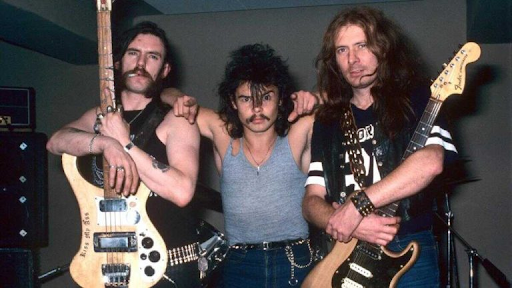
Within the New Wave of British Heavy Metal context, Motörhead stood at the leading edge of the shift toward faster, more aggressive British metal. The group brought together punk’s velocity and stripped-down attack with the density and thematic topics of heavy metal. Their name—slang for an amphetamine user—matched their abrasive sound and image, and like many metal acts, they adopted stylized spelling conventions such as the umlaut. Their music moved at a faster tempo than most earlier metal, built on distorted guitar textures and a vocal delivery that wavered between singing and shouting. Lyrically, they combined traditional metal subjects such as conflict, morality, and power with more immediate themes, including gambling, sex, and drug use. Although the band experienced multiple lineup changes, its most widely recognized recordings featured Lemmy Kilmister on bass and vocals, Phil Taylor on drums, and Eddie Clarke on guitar.
After releasing several albums in the late 1970s, Motörhead reached a broader audience with Ace of Spades (1980). Its title track, “Ace of Spades,” captures the qualities most closely associated with the band: rapid tempo, heavy distortion, and a forceful, unpolished vocal style. While their commercial success remained more limited than that of some contemporaries, their influence stretched widely.
At the same time, other British bands were refining and expanding the sound in different directions. Judas Priest, formed in 1970, did not achieve major commercial success until the end of the decade with “Hell Bent for Leather” (1979) and the album British Steel (1980). These releases established the group as a leading force in the movement, particularly in the United Kingdom, while songs such as “Breaking the Law” and “Living After Midnight” also achieved popularity in the United States. One of their most influential contributions was the use of two lead guitarists, a format that enabled harmonized lines and more complex solo passages, which soon became a common feature of the genre.
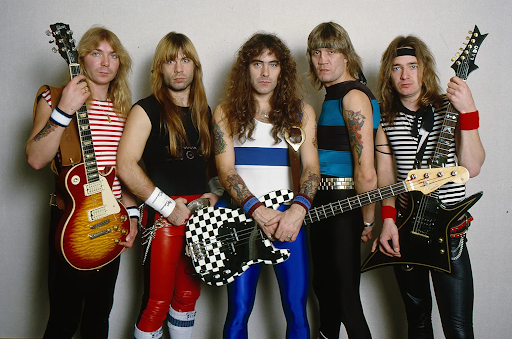
The dual-guitar format also appeared in Iron Maiden, formed in 1975. Drawing their name from a medieval torture device, the band developed a lyrical style that combined historical, literary, and contemporary themes. Their songs commonly depict scenes of violence and punishment drawn from myth and the medieval past, alongside reflections on colonial expansion, twentieth-century warfare, and the threat of nuclear destruction. Their 1982 album The Number of the Beast marked their breakthrough in the American market and included “Run to the Hills,” which recounts the experience of Native Americans during European colonization. The album also incorporates imagery from the Book of Revelation, especially its portrayal of the Antichrist. Despite the album's use of biblical imagery, some listeners and critics misinterpreted these references as endorsements of satanic practice rather than narrative or symbolic material.
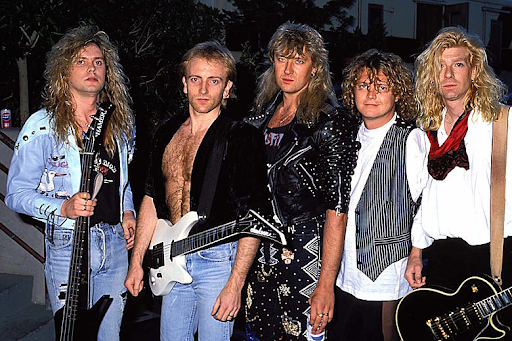
While bands like Judas Priest and Iron Maiden emphasized intensity and darker subject matter, Def Leppard pursued a more accessible direction within the same movement. After signing a recording contract in 1979, they toured with more established acts and gradually built a wider audience. Like their peers, they featured two lead guitarists, but their songs focused more often on relationships, leisure, and youthful escapism rather than violence or destruction. Their musical style also differed in structure. Although they frequently opened songs with strong guitar riffs, those riffs were not always sustained throughout entire tracks, giving their music greater textural variety.
Def Leppard’s rise also coincided with the growing influence of music television. Their video for “Bringin' On the Heartbreak” (1981) became one of the first heavy metal clips to receive airplay on MTV, helping introduce the genre to a larger audience. Their profile continued to grow with the success of Pyromania (1983). Soon after its release, drummer Rick Allen was involved in a car accident that resulted in the loss of his left arm. Rather than replacing him, the band adapted their sound and performance setup to accommodate his continued role. Allen developed a customized drum kit that used foot pedals and electronic components, enabling him to perform the parts needed for the band’s repertoire.
Rick Allen's adapted drum setup carried into their next album, Hysteria (1987), which became one of their most commercially successful releases. The album produced seven singles, including “Love Bites” and "Pour Some Sugar on Me,” and secured Def Leppard a lasting place in popular rock repertoires. Motörhead, Judas Priest, Iron Maiden, and Def Leppard demonstrate the stylistic range of the New Wave of British Heavy Metal, from raw speed and aggression to the polished, melodic metal that gained greater commercial prominence by the mid-1980s.
Van Halen
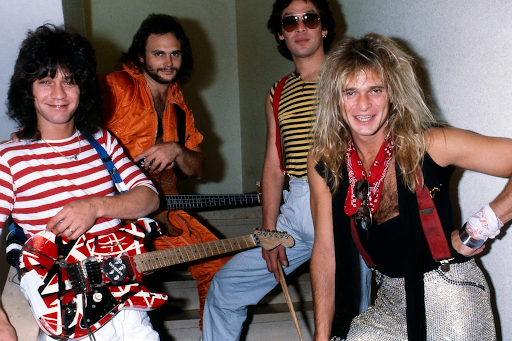
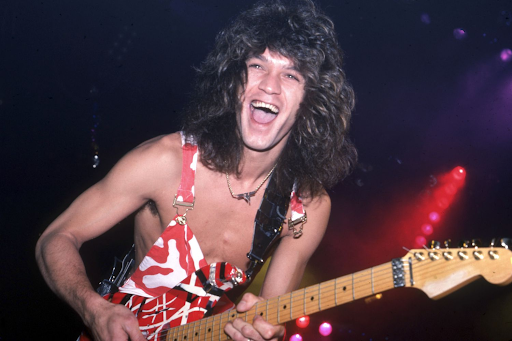
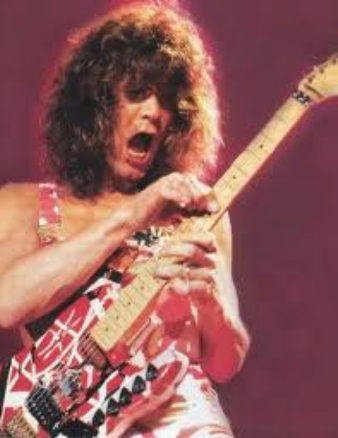
Van Halen, formed in 1974 by brothers Eddie and Alex Van Halen, along with singer David Lee Roth and bassist Michael Anthony, became one of the most influential American metal bands of the 1970s and early 1980s. Eddie Van Halen’s classical training in piano and guitar allowed him to develop techniques that expanded the possibilities of rock guitar playing. He popularized two-handed tapping, enabling rapid, fluid note sequences along the fretboard, and mastered hammer-ons, pull-offs, harmonics, and volume swells. These techniques produced a range of textures, from percussive staccato runs to soaring, keyboard-like lines, giving the electric guitar a wider expressive range.
Eddie also experimented with the whammy bar, performing dramatic dive bombs, pitch bends, and squeals that could mimic the sound of a neighing horse. He often played with his back to the audience, preventing fans from copying his precise hand techniques. His 1978 instrumental, “Eruption,” remains a landmark in guitar virtuosity, showcasing rapid-fire tapping runs, tremolo harmonics, and an inventive use of the guitar’s tone controls. The piece inspired countless guitarists and became a signature part of Van Halen’s live shows, setting a standard for technical mastery in metal.
By the early 1980s, Van Halen had incorporated synthesizers without compromising their heavy metal identity. The 1984 album, and particularly the single “Jump,” bridged the gap between mainstream pop and hard rock. "Jump" opened with a prominent synthesizer riff that supplied the song's principal hook while retaining the rhythmic weight and energy associated with Van Halen's hard-rock sound. Its accompanying video drew attention to David Lee Roth’s athleticism and humor, with the band literally jumping and smiling. The playful performance style of the "Jump" video made metal more accessible to a broader audience while retaining its emphasis on instrumental skill.
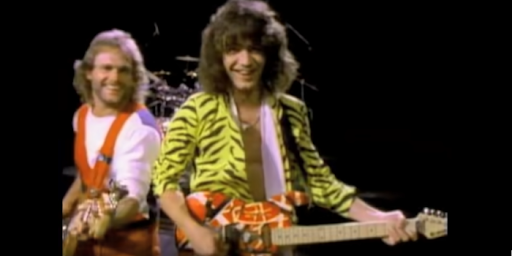
The song’s lyrics and melody were relatively light, focusing on a playful, flirtatious invitation, but the musical execution—the combination of keyboard textures, pounding drums, and Eddie’s explosive guitar techniques—preserved the band’s heavy metal character. “Jump” reached the top of the charts, showing that metal could sell alongside pop and encouraging other bands to combine technical skill with radio-friendly hooks. The video’s MTV rotation increased the band’s visibility, introducing metal to audiences that might otherwise have ignored the genre.
Van Halen’s videos often paired musical complexity with theatrical humor, as seen in the 1984 video for “Hot for Teacher.” The song begins unusually for a single, opening with a 30-second drum solo showcasing Alex Van Halen’s double bass technique, followed by another 30 seconds of instrumental introduction. The music video blends narrative and performance, depicting the band as both adult musicians and mischievous students traversing a hyper-stylized high school. Two models appear as teachers: Donna Rupert, 1981 Miss Canada pageant runner-up, plays the chemistry teacher, and Norwegian actress Lillian Müller plays the physical education instructor. Both reveal bikinis under their classroom attire to the cheers of students, adding a provocative element played for laughs, typical of MTV’s early visual style.
On stage, Van Halen delivered performances driven by the interplay between Eddie’s technical guitar wizardry and Roth’s charismatic stage presence. Eddie’s tapping, harmonics, and dive-bomb techniques created dynamic soundscapes, while Roth’s acrobatics, flashy jumps, and stage antics reinforced the band’s playful yet high-energy image. Van Halen's combination of instrumental skill and theatrical performance helped cement their reputation as both technically brilliant and immensely entertaining, creating a large fanbase across metal fans and mainstream listeners alike.
Van Halen’s lineup shifted repeatedly over the decades. David Lee Roth left in 1985 and was replaced by Sammy Hagar, whose presence steered the band toward a heavier, more polished hard rock sound. Roth returned briefly in 1996, after which Gary Cherone of Extreme stepped in as lead vocalist. Cherone’s tenure was short-lived, and Hagar later rejoined the group before eventually departing again. Roth ultimately returned for a full reunion in 2007, and he remained the band’s frontman through their final tours. Across these changes, Eddie Van Halen’s guitar playing provided stylistic continuity, giving the band its distinctive sound and leaving a lasting influence on later rock and metal musicians.
Guns N’ Roses
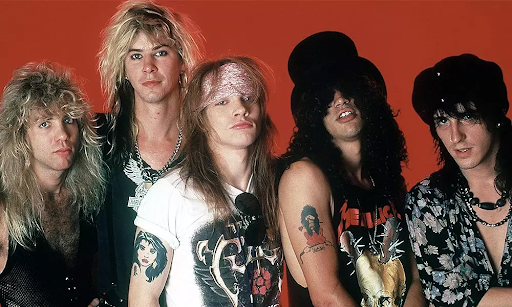
Guns N' Roses emerged as one of the most commercially successful American hard-rock and metal acts of the late 1980s. The band blended punk attitude, blues-influenced hard rock, and unrefined energy, distinguishing themselves from more polished metal acts. Their music incorporated horns, multi-voice choruses, synthesizers, and occasionally acoustic guitar. Guitarist Slash contributed a distinctive melodic and virtuosic style, notably apparent in the song “November Rain.”
The band’s lineup during their most influential period included Axl Rose on vocals and piano, Slash on lead guitar, Izzy Stradlin on rhythm guitar, Duff McKagan on bass, and Steven Adler on drums, though Matt Sorum later replaced Adler. Guns N’ Roses’ debut album, Appetite for Destruction (1987), reached number one on the Billboard charts and remains the best-selling debut album in U.S. history. Songs like “Welcome to the Jungle” captured the grit and danger of Los Angeles streets, drawn from Rose’s own experiences, while “Sweet Child O’ Mine” prominently featured Slash’s melodic guitar riffs and delivered a more intimate, personal narrative. Both videos received heavy MTV rotation, accelerating the band’s ascent from underground metal to mainstream rock stardom.
Cultivating an image of controversy and danger was central to Guns N' Roses' public persona. Axl Rose’s volatile personality fueled both live performance drama and media attention. In 1988, the single “One in a Million” sparked backlash for its use of homophobic and racial language. Rose also incited riots at shows, most famously in 1991 when he attacked a fan filming a concert. His penchant for provocative imagery extended to clothing, including shirts depicting Charles Manson, and he recorded a Manson song for the 1993 album The Spaghetti Incident?. The band also openly referenced drug and alcohol use in songs like “Mr. Brownstone,” further cementing their image as the dangerous, unpredictable embodiment of Sunset Strip excess.
Guns N’ Roses’ lyrics and visual identity frequently addressed life on Sunset Strip, the center of the Los Angeles metal scene. Songs like “Paradise City” and “Nightrain” celebrated youthful excess and survival in a chaotic urban environment. Their videos, shot with cinematic attention to narrative and visual spectacle, translated the high-energy, gritty club performances into a product suitable for MTV, increasing accessibility while retaining the authenticity of their live persona. Their combination of raw musical power, narrative storytelling, and cultivated controversy helped position the band as both a commercial and cultural force.
By the mid-1990s, internal conflicts and substance abuse led to the departure of all original members except Axl Rose, though the band continued to record and tour with new lineups. Despite these changes, Guns N’ Roses maintained their signature sound—Slash’s guitar solos, Rose’s vocal intensity, and a fusion of hard rock and metal textures—and continued to attract devoted fans worldwide.
Hair Metal
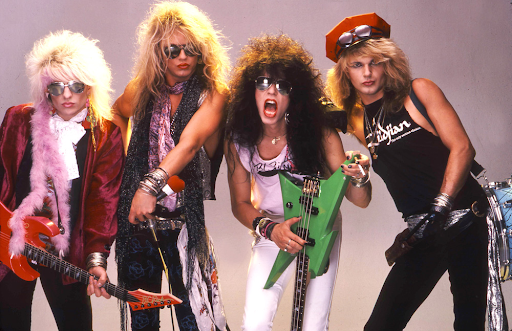
By the late 1970s and early 1980s, Los Angeles had become the primary center for a commercially oriented strain of heavy metal played in clubs along the Sunset Strip. Clubs such as the Whisky a Go Go, the Roxy Theatre, the Troubadour, the Starwood, and venues like the Trip hosted a steady rotation of emerging local and regional bands. Many of these clubs avoided punk bookings because of concerns about crowd violence and instead filled their calendars with metal acts, often requiring bands to sell tickets in advance under “pay-to-play” arrangements. The pay-to-play system forced musicians to quickly cultivate local audiences and to improve both musical execution and stage performance. As a result, the Strip developed into a dense, competitive circuit where bands performed frequently, refined their material, and built reputations through word of mouth.
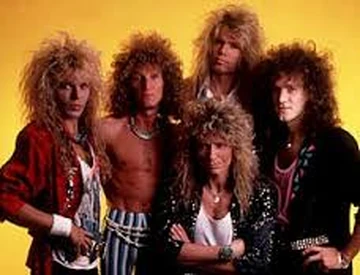
On the Strip, success depended as much on visual identity as on musical ability. Bands competed through virtuosic guitar playing, tightly arranged rhythms, and commanding vocal styles, but they also relied on deliberately designed images. Performers adopted long, heavily styled hair, makeup, leather or brightly colored clothing, and exaggerated accessories, often drawing on the fashion of 1970s glam rock. Stage productions incorporated pyrotechnics, synchronized lighting rigs, and extended guitar solos designed to hold audience attention. Groups such as Mötley Crüe, Ratt, and Poison translated virtuosic playing and glam-influenced spectacle into a format that later corresponded closely with MTV’s emphasis on visual presentation.
Musically, glam metal—also referred to as hair metal, pop metal, or more dismissively as “lite metal”—combined a traditional heavy metal foundation with elements of hard rock and punk while incorporating pop-oriented hooks. Songs typically featured distorted guitar riffs, rapid or tightly controlled rhythms, and prominent shred-style solos. At the same time, the overall sound leaned toward melody rather than the heavier, bass-driven textures associated with other metal subgenres. Vocal styles were generally smoother and more accessible, often supported by layered harmonies. These harmonies became especially prominent in power ballads, which followed a recognizable structure: a slow, emotionally focused opening that gradually intensified into a louder, anthemic conclusion. Power ballads frequently addressed romantic desire, heartbreak, or longing and became some of the genre’s most commercially successful releases, attracting listeners beyond the traditional heavy metal audience.
The lyrical content of glam metal centered on themes of pleasure, excess, and personal freedom. Songs regularly depicted nightlife, alcohol consumption, drug use, and casual sexual encounters, presenting the life of a touring musician as one of continuous indulgence. Many lyrics emphasized male sexual prowess, sometimes in ways critics viewed as objectifying or misogynistic. Alongside these themes, bands also produced songs about relationships, ranging from fleeting encounters to more sentimental expressions of attachment. Despite the variety of lyrical themes, the tone generally remained upbeat and geared toward entertainment, reinforcing an atmosphere of escapism in which listeners could imagine participation in a glamorous, exaggerated version of everyday life.
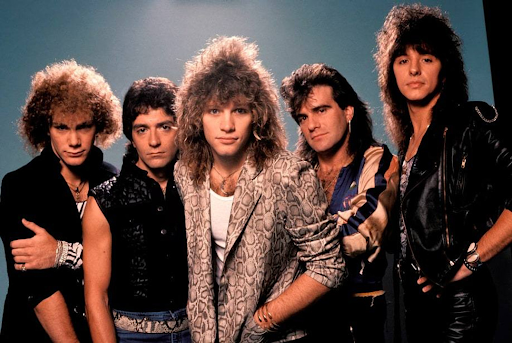
By the mid-1980s, a growing number of bands began achieving commercial success. In 1984 alone, several groups released debut albums that increased the reach of the genre, including Ratt’s Out of the Cellar, and the self-titled albums by Bon Jovi, Great White, Black 'n Blue, and W.A.S.P.. Two years later, the genre reached a new level of mainstream visibility with Bon Jovi’s Slippery When Wet (1986). The album combined metal instrumentation with a strong pop sensibility and spent eight weeks at number one on the Billboard 200, eventually selling more than fifteen million copies in the United States. It produced three Top 10 singles: “You Give Love a Bad Name” and “Livin’ on a Prayer”, both of which reached number one, and “Wanted Dead or Alive”, which peaked at number seven. The album’s success broadened the genre’s appeal, drew a significant female audience, and paved the way for greater MTV exposure and mainstream breakthroughs for similar bands throughout the late 1980s.
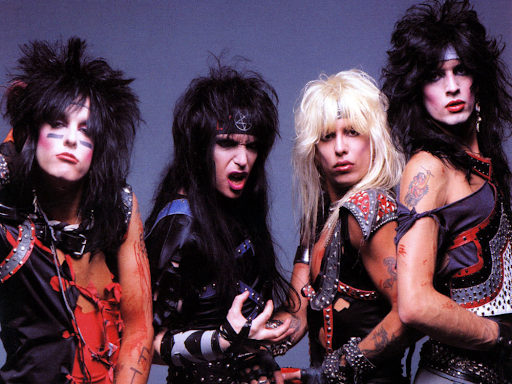
Within the broader metal scene, Mötley Crüe played a more aggressive and darker variant of the style. Their sound combined Vince Neil’s high-pitched vocals with Mick Mars’s heavily distorted guitar tone, Nikki Sixx’s bass lines, and Tommy Lee’s forceful drumming. Their 1983 track "Shout at the Devil" exemplifies their style through its driving riffs and chant-like refrains designed to encourage audience participation. Later videos, including “Kickstart My Heart,” presented the band through rapid editing, performance footage, and imagery centered on speed, danger, and excess, reinforcing their public image.
Poison developed a more overtly melodic and accessible style within the same scene. Originally formed in Pennsylvania, the band relocated to Los Angeles to take advantage of the Sunset Strip circuit. Their lineup—Bret Michaels (vocals), C.C. DeVille (guitar), Bobby Dall (bass), and Rikki Rockett (drums)—produced songs built around catchy hooks and steady, upbeat rhythms. Tracks such as “Talk Dirty to Me” (1987) and “Nothin' But a Good Time” (1988) presented a celebratory view of partying and leisure. Their music videos, widely broadcast on MTV, used bright colors, teased hairstyles, and playful, sexualized imagery, adding to their broad appeal and strong album sales, including a significant female fan base.
Media coverage during the mid-to-late 1980s frequently focused on the musicians' offstage behavior. Reports of drug use, late-night parties, and relationships with groupies appeared regularly in tabloids, reinforcing the lifestyle portrayed in their songs. Scholars and critics later grouped these bands under a variety of overlapping labels. Sociologist Deena Weinstein used the category of commercially oriented or “lite” metal to describe this cluster of styles, while critic Philip Bashe introduced the term “pop metal” in 1983 in reference to acts such as Van Halen and Def Leppard. Subsequent analyses, including research by Sam Dunn, distinguished between more polished pop metal bands—such as Europe and Whitesnake—and groups more closely associated with glam metal’s visual excess, including Mötley Crüe and Poison.
By the mid-to-late 1980s, glam metal had moved into the center of American popular media through MTV’s rapid growth. The network’s programming kept these bands in constant circulation: videos ran multiple times a day, often reaching the top of countdown segments, while Headbangers Ball drew weekly audiences exceeding one million viewers. Within MTV's programming environment, a song’s success depended on how well it translated into a repeatable visual format. Directors and bands worked with short runtimes, quick edits, and striking imagery that could register immediately, even when viewers encountered the video in fragments.
What developed was a tightly codified visual style built around the body. Performers wore heavy eyeliner, lipstick, teased hair, spandex pants, open vests, and leather clothing that exposed the chest and arms. The camera emphasized physical display as much as musicianship. It moved across guitar necks during solos, cut to close-ups of hands and torsos, and returned to singers whose gestures—hip thrusts, hair flips, direct stares into the lens—were timed to the beat. This visual language played with gender presentation: makeup and stylized clothing drew from earlier glam traditions, yet the framing of the shots kept male performers positioned as objects of heterosexual desire rather than destabilizing that framework.
Sexuality operated as a central organizing principle within these videos. Scenes were often set in bedrooms, backstage areas, or nightclubs, where the boundary between performance and intimacy remained deliberately unclear. Women appeared in lingerie, high heels, or figure-fitting outfits, frequently placed in close physical proximity to band members. The camera cuts between performance footage and staged moments of flirtation, dancing, or implied sexual access. Rather than building narrative complexity, these sequences repeated familiar visual cues: A woman’s invitation, her approach, the display of the female body, and the suggestion of sexual availability. Across repeated broadcasts, this structure produced a consistent fantasy in which fame granted immediate entry into a domain of sexual attention and excess.
Whitesnake’s “Here I Go Again” (1987) offers a clear example of how glam metal's sexualized imagery functioned. While singer David Coverdale performs the song, the video’s most recognizable sequence centers on the model Tawny Kitaen. Filmed in slow motion, she moves across the hood and windshield of a Jaguar, arching her body, kicking her legs upward, and maintaining direct engagement with the camera. The car, the lighting, and the pacing all frame her movement as a form of controlled display. The sequence does not advance a storyline; instead, it isolates a series of poses and motions that can be replayed and remembered independently of the song’s lyrics. The repeated sequence of poses condenses glam metal's emphasis on spectacle, sexuality, and repetition into a set of memorable images that circulated widely on MTV.
A different structure appears in Twisted Sister’s “We're Not Gonna Take It” (1984), which builds its impact through narrative and exaggeration. The video opens in a suburban dining room, where a strict father—played by Mark Metcalf—interrupts his son’s interest in rock music with a lecture about discipline and responsibility. When the boy responds, in singer Dee Snider’s voice, “I wanna rock,” the scene shifts abruptly. A guitar chord sends the father crashing backward, the child transforms into Snider, and the band enters the house. What follows is a sequence of staged destruction: furniture overturns, walls break apart, and the father is repeatedly thrown through windows and across rooms. The band’s appearance—makeup, wigs, and exaggerated clothing—draws on the same visual codes as glam metal more broadly, but here such elements are used to stage a confrontation with parental authority. The humor remains broad and physical, yet the structure is precise, with each visual gag timed to the song’s chorus and rhythmic accents.
Thrash Metal
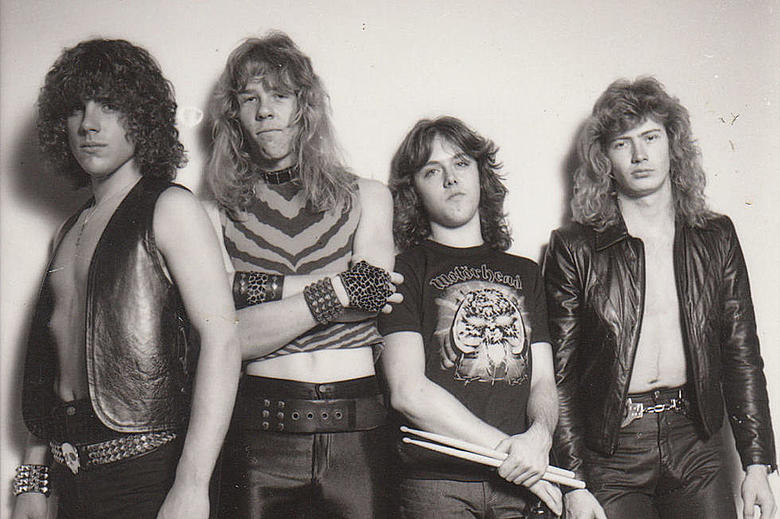
While glam metal celebrated excess and theatricality, thrash metal evolved as a musically aggressive, technically demanding counterpoint. Originating in the San Francisco Bay Area with bands like Metallica and Megadeth, and in New York with Anthrax, thrash fused speed, precision, and politically charged lyrics with punk-inspired aggression. Metallica, initially formed in Los Angeles before relocating north, drew on Black Sabbath’s heaviness and Led Zeppelin’s structural ambition, focusing on rapid tempos, intricate riffs, and virtuosic solos. Their 1986 album Master of Puppets exemplified thrash’s musical sophistication: palm-muted guitar riffs enabled lightning-fast precision under heavy distortion, while complex song structures and socially conscious lyrics explored issues such as drug abuse, personal manipulation, and war.
Metallica’s lineup—James Hetfield on rhythm guitar and vocals, Kirk Hammett on lead guitar, Lars Ulrich on drums, and Cliff Burton on bass—produced a fast, precise sound featuring rapid guitar picking and complex riffs. Burton’s use of melodic bass lines and classically influenced solos brought depth to the arrangements, while Hetfield and Hammett employed rapid alternate picking in their intricate riffing. Tracks such as “One,”“Battery,” and “Master of Puppets” showcased synchronized riffing, tempo shifts, and virtuosic guitar interplay, cementing Metallica’s reputation for technical mastery. Following Burton’s tragic death in 1986, Jason Newsted joined on bass, helping the band continue to release influential albums, including …And Justice for All(1988) and Metallica(The Black Album, 1991), which bridged thrash with mainstream audiences.
The LA metal scene, as a whole, cultivated an environment where image and musicianship were inseparable, although bands balanced the two in different ways. Glam metal acts relied on fashion, makeup, and choreographed spectacle to complement hook-driven songs, broadening their audience beyond traditional metal circles and attracting female fans and teenagers. Thrash bands, by contrast, prided themselves on speed, technicality, and lyrical substance, often avoiding overt spectacle to maintain underground credibility. Both approaches relied on MTV’s video format, which broadcast performances with costumes, choreography, or dynamic camera work to national audiences.
MTV gave heavy metal nationwide exposure, presenting glam metal and thrash acts to viewers across the United States. Hair metal bands such as Mötley Crüe, Poison, and Def Leppard flourished in the channel’s visually driven medium, where flashy outfits and high-energy performances matched their catchy hooks. Thrash bands like Metallica used the platform differently, offering performance-focused videos that featured complex guitar solos, aggressive drumming, and vocal intensity rather than sexualized narratives. In both cases, MTV magnified the connection between sound and image, molding how heavy metal was consumed and establishing new standards for its presentation to mass audiences.
Hardcore
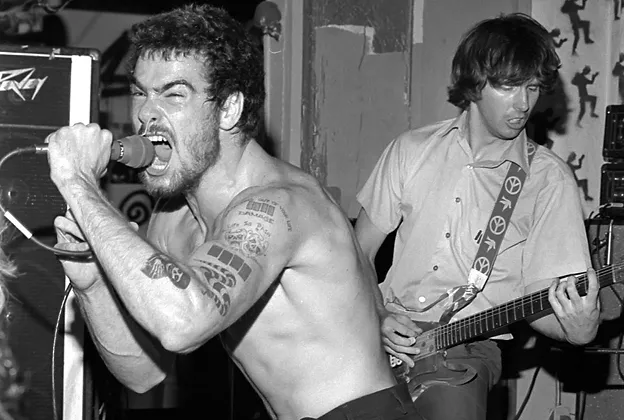
Bands such as the Sex Pistols and the Clash had already established the confrontational tone and stripped-down musical style that influenced the genre. A new generation of American groups pushed those qualities further, driving punk toward higher tempos and heavier volume. By the early 1980s, this style had become widely associated with the hardcore scene in Los Angeles and other West Coast cities. The music drew a devoted audience largely composed of white, middle- and working-class young men, whose presence influenced both the atmosphere at performances and the public reputation of the genre.
In the early 1980s, California became an important center of early hardcore. In San Francisco, the Dead Kennedys gained prominence, while Los Angeles produced influential groups such as the Germs, Black Flag, X, and Circle Jerks. Other bands soon appeared outside California as well, including the Texas-based Butthole Surfers. These performers intensified the rapid tempos and blunt musical structures heard in the work of Ramones and other early punk groups. Their songs were typically short and built around simple riffs played at extremely fast tempos, while shouted or barked vocals delivered sarcastic, confrontational lyrics over thick layers of distorted guitar.
The atmosphere at hardcore performances reflected the music’s ferocity. Fans often arrived with buzz cuts, tattoos, and combat boots, forming tightly packed crowds in front of the stage. Within the dense crowd, audiences developed the practice known as slam dancing, or moshing. Participants pushed their way toward the center of the crowd—an area known as the mosh pit—and collided with one another in a frenzied mass of humanity. It also became common for audience members to climb onto the stage and leap back into the crowd in a practice later known as stage diving. The physical intensity of these concerts contributed to the reputation of hardcore shows as volatile, highly masculine environments.
Hardcore recordings circulated largely outside the major-label system. Most releases were issued by independent companies such as SST Records, Alternative Tentacles, and I.R.S. Records. The records themselves often sounded rough and unrefined, and their packaging frequently appeared homemade. Rather than viewing the rough presentation as a flaw, fans treated it as evidence that the music remained entrenched in an underground network rather than controlled by commercial expectations.
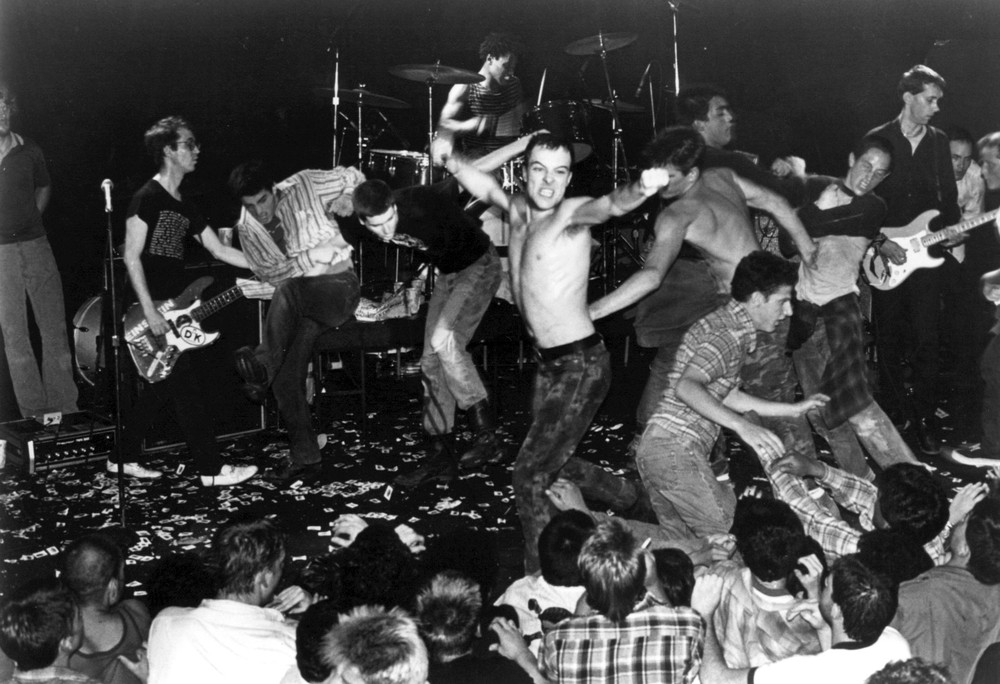
A widely cited example of early hardcore sensibility appears in “Holiday in Cambodia” by Dead Kennedys. The song first appeared on the album Fresh Fruit for Rotting Vegetables, released in the United Kingdom in 1980 and issued in the United States the following year through Alternative Tentacles. Written by the band’s singer Jello Biafra (Eric Boucher, born 1958 in Boulder, Colorado), the lyrics employ biting sarcasm directed at privileged suburban youth. In the song, Biafra proposes sending these comfortable teenagers to forced-labor camps in Cambodia—then under the genocidal rule of Pol Pot—so they might gain perspective on the scale of their own complaints. The recording begins with a barrage of guitar effects reminiscent of Jimi Hendrix's playing, including squealing feedback, sliding notes, and distorted bursts that invoke the turmoil of a battlefield. Gradually, the band—guitar, bass, and drums—accelerates to an extremely rapid tempo of roughly 208 beats per minute, while Biafra delivers the lyrics in a nasal, taunting voice.
Political commentary occupied a central place in the Dead Kennedys’ work. Their songs criticized American foreign policy, environmental destruction, and what they viewed as the hypocrisy of suburban life. Titles such as “California Über Alles,” “Kill the Poor,” and “Chemical Warfare” combined dark humor with pointed social criticism. As the hardcore scene began to attract racist skinhead factions—a problem that had also surfaced in parts of the earlier punk movement—Biafra responded with the 1981 song “Nazi Punks F--- Off,” which attempted to push white supremacist groups out of the scene and distinguish progressive skinheads from fascist organizations. The band's original lineup dissolved in 1986 following a widely publicized obscenity trial stemming from graphic artwork on their 1985 album Frankenchrist.
The PMRC
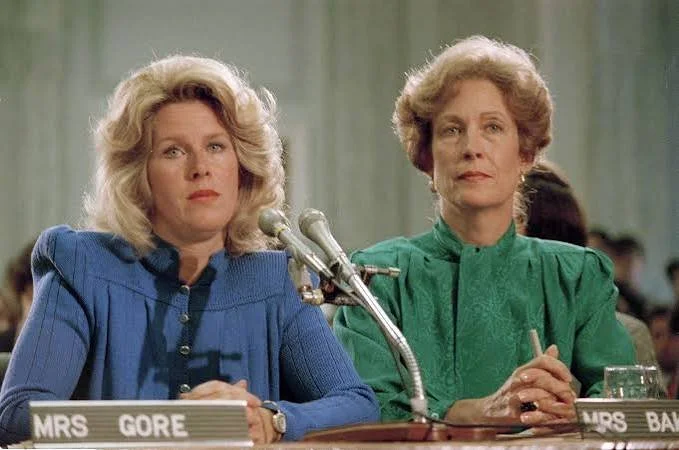
As popular music and music videos became increasingly central to youth culture in the early 1980s, concerns about its potential moral influence grew among parents and political figures. In 1985, the Parents Music Resource Center (PMRC) was founded as a bipartisan initiative to give parents greater control over children’s access to music containing sexual, violent, or drug-related content. The impetus for the organization arose in part from co-founder Tipper Gore (wife of Senator and later Vice President Al Gore), who reportedly became alarmed after hearing her 11-year-old daughter listening to Prince’s “Darling Nikki,” a sexually explicit track from the 1984 album Purple Rain. Gore and her fellow founders—Susan Baker (wife of Treasury Secretary James Baker), Pam Howar (wife of Washington realtor Raymond Howar), and Sally Nevius (wife of former Washington City Council Chairman John Nevius), collectively known as the “Washington Wives”—sought to protect children from what they viewed as harmful influences in popular music, particularly hard rock, heavy metal, and sexually charged pop.
Supported by conservative political and religious networks, including televangelists and Reagan-era figures, the PMRC argued that lyrics and videos containing sex, drugs, or violence could have a corrupting influence on youth. With financial and logistical support from prominent individuals such as Mike Love of the Beach Boys and Joseph Coors, a member of the Coors Beer family and co-founder of the conservative Heritage Foundation, the group gained access to political connections and office space in Washington, D.C., enabling them to organize a national campaign to regulate music content.
The PMRC launched a national campaign to pressure the music industry into adopting content warnings, proposing measures modeled on the Motion Picture Association of America’s film rating system. Their recommendations included printing warnings and lyrics on album covers, restricting explicit albums to designated areas in stores, discouraging television stations from airing certain videos, and establishing panels to set industry standards. In 1985, the group released the notorious “Filthy Fifteen,” a list of songs deemed most objectionable for their sexual, violent, or occult content. The list spanned heavy metal and hard rock bands such as Judas Priest, Mötley Crüe, AC/DC, W.A.S.P., Twisted Sister, and Mercyful Fate, as well as pop artists such as Madonna, Sheena Easton, Prince, and Cyndi Lauper.
The controversy reached its peak during Senate hearings on September 19, 1985, convened by the Commerce, Science, and Transportation Committee to examine concerns over “porn rock” and explicit recordings. Senators linked to the PMRC, including Al Gore and Ernest Hollings, participated in the meeting. At the same time, supporters like Paula Hawkins presented albums and music videos—including Van Halen’s “Hot for Teacher” and Twisted Sister’s “We’re Not Gonna Take It”—as evidence of moral degradation in popular culture. Expert testimony included music professor Dr. Joe Stuessy, who described heavy metal as a form of “church music” rooted in hatred (although he would later write an influential textbook on Rock Music history), and psychiatrist Dr. Paul King, who spoke about the idolization of metal musicians among youth. The hearings offered a highly public forum for moral and cultural debates surrounding popular music.
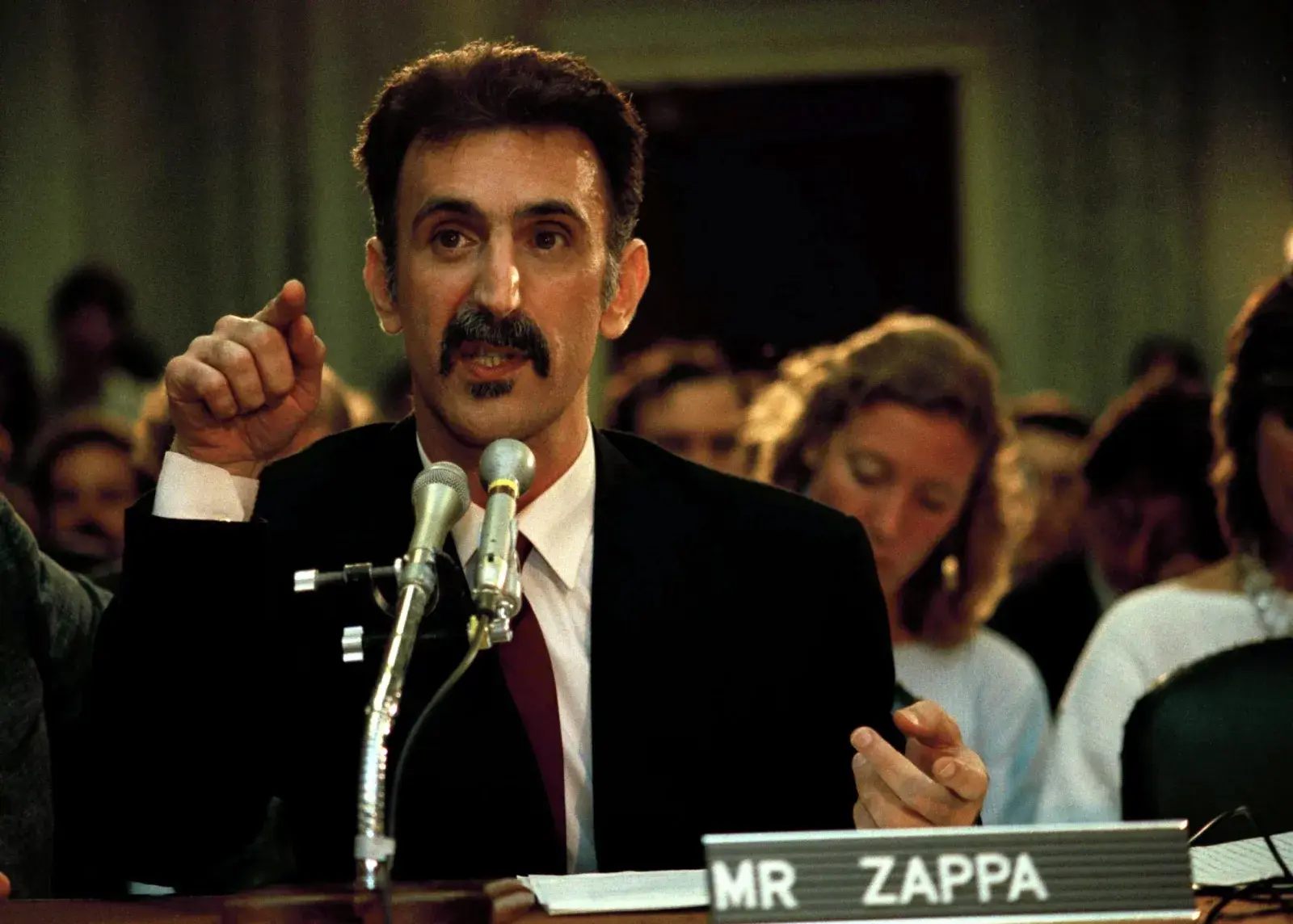
Opposition voices challenged the PMRC’s campaign and the broader threat of censorship. The eclectic composer and guitarist Frank Zappa criticized the proposal as “an ill-conceived piece of nonsense” that infringed upon civil liberties, suggesting the hearings were a pretext for the Home Audio Recording tax bill. Singer-songwriter John Denver argued that censorship was counterproductive, noting that forbidding music often made it more appealing to young listeners. Dee Snider of Twisted Sister defended his songs “Under the Blade” and “We’re Not Gonna Take It,” clarifying that the PMRC had misinterpreted lyrics addressing surgery and general frustration rather than sadomasochism or violence. Zappa later incorporated excerpts from the hearings into his audio collage “Porn Wars” on Frank Zappa Meets the Mothers of Prevention, responding to the contentious cultural debate surrounding the PMRC.

In response to the hearings and mounting political pressure, the Recording Industry Association of America (RIAA) introduced a voluntary system on November 1, 1985, to label albums containing explicit sexual, violent, or drug-related content. The initial labels were fairly generic, offering no detailed explanation of the specific material, but they quickly became recognizable to consumers and retailers. By 1990, the system had been standardized as the “Parental Advisory: Explicit Content” sticker—commonly referred to as the “Tipper Sticker.” While the label’s primary purpose was to inform parents about potentially objectionable material, it often had the opposite effect commercially: by marking specific albums as “restricted,” it made them seem more enticing to teenagers and young adults, creating a “forbidden fruit” effect—an allure driven by the very sense of prohibition.
Chapter 33: Conclusion
Beginning with Motörhead in the late 1970s, British heavy metal absorbed the raw energy and aggression of punk, accelerated tempos, sharpened guitar riffs, and brought a more confrontational stage presence. Bands such as Iron Maiden explored historical battles, apocalyptic narratives, and other macabre subjects, while groups like Def Leppard and Poison paired heavy guitar work with accessible melodies and lyrics centered on romance, partying, and the rock lifestyle. Across the Atlantic, Los Angeles became the incubator for American metal, producing acts such as Mötley Crüe, Van Halen, and Guns N’ Roses, whose mixture of technical skill, theatricality, and flamboyant image helped fashion the glam metal subgenre.
At the same time, other bands rejected the polished glamour of Los Angeles in favor of heavier, more aggressive styles. Metallica, Slayer, Megadeth, and Anthrax led the thrash metal movement. Thrash’s intensity offered a stark contrast to the anthemic and party-oriented focus of glam metal, appealing to fans seeking speed, precision, and a sense of authenticity rooted in raw performance rather than spectacle. Hardcore punk similarly intersected with metal, emphasizing minimalism, speed, and direct political or social commentary, influencing a generation of crossover acts and underground scenes.
The visibility of metal and its subgenres drew both fascination and criticism in the 1980s, particularly from moral watchdogs such as the PMRC (Parents Music Resource Center). The PMRC publicly challenged the content of heavy metal and glam metal lyrics, citing themes of sex, drugs, and rebellion as corrupting influences on youth. Bands responded in different ways: Twisted Sister’s “We’re Not Gonna Take It” directly satirized authority figures, using exaggerated visual comedy and destruction to push back against censorship, while other acts leaned into theatrical exaggeration, using sex and spectacle to amplify their cultural visibility. The PMRC hearings and wider censorship debates only increased metal's profile, generating broader public attention and, paradoxically, strengthening its fan base.
By the early 1990s, heavy metal had diversified into a spectrum of sounds and images. Glam metal had reached the peak of its commercial success and paved the way for MTV-driven visual culture, while thrash and hardcore bands cultivated loyal followings through underground networks and independent labels. A few acts transcended niche boundaries, achieving mainstream popularity and even collaborating with artists from pop and hip-hop, including Michael Jackson, Run-DMC, and the Beastie Boys.
Heavy metal, which had seemed marginal at the beginning of the decade, rapidly gained listeners as the 1980s progressed. By 1983, metal accounted for about 8 percent of U.S. record sales. A year later, it reached roughly 20 percent. Bon Jovi’s 1986 album Slippery When Wet topped the charts for eight weeks and sold over twelve million copies worldwide. By the close of the decade, the genre had become a major commercial presence; in many weeks during the late 1980s, heavy metal albums accounted for roughly half of the titles appearing in the Top 20 of the Billboard album charts. The commercial success of heavy metal and MTV-driven promotion demonstrates how MTV’s growing influence and the expanding market for rock and metal altered the music industry during the decade.
Chapter 33: Further Reading
Adler, Steven. My Appetite for Destruction. New York: HarperCollins, 2011.
Bashe, Philip. Heavy Metal Thunder. Garden City, NY: Doubleday, 1985.
Beebe, Roger, and Jason Middleton, eds. Medium Cool: Music Videos from Soundies to Cellphones. Durham: Duke University Press, 2007.
Björnberg, Alf. “Structural Relationships of Music and Images in Music Video.” Popular Music 13, no. 1 (1994): 51–74.
Chastagner, Claude. “The Parents’ Music Resource Center: From Information to Censorship.” Popular Music 17 (1999): 179–92.
Crocker, Chris. Metallica: the Frayed Ends of Metal. New York: Omnibus, 1993.
Cutietta, Robert. “Rock Music Gets a Label.” Music Educators Journal 72, April (1986): 36–38.
Denisoff, R. Serge. Inside MTV. New Brunswick, NJ: Transaction, 1988.
Frith, Simon. “Only Dancing: David Bowie Flirts with the Issues.” In Zoot Suits and Second Hand Dresses, edited by Angela McRobbie, 132–40. London: Macmillan, 1989.
———, Andrew Goodwin, and Lawrence Grossberg, eds. Sound and Vision: The Music Video Reader. New York: Routledge, 1993.
Goodwin, Andrew. Dancing in the Distraction Factory: Music Television and Popular Culture. Minneapolis: University of Minnesota Press, 1992.
Hale, Mark. Headbangers: the Worldwide MegaBook of Heavy Metal Bands. Ann Arbor: Borders, 1993.
Hoskyns, Barney. Waiting for the Sun: Strange Days, Weird Scenes, and the Sound of Los Angeles. New York: Backbeat Books, 1999.
Kaplan, E. Ann. Rocking around the Clock: Music Television, Postmodernism and Consumer Culture. New York: Methuen, 1987.
Lewis, Lisa. Gender Politics and MTV: Voicing the Difference. Philadelphia: Temple University Press, 1990.
McCombe, John. “Authenticity, Artifice, Ideology: Heavy Metal Video and MTV’s ‘Second Launch’, 1983–1985.” Metal Music Studies 2, no. 3 (2016): 405–11.
Obrecht, Jas. Masters of Heavy Metal. New York: Miller Freeman, 1984.
Shore, Michael. The Rolling Stone Book of Rock Video. London: Rolling Stone Press, 1984.
United States Senate. Record Labeling: Hearing before the Committee on Commerce, Science, and Transportation. Washington, DC, 1985.
Vernallis, Carol. Experiencing Music Videos: Aesthetics and Cultural Context. New York: Columbia University Press, 2004.
Walser, Robert. Running with the Devil: Power, Gender, and Madness in Heavy Metal Music. Hanover, NH: University Press of New England, 1993.
Weinstein, Deena. Heavy Metal: A Cultural Sociology. New York: Lexington, 1991.
———. Heavy Metal: The Music and Its Culture. 2nd rev. ed. New York: Da Capo, 2000.