Chapter 7: Swing and Big Bands

Chapter 7: Introduction

In the aftermath of World War I, the United States entered a period of rapid economic growth and cultural change, commonly called the “Roaring Twenties.” Although the war began in Europe in 1914, the U.S. initially remained neutral. However, that changed in 1917, when a combination of factors—including Germany’s unrestricted submarine warfare, the sinking of the Lusitania, and the interception of the Zimmermann Telegram—pushed the U.S. to join the Allies in the war effort. American troops arrived on the Western Front in 1918, tipping the balance of the conflict and helping to bring the war to an end. More than four million Americans served in the global conflict, and over 100,000 lost their lives. Domestically, the war had significant impacts, including the acceleration of industrialization and urban migration, which set the stage for the economic expansion of the 1920s.
The post-war era saw rapid urbanization, the expansion of consumer culture, and the rise of new technologies like radio, talking films, and phonographs. In 1927, the release of the first talking motion picture, The Jazz Singer, known initially as a “talkie,” revolutionized the film industry and signaled the growing importance of synchronized sound in entertainment. While the film introduced synchronized sound to mainstream cinema, it was also a reflection of the era's entrenched racism. The movie’s star, Al Jolson, famously performed in blackface, echoing minstrel traditions that remained embedded in American popular culture.
Prohibition, enacted in 1920 through the Eighteenth Amendment and the Volstead Act, grew out of decades of temperance activism by religious leaders, progressives, and women’s groups, who associated alcohol with crime, poverty, and moral problems. The reformist impulse toward temperance had already appeared in American music by the mid-nineteenth century. Groups like the Hutchinson Family Singers, best known for their abolitionist anthems, also performed songs supporting temperance, using their music to rally public support and portray drinking as both a personal vice and a societal evil. One popular example was the song, “Lips that touch liquor shall not touch mine,” based on a slogan that became a widely circulated musical catchphrase for the movement. The temperance cause gained further traction during World War I, when anti-German sentiment targeted breweries and wartime austerity encouraged national sobriety.
Although Prohibition was intended to instill discipline and moral order, it ultimately produced the opposite effect. A vast underground economy sprouted around bootlegging and speakeasies, secret bars where illegal alcohol flowed freely and live jazz reigned. In cities like Chicago and New York, jazz musicians found consistent work in these venues, where their energetic, improvisational music provided the soundtrack for dancing, drinking, and protest. As jazz became associated with youthful rebellion and city refinement, it moved from the margins to the mainstream. Americans turned to this form of entertainment to embrace modern life. It also exposed African American musical traditions to wider audiences, though segregation restricted recognition and opportunities for many performers.

The cultural high of the Roaring Twenties came to a sudden halt on October 29, 1929, Black Tuesday, when the stock market crashed, and the nation plunged into the Great Depression. Over the next few years, economic devastation swept the country. Nearly 25,000 banks failed, 30,000 businesses closed, and by 1931, more than 10 million Americans were unemployed. Bread lines, soup kitchens, and free milk depots became part of daily life as families struggled to survive in a nation where prosperity had formerly seemed boundless.

The impact on the music and entertainment industries was swift and severe. Record sales plummeted. In 1921, Americans spent over $100 million on records; by 1933, that number had dropped to just $6 million. Many nightclubs, theaters, and dance halls shut down, and concert attendance reached historic lows. In an era of shrinking paychecks and growing uncertainty, music, particularly live music, had to adapt to survive.
Despite the economic turmoil, technological advances in music and media created new possibilities. By the 1930s, electric phonographs had replaced hand-cranked models, offering improved sound quality. The 78 RPM shellac disc, which had become the standard format for records by the 1920s, made recorded music more portable and accessible. Electric phonographs and 78 RPM records allowed swing and big band music to circulate widely across the country, even as many Americans faced economic hardship.
Swing emerged amid the economic hardship and cultural reinvention of the Great Depression. Swing drew on blues, ragtime, and dance band traditions, creating a sound that suited changing patterns of popular entertainment in the 1930s. Swing combined musical style with dance culture, providing energy and social gathering spaces while influencing American popular music. The big band, a larger, more orchestrated ensemble than the small jazz combos of the 1920s, became the primary vehicle for this sound. These bands featured arranged music, powerful horn sections, and driving rhythms designed to keep the audience moving.
As we’ll see in the chapter ahead, swing became the soundtrack of the 1930s and early 1940s, offering joy and escapism during one of the most challenging periods in American history. It also marked a turning point in the integration of American popular music, as Black and white musicians began to influence and collaborate in new, though still unequal, ways. Music came directly into homes through radio, making the sounds of swing and big bands accessible to a broad audience, regardless of location or social status. It was a time when music became increasingly structured and reached larger audiences, spreading widely across the country and influencing patterns of American cultural engagement.
The Radio

As the Great Depression gripped the United States in the 1930s, many Americans found themselves with less disposable income, which dramatically changed the way they consumed music. Many could no longer afford to purchase records, attend concerts, or visit nightclubs regularly. However, one form of entertainment remained widely accessible and affordable: the radio.
Radio emerged as a central way for Americans to hear and share music during the Swing Era. By the early 1930s, radio had entered its so-called “Golden Age,” and households across the country gathered around the radio not only for news and variety programs, but also for live music broadcasts. National networks like NBC and CBS expanded rapidly, connecting local stations into coast-to-coast networks that enabled millions of Americans to hear the same music simultaneously, often in real-time.
One of the most influential uses of the radio during this era came from President Franklin D. Roosevelt, who delivered a series of informal addresses known as “fireside chats’’. These broadcasts, which began in 1933, were designed to reassure the American public, explain complex policies like the New Deal, and build trust in a time of widespread hardship. The “fireside chats’’ demonstrated the power of radio to reach the entire nation. Roosevelt’s warm, conversational tone helped humanize the presidency and made listeners feel as though the President spoke directly to them in their own living rooms.
No big band could succeed without radio exposure. Bands were featured on the air in various formats. Some broadcasts were live transmissions from dance halls, hotels, and ballrooms, where the band performed before a live audience. Others took place in radio studios, where bands played specially arranged sets for radio listeners. These performances helped build the national reputations of bandleaders and musicians, turning many into household names.
In addition to live performances, radio shows such as Your Hit Parade and The Make-Believe Ballroom played phonograph records on the air, exposing listeners to hit songs even if they couldn’t afford to buy the records themselves. The shift toward broadcasting phonograph records helped popularize recorded music and laid the groundwork for the Top 40 radio format that would emerge in later decades.
Radio introduced swing music to audiences across the country, making it accessible to listeners in cities and rural areas, and to those with limited income. Even those living in rural areas or under financial strain could hear the latest tunes, follow their favorite bands, and feel connected to a broader national culture.
Society Syncopators
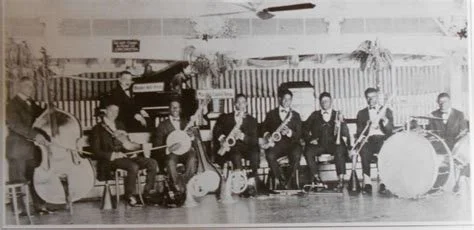
Before swing music and big bands took center stage in the 1930s, a rich tradition of large dance ensembles had already existed, performing in restaurants, nightclubs, riverboats, and dance halls throughout the 1920s. These groups were commonly referred to as “society syncopators.” Whether Black or white, these bands provided popular music for dancing and socializing, providing a bridge between early jazz combos and the more structured swing orchestras that would follow.
Instead of focusing on improvisation or solo virtuosity, society syncopator bands focused on continuous performances of familiar tunes. Their role was to entertain and maintain a danceable atmosphere, providing a background of lively yet controlled music for diners, dancers, and partygoers. Because their primary purpose was to serve the space's social function, these bands rarely featured dramatic musical moments. Instead, they performed tight, polished arrangements that prioritized rhythm and melody over improvisational and harmonic experimentation.
One of the best-known society bands of the time was Fate Marable’s Society Syncopators. In 1924, his band featured a nine-piece lineup that included piano, drums, banjo, and tuba in the rhythm section, along with a trumpet, trombone, tenor saxophone, and two alto saxophones in the front line. Several musicians also doubled on instruments like the violin or mellophone, a piston valve instrument shaped like an oversized trumpet that sounds similar to a French horn. Louis Armstrong was among the many notable musicians who passed through Marable’s band, performing aboard riverboats that traveled up and down the Mississippi River, connecting New Orleans to Chicago and the broader Midwest.
These society bands had a presence across most of America's major cities. In New Orleans, Chicago, and New York, venues regularly featured these groups, serving high society and contributing to the popular soundscape of the era.. Interestingly, most society syncopator bands did not include the word “jazz’’ in their names. This was intentional. For many venues and audiences, “jazz” still carried connotations of rowdiness, unpredictability, or associations with lower social classes. A few bandleaders used the term “jazz” selectively, often to suggest that their ensemble included talented improvisers capable of occasional solos. However, even then, their primary goal remained clear: to deliver high-energy dance music that would keep the crowd on its feet. Although society syncopator bands rarely pursued musical innovation for its own sake, they established professional standards for ensemble coordination and entertainment practices that became central to big band swing in the 1930s.
Big Bands

By the mid-1920s, several bands began moving away from the controlled and reserved style of the society syncopators. Although these new groups still played music suitable for dancing, their sound grew bolder, more intricate, and increasingly focused on the talents of individual soloists and arrangers. would establish the dominant sound of the Swing Era in the 1930s and 1940s.
Big band instrumentation began to assume its familiar form during this period and was fairly standardized by the mid-1930s. Most bands featured a rhythm section consisting of piano, guitar, string bass, and a drum set. The brass section typically included three trumpets, with the second trumpet often taking the lead on solos, and two trombones. The reed section generally consisted of four saxophones—first and third alto, and second and fourth tenor—with the second tenor frequently serving as the featured soloist. Although specific instrument combinations varied among ensembles, this general layout became the blueprint for most swing orchestras. The large number of players enabled richly layered textures, dynamic call-and-response passages between sections, and intricate arrangements that seamlessly blended tight ensemble playing with moments of individual improvisation.
As these bands began to develop distinct personalities and musical trademarks, they were often labeled with vivid, racially coded language by journalists. For instance, some writers referred to driving rhythms and dense textures of their music as "jungle sounds", especially when describing the more primal, percussive, and blues-inflected styles of Duke Ellington's band at New York's Cotton Club. While the term often carried racialized stereotypes, it also conveyed the unfiltered energy and complexity that distinguished these new big bands from earlier, more restrained dance orchestras.
Fletcher Henderson

Fletcher Henderson was one of the most important and often underappreciated architects of big band jazz. Born into a middle-class African American family in Cuthbert, Georgia, Henderson received early musical training from his mother, who taught him classical piano. He went on to earn degrees in chemistry and mathematics from Atlanta University and, in 1920, moved to New York City to pursue graduate studies in chemistry at Columbia University.
However, Henderson’s path quickly shifted toward music. In 1921, he accepted a job at Henry Pace’s Black Swan Phonograph Company, the first Black-owned recording label to focus on producing race records. There, Henderson served as a piano accompanist, bandleader, and eventually recording manager. At Pace’s suggestion, he formed a touring band to support Ethel Waters, whose early records were struggling to gain traction. That experience launched his full-time music career.
After returning to New York, Henderson began assembling a permanent ensemble featuring some of the most skilled and educated musicians of the time, many of whom were college graduates who could read music fluently and play multiple instruments. In 1924, his newly formed Fletcher Henderson Orchestra began a long-term residency at the Roseland Ballroom in midtown Manhattan, a popular venue catering to whites-only patrons during this segregated era.
Their music centered on a steady four-four rhythmic pulse that provided a consistent foundation for both ensemble passages and improvised solos. Within this framework, they employed call-and-response exchanges between the brass and reed sections, creating dynamic contrasts and a sense of dialogue within the band. Unison riffs were often placed beneath soloists, reinforcing the groove while spotlighting individual improvisation. Sudden key changes, transitional interludes, and full-band climaxes all contributed to a heightened sense of drama and structural coherence. Henderson's use of call-and-response, riffs, and sectional contrast became the structural and aesthetic blueprint for the Swing Era.
Henderson’s arrangements were meticulously rehearsed yet held space for improvisation, striking a balance between precision and spontaneity. Despite his musical brilliance, Henderson struggled with management and finances. In 1934, economic pressures forced him to sell many of his arrangements to the white bandleader Benny Goodman, who would later become known as the “King of Swing.” These arrangements, including “King Porter Stomp” and “Blue Skies,”became massive hits for Goodman and introduced Henderson’s musical ideas to a much broader audience.
In 1939, Henderson officially joined Goodman's band as a full-time staff arranger, continuing to influence the sound of swing from behind the scenes. Although he never achieved the same level of fame as some of his contemporaries, his techniques became standard practice in big band arranging and were widely adopted by later bands. However, the latter part of Henderson's career was marred by hardship. A serious car accident in 1928 limited his ability to lead bands, and in 1950, a stroke left him partially paralyzed until he died in 1952. Nonetheless, Fletcher Henderson laid the stylistic and structural groundwork upon which swing was built.
Duke Ellington

Edward Kennedy “Duke” Ellington (1899–1974) composed and arranged music that expanded the capabilities of jazz orchestration. More than just a bandleader or pianist, Ellington was a musical architect who developed new ways of orchestrating jazz for large ensembles. While many of his contemporaries focused on arranging popular tunes for dance audiences, Ellington distinguished himself by writing original music that emphasized each musician’s strengths and made use of the orchestra’s tonal range.
Ellington arrived in New York City in the early 1920s and, from 1923 to 1927, led his ensemble, the Washingtonians, at the Hollywood Club on Broadway and 39th Street. In 1927, his group—now enlargened to a 14-member orchestra—was hired as the house band at the Cotton Club, an upscale Harlem nightclub catering to white patrons only. Though the venue's racial dynamics were troubling, the engagement gave Ellington a national platform and led to regular live radio broadcasts that brought his music directly into homes across America.
One of Ellington's most significant innovations was his focus on tone, color, and timbre. He encouraged his musicians to use a variety of mutes, particularly the plunger mute. Ellington's sonic experimentation gave his music a textural richness that stood apart from the more formulaic dance bands of the era. The press often described Ellington's sound as "jungle music"—a label promoted in advertisements. While the term played into racist stereotypes and exoticized the music for white audiences, Ellington combined instruments in new ways to produce previously unheard textures, without accepting the dehumanizing connotations. He saw sound as storytelling, and he was constantly seeking new combinations of instruments and voices to tell those stories.
At the Cotton Club, Ellington was expected to compose a steady stream of new material, including dance numbers, theatrical interludes, and blues-inspired mood pieces. His orchestra featured an all-star lineup, including Cootie Williams and Bubber Miley on trumpet, Johnny Hodges on alto saxophone, Harry Carney on baritone saxophone, Barney Bigard on clarinet, and Joe "Tricky Sam" Nanton on trombone. The stable core of musicians allowed Ellington to write parts specifically tailored to their musical strengths. Works like "Concerto for Cootie" and "Jeep's Blues" were composed to feature the distinctive artistry of Cootie Williams and Johnny Hodges, respectively. These long-form solos gave individual musicians space to develop their ideas while strengthening the ensemble's collaborative cohesion.
One of Ellington's most iconic pieces from the Cotton Club era is "Old Man Blues", which was prominently featured in the 1930 film Check and Double Check. Despite the title, the piece does not follow the 12-bar blues structure. Instead, it is an example of Ellington's freely composed forms, where short solos are layered with instrumental riffs and shifting tone colors. The arrangement uses plunger mutes, growling brass, and contrasting textures to keep the listener's ear engaged from start to finish. In contrast to other Ellington pieces that might feature a single soloist for an extended stretch, "Old Man Blues" relies on a series of short, dynamic solos punctuated by ensemble interjections, showcasing Ellington's mastery of pacing and orchestration.
Throughout his career, Ellington challenged the boundaries between jazz and classical music, as well as between entertainment and art. His innovations in composition, orchestration, and bandleading influenced Swing Era performance and elevated jazz as a respected art form. He composed over 1,000 works, ranging from short songs to extended suites and sacred music. Even after his time at the Cotton Club ended, Duke Ellington remained a dominant figure in American music until his death in 1974, leaving a body of work that continues to influence composers and performers in the jazz idiom.
The Harlem Renaissance

The Harlem Renaissance was a cultural movement that emerged in the aftermath of World War I and the Great Migration, which brought large numbers of African Americans from the South to urban centers such as Harlem, New York. During the 1920s and early 1930s, Harlem became a center for African American art, literature, and music, fostering creative experimentation and public celebration of Black identity. The movement celebrated Black identity and challenged dominant racial stereotypes that persisted two generations after the abolition of slavery through poetry, prose, visual art, performance, and especially music. Intellectuals such as Alain Locke promoted artistic independence and self-expression through works like The New Negro (1925), encouraging writers and artists to explore African American identity and social experience.
Writers, visual artists, and musicians created work that explored African American life, identity, and resilience, addressing social and cultural concerns through poetry, art, and performance. Writers such as Langston Hughes, Zora Neale Hurston, and Claude McKay used their literary voices to examine themes of heritage, resilience, and everyday life. Visual artists, including Aaron Douglas, blended African motifs with modernist aesthetics to create a new visual language for Black identity. Through literature, visual art, and music, they challenged racist caricatures and presented nuanced portrayals of everyday life in black communities. The Great Depression reduced the movement’s activity, but writers and musicians continued to influence American cultural life and inspire later civil rights activism.
Within this flourishing artistic community, Duke Ellington became a leading musician during the Harlem Renaissance, performing and composing works that reached wide audiences. His sophisticated compositions and groundbreaking use of tone color elevated jazz to a new artistic level, challenging prevailing assumptions about the “primacy” or simplicity of African American music. Ellington's collaborations with Black writers and artists positioned him not only as a pioneering musician but also as a central cultural voice within a movement determined to assert the value, depth, and humanity of Black life in America.
Paul Whiteman

While African American bandleaders like Fletcher Henderson and Duke Ellington were central to the development of big band jazz, the first bandleader to achieve widespread stardom and commercial success in the swing genre was Paul Whiteman (1890–1967). A classically trained violinist and conductor, Whiteman was dubbed the "King of Jazz"—a title that, while exaggerated and often rejected by Whiteman, acknowledges the influential role he played in popularizing jazz-influenced music among white, middle-class audiences during the 1920s and early 1930s
Whiteman famously declared that he wanted to "make a lady out of jazz", expressing his intent to refine and legitimize the genre by adapting it for symphonic settings and formal concert performances. Contrary to the blues-driven, improvisatory bands led by Black musicians, Whiteman emphasized polished arrangements, complex harmonies, and tightly controlled performances. His music was more likely to be heard in concert halls and theaters than in dance clubs or roadhouses, and it often resembled light classical music with subtle traces of jazz rhythm and syncopation.
Whiteman's success was deeply determined by the racial relations of the time. As a white musician operating in a segregated music industry, he was granted access to performance venues, media platforms, and recording opportunities that were often denied to Black bandleaders. His race allowed him to present a "respectable' version of jazz to mainstream audiences, making the genre more palatable to conservative listeners while drawing from the innovations of African American musicians whose contributions often went uncredited or undercompensated.
Despite his conservative musical style, Whiteman played an important role in the careers of several future jazz legends. His orchestra included Jimmy and Tommy Dorsey, Frankie Trumbauer, and Jack and Charlie Teagarden, all of whom went on to become significant figures in swing and big band music. He also championed composers like George Gershwin, famously commissioning Rhapsody in Blue in 1924—a landmark work that blended classical forms with jazz idioms and helped "legitimize' jazz as a serious art form.
Whiteman was a frequent presence in early radio broadcasts and sound films, and his large orchestra became one of the most recognizable symbols of American popular music in the pre-swing era. Although he played a more minor role in the more rhythmically intense swing revival of the 1930s and 1940s, his influence lingered. Many of the white big band musicians who came to prominence during that period were either directly trained by Whiteman or influenced by the musical culture he helped establish.
Whiteman's legacy remains complicated. He introduced jazz elements to a broader public and and helped establish the early sound of American popular music, yet his prominence was made possible by a racially unequal system that marginalized the very musicians who created the music he profited from. Nonetheless, his role in directing the public perception of jazz and nurturing the careers of key musicians secured his status as a significant figure in the history of big band music.
Benny Goodman

The Jewish clarinetist and bandleader Benny Goodman became one of the most iconic figures of the Swing Era. Goodman, known for his flawless technique, musical discipline, and drive for perfection, played a central role in bringing swing music to mainstream American audiences and in popularizing jazz as a respected art form.
In 1934, Goodman formed a new orchestra and auditioned for a national radio program called Let's Dance, sponsored by the National Biscuit Company (Nabisco). The show aired on NBC on Saturday nights and gave Goodman's band unprecedented exposure. The ensemble quickly became a favorite among radio listeners across the country. By 1935, during the height of his popularity, the respected jazz magazine Metronome named the Benny Goodman Band the "Best Swing Band of the Year," and major newspapers soon began referring to him as the "King of Swing."
Goodman's popularity soared in the late 1930s. He hosted two prominent radio programs, "Let's Dance" and "The Camel Caravan," which further augmented his national audience. His music reached Hollywood as well, with appearances in films like Hollywood Hotel (1937). One of his most famous recordings, the explosive instrumental version of Louis Prima's "Sing, Sing, Sing (With a Swing)" (1937), became a swing anthem. During a 1935 performance at the Palomar Ballroom in Los Angeles, the audience's response to "Sing, Sing, Sing" was so enthusiastic that the dancers stopped to gather near the stage and watch the band, signaling that swing music had become a spectacle more than just dance music.
While Goodman demanded discipline and excellence from his musicians, he also broke significant racial barriers. At a time when segregation was still deeply entrenched in American life, Goodman made the bold choice to integrate his small ensembles, hiring top Black musicians such as pianist Teddy Wilson, vibraphonist Lionel Hampton, and guitarist Charlie Christian. Their collaborations, which produced classics like "Wholly Cats" and "Breakfast Feud," marked some of the earliest instances of Black and white musicians performing together in public as equals. Goodman's decision to integrate his small ensembles was both musically groundbreaking and socially courageous, especially for a nationally visible figure.
Despite his pioneering efforts, racial inequality remained stark in the swing era. Between 1935 and 1945, white bandleaders such as Benny Goodman, Jimmy Dorsey, Tommy Dorsey, and Glenn Miller dominated the charts, scoring a combined 292 top ten hits. In contrast, African American orchestras led by Duke Ellington, Count Basie, Jimmy Lunceford, and Chick Webb achieved only 32 top-ten hits during the same period, a result of systemic disparities in radio airplay, record distribution, and financial support within the music industry.
Even so, Benny Goodman's success helped legitimize jazz and swing in the eyes of mainstream American audiences. His music brought jazz into the concert hall, and in 1938, he famously headlined a Carnegie Hall performance, a landmark event that symbolized jazz's arrival as a respected form of American music.
Kansas City Jazz

As swing music evolved across the country, a unique and highly influential style emerged in Kansas City, a vibrant Midwestern hub that played a crucial role in forming the aesthetics of the Swing Era. During the 1920s and 1930s, Kansas City stood apart from many other American cities thanks to a combination of economic opportunity, cultural diversity, and political corruption that allowed nightlife and music to flourish even during Prohibition. The area surrounding 18th & Vine became the heart of Kansas City's African American community. The 18th & Vine district buzzed with bars, clubs, theaters, and restaurants, and was a center of Black-owned businesses, newspapers, and professional organizations. Despite widespread racial segregation, Kansas City's Black musicians found support and opportunity within the thriving local scene.
A key factor in the city's permissive nightlife was the political boss Tom Pendergast, whose control of local government and law enforcement allowed for widespread gambling and illegal alcohol sales during the 1930s. As a result, Kansas City became known as the "wide-open town"—a place where music thrived in the underground clubs, dance halls, and late-night jam sessions. The city's permissive nightlife attracted musicians from across the Midwest and South, where they explored new musical ideas in clubs and jam sessions, making Kansas City a magnet for displaced and ambitious jazz artists.

In a similar sense to the Harlem Renaissance, Kansas City had a Black community that supported clubs, newspapers, professional organizations, and baseball teams, influencing cultural life in multiple arenas. One striking example was the city's celebrated Negro Leagues baseball team, the Kansas City Monarchs. Founded in 1920, the Monarchs quickly became a dominant force in Black baseball, winning 10 league pennants and launching the careers of legendary players such as Satchel Paige, Willard Brown, and Jackie Robinson. Their games at Municipal Stadium were major social events that fostered community pride and unity, as well as allowed local musicians to perform their unique style of Kansas City jazz.
Count Basie

William James "Count" Basie (1904–1984) was one of the most influential bandleaders and pianists in Kansas City and the larger Swing Era. Renowned for his distinct piano "comping," a tightly swinging rhythm section, and relaxed yet powerful arrangements, Basie played a central role in developing Kansas City's distinctive style.
Born in Red Bank, New Jersey, in 1904, Basie learned to play the piano from his mother and began performing in vaudeville shows as a teenager. Between 1923 and 1926, he spent a significant amount of time in Harlem, where he developed his technique under the informal guidance of the stride piano legend Fats Waller. In 1927, while touring with a show, Basie was stranded in Kansas City. He remained in the city, where he played in movie theater pit bands and joined Walter Page's Blue Devils, before becoming the pianist for Bennie Moten's Kansas City Orchestra.
Moten's band had already developed a distinctive regional sound that emphasized twelve-bar blues forms, riff-based arrangements, and a powerful rhythm section. After Moten's unexpected death in 1935, Basie formed his own band, employing many members of the Moten ensemble. In contrast to Duke Ellington, who composed with the unique tone of each musician in mind, Basie focused on producing a cohesive sound within each section and recruited specific players to fit his vision. While his band emphasized unified grooves, tight riffs, and an increased sense of rhythmic drive rather than complex arrangements, Basie still made space for individual solos that showcased the musicians' talents.
In 1936, influential producer and critic John Hammond discovered a faint radio broadcast of Basie's performance at Club Reno in Kansas City on station WXBY. Impressed by the sound, Hammond invited Benny Goodman to hear Basie live and quickly arranged bookings in Chicago and New York, as well as national tours and recording contracts. By 1937, the Count Basie Orchestra had signed with Decca Records and relocated to New York, where they became one of the most popular swing bands in the country. A 1938–1939 residency at the Famous Door, a small jazz club in Manhattan, featured almost nightly national network radio broadcasts, further elevating Basie's national profile.
At the center of Count Basie’s orchestra was its influential rhythm section, which became a model for jazz ensembles for decades. Basie’s piano style used syncopated comping, in which he placed sparse, precisely timed rhythmic and harmonic chords between horn lines rather than continuously filling space. Basie's restrained comping style allowed the ensemble to breathe and heightened the impact of each musical gesture. His playing also drew on elements of boogie-woogie, particularly through occasional left-hand ostinatos—short, repeated rhythmic figures—that grounded his otherwise minimalist right-hand texture.
Bassist Walter Page played a central role in stabilizing the band’s sound through his development of the walking bass line, a technique in which a single note is played on each beat, typically moving stepwise or through arpeggiated patterns, providing a steady harmonic and rhythmic foundation that anchored the ensemble’s groove. Guitarist Freddie Green complemented this foundation with a subtle yet unwavering continuous four-beat chord strumming, making the guitar sound percussive on each beat to supply rhythmic continuity without drawing attention away from the ensemble.
Drummer Jo Jones further refined the band's rhythmic style by shifting the primary timekeeping role from the bass drum to the hi-hat cymbal. Jones's innovations produced a lighter, more buoyant swing feel that energized the music and enhanced its danceability. Together, these musicians created a rhythm section that was flexible, cohesive, and rhythmically sophisticated, balancing clarity and propulsion while supporting both ensemble passages and improvised solos.
One of the band's most celebrated members was tenor saxophonist Lester Young, whose cool, laid-back phrasing and light tone offered a striking contrast to the heavier style of contemporaries like Coleman Hawkins. Young's improvisational style of playing would later become a major influence on bebop. and influence saxophonists like Charlie Parker.
Count Basie's musical style is captured in classic recordings such as "Lester Leaps In" and "Straight Ahead," both of which capture the band's tight ensemble work, compelling rhythm section, and dedication to a swinging feel. The Basie sound became a staple in dance halls, theaters, colleges, and hotels, and his band remained in high demand throughout the Swing Era and beyond.
In the 1950s, Basie embarked on international tours that established him as a global ambassador of jazz, and he continued to perform and record into the 1980s. He died of pancreatic cancer in 1984, but the Count Basie Orchestra continued under new leadership, a testament to the lasting power of his music and his vision.
Jazz After the Swing Era

During the 1930s and early 1940s, swing and big band jazz were the dominant forms of American popular music. Swing music was the soundtrack of a generation, played on the radio, danced to in ballrooms, and celebrated in films. Jazz became mainstream entertainment, deeply embedded in everyday American life. Its rhythms echoed in dance halls, its melodies were hummed across the country, and its bandleaders were cultural icons.
By the late 1940s, however, popular taste began to shift. Big bands were increasingly expensive to maintain, and audiences began gravitating toward smaller combo groups and altogether new musical styles. At the same time, a group of forward-thinking musicians were dilating jazz beyond its role as dance music into art music, giving rise to bebop, a fast-paced, harmonically complex, and highly improvisational style that emphasized individual expression and technical virtuosity.
At the forefront of jazz's transition into an art music was alto saxophonist Charlie Parker, whose dazzling fast improvisations and profound harmonic mastery expanded jazz beyond its earlier role as primarily dance music and established new possibilities for artistic expression.
Miles Davis, the cool-toned trumpeter and visionary bandleader, played a leading role in several major stylistic shifts in jazz. Davis recorded and performed various jazz styles. Cool jazz used relaxed tempos and soft tones. Hard bop drew on blues and gospel with stronger rhythms. Modal jazz explored improvisation based more on scales than chord changes. Jazz Fusion combined jazz improvisation with rock, funk, and electronic instruments.

John Coltrane, a tenor saxophonist known for his spiritual intensity and technical brilliance, pushed the boundaries of jazz through his deeply emotional solos and experimental work in the 1960s, often associated with avant-garde jazz and free jazz, styles that emphasize free improvisation, unconventional structures, and an exploration of new sounds and textures.

While jazz was no longer the dominant form of popular music in America by the mid-20th century, it developed into a more specialized and artistically ambitious genre. As swing and big band jazz gave way to bebop and later styles, jazz increasingly shifted away from mass-market dance entertainment toward a form of "art music" appreciated for its complexity, innovation, and expressive richness. The transition from dance music to art music meant that jazz moved out of ballrooms and mainstream radio and into more intimate settings, such as clubs, concert halls, and academic venues.
Beyond its artistic achievements, jazz also became a powerful form of protest and civil rights advocacy. Many musicians used their art and public platforms to challenge racial segregation and injustice, expressing the struggle for equality and freedom. Artists like Art Blakey infused their hard bop style with elements of gospel and blues, giving musical expression to the genre’s resilience and racial pride. Max Roach, a pioneering drummer and civil rights activist, used his music to confront racial oppression directly. His 1960 album We Insist! Freedom Now Suite boldly addressed racial injustice and became an anthem of the civil rights movement. The close connection between jazz and social activism helped the genre maintain its relevance and resonance as a voice for change throughout the mid-20th century and beyond.
Chapter 7: Conclusion

In the early 1920s, society syncopators provided the soundtrack for American nightlife, playing polished, arranged versions of popular songs for dancing, drinking, and socializing. These bands emphasized rhythm and familiar tunes, avoiding improvisation that would later distinguish many jazz styles. Their recordings and performances influenced later musicians. However, as the decade progressed, visionary bandleaders like Fletcher Henderson and Duke Ellington began to expand the possibilities of the big band format. Through innovative arrangements, complex orchestrations, and an emphasis on individual soloists, they helped establish a new sound that would become known as swing. Swing music retained its danceable appeal while pushing the limits of composition, performance, and ensemble coordination.
By the 1930s, swing had become the dominant form of American popular music. Bandleaders such as Benny Goodman, Paul Whiteman, and Count Basie became household names, performing on radio broadcasts, in dance halls, and in films. Each brought a distinct style and artistic vision to the swing idiom: Goodman with his tightly arranged, virtuosic sound; Whiteman with his orchestral stylings; and Count Basie with his relaxed, riff-driven Kansas City swing, supported by a rhythm section that maintained a steady pulse and flexible grooves.
Essayist Gerald Early captured the lasting significance of this era when he wrote: “There are only three things that America will be remembered for 2,000 years from now when they study this civilization: the Constitution, Jazz music, and baseball. These are the three most beautiful things that this culture has ever created.” It is through the efforts of Henderson, Ellington, Goodman, Whiteman, and Basie that big band music transcended its dancehall origins to become a nationally celebrated art form, laying the foundation for the continued development and innovation of jazz in the decades that followed.
Chapter 7: Further Reading
Basie, William, and Albert Murray. Good Morning Blues: The Autobiography of Count Basie. New York: William Morrow, 1995.
Collier, James Lincoln. Benny Goodman and the Swing Era. New York: Oxford University Press, 1989.
Dance, Stanley. The World of Count Basie. New York: Charles Scribner’s Sons, 1980.
———. The World of Duke Ellington. New York: Charles Scribner’s Sons, 1970.
Ellington, Duke (Edward Kennedy). Music Is My Mistress. Garden City, NY: Doubleday, 1973.
Gitler, Ira. Jazz Masters of the Forties. New York: Da Capo Press, 1966. Reprint.
———. Swing to Bop: An Oral History of the Transition in Jazz in the 1940s. New York: Oxford University Press, 1985.
Gioia, Ted. The History of Jazz. New York: Oxford University Press, 2011.
Hasse, John Edward. Beyond Category: The Life and Genius of Duke Ellington. New York: Da Capo Press, 1993.
Kofsky, Frank. Black Nationalism and the Revolution in Music. New York: Pathfinder Press, 1970. Reprint as John Coltrane and the Jazz Revolution of the 1960s, 2nd ed., 1998.
Leonard, Neil. Jazz and the White Americans: The Acceptance of a New Art Form. Chicago: University of Chicago Press, 1962.
Ogren, Kathy J. The Jazz Revolution: Twenties America and the Meaning of Jazz. New York: Oxford University Press, 1989.
Russell, Ross. Jazz Style in Kansas City and the Southwest. Berkeley: University of California Press, 1971.
Schiff, David. The Ellington Century. Berkeley: University of California Press, 2012.
Schuller, Gunther. Early Jazz: Its Roots and Musical Development. New York: Oxford University Press, 1968.
Simon, George T. The Big Bands. 4th ed. New York: Schirmer Books, 1982.
Stowe, David W. Swing Changes: Big-Band Jazz in New Deal America. Cambridge, MA: Harvard University Press, 1994.
Sudhalter, Richard M. Lost Chords: White Musicians and Their Contribution to Jazz, 1915–1945. New York: Oxford University Press, 1999.
Tucker, Mark, ed. The Duke Ellington Reader. New York: Oxford University Press, 1993.
Walser, Robert, ed. Keeping Time: Readings in Jazz History. 2nd ed. New York: Oxford University Press, 2013.
Whiteman, Paul, and Mary Margaret McBride. Jazz. New York: Da Capo Press, 1974