Chapter 3: American Popular Music in the Nineteenth Century Pt.2
Table of Contents
“Jeanie with the Light Brown Hair”
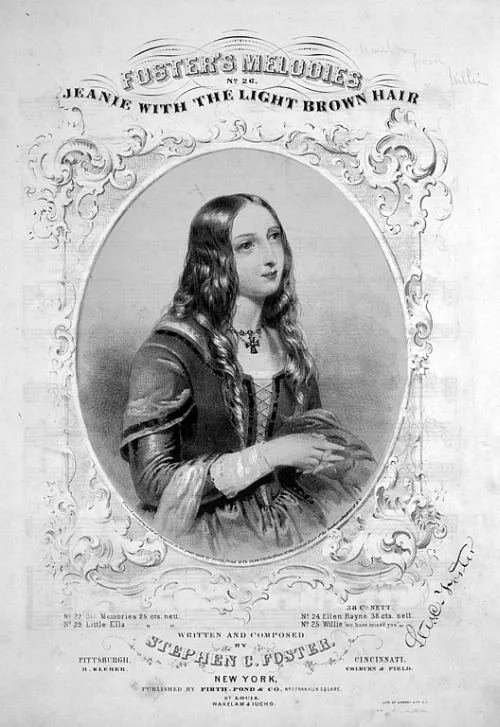
Album/Year Released
Published 1854
Artist/Composer
Stephen Foster (1826–1864)
Genre/Style
Sentimental Parlor Song
Song Form
Quaternary form (AABA)
“Jeanie with the Light Brown Hair,” composed by Stephen Foster and published in 1854 by Firth, Pond & Co. in New York, mirrors the composer’s estrangement from his wife, Jane McDowell. Rather than telling a narrative story, the song centers on longing and idealized remembrance. Each of the song’s three verses opens with a refrain—“I dream of Jeanie,” “I long for Jeanie,” and “I sigh for Jeanie”—that positions the beloved as absent and accessible only through memory. The song's emphasis on nostalgia and emotional distance is characteristic of Foster’s sentimental parlor style, in which personal loss is rendered through gentle lyricism rather than dramatic action.
The song belongs to the parlor song tradition, a genre intended for amateur performance in middle-class homes. Parlor songs typically feature singable melodies, regular phrase structures, and uncomplicated harmonic progressions that suit domestic music-making. Within the parlor song tradition, “folk” describes commercially published music that adopts the simplicity and emotional directness associated with vernacular traditions rather than anonymous oral transmission. Foster’s melodies exemplify this common melodic style, sounding familiar and intimate while remaining carefully composed. In “Jeanie,” the melody is conjunct meaning it moves primarily by step, that is occasionally punctuated by wider intervallic leaps to heighten expressive moments in the text.
Formally, the song follows quaternary, or AABA, form, a common organizational model in nineteenth-century popular music. Song form refers to the way musical ideas are arranged and repeated over time. The organization of musical sections helps listeners recognize patterns, anticipate returns, and perceive moments of contrast. In AABA form, a principal musical idea (A) is stated twice, followed by a contrasting section (B), and then returns once more. The B section introduces new melodic material and harmonic motion before leading back to the final A, which concludes with a clear cadence.
More broadly, song forms are ways to structure music so that it communicates effectively to the listener. Some common types include:
Binary Form (AB): Two contrasting sections, often repeated (common in Baroque dances).
Ternary Form (ABA): A statement, contrast, then return, like a musical sandwich.
Through-Composed: Music continuously develops without repeating large sections (often used in art songs).
Rondo (ABACA, ABACABA): Alternating main themes and contrasting episodes.
Verse-Chorus Form (ABAB…): Standard in modern pop, with verses telling the story and choruses providing a repeated, memorable hook.
The AABA structure would become one of the most influential formal models in American popular music, later dominating Tin Pan Alley songs, Broadway standards, and jazz repertory. In Foster’s time, however, it already functioned as a powerful organizing principle for listeners. Song forms create expectations about repetition, contrast, and return. Once audiences internalize a form, they anticipate the return of familiar material and register deviation as meaningful contrast. Performers and arrangers may manipulate these expectations by delaying, abbreviating, or altering sections, but such choices are effective only because the listener recognizes the underlying structure.
“Jeanie” was not especially lucrative for Foster during his lifetime. He earned just over $200 in royalties from the initial sale of approximately 10,000 copies and, amid persistent financial hardship, sold the rights to the song. Only after his death did ownership revert to Jane McDowell and their daughter Marion in 1879. Foster's financial struggles reflects and is indicative of the harsh economic realities faced by many 19th-century composers, even those whose works would later be recognized as foundational to the American popular song tradition.