Chapter 31: New Wave
“Heart of Glass”
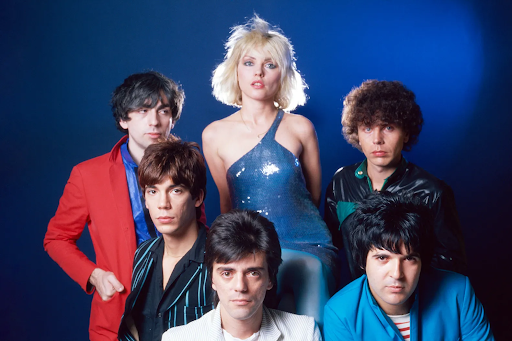
Album/Year Released
1978 (album: Parallel Lines)
Artist/Composer
Blondie
Debbie Harry, Chris Stein
Genre/Style
New wave; disco-influenced rock
Song Form
Verse–chorus with instrumental breaks
“Heart of Glass,” released in 1978 on Parallel Lines, places Blondie at the intersection of late-1970s disco, new wave, and synth-driven pop. Written by Debbie Harry and Chris Stein, the song develops in duple meter (4/4) and follows a verse–chorus design punctuated by instrumental breaks. Its rhythmic foundation draws directly from disco practice, with a steady four-on-the-floor bass drum pattern reinforced by a syncopated bass line and off-beat hi-hat figures. At the same time, the track’s surface texture leans toward a restrained, mechanical feel created by synthesizers and early drum-machine technology rather than the orchestral gloss typical of mainstream disco.
The production combines live drums with a Roland CR-78 drum machine, whose trigger-pulse function drove early polyphonic synthesizers, adding a distinctive electronic pulse throughout the track. Additional synthesizer parts were recorded separately using a Roland SH-5 and a Minimoog, with multiple passes required due to the lack of modern sequencing tools. Guitar parts were also tracked individually, while Debbie Harry’s vocal was recorded double-tracked, then blended into a unified vocal line. Harry sings lines such as "Once I had a love and it was a gas / soon turned out to be a pain in the ass," with irony and cool detachment, connecting disco's danceability with new wave's more cerebral aesthetic.
Harmonically, “Heart of Glass” centers on a repeating progression in E major. While the verses and choruses maintain a consistent phrase structure suited to dance music, the instrumental interludes depart from disco convention by using phrases in 7/8 meter, an unusual choice in a style that commonly relies on strict eight-bar groupings. These interludes eventually resolve back into standard phrasing, preserving forward motion while subtly unsettling listener expectations. The song opens with a synthesizer hook and concludes with a fade-out that layers instrumental textures and vocal ad-libs.
While some critics accused Blondie of "selling out" by embracing disco as a “rock band,” the band's eclecticism was central to its appeal, demonstrating that commercial success could coexist with experimentation across genres. Blondie's fusion of disco and rock helped establish new wave ase as a style that absorbed dance music’s physical appeal while retaining distance and restraint, allowing the song to function as both a popular club track and an ironic commentary on pop stylings.
“Psycho Killer”
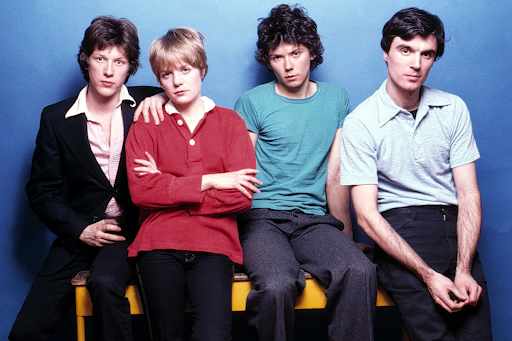
Album/Year Released
1977 (album: Talking Heads: 77)
Artist/Composer
Talking Heads
David Byrne, Tina Weymouth, Chris Frantz
Genre/Style
New wave; art rock
Song Form
Verse–chorus with contrasting sections
“Psycho Killer,” released by Talking Heads in 1977, is built around one of the most recognizable basslines in new-wave music, with Tina Weymouth’s part as the song’s primary structural force. The bass line is repetitive, rhythmically exact, and melodically focused, establishing both groove and harmonic direction instead of simply backing the guitar. It accentuates strong beats and introduces syncopation that generates tension beneath the restrained surface of the arrangement. The independent, rhythmically active bass line was consistent with a broader late-1970s tendency toward more prominent bass parts in rock. David Byrne’s guitar remains sparse and percussive, often using muted strums, harmonics, and brief power-chord gestures, letting the bass carry the song’s momentum. The overall texture is minimal and tightly controlled, matching the band’s art-rock treatment of pop songwriting.
Formally, the song follows an extended verse–chorus design with a clear sequence: introduction, verse, chorus, verse, chorus, bridge, verse, chorus, and outro. While many rock songs blur major and minor through blues influence, “Psycho Killer” approaches that tradition obliquely rather than inhabiting it directly. The bridge brings another abrupt change, moving into B natural minor, creating an intentionally abrupt harmonic shift. The outro features an atonal guitar solo from Byrne that resists tonal grounding and intensifies the song's nervous atmosphere. Beneath the guitar, the bass and drums maintain a steady, funk-influenced pulse, with the bass remaining constant as the guitar adopts increasingly choppy, anxious patterns. The chorus introduces greater melodic lift and intensity without abandoning the song’s controlled tension. Byrne’s vocal delivery alternates between detached speech-song and more animated phrases, including the French-language section in the chorus (“Qu’est-ce que c’est…”), which adds to the sense of psychological fragmentation. Lyrically, the song adopts the voice of a disturbed narrator, a choice that added to its uneasy tone.
Although “Psycho Killer” became associated with the Son of Sam murders because its release coincided with widespread media coverage, the connection was coincidental. The song had been written several years earlier during the band’s art-school period. The group was uncomfortable with the association, but their record label took advantage of the timing. Originally conceived as a ballad, the song was later rearranged into the rhythm-driven version audiences know today, which AllMusic described as deceptively funky despite its tense surface.
“Purple Rain”
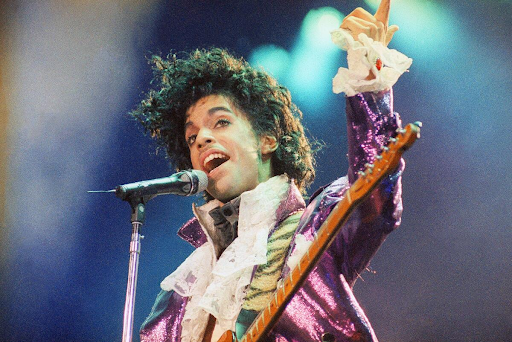
Album/Year Released
1984 (album: Purple Rain)
Artist/Composer
Prince
Genre/Style
Pop rock; funk-influenced rock
Song Form
Verse–chorus with extended guitar coda
“Purple Rain,” released in 1984 by Prince and the Revolution, is a power ballad built around a verse–chorus structure that expands into a long, expressive guitar-led outro. The song unfolds as an introduction followed by three verse–chorus cycles and culminates in an extended guitar solo and fade, bringing the runtime to more than eight minutes. Its musical vocabulary draws from rock, soul, and gospel. The song plays a central role in both the album Purple Rain and the film of the same name, serving as the musical and narrative focal point. Within the movie, each verse corresponds to a different strained relationship faced by Prince’s character, and the song is dedicated to his father.
The guitar sound at the center of “Purple Rain” derives much of its character from a chorus effect. This timbral effect splits the original signal into multiple copies, slightly detunes and delays them, then blends them back together. The processed guitar signal produces a thicker, wider tone with a gentle wavering or shimmering quality that gives sustained notes motion and depth. Prince also relies on modulation effects more broadly, meaning processes that alter aspects of the sound, such as pitch, timing, or amplitude over time, using a repeating control pattern. The vocals also employ a prominent delay effect, in which the signal is repeated after a set interval to create an echo-like resonance, adding depth and space to the performance.
Harmonically, the song is fairly repetitive, emphasizing tone color, phrasing, and dynamics rather than elaborate chord motion. The guitar solo develops gradually through long sustained notes, blues-inflected bends, controlled vibrato, and measured phrasing, allowing the intensity to accumulate across the extended outro. Prince’s vocal delivery shifts from restraint to heightened urgency as the track progresses, corresponding with the growing instrumental texture. The climactic guitar solo demonstrates his Hendrix-inspired phrasing, blending blues-inflected bends, sustained notes, and expressive dynamics that heighten the track's dramatic tension.
“Purple Rain” began as a country-leaning instrumental intended for Fleetwood Mac singer Stevie Nicks, who received a ten-minute demo and declined after feeling overwhelmed by its scope. Prince later brought the song to a rehearsal session, where guitarist Wendy Melvoin introduced chord voicings that moved the music away from its country character. As the band played the song repeatedly over several hours, Prince reworked its structure and intensity. By the end of the session, the core composition and arrangement were largely in place. Prince later described the song’s imagery as apocalyptic and spiritual, associating the color purple with a sky filled with red and blue and framing the song as a meditation on faith, love, and guidance at the end of the world. Similar imagery had appeared earlier in his song “1999,” and the phrase "purple rain" was inspired by lyrics from America’s 1972 song “Ventura Highway.”