Chapter 19: American Responses to the British Invasion
“Louie Louie”
Album/Year Released
1963 (single)
Artist/Composer
The Kingsmen
Richard Berry (composer)
Genre/Style
Garage rock
Song Form
Verse-chorus
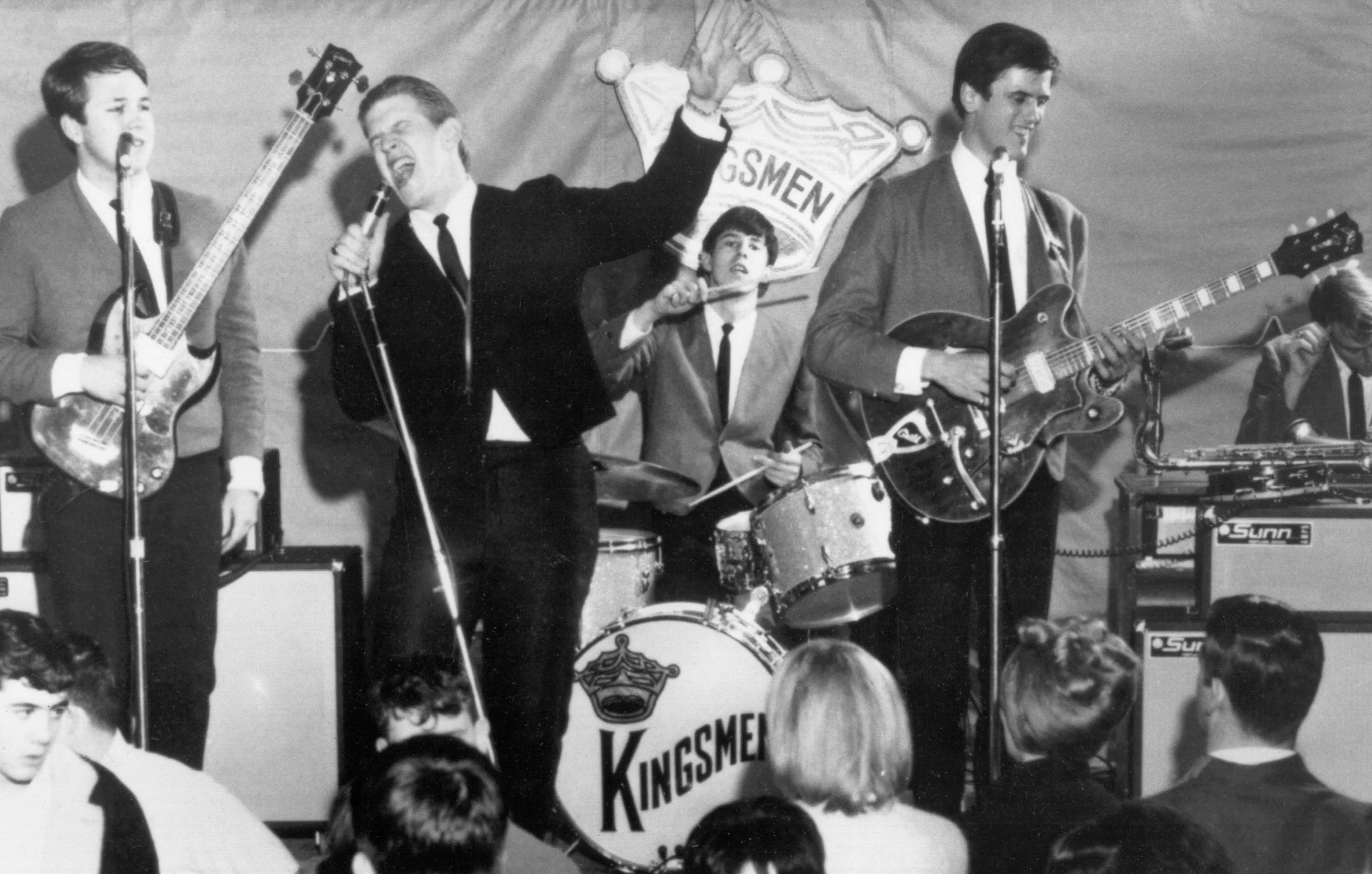
"Louie Louie" was originally written, composed, and recorded by American musician Richard Berry in 1956 and released in 1957. The song draws on the tune "El Loco Cha Cha," popularized by bandleader René Touzet, incorporating Afro-Cuban influences into American popular music. It tells the first-person story of a lovesick sailor who laments to a bartender his desire to return home to his girl. The Kingsmen’s 1963 recording, made in April at Northwestern Inc. in Portland, Oregon, elevated the song into one of the most famous garage rock tracks, famous for its raw, unpolished sound and energetic, lo-fi performance.
The track relies on a simple three-chord progression (I–IV–V) repeated throughout in 4/4 meter, with the main riff, verse melody, and chorus cycling continuously to create a hypnotic, chant-like quality. Jack Ely’s muffled, slurred vocals, impeded by his braces, along with his tiptoe positioning to reach the boom microphone, contributed to the recording’s spontaneous, rebellious character. His delivery, described as a “giraffe-neck gabble,” unintentionally reintroduced the stop-time rhythm from Berry’s 1957 version, producing a distinctive 1–2–3, 1–2, 1–2–3 beat that distinguished it from the earlier Rockin’ Robin Roberts and Wailers versions.
A notable mistake occurred just after the lead guitar break: Ely came in too soon before the expected restatement of the riff. Drummer Lynn Easton quickly covered the gap with a drum fill. The Kingsmen’s performance, characterized as ragged, chaotic, and gloriously incoherent, amplified the song’s DIY charm. Instrumentally, the guitar, bass, drums, and occasional keyboard maintain relentless forward momentum, punctuated by a shouted introduction, a manic lead guitar break, and energetic drum fills. The raw, unsanitized energy of the recording, combined with the lyrics' unintelligibility, sparked rumors of profanity, leading to bans on many U.S. radio stations and a 31-month FBI investigation that ultimately concluded the words could not be interpreted. However, ironically, drummer Easton later admitted to shouting an expletive during a drum fill after losing grip on his drumsticks.
“Daydream Believer”
Album/Year Released
1967 (single)
Artist/Composer
The Monkees;
John Stewart (composer)
Genre/Style
Pop rock
Song Form
Verse-chorus with Instrumental Bridge
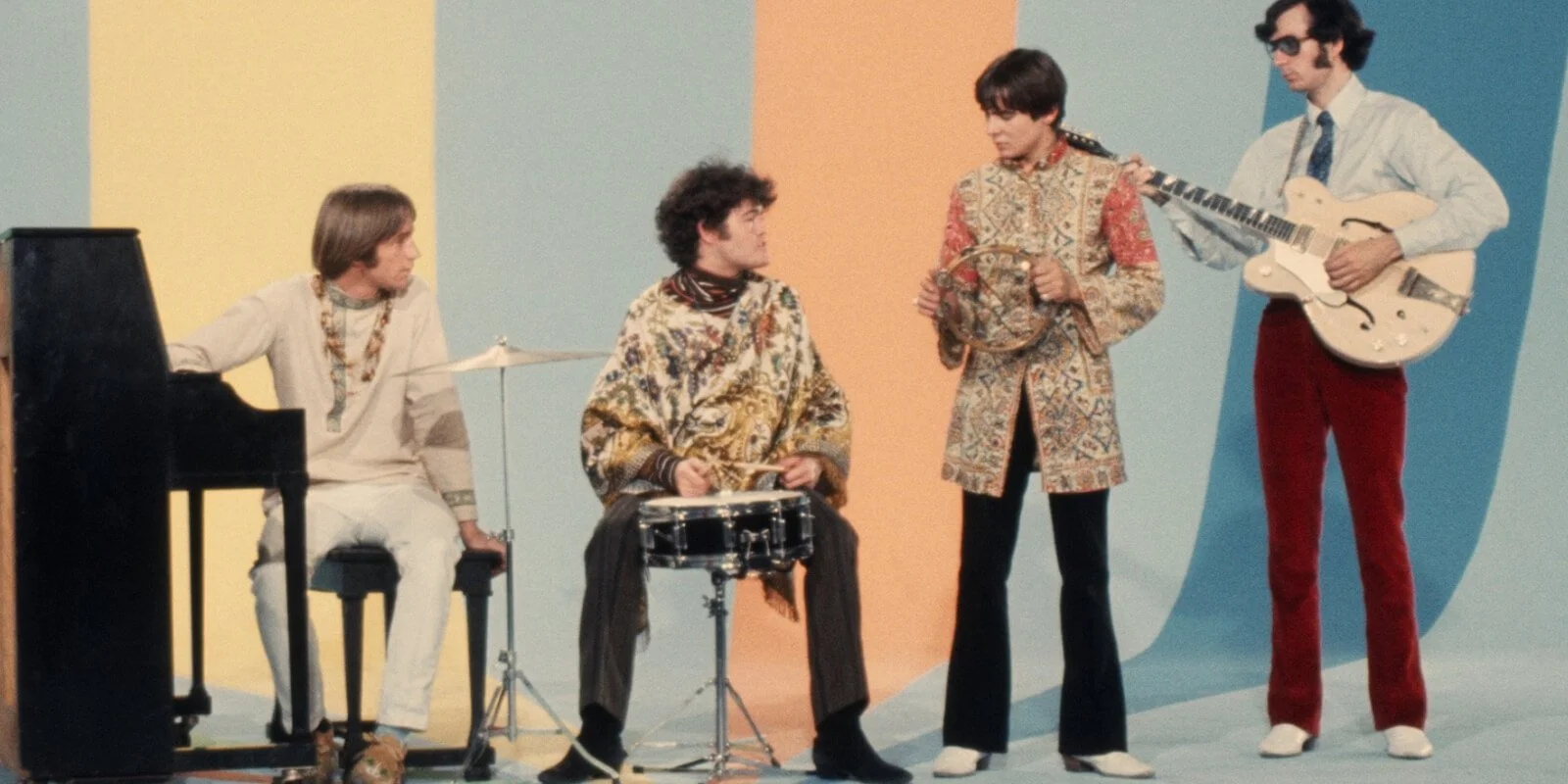
“Daydream Believer,” recorded in 1967 at RCA Victor Studios, became the Monkees’ most commercially successful single, reaching No. 1 on the U.S. Billboard Hot 100 for four weeks beginning in December 1967 and peaking at No. 5 on the UK Singles Chart. Written by John Stewart shortly before his departure from the Kingston Trio, the song features smooth, ascending melodic lines that produce an airy, optimistic tone closely associated with sunshine pop.
The recording features all four Monkees: Davy Jones sings lead vocals, Michael Nesmith plays lead guitar, Peter Tork performs piano, and Micky Dolenz provides backing vocals. Tork also composed the distinctive piano introduction, while the orchestral elements were arranged by jazz trumpeter and composer Shorty Rogers. Set in 4/4 meter, the song maintains steady rhythmic grounding that supports Jones’s vocal delivery. The instrumentation includes piano, guitar, bass, drums, and restrained orchestral color, gradually expanding from the opening piano figure into a fuller ensemble texture.
Harmonically, the song remains grounded in a simple chord progression, while the bridge supplies contrast through a brief modulation that refreshes the form. The lyrics depict a narrator looking back on a relationship that feels comfortable yet emotionally distant, crystallized in the phrase “daydream believer and a homecoming queen,” which blends romantic longing with subtle dissatisfaction. Contemporary reviews were enthusiastic: Billboard praised it as a “well-written easy beat rhythm ballad” with a “clever opening,” Cash Box noted how the arrangement grows from piano alone into a layered ensemble while sustaining a repeating refrain, and Record World singled out its melodic and lyrical appeal. Stewart’s original line, “Now you know how funky I can be,” was altered to “Now you know how happy I can be” at RCA’s request, aligning the song more closely with its bright tone. Through its balanced arrangement, memorable melody, and polished execution, “Daydream Believer” is a hallmark of late-1960s pop and the Monkees’ most lasting success.