Chapter 13: Rock and Roll Pt. 1
“Tutti Frutti”
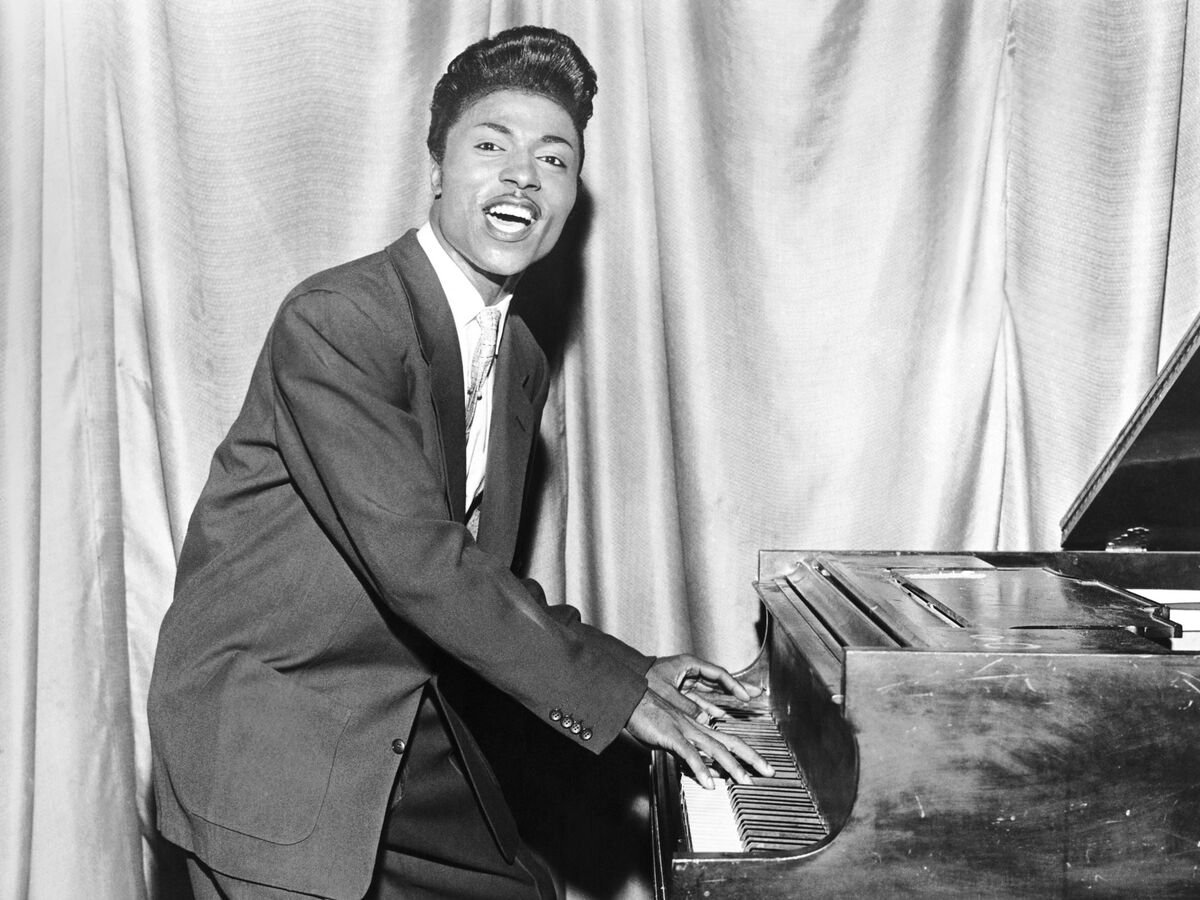
Album/Year Released
Recorded 1955
Artist/Composer
Little Richard (Richard Penniman, 1932–2020)
Genre/Style
Rock and roll; rhythm and blues
Song Form
Verse-chorus; 12-bar blues framework
“Tutti Frutti,” recorded by Little Richard in 1955, is a high-energy rock-and-roll song built on a 12-bar blues progression with a strong backbeat. The song follows a verse–chorus structure over the I–IV–V chords, providing a harmonic framework that supports Little Richard’s vocal improvisations and the piano and drum accompaniment. The progression allows for repeated riffs, while the form lets the melody and lyrics cycle predictably for audience recognition.
Little Richard’s vocals are notable for their raspy timbre, shouted phrases, screams, and melismatic passages, where a single syllable stretches across multiple pitches. He alternates these with syllabic singing, assigning one note per syllable for clarity, especially in rapid, rhythmically precise sections. His singing also uses glissandi (sliding between notes) and dynamic accents that match the energetic pulse of the piano and drums. The iconic refrain, “A-wop-bop-a-loo-mop-a-lop-bam-boom,” began as a verbalization of a drum pattern and serves as both a rhythmic and melodic element in the song.
The song’s title was inspired by a lunch-break improvisation during recording. Frustrated that the session wasn't capturing his style, Little Richard delivered a lively piano-and-vocal performance that drew on his earlier routines. The producers then formalized the piece, revising lyrics while keeping Little Richard’s performance style.
The lyrics were adapted from Little Richard’s earlier live performances, which contained sexually explicit content. Producer Robert “Bumps” Blackwell saw the song’s potential but asked for the lyrics to be revised. Dorothy LaBostrie rewrote them, creating the now-familiar lines “Tutti Frutti, aw rooty,” a slang expression meaning “all right.” A third name, Lubin, appears as a co-writer on some releases, possibly a pseudonym used by Specialty Records owner Art Rupe to claim royalties, though some sources suggest songwriter Joe Lubin. The revised lyrics kept the exuberant tone while removing explicit references.
Little Richard accompanied himself on piano, using two-handed patterns with the right hand emphasizing the high register. These patterns, rooted in boogie-woogie, move away from its shuffle rhythm and create a more percussive rock-and-roll beat. The piano lines reinforce the backbeat and interact with the vocal phrasing. Bass and drums were added in the studio to create a fuller, danceable rhythm, and the producer guided minor changes to the song’s structure and tempo to capture Little Richard’s live energy.
The refrain and verses feature repeated riffs, rhythmic punctuation, and call-and-response between vocals and piano. Melodic ornamentation, dynamic variation, and percussive accents create a texture that blends influences from boogie, gospel, and rhythm-and-blues traditions. Little Richard performed versions of the song in clubs across the South before recording it, and his live style, including spontaneous piano pounding, was carried directly into the recorded performance.
“Tutti Frutti” became Little Richard’s first major hit and helped establish his career. It was widely covered, including by Pat Boone, whose version softened the lyrics and vocal delivery, and by Elvis Presley and the Beatles. Boone’s version reached number 12 on the pop charts, while Little Richard’s version followed at number 21, showing the song’s appeal across musical audiences. The recording combined piano, bass, drums, and vocals in a structure that bridged rhythm-and-blues, gospel, and boogie influences with a new rock-and-roll beat, influencing subsequent musicians such as Chuck Berry.
“Johnny B Goode”

Album/Year Released
Recorded 1958
Artist/Composer
Chuck Berry (1926–2017)
Genre/Style
Rock and roll
Song Form
Verse-chorus; 12-bar blues framework
“Johnny B. Goode” was written by Chuck Berry in 1955 and released as a single in 1958. The lyrics tell the story of an illiterate “country boy” from the New Orleans area who plays guitar “just like ringing a bell” and hopes to one day have his “name in lights.” Berry has said the song is partly autobiographical. The original lyrics referred to Johnny as a “colored boy,” but Berry changed this to “country boy” to improve the song’s chances for radio play. The title also references Berry’s own life, as he was born at 2520 Goode Avenue in St. Louis, tying the narrative to personal experience.
Musically, the song uses a 12-bar blues progression with I–IV–V chords, providing a framework for Berry’s guitar lines and vocal performance. The opening riff outlines the harmony and engages in call-and-response with the vocal line. Berry’s guitar work combines single-note riffs, double stops, and power chords that emphasize the root and fifth instead of full triads. In the shuffle feel, Berry often alters the power chords by alternating between the fifth and added sixth with his pinky, a common blues and boogie-woogie device that creates movement within static harmony. Guitar fills often mimic or answer the vocal melody, and the repeated riff provides melodic hooks and momentum, showing the electric guitar’s role as both lead and accompaniment in early rock and roll. Syncopation and swing are emphasized, with some notes slightly ahead of or behind the beat to create rhythmic tension.
The recording session featured Lafayette Leake on piano, Willie Dixon on bass, and Fred Below on drums, produced by Leonard and Phil Chess. The opening guitar riff borrows from Carl Hogan’s 1946 single-note solo on Louis Jordan’s “Ain’t That Just Like a Woman.” Berry’s guitar interacts with the swing of the piano and drums, contrasting with the straight rhythm of his lead lines. The shuffle feel, alternating power chords, and melodic riffs give the song its distinctive sound.
Upon release, “Johnny B. Goode” reached number two on the Hot R&B Sides chart and number eight on the pre-Billboard Hot 100 chart. Over time, it became a rock-and-roll standard, covered by numerous artists, recognized as one of the first rock-and-roll hits about stardom, and included on the Voyager Golden Record as an example of human musical achievement. It has also appeared on multiple Rolling Stone lists of greatest songs, ranking 7th in 2004 and 33rd in 2021.
“Hound Dog”

Album/Year Released
Big Mama Thornton, 1952
Elvis Presley, 1956
Artist/Composer
Jerry Leiber & Mike Stoller, songwriters;
Big Mama Thornton
Elvis Presley
Genre/Style
Big Mama Thornton: R&B / blues;
Elvis Presley: Rock and roll; Rockabilly
Song Form
12-bar blues
“Hound Dog” was written by Jerry Leiber and Mike Stoller in 1952 and first recorded by Big Mama Thornton on August 13 that year in Los Angeles. Released by Peacock Records in early 1953, Thornton’s version became her only major hit, selling over 500,000 copies and spending fourteen weeks on the R&B charts, including seven at number one. The song is a twelve-bar blues composition, following the I–IV–V chord progression, with the instrumentation of guitar, bass, and drums providing a steady swing. Thornton’s vocal delivery is deep and growling, typical of R&B blues, emphasizing syllabic phrasing with occasional melismatic flourishes on key words. She uses subtle dynamic shifts to accentuate important lyrics, while her phrasing incorporates micro-inflections and flexible syncopations. Elements of habanera and mambo rhythms, along with a jazz-influenced bass line by Puerto Rican musician Mario Delagarde, add extra rhythmic complexity to the recording. The lyrics assert a rejection of a selfish, exploitative man, metaphorically called a “hound dog”. The sparse arrangement centers her vocals, allowing them to dominate the texture and convey both humor and authority. Thornton’s “Hound Dog” influenced the evolution of R&B into rock music and was later recognized by the Rock and Roll Hall of Fame as one of the “500 Songs That Shaped Rock and Roll,” ranked 318th on Rolling Stone’s 500 Greatest Songs of All Time (2021), and inducted into the Grammy Hall of Fame in 2013.
Elvis Presley recorded his version of “Hound Dog” in 1956 at RCA Victor’s New York studio with Scotty Moore on lead guitar, Bill Black on bass, D.J. Fontana on drums, and backing vocals from the Jordanaires. Presley's interpretation introduces a lighter, more rhythmic vocal timbre, featuring short glottal breaks between syllables called vocal hiccups that add drive and playful articulation. His phrasing is more melodic and syncopated than Thornton's, while the instrumentation of strummed guitar, slapback echo on vocals, and aggressive drumming, gives the song rock-and-roll energy within the same twelve-bar blues framework. The recording also uses slapback delay on Presley’s vocals, a short echo effect produced during recording that thickens the sound and adds rhythmic bounce. Moore’s guitar alternates between low-register rhythm playing, open fifths, and bent or distorted pitches, with repetitive breaks that sometimes verge on atonality. Fontana’s drumming is especially prominent on the snare, often distorting into clipped noise due to its intensity, while the Jordanaires provide minimal vocal backup, letting Presley’s performance take the lead.
Released as a single, Presley’s recording became one of the best-selling singles of all time, selling about ten million copies worldwide. It topped the US pop, country, and R&B charts simultaneously, holding the pop number-one position for eleven weeks, a record that stood for 36 years. Presley’s version was inducted into the Grammy Hall of Fame in 1988 and is recognized by the Rock and Roll Hall of Fame as a key song in the development of rock music. The contrasting performances of Thornton and Presley demonstrate how the same twelve-bar blues framework can produce markedly different musical expressions through changes in vocal technique, rhythmic treatment, and instrumentation.