Chapter 4: Tin Pan Alley

Chapter 4: Introduction

As the nineteenth century gave way to the twentieth, American popular music developed into a powerful cultural presence and, perhaps more significantly, a commercial force. Printed sheet music was still the primary medium through which Americans engaged with music at home, and by the late 1800s, sales had become so profitable that music publishing had grown into a thriving industry. By the 1890s, a dense cluster of publishers had established themselves along 28th Street in New York City, a stretch that became famously known as "Tin Pan Alley."
Between 1900 and 1915, the United States developed a growing sense of national culture, powered by sweeping changes in technology, transportation, and entertainment. In the decades after the Civil War, Americans began to increasingly identify themselves as members of a unified nation rather than primarily as citizens of individual states, and new forms of mass communication and communal experience reinforced the shift toward a shared national culture. The telephone, first invented by Alexander Graham Bell in 1876, became common in homes by the early 1900s, making long-distance communication instantaneous and personal. In 1903, the Wright Brothers' successful powered flight at Kitty Hawk heralded a new era of transportation, while Henry Ford's introduction of the Model T in 1908 revolutionized manufacturing and made automobiles affordable to the general public, changing how Americans lived and traveled.. Railroads continued to knit the country together, connecting rural and urban communities, enabling the rapid circulation of cultural trends, and allowing musicians and song pluggers to spread Tin Pan Alley hits nationwide. Mass entertainment also flourished: 1903 saw both the first World Series, where the Boston Americans (later the Red Sox) defeated the Pittsburgh Pirates, and the debut of The Great Train Robbery, the first narrative motion picture, which captivated audiences with its innovative use of editing, location shooting, and live musical accompaniment performed by pianists hired in the local theater. Taken together, these innovations changed everyday American life and created the basis for a modern, nationally shared popular culture.
Around the turn of the century, the American music publishing industry established its first successful business model. Publishers partnered with vaudeville theaters, then the dominant form of mass entertainment, to promote their songs to broad audiences. Vaudeville performers were paid to feature new tunes in their acts, creating powerful opportunities for exposure and increasing sheet music sales. The move toward a more professional music industry occurred alongside efforts to regulate publishing and to professionalize the music industry. For much of the 19th century, music publishing had been unregulated, leaving many songwriters vulnerable to exploitation. That began to change with the passage of the U.S. Copyright Act of 1909. The act standardized the collection of royalties and granted songwriters more control over their work, encouraging a more stable and sustainable music business. It set the groundwork for the modern music industry, in which copyright protections and royalty systems remain crucial sources of income for artists and publishers alike.
Tin Pan Alley songwriters continued to produce sentimental ballads, comic songs, and patriotic tunes. Ragtime then became a major stylistic shift. But a major stylistic shift was emerging: ragtime. Developed from African American musical traditions in the late 19th century, ragtime featured syncopated rhythms layered over steady two-beat march patterns. March music, popularized during the Civil War and rooted in European tradition, was a staple at public events. African American musicians, many of whom had performed in brass bands during and after the war, infused the form with their own rhythmic innovations. The result was a vibrant, hybrid genre that energized American music. Tin Pan Alley's embrace of ragtime signaled a major development in the commercial adoption of Black musical styles, a pattern that would continue throughout the 20th century.
Tin Pan Alley: The Business of Song
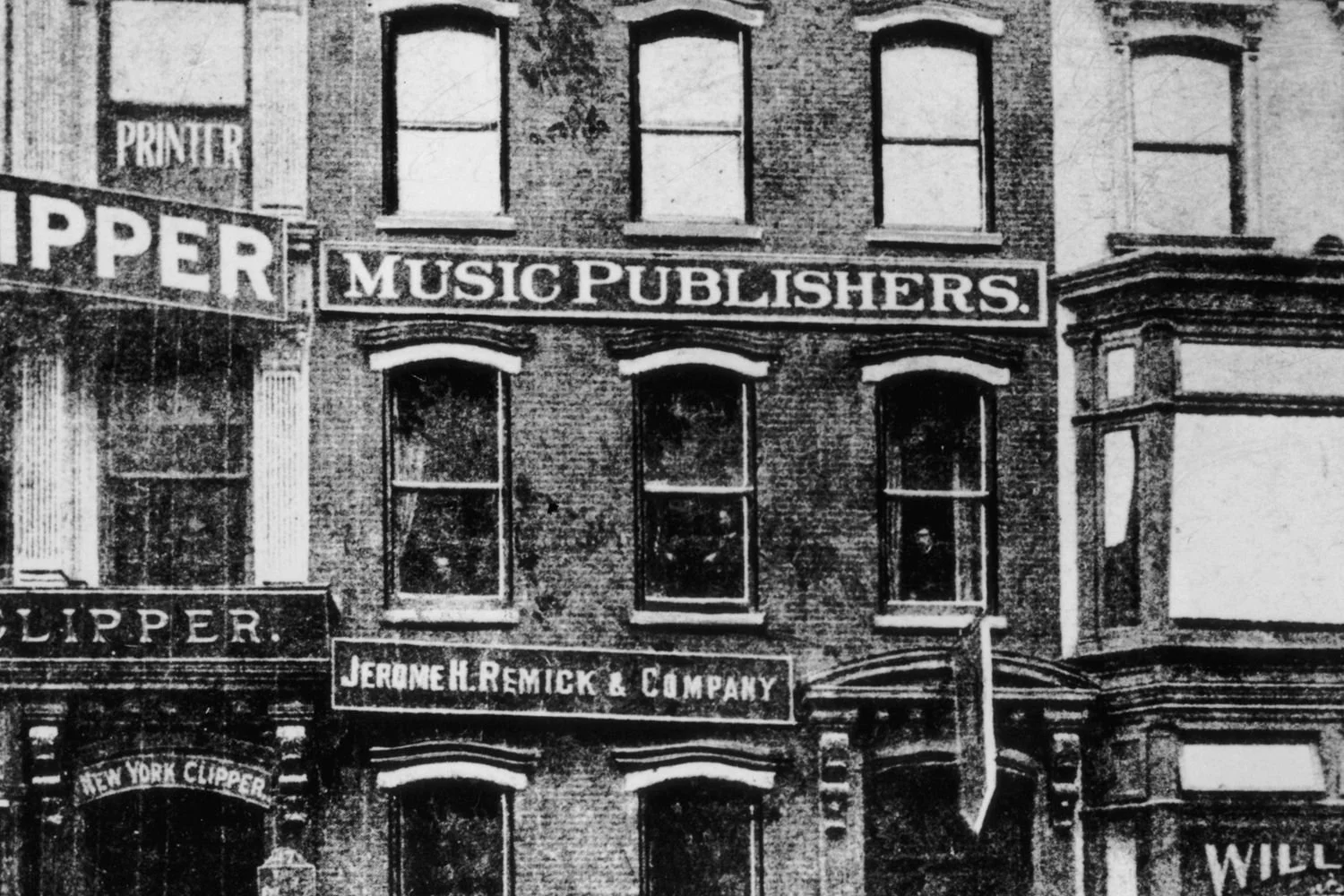
"Tin Pan Alley" refers to a district in New York City, specifically 28th Street between Fifth Avenue and Broadway, where dozens of music publishers gathered to build a booming music industry. These companies essentially functioned like factories, hiring staff composers and lyricists under work-for-hire arrangements to produce songs quickly and consistently. Publishers often placed writers under exclusive contracts and either bought their songs outright for a flat fee or offered modest royalties. The work-for-hire system allowed publishers to control the rights to popular songs and standardize their production and promotion. As a result of these business practices, Tin Pan Alley became the epicenter of American sheet music publishing in the early 20th century.
Some of the prominent companies operating in Tin Pan Alley included M. Witmark and Sons and T. B. Harms, which churned out thousands of songs in collaboration with aspiring composers and lyricists. The music publishing company was responsible for producing, promoting, and distributing songs, typically in printed sheet music form. These companies secured the rights to compositions, marketed them to performers and the public, and earned revenue through sheet music sales and, eventually, royalties. Publishing served as the principal mechanism through which songwriters reached audiences, and for many years, it was the backbone of the commercial music industry. Notable early composers whose careers began under the influence and infrastructure of Tin Pan Alley included Harry von Tilzer, who helped popularize the sentimental ballad style, and later giants like George and Ira Gershwin, Cole Porter, and Irving Berlin.
There are several stories behind the name "Tin Pan Alley," although many are attributed to folklore and urban legend. One version tells of journalist Monroe Rosenfeld, who visited 28th Street to write an article about the music business. During his visit, he heard Harry von Tilzer experimenting with a piano by placing strips of paper between the strings to create a distinctive, metallic sound. The auditory effect inspired Rosenfeld to title his article "Tin Pan Alley". Another story suggests that the district was so full of competing sounds, such as pianos clanging, singers rehearsing, and song pluggers performing, that it resembled the chaotic rattle of banging on tin pans. According to another legend, rival song promoters and clerks would bang on trash can lids to sabotage a competing publisher's performance and disrupt a potential sale.
Copyright and Control in the Music Industry

Throughout the 19th century, American copyright law was inconsistent and poorly enforced. Composers had little legal protection and often lacked ownership or control over their own work. It was common for multiple publishers to print and sell the same songs, often with different cover art, without compensating the original songwriter. The lack of effective copyright regulation left many composers vulnerable to exploitation.
The legal situation began to change in the early 20th century with the U.S. Copyright Act of 1909, which was signed into law by President Theodore Roosevelt and enacted on March 4, 1909. The act granted legal protection to published works that included a proper copyright notice and granted limited protection to unpublished works under state law. Works published without such notice immediately entered into the public domain, meaning they were not protected by copyright. The new law gave composers and publishers greater control over their music. It established an initial copyright term of 28 years, with the possibility of a 28-year renewal. Importantly, it gave authors the right to terminate a copyright transfer between the initial and renewal periods, helping to rebalance control between creators and companies.
One of the act's most consequential provisions was the introduction of the first compulsory mechanical license. The compulsory mechanical license allowed others to reproduce a copyrighted musical composition on phonographs or piano rolls without the copyright owner's permission, provided they followed specific legal procedures and paid set royalties to the owner. Royalties are ongoing payments to composers or rights holders each time a work is reproduced, performed, or sold, making sure that creators are compensated for the continued use of their music. The compulsory licensing system helped standardize royalties and incentivize cooperation between songwriters and publishers, and remains the basis for the royalty collection system in the present day. As a result, composers could begin to earn more consistent income from their work, and publishers had legal grounds to defend their catalogs.
The American Society of Composers, Authors, and Publishers (ASCAP) was founded in 1914 to protect the rights of composers, lyricists, and music publishers. Its primary purpose was to ensure that songwriters were fairly compensated when their music was performed publicly in theaters, restaurants, hotels, and eventually on radio and television. ASCAP pioneered the model of a performance rights organization (PRO), an entity that collects licensing fees from venues and broadcasters who publicly use music and then distributes those fees as royalties to composers and publishers. The PROsystem replaced the chaotic, case-by-case permissions of the past with a more standardized and enforceable model. Venues and radio stations could pay a blanket license to use the entire ASCAP catalog legally, and creators were paid based on how frequently their works were performed. In doing so, ASCAP helped establish professional standards for the music industry and strengthened the idea that composers should earn income not just when a song was sold but every time it was performed publicly.
Song Pluggers
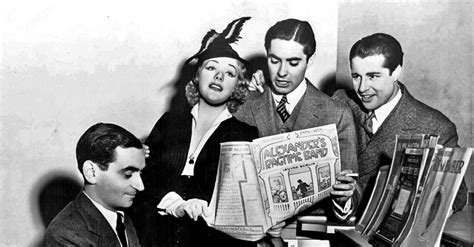
The sound of Tin Pan Alley, both literal and metaphorical, represented a major evolution in American music. It was a site where creative talent met aggressive marketing, and where popular music began to function as a fully developed commercial industry. By 1910, Americans were buying approximately 30 million copies of sheet music per year, a testament to the industry's size and cultural reach. Song pluggers, hired by publishing companies, used highly creative and often relentless tactics to make songs known to the public. These musicians performed new songs for store customers, theater owners, and vaudeville acts, acting as live advertisements. While Tin Pan Alley songwriters continued to compose in styles reminiscent of earlier composers like Stephen Foster, their marketing strategies were far more aggressive and wide-reaching. In this new era, the "plugging" or promotion of a song was often as important as writing it.
Song pluggers would perform new songs in music stores, five-and-dime stores, and even on the streets, hoping to generate buzz and boost sheet music sales. They carried chorus slips, printed lyrics to the refrain of a song, which they distributed in taverns and theaters so patrons could sing along. They would rent hay wagons, bolt pianos to flatbeds, and station them outside theaters, amusement parks, and sports arenas to catch crowds as they exited.
Pluggers were also known to pay bandleaders to feature their songs at dances, bribe restaurant servers to hum or sing the tunes to customers, and hire boys to sing the songs in public spaces while selling sheet music like newspapers. At silent film screenings, boys would jump up and sing during reel changes to promote the latest songs. However, one of the most effective and targeted promotional methods involved vaudeville performers.
Vaudeville

As a live entertainment tradition, vaudeville offered a rotating bill of short, diverse acts that might include singers, comedians, dancers, magicians, jugglers, ventriloquists, trained animals, dramatic monologues, and even early film shorts. Its eclectic format appealed to audiences of all ages, social classes, and geographic regions, making it the most visible and accessible form of live entertainment in the early 20th century. Vaudeville stages provided testing grounds for new performers, popular songs, and trends in American culture.
The expansion of vaudeville was made possible in large part by the country’s growing railroad infrastructure. In fact, the national touring routes first established for professional baseball teams helped lay the basis for traveling vaudeville troupes. Just as sports teams moved city to city for scheduled games and barnstormed across the West during the offseason, vaudeville performers used the same train lines to travel between theaters. The national railroad network enabled vaudeville to thrive in metropolitan areas and small towns alike, creating a unified system of popular entertainment that connected Americans across regional divides.
As performers and musical acts traveled from stage to stage, they carried the latest Tin Pan Alley hits, which standardized popular taste and established a shared cultural identity. Baseball, too, contributed to this growing national culture. The sport’s touring mode, which was interconnected with the vaudeville circuit in major cities, helped make it America’s pastime, and its biggest stars became early media celebrities. During the off-season, some players—most famously Babe Ruth—took to the vaudeville stage, entertaining crowds with comedy routines, songs, or personal anecdotes.

Vaudeville also launched the careers of many legendary American entertainers. Comedy teams like Abbott and Costello rose to fame with routines such as “Who’s on First?,” while acts like the Three Stooges became fixtures of American comedy for generations. These performers honed their craft in vaudeville’s rigorous, fast-paced environment before becoming household names through film and television.
Comparing Vaudeville and Minstrelsy

As vaudeville expanded into a national entertainment phenomenon, it inherited elements of earlier theatrical traditions, particularly minstrelsy, while developing a broader style of popular entertainment. Although the two genres coexisted for a time and shared conventions such as music, comedy, and dance, they differed in content, audience, and structure. Minstrelsy centered on racially stereotyped performances, often presented in blackface, and typically followed a fixed format of opening songs, comic exchanges, variety acts, and plantation-themed skits. Vaudeville instead featured a rotating lineup of largely unrelated acts, including comedians, musicians, magicians, dancers, and acrobats, allowing programs to change frequently. While caricature sometimes appeared in vaudeville, it generally pursued a broader, family-friendly appeal and relied far less on blackface performance. The structural and thematic differences between vaudeville and minstrelsy also influenced what audiences were drawn to the medium. Minstrelsy primarily attracted white audiences and operated within the racial prejudices of the era, whereas vaudeville drew a more socially diverse audience through its wide variety of acts and flexible programming.
The structure of the vaudeville industry was instrumental in the rise of Tin Pan Alley. The Orpheum Circuit dominated the western United States, while the Keith-Albee theater chain held power in the East. Publishing companies teamed closely with these networks, using vaudeville stages as prime platforms for song promotion. In exchange for featuring new songs in their acts, performers were often offered prime placement on sheet music covers, a share of the profits, or lavish gifts, including cigars, liquor, jewelry, perfume, and cash. The mutually beneficial relationship between publishers and performers helped embed popular music into American daily life and demonstrated the increasing power of promotion, performance, and celebrity in determining musical success.
Some composers went so far as to credit performers as coauthors of songs, regardless of their actual involvement, to boost a song’s visibility and lend it celebrity endorsement. Al Jolson and Gene Austin were frequently listed as co-writers on songs they had not composed, simply because they popularized them. Eddie Cantor, Ruth Etting, and other vaudeville stars later admitted to accepting generous payments for incorporating songs into their performances. Rudy Vallée once claimed he built his estate in Connecticut on the back of plugger “gifts,” while Al Jolson famously received a racehorse in exchange for promoting a tune.

Vaudeville's widespread reach made it a powerful testing ground for musical appeal. The industry even coined the phrase “Will it play in Peoria?” referring to the Illinois city whose demographics and location made it a bellwether for national taste, standing in as the quintessential middle-American town. If a song or act succeeded in Peoria, it was believed to have broad appeal nationwide.
The partnership between vaudeville and Tin Pan Alley helped embed popular music in everyday American life, while also showing the growing power of promotion and celebrity in forming musical success. They demonstrate that Tin Pan Alley depended not only on musical creativity but also on an incessant and evolving approach to getting songs into the ears and eventually the homes of the American public.
"After the Ball"

The musical characteristics associated with Tin Pan Alley grew out of a shift in both songwriting style and business strategy. Composers like Harry von Tilzer, known as the "Daddy of Popular Song", famously advised fellow songwriters to keep their melodies so simple that even a child could hum them. The emphasis on simple melodies was created to make songs as accessible as possible for the widest audience, lowering any skill barrier for performance. His songs, including "A Bird in a Golden Cage" and "I Want a Girl Just Like the Girl That Married Dear Old Dad", exemplify Tin Pan Alley's emphasis on easily memorable melodies and sentimental themes.
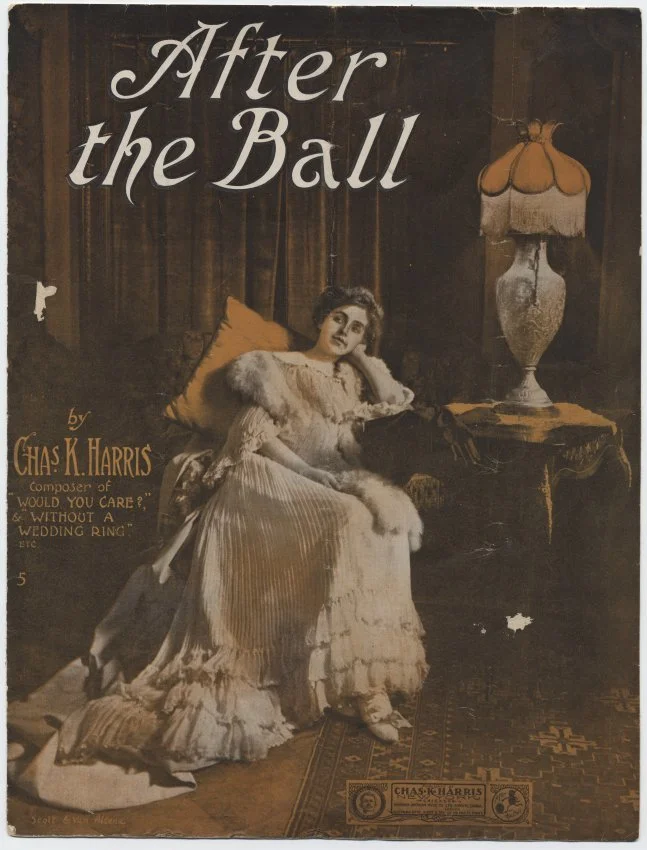
One of the earliest and most successful Tin Pan Alley songs was "After the Ball" (1891), composed by Charles K. Harris. Born in Poughkeepsie, New York, and raised in Milwaukee, Harris taught himself to sing and play the banjo. Though he never learned to read music, he developed a system where he would hum a melody to a trained musician, who would transcribe and arrange it for piano. Frustrated with poor royalty payments from previous songs, Harris decided to publish "After the Ball" himself. The result was a sensation, selling more than 10 million copies and becoming the best-selling song of its time.
"After the Ball" is a classic example of a Tin Pan Alley ballad. The song tells a sentimental story of lost love, unfolding through a conversation between an older man and a child. In verse-chorus form, a structure that would dominate popular music for decades, the song tells the story of the older man's heartbreak over a misunderstood moment: he left his sweetheart after seeing her kiss another man, only to learn later that the man was her brother. Musically, the piece is a waltz, written in triple meter, with three beats per measure and an emphasis on the first beat, giving it a flowing, danceable quality.
Recognizing the song’s potential, Harris paid vaudeville singer J. Aldrich Libbey $500 and offered him a share of the profits in exchange for performing the song in all his shows. Audiences loved it, often requesting encores multiple times in a single performance. During the 1890s, Harris was earning at least $25,000 a month from sales of the song, which allowed him to open his own song publishing business in New York in 1903. Harris's marketing savvy, paired with a simple, emotionally resonant melody, created a model that other Tin Pan Alley composers would follow. His story helped establish the archetype of the self-made American songwriter and demonstrated the power of combining music with strategic promotion—an idea that would remain central to the music industry for generations.
Tin Pan Alley Song Types
Many different types of songs flourished through Tin Pan Alley. Some genres were still recognizable from the 19th century, including sentimental ballads, patriotic songs, and songs anchored in the traditions of blackface entertainment. The vast majority of Tin Pan Alley songs were waltzes, composed in triple meter, which gave them a flowing, danceable rhythm well suited to parlor performance and social dancing. Romantic songs were among the most commercially successful, and most of them presented idealized images of love. In many of these songs, lovers were kept at a distance, often longing or reminiscing rather than interacting. Examples include “Sweet Adeline” (lyrics by Richard H. Gerard, music by Harry Armstrong) and “You Tell Me Your Dream and I'll Tell You Mine” by Charles N. Daniels. While most depictions of women in these songs were sentimental and proper, there were occasional exceptions. Paul Dresser’s “My Gal Sal” (1905), for instance, describes a woman who is “a wild sort of devil” and the narrator’s “old pal.” Sal is portrayed less as a romantic ideal and more as a companion—a notable departure from the norms of the genre.
Tin Pan Alley songs also often depicted specific geographic places, helping to invoke nostalgia or civic pride. Songs like "The Sidewalks of New York" and "Meet Me in St. Louis", the latter celebrating the 1904 World's Fair, painted musical portraits of bustling cities and hometown charm. Some songs aimed to evoke ethnic communities, particularly Irish American neighborhoods, as in “Daisy Bell,” “In the Good Old Summertime,” and “My Wild Irish Rose’’. These songs often drew on ethnic stereotypes and caricatures, showing both the growing population of immigrants in America at the time (particularly in New York) as well as biases held against them.
Coon Songs
Blackface minstrelsy remained a popular form of entertainment well into the twentieth century, and popular songs were frequently featured in or adapted from minstrel troupes’ performances. By the turn of the century, blackface minstrelsy was so entrenched in American culture that it included both white performers in blackface and, increasingly, Black performers as well, although the two groups did not share the stage. Because performance opportunities for Black musicians were limited, many Black performers participated in minstrel shows despite the degrading nature of the material. Though many likely felt conflicted about portraying caricatures like Jim Crow or Zip Coon, such performances were among the few avenues available to professional musicians.
A particularly troubling offshoot of minstrelsy was the genre of "coon songs", named after a racial slur. These songs focused on demeaning stereotypes of Black men, often portraying them as lazy, foolish, dangerous, and driven by vice. With titles like "All Coons Look Alike to Me" and "Gimme Ma Money," many Coon Songs often included insulting portrayals of black characters who sang about watermelon, fried chicken, liquor, and gambling. Common themes included gambling, drinking, and sexual impropriety, and the songs relied on cheap gags, racial epithets, and exaggerated dialects to provoke laughter and sell sheet music. Despite this toxic landscape, a few Black composers achieved commercial success. James Bland, for example, became the first widely successful Black singer-songwriter with hits such as "Carry Me Back to Old Virginny." Still, the overwhelming majority of coon songs were written and published by white musicians, and the genre shows how racist stereotypes were turned into commercial products within early American popular music.
Marches
Throughout the nineteenth century, American popular music was closely tied to dance and other social functions, including courtship, entertainment, public celebration, and the expression of class and ethnic identity. Early American dance music was heavily influenced by English models, particularly the contra dance or country dance tradition, in which dancers formed geometric patterns such as lines, circles, and squares. Alongside these group dances, couples also performed dances such as the waltz, mazurka, polka, and schottische, many of which originated in European rural traditions but were adapted for American audiences.
Among the urban elite, dancing typically took place at formal balls, carefully organized social events accompanied by orchestras and regulated by strict codes of behavior. Dance programs followed a predetermined sequence of styles, often overseen by a dance master who called steps using written manuals. Traditional ballroom etiquette emphasized restraint, uniformity, and a controlled posture, reinforcing Europeanized ideals of refinement and gentility. Although some dances, particularly the waltz, were initially criticized as morally suspect because of physical proximity between partners, by the late nineteenth century, the waltz had become a prominent symbol of sophistication and romance.
American dance culture also developed distinctive local variants that that varied according to regional and social conditions. These included the miners’ balls of the California Gold Rush, known for their informality and rowdiness, and slave balls on southern plantations, where enslaved people often parodied the elite dances of white slaveholders. Throughout the century, there was constant exchange between rural and urban traditions and between elite and popular culture. Popular songs and minstrel tunes—including pieces such as “Turkey in the Straw” and Stephen Foster’s “Camptown Races”—circulated between professional performers and community dance traditions, while African American dance practices increasingly influenced the broader popular repertoire.
In the public sphere, from the Civil War through the early twentieth century, brass bands became one of the most visible and influential musical institutions in American life. Military bands expanded dramatically during the Civil War, with thousands of musicians serving in both Union and Confederate regiments. After the war, many of these musicians formed civilian bands in their hometowns, while schools, churches, colleges, and civic organizations established their own ensembles. By the late nineteenth century, nearly every town of note had a bandstand, and brass band concerts were central to public life. Bands performed patriotic marches, popular songs, dance music, and arrangements of classical works, reinforcing their role as community institutions and vehicles for national identity.
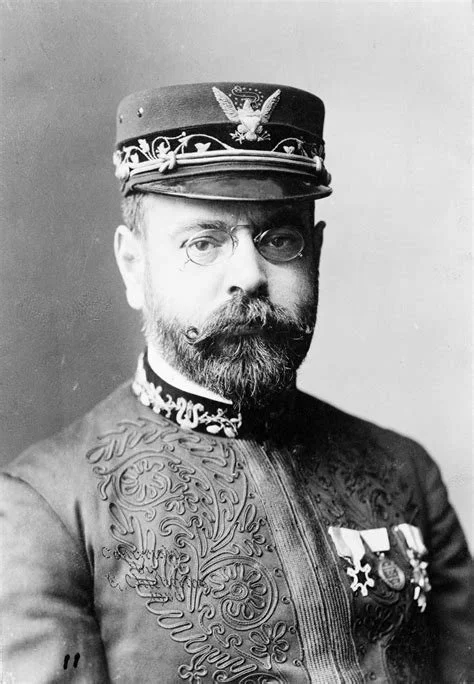
The most influential bandleader of the late nineteenth and early twentieth centuries was John Philip Sousa (1854–1932), widely known as America’s “March King.” Born in Washington, D.C., to a Portuguese father and a German mother, Sousa was immersed in military band culture from an early age. His father was a trombonist in the U.S. Marine Band, and Sousa joined the ensemble himself as an apprentice at the age of thirteen. After years of professional experience as a violinist, conductor, and theater musician, he returned to the Marine Band in 1880 as its leader, a position he held for twelve years.
During his tenure with the Marine Band, Sousa elevated the ensemble to national prominence. He expanded its repertoire, raised the performance standards, and increased its visibility through public concerts and national tours. Under Sousa’s leadership, the band became a symbol of American civic pride and musical professionalism at a time when nationalism and public culture were becoming increasingly intertwined. His marches from this period combined strong melodic lines, clear song structures, and rhythmic emphasis, which made them immediately accessible to broad audiences.
Sousa resigned from the Marine Band in 1892 to form the Sousa Band, a civilian touring ensemble that operated as a commercial enterprise rather than a government institution. The Sousa Band toured relentlessly across the United States and internationally, performing in large theaters, outdoor venues, and world fairs. By the early twentieth century, it had become one of the most famous touring musical groups in the world, sometimes attracting crowds comparable to those of major political events. The ensemble also made numerous phonograph recordings between the 1890s and World War I, helping to spread Sousa’s music even further, though Sousa himself famously distrusted recorded sound and referred to it as “canned music’’.
As a composer, Sousa was extraordinarily prolific. He wrote 136 marches, including“The Stars and Stripes Forever,” later designated the official national march of the United States, as well as “The Washington Post March,”“Semper Fidelis,”and “El Capitan.” Although his marches secured his legacy, Sousa also composed operas, waltzes, songs, and chamber music that drew on his training in European classical traditions. However, his marches became a major sonic aspect of American civic life, and many are still performed at parades, political rallies, national holidays, and ceremonies.
Beyond composition and performance, Sousa helped establish many practices associated with the modern music business. He was one of the first American composers to insist on royalty payments based on sales, and he became a leading advocate for copyright reform at a time when many composers received little financial compensation for their work. He was also among the first composers to exploit the commercial potential of sound recordings. Through his touring ensemble, his compositions, and his public advocacy, Sousa broadened the professional possibilities available to American musicians at the turn of the twentieth century.
A typical march piece followed a multipart form—commonly AABBACCDD—with each letter representing a distinct 16-measure strain or section. The repetition of each section (AA, BB, etc.) provided familiarity and predictability, while the introduction of new strains (C and D) offered contrast and variation. The 'A' and 'B' sections typically introduced strong, march-like themes, while the 'C' section, often referred to as the trio, featured a more lyrical, flowing melody and a modulation to a new key, usually the subdominant. The final 'D' strain often brought back rhythmic intensity or a climactic resolution.
Ragtime

Another popular musical genre around the turn of the twentieth century was ragtime. Unlike Tin Pan Alley songs, ragtime was primarily an instrumental genre, typically performed on solo piano. It earned its name from the "ragged" nature of its melodies, so called because they featured syncopation, the deliberate displacement of rhythmic accents onto weak beats or offbeats. Syncopation created a sense of rhythmic tension and unpredictability that was exciting and fresh to early 20th-century listeners. The syncopated right-hand melody was layered over a steady, march-like rhythm in the left hand in a 2/4 meter, often alternating between bass notes and chords. The contrast between the rhythmically steady left hand and the syncopated, or “ragged,” right hand gave ragtime its signature sound.
Ragtime thus represents a hybrid musical form, combining European march structures, American sheet music traditions, and African American rhythmic and improvisational practices. Ragtime compositions often used the same song form as military marches, particularly those popularized by John Philip Sousa. At the same time, ragtime’s rhythmic complexity and emphasis on syncopation point forward to later developments in American music, particularly jazz, which would emerge in the early twentieth century from many of the same cultural and musical currents.
The most prolific and influential composer of piano rags was Scott Joplin, often referred to as the "King of Ragtime." Born in 1867 or 1868 in Texarkana, Texas, to a formerly enslaved father and a free-born Black mother, Joplin was raised in a musical household and became an accomplished pianist. He honed his skills performing in clubs and saloons in Sedalia and St. Louis, Missouri, during the 1890s. Joplin’s career took off after he met music publisher John Stark, who began publishing his works. In 1899, Stark agreed to pay Joplin one cent per copy of his composition "Maple Leaf Rag,"rather than purchasing the work outright for a flat fee, which was an unusual deal for the time. The arrangement paid off: the piece became a national sensation and sold over half a million copies in the following decade, providing Joplin with a steady income and making him one of the first African American composers to gain commercial success on a national scale.
Though he is most famous for his piano rags, Joplin aspired to be recognized as a serious composer of art music. His opera Treemonisha (1910) combined classical forms with African American musical idioms and narratives. Joplin moved to New York to seek a professional staging of the opera, but it remained unperformed in his lifetime. Nevertheless, Treemonisha was revived in 1972 and staged on Broadway in 1975, receiving acclaim for its originality and significance. In recognition of his contributions to American music, Joplin was awarded a posthumous Pulitzer Prize in 1976.
Joplin’s "Maple Leaf Rag" exemplifies the ragtime style. It features a steady left-hand rhythm, sometimes called "stride," with a syncopated melody in the right hand that creates the genre's "ragged" sound. The use of syncopation, placing rhythmic emphasis on weaker beats, was a prominent feature of African American music and startled many white listeners at the time, who were unaccustomed to such rhythmic complexity in mainstream compositions.
As ragtime grew in popularity, musicians began "ragging" existing compositions, particularly marches and existing parlor songs. Bands, particularly African American groups like those led by James Reese Europe in the 1910s, would take standard marches by composers like John Philip Sousa and add offbeat rhythms and phrasing. The practice of rhythmic reinterpretation was a direct precursor to the development of jazz. In fact, during the early years of jazz, many people used the terms "ragtime" and "jazz" interchangeably. Ragtime bridged the 19th-century traditions of parlor music, military marches, and folk tunes with the innovations of African American rhythm and style, preparing the ground for the explosion of jazz in the decades that followed.
Ragtime and Tin Pan Alley

The term ragtime came to nomenclate more than just a distinct genre. It also became a popular theme and marketing tool for Tin Pan Alley publishers. Songs with titles referencing ragtime, such as "Railroad Rag,""Alexander's Ragtime Band,"and "Hello, Ma Baby," proliferated in the early 20th century. These songs were not typically true piano rags; instead, they were popular songs that incorporated some rhythmic elements of ragtime, particularly syncopation, while maintaining a more conventional verse-chorus structure. Because they included lyrics and were intended for vocal performance, these songs were more aligned with Tin Pan Alley’s mainstream output than with the instrumental tradition of ragtime. An early example of this crossover is Ernest Hogan’s 1896 song "All Coons Look Alike to Me," which, despite its deeply racist content, was one of the first commercially successful songs to include a ragtime chorus. The syncopated right-hand melody paired with a stride left hand followed established ragtime conventions, even as the lyrics exemplified the racial stereotypes often found in coon songs.
One of the most prolific composers of ragtime-themed Tin Pan Alley songs was Irving Berlin. Born Israel Baline in Temun, Russia, in 1888, Berlin immigrated to the United States with his family in 1893 to escape anti-Jewish pogroms. He grew up in poverty on New York City’s Lower East Side. After his father, a cantor, passed away when Berlin was just 13, he began working various jobs, eventually finding employment as a singing waiter in a saloon. Although he never learned to read or write music traditionally and could only play the piano in one key, F-sharp, he possessed an extraordinary talent for melody and rhythm.
By his late teens, Berlin had secured a position as a staff lyricist with Tin Pan Alley music publisher Ted Snyder. Though he had limited formal musical training, Berlin began writing melodies to match the lyrics he was creating. Lacking the ability to read or write music fluently, he would compose single-line melodies and then collaborate with trained musicians who could transcribe and harmonize his ideas into full arrangements. Berlin’s talent and drive paid off quickly. By age 22, he had placed songs in four major Broadway revues, including the prestigious Ziegfeld Follies. With a keen understanding of the financial pitfalls facing many composers, he founded his own publishing company, which allowed him to retain royalties for his songs—a rare move at the time that ensured his long-term financial success.
Berlin’s first major success came in 1911 with "Alexander’s Ragtime Band", a song that brought him national fame and helped popularize ragtime among white middle-class audiences. Throughout his lifetime, Berlin wrote over 1,500 songs, including enduring hits such as "God Bless America","There's No Business Like Show Business," and "White Christmas", which became one of the best-selling songs ever. He also composed scores for many Broadway shows and Hollywood films, including notable productions such as Annie Get Your Gun and Holiday Inn. By age 24, Berlin was already a millionaire thanks to a string of hugely popular songs that captured the American imagination.
Berlin’s versatility and long career made him a central figure in the American songbook. His ability to adapt to evolving musical tastes, ranging from ragtime and vaudeville to swing and patriotic ballads, ensured his relevance for more than fifty years. Widely recognized as one of the greatest songwriters in American history, Berlin received many honors during his lifetime, including a Congressional Gold Medal and a special Tony Award for his contributions to the stage.
Interestingly, despite its title, "Alexander’s Ragtime Band" includes very little actual ragtime music. The song follows a typical Tin Pan Alley verse-chorus structure and features only subtle syncopation. However, its title and lyrical references to ragtime helped it capitalize on the genre’s popularity. Berlin continued to write other ragtime hits such as "That Mysterious Rag" and "Everybody's Doing It", both published in 1911. His early success with ragtime songs opened the door to his transition into Broadway musicals, vaudeville songs, and film scores. He later composed enduring classics, such as "White Christmas," and contributed to numerous stage and screen hits throughout the 1930s and 1940s. His ability to keep pace with changing musical trends while appealing to broad audiences cemented his place as a foundational figure in American songwriting.
While most Tin Pan Alley 'rags' were not structurally faithful to the instrumental ragtime genre, they helped introduce ragtime’s rhythms and energy to a greater popular audience. The fusion of Black musical innovation and commercial song production would become a recurring feature of American popular music.
Chapter 4: Conclusion
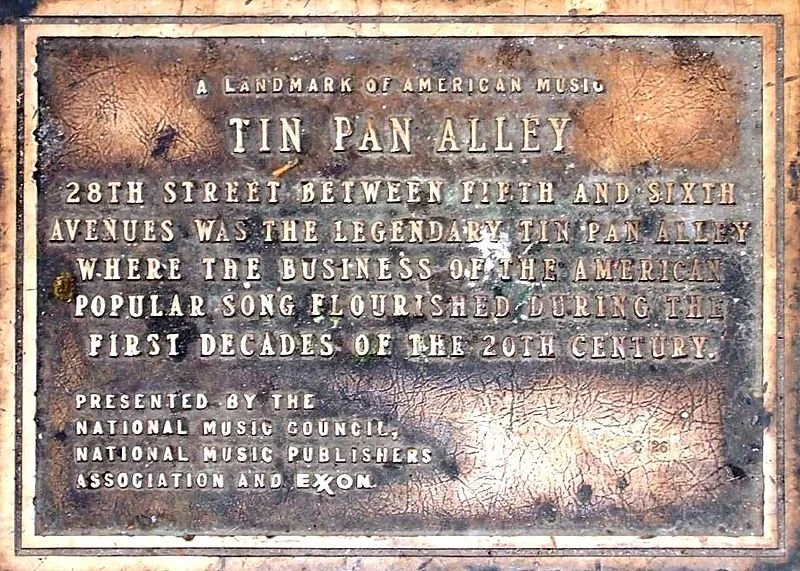
Tin Pan Alley grew into a central hub that influenced the modern American music industry. It represented a meeting between art and commerce, where songwriting became a structured enterprise and music a mass-marketed cultural product. From its offices at 28th Street, publishers developed methods that linked composition, marketing, and celebrity endorsement to reach audiences across the country. The success of Charles K. Harris’s “After the Ball” illustrated this system, demonstrating that a skillfully crafted song, combined with effective promotion, could attain unprecedented commercial success.
Tin Pan Alley’s reach extended beyond its physical location through its adoption of ragtime and the rhythms of African American music. Although most Tin Pan Alley “rags” did not replicate the genre exactly, their popularity brought syncopation and African American musical styles to wider audiences. The district’s commercial practices, including collaboration with vaudeville and the emergence of the song plugger, anticipated marketing strategies that would become standard throughout the music industry.
Even as radio, records, and film reduced the neighborhood’s prominence, Tin Pan Alley’s influence remained central to the American popular songbook. Tin Pan Alley influenced the development of new genres and demonstrated how art and commerce intersect in popular music. It established the model of the self-made American songwriter and showed the impact of combining musical skill with deliberate promotion, an approach that continued to guide the industry for years to come.
Chapter 4: Further Reading
Berlin, Edward A. King of Ragtime: Scott Joplin and His Era. New York: Oxford University Press, 1994.
———. Ragtime: A Musical and Cultural History. Berkeley: University of California Press, 1980. Enlarged ed., 1984.
Blesh, Rudi, and Harriet Janis. They All Played Ragtime. New York: Oak Publications,1950. 4th ed., 1971.
Ewen, David. The Life and Death of Tin Pan Alley: The American Popular Song and Its Creators. New York: Funk & Wagnalls, 1964.
Furia, Philip, with Graham Wood. Irving Berlin: A Life in Song. New York: Schirmer Books, 1998.
Harris, Charles Kassell. After the Ball: Forty Years of Melody. New York: D. Appleton and Company, 1926.
Meyer, Hazel. The Gold in Tin Pan Alley. Philadelphia and New York: Chilton Company, 1958.
Pearsall, Ronald. Popular Music of the Twenties. London: David & Charles, 1976.
Shepherd, John. Tin Pan Alley. London: Temple Smith, 1982.
Whitcomb, Ian. After the Ball: Pop Music from Rag to Rock. London: Penguin Books, 1972.
Wilder, Alec. American Popular Song: The Great Innovators, 1900–1950. New York: Oxford University Press, 1972.
Witmark, Isidore. The Story of the House of Witmark: From Ragtime to Swingtime. New York: Lee Furman, 1939. Reprint.