Chapter 3: American Popular Music in the Nineteenth Century Pt.2
Chapter 3: Introduction

As the Industrial Revolution took hold in the late 18th and early 19th centuries, advances in manufacturing, transportation, and domestic technologies led to rising urbanization and the growth of a new middle class in America. For many middle-class families, the piano was a symbol of cultural aspiration and social status. As piano ownership became more common, music lessons and amateur music-making became staples of domestic life. Home music-making created a new market for printed sheet music.” Long before the invention of recorded sound, sheet music was the primary means by which popular songs circulated. Consumers purchased the latest hits to play at home, and publishers responded by producing songs across a range of popular genres. The surge in sheet music demand helped establish a concentrated music publishing industry in New York, Boston, and Philadelphia.
Many middle-class households stressed musical education for women, where piano study was part of their domestic responsibilities and social training. Learning to play the piano or sing parlor songs was seen as a sign of refinement and virtue, but also as a form of social capital, an accomplishment that could improve a woman's marriage prospects and family reputation. For children, music education became increasingly common as part of moral and intellectual development. Parlor songs, often performed on the piano, addressed themes of courtship, longing, and social reform. Music also played a crucial role in promoting causes such as abolition and temperance, making it a vital element of 19th-century reform movements
The mid-19th century, however, brought out deep national division. Long-standing conflicts over slavery, economics, and federal versus state authority culminated in the American Civil War (1861–1865). Eleven Southern states, collectively known as the Confederacy, attempted to secede from the United States in defense of slavery and to assert regional autonomy and pride. In response, President Abraham Lincoln issued the Emancipation Proclamation in 1863, declaring enslaved people in Confederate states legally free. Ratified on December 6, 1865, the Thirteenth Amendment formally abolished slavery in the United States, declaring that "neither slavery nor involuntary servitude... shall exist within the United States."
The Civil War influenced American music in many ways. During the war, music played a significant role on both the battlefield and the home front. Soldiers from both the North and South sang familiar tunes—many of which were drawn from minstrel shows, which had widespread popularity regardless of region. These songs offered comfort, a boost in morale, and a sense of unity among troops. Back home, the family members left behind gravitated to sentimental ballads, hymns, and patriotic anthems published as sheet music to convey hope, grief, and national pride. Some songs explicitly supported abolition or glorified Union ideals, while others idealized the sacrifices of Confederate soldiers. The use of music for both political expression and emotional connection during the war demonstrated the growing power of popular music to direct public sentiment. Songs became tools of patriotism, protest, mourning, and mobilization, while the commercial music industry grew rapidly, driven by sheet music sales and new forms of live entertainment like blackface minstrelsy.
Parlor Songs

The Industrial Revolution brought sweeping changes to American musical life. As mass production and expanded transportation networks made goods cheaper and more accessible, musical instruments, particularly the piano, became increasingly available to middle-class households. By the mid-19th century, it had become common for families to own a piano, as the instrument symbolized cultural refinement and domestic respectability, and was associated with education, morality, and upward mobility. Upright pianos, which took up less space and were more affordable than grand pianos, were invented in 1826 and came in various cabinet styles to suit home interiors. These included square uprights, console pianos, and spinet models that blended functionality with decorative appeal, making them suitable for most homes.
In 1848, Heinrich Steinweg, a German piano maker, emigrated to New York to escape political unrest in Europe. Once in the United States, he anglicized his name to Henry Steinway and began manufacturing high-quality pianos that quickly gained a reputation for their superior craftsmanship and sound. He then founded Steinway & Sons, a company that revolutionized piano construction and helped set new standards for durability, tone, and technical innovation. Steinway pianos became the preferred choice for concert halls, music conservatories, and affluent homes alike, and the company played a significant role in establishing the piano as a central fixture of American musical life and is still considered a gold standard in piano-making to this day.
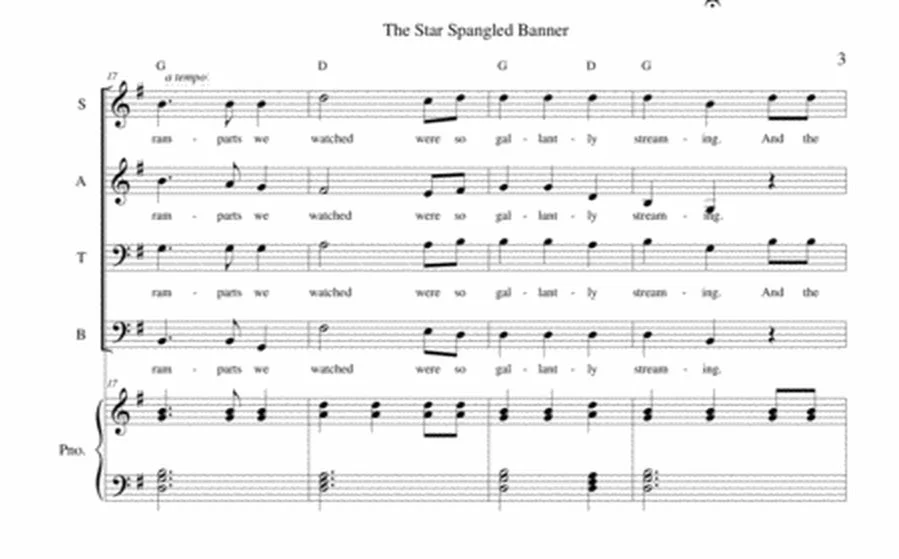
Playing music at home became an acceptable and encouraged pastime for women, in alignment with contemporary gender norms that emphasized domesticity, modesty, and refinement. While women were barred from political participation—they could not vote or hold most forms of public authority—the cultivation of musical skill was seen as a respectable way to embody ideals of femininity and contribute to the household's moral atmosphere. The popularity of the piano fueled a booming sheet music industry, as publishers recognized the instrument’s versatility as both a solo and an accompaniment instrument. To reach the widest possible audience, popular songs were often published in multiple formats, including solo voice with piano, solo piano, solo voice with guitar, four-part SATB (soprano, alto, tenor, bass) chorus, and male chorus (TTBB) settings. The strategy of publishing songs in multiple formats ensured that performers of varying skill levels, with different available instruments, could all access and engage with the music in their homes.
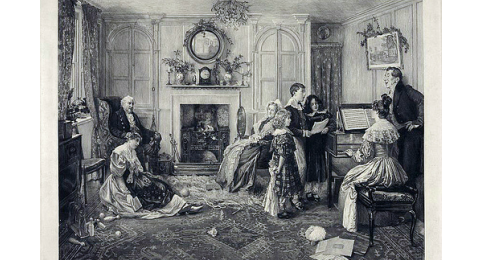
Songs designed for home use became known as parlor songs, named for the room in which they were typically performed. The parlor, a family’s formal sitting room, served as the central space for socializing and entertaining. Parlor songs generally featured simple piano accompaniments, making them accessible to amateur musicians. Importantly, their simplicity also made it easier for individuals to accompany themselves while singing, a common form of group entertainment before the advent of recorded sound.
Though parlor songs were unified by their domestic setting, they encompassed a wide range of musical genres and thematic content. Some focused on sentimental ballads, exploring themes of love, loss, and home, while others were comic or novelty songs designed to entertain and amuse. Many addressed current events, offering listeners commentary on political or social developments, and some were tied to reform movements, such as temperance or abolition.
At the same time, musical experience extended well beyond the home through a growing network of commercial entertainment spaces enabled by new transportation systems and urban expansion. Rail lines, steamboat routes, and improved roads enabled touring performers to move between cities, towns, and rural communities with greater ease. Greater transportation mobility supported a culture of itinerant entertainment, where audiences encountered music through traveling shows, theatrical productions, circuses, and showboats. Rather than remaining confined to local settings, songs and performance styles circulated widely, creating overlapping listening experiences across distant regions.
Among the most prominent of these venues was the circus. In the nineteenth century, organizations such as the Ringling Bros. and Barnum & Bailey Circus drew large crowds by combining acrobatic displays, trained animal acts, comedy routines, and live music into a single traveling spectacle. Brass bands became a central part of the performance schedule, performing marches, dance tunes, and popular songs throughout the event and during street parades. These ensembles also contributed to the popular circulation of composers such as John Philip Sousa, whose march style became widely recognizable through outdoor performances and touring ensembles. Circus parades, staged as public processions, turned city streets into temporary performance spaces, drawing spectators before the main show even began.
Showboats offered a different but related form of itinerant entertainment. Traveling along major river systems such as the Mississippi and Ohio, these floating theaters brought staged performances to towns without permanent venues. Vessels like the Cotton Blossom functioned as mobile cultural centers, hosting music, drama, comedy sketches, and variety acts for local audiences. Programs often included sentimental ballads, comic songs, operatic excerpts, and material drawn from minstrel and vaudeville traditions, performed by professional touring troupes. Because these boats moved from town to town throughout the performance season, they helped carry songs and stage practices across regional boundaries, linking otherwise isolated communities into shared entertainment circuits.
As noted earlier, one major source of commercially successful songs was the blackface minstrel show. Audiences who heard catchy or humorous songs during minstrel performances could later purchase sheet music and recreate the experience at home—albeit in a more sanitized, domesticated format. For example, a raucous banjo-and-bones performance from the stage might be refashioned into a singable tune with light piano accompaniment suitable for the parlor. The interaction between live performance, commercial publishing, and domestic music-making laid the groundwork for an enduring feature of American popular music: the integration of public performance trends into everyday private life.
Courtship Songs

Another major genre of 19th-century parlor song was the courtship song, a sentimental style centered on themes of yearning, absence, and emotional distance. These songs typically depicted romantic partners separated by circumstances such as spatial distance, shyness, social expectations, or even death. Courtship songs focused on feelings, expressing longing and memory when lovers were apart.
In contrast to later popular songs that emphasized physical attraction or romantic fulfillment, courtship songs of this era were deeply restrained. Their emotional core lay in idealized affection and unfulfilled desire, with no explicit reference to physical intimacy. In many cases, the characters never even interacted or touched each other. These songs drew on Victorian-era values, where modesty and emotional control were central social expectations, particularly for women.
These songs were designed for performance in the domestic parlor, often by amateur women who accompanied themselves on the piano. Their generally simple compositions minimized technical barriers, making them accessible to a wide range of performers. In doing so, they provide insight into the musical preferences and emotional world of nineteenth-century middle-class life.
The most iconic composer of American courtship songs was Stephen Foster, whose works often capture the bittersweet melancholy associated with lost or unattainable love. A classic example is "Jeanie with the Light Brown Hair" (1854), a song written in memory of Foster's estranged wife, Jane. The piano accompaniment is often arranged as blocked chords that support the vocal line without overpowering it, making the song accessible for amateur performance. In instrumental sections, the piano mirrors the vocal melody, sustaining the emotional tone even in the absence of lyrics. Like most parlor songs, "Jeanie" follows the familiar structure of verse-chorus form in which each verse introduces new lyrics over the same music, followed by a repeating chorus. The vocal line frequently includes wide leaps, which evoke a sighing effect, musically conveying the emotional ache of separation.
Lyrically, "Jeanie with the Light Brown Hair” is rich in idealized imagery. Jeanie herself is not portrayed as a tangible, autonomous figure but as a romantic fantasy, envisioned floating in the air, singing with birds, and dancing beside a stream. She functions less as a character with agency than as a projection of the narrator’s longing. Other Foster songs in the courtship or romantic genre follow similar patterns: “Beautiful Dreamer” presents a dreamlike, unattainable beloved, while “Gentle Annie” is a mournful address to a deceased or absent lover, blending sentimentality with an almost elegiac reflection.
Patriotic Songs
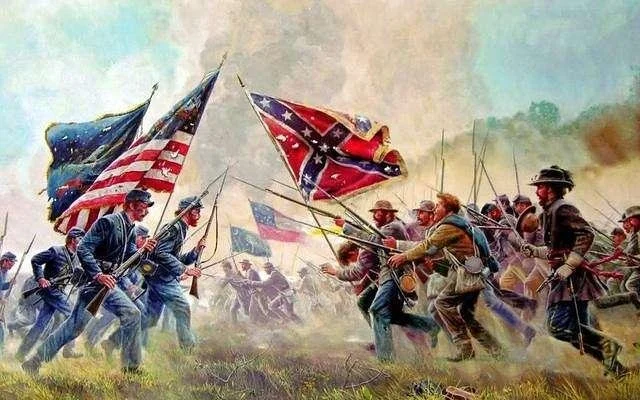
When the American Civil War broke out in 1861, composers of popular music quickly responded to the conflict with a surge of new songs that captured the emotional and political climate of the time. These songs typically fell into two broad categories: patriotic anthems and homefront ballads. Each type of song played a different role, but both helped people express emotions and connect to national events.
Patriotic songs were designed to stir enthusiasm, boost morale, and promote loyalty to either the Union or the Confederacy. These songs were energetic, optimistic, and highly performative, intended for group singing on battlefields, at recruitment rallies, or at public gatherings. Their lyrics often featured imagery of flags, freedom, sacrifice, and courage, along with an overtly regionalistic or partisan view of national destiny.
One of the most famous Union songs was George F. Root's "Battle Cry of Freedom," which became an effective recruitment anthem. Its stirring chorus, "The Union forever! Hurrah, boys, hurrah!" helped energize Northern troops on the battlefield and promote patriotic unity throughout the country. Similarly, Julia Ward Howe's "Battle Hymn of the Republic" reimagined a camp revival song as a religiously infused anthem for the Union cause.
The Confederacy had its own musical expressions of pride and resistance. Dan Emmett's"Dixie" (1859), initially written for a minstrel show, was adopted as an unofficial Southern anthem. With its lively tempo and celebratory refrain, "I wish I was in Dixie, hooray! hooray!" the song took on new meaning as a symbol of Southern identity and nostalgia. Some performers modified the lyrics to support the Confederate cause, introducing militarized lines such as “To Arms! To Arms! To Arms in Dixie!” alongside the original celebratory chorus. Other notable songs associated with the Confederate experience included Walter Kittredge’s “Tenting on the Old Campground,” which offered a reflective, intimate perspective from soldiers in the field, and James Ryder Randall’s “Maryland, My Maryland,” a Confederate rallying cry whose original lyrics denounced President Abraham Lincoln as “the tyrant,” “the despot,” and “the Vandal” while labeling the Union as “Northern scum.” Ironically, the song remained Maryland’s state song until 2021, despite the state’s decision to remain in the Union.
Sentimental Songs

While patriotic songs galvanized soldiers, another genre of Civil War music addressed the emotional toll of war on those left behind, particularly the wives and mothers of those deployed. These Parlor Songs, written for domestic performance, dealt with themes of grief, waiting, hope, and emotional strength. Songs such as "The Vacant Chair" and "Just Before the Battle, Mother" gained popularity for their ability to convey the experiences of women during wartime. "Weeping, Sad, and Lonely," which tells the story of a woman whose fiancé has gone off to fight. The song features a solo verse followed by a choral refrain, with a choir joining in, suggesting a supportive community sharing in her sorrow.
The music of the Civil War era, whether patriotic or personal, public or private, offers a window into how Americans understood their world during one of the nation's most turbulent periods. These songs gave voice to ideals of heroism, sacrifice, and national unity while also expressing the quieter but equally powerful realities of grief, longing, and endurance.
Taken together, Civil War music demonstrates how popular song served as a tool for mobilization, comfort, connection, and memory. The genre diversity from rallying cries to tender ballads demonstrates how music functioned as a shared emotional language across divides of gender, geography, and ideology
The Phonograph

The phonograph, introduced in 1877 by American inventor Thomas Edison (and independently conceived around the same time by French inventor Charles Cros), was the first device capable of both recording and reproducing sound. Using a diaphragm and stylus, the machine translated sound vibrations into grooves on a rotating cylinder wrapped in tinfoil or wax. When played back, the stylus followed these grooves to reproduce the original sound, enabling the preservation and replay of audio for the first time. Unlike earlier mechanical devices, such as music boxes, which could play only pre-programmed tunes, the phonograph captured live performances and allowed them to be replayed. Edison's earliest test recording was of himself reciting the nursery rhyme "Mary Had a Little Lamb," making it the first known audio recording that could be played back.
In the years that followed, the technology underwent rapid evolution. Emile Berliner introduced a flat disc system in 1887 that offered several advantages over cylinders. These discs were more durable, easier to manufacture, and simpler to store. As a result, the disc format soon became the industry standard. By the 1890s, public machines called "nickelodeons"began to appear, allowing people to pay a small fee to hear the latest recordings, an essential predecessor for what would become the jukebox.
By the early 1900s, companies like Columbia Records and the Victor Talking Machine Company led the emerging record industry. New formats, such as twelve-inch shellac discs spinning at 78 revolutions per minute, could hold up to four minutes of audio. The arrival of double-sided records in 1904 increased both convenience and commercial appeal as each record was essentially doubled. At first, the phonograph was often seen as a novelty item, helpful in preserving family voices or historic speeches. However, its commercial potential became apparent when Victor released recordings by the famed tenor Enrico Caruso, who performed opera arias in London in 1902. After his successful American performance debut, Victor released the recordings in the U.S., and they became bestsellers. Following Caruso's death in 1921, Victor reportedly sold over $2 million worth of his records in a single year, confirming the economic power of recorded music.
The popularity of recorded music continued to grow. By 1909, over 26 million records were being produced annually in the United States. Phonographs were increasingly found in American homes, often designed as elegant pieces of furniture in a similar fashion to the upright pianos. The rise of recorded sound raised new questions about music's role in society. Philosophically, the phonograph introduced what scholar R. Murray Schafer later termed schizophonia—the separation of sound from its original source. For the first time, music could be divorced from its live performance context, sparking concerns about the dehumanization of musical experience. Yet others viewed this separation as a democratic breakthrough: recorded music could now travel far beyond its place of origin, reaching diverse and distant audiences.
Not everyone embraced the emergence of recording technology. Composer and bandleader John Philip Sousa (whom we will cover in a later chapter) famously criticized recorded music in his 1906 essay, "The Menace of Mechanical Music".He argued that phonographs would discourage people from making music themselves and lead to the decline of amateur musicianship and community-based music making. Sousa feared a future in which passive listening would replace active musical engagement, coining the term "canned music" to express his disdain for such recordings.
In retrospect, the phonograph fundamentally changed how music was conceived and valued. For centuries, sheet music had served as the primary means of preserving musical works, capturing only the abstract notation to be reinterpreted with each new performance. With the advent of sound recording, however, the actual sound of a performance could be preserved, replayed, and distributed across time and space. Music became a product that was fixed, repeatable, and widely accessible. Over time, songs became closely associated with particular recordings, establishing what audiences came to hear as definitive versions. The phonograph launched the modern recording industry, turning sound recordings into lasting cultural artifacts and paving the way for the record industry's global dissemination during the twentieth century.
Chapter 3: Conclusion
In the 19th century, sheet music was the primary medium through which Americans engaged with popular music. Its affordability and widespread availability enabled families to bring music into their homes, particularly as pianos became a common fixture in middle-class households. Making music in the parlor became both a form of entertainment and a socially sanctioned activity, especially for women, who were encouraged to cultivate musical skills as a mark of refinement and personal expression. Parlor songs addressed a diverse array of themes, from courtship and emotional longing to separation and loss, from patriotic celebration and national pride to social reform causes such as temperance and abolition. Parlor songs offered enjoyment while helping listeners process personal and political events in a time of social change.
Throughout the 19th century, American popular music began grappling with many of the same issues that would continue to guide its development well into the 20th and 21st centuries. These included questions of authorship, representation, gender roles, and the growing commercialization of music. By the end of the century, major technological innovations began to change the creation, sharing, and experience of music. These technologies signaled the beginning of a cultural shift from participatory music-making to the consumption of pre-recorded, mechanically reproduced music, a development that would profoundly influence American musical culture in the decades to come.
Chapter 3: Further Reading
Austin, William W. "Susanna," "Jeanie," and "The Old Folks at Home": The Songs of Stephen C.Foster from His Time to Ours. New York: Macmillan, 1975.
Blocker, Jack S., David M. Fahey, and Ian R. Tyrrell. Alcohol and Temperance in Modern History: An International Encyclopedia. Santa Barbara, CA: ABC-CLIO, 2003.
Cockrell, Dale, ed. Excelsior: Journals of the Hutchinson Family Singers. New York: Syracuse University Press, 1989.
Dichter, Harry, and Elliott Shapiro. Early American Sheet Music: Its Lure and Its Lore, 1768–1889. New York: R.R. Bowker, 1941.
Finson, Jon W. The Voices That Are Gone: Themes in Nineteenth-Century American Popular Song. New York: Oxford University Press, 1994.
Frick, John W. Theatre, Culture and Temperance Reform in Nineteenth-Century America. Cambridge: Cambridge University Press, 2003.
Glass, Louis C and Paul Singer, eds. Singing Soldiers: A History of the Civil War in Song. New York: Grosset & Dunlap, 1975.
Heaps, Willard A., and Porter W. Heaps. The Singing Sixties: The Spirit of Civil War Days Drawn from the Spirit of the Times. Norman: University of Oklahoma Press, 1960.
Hildebrandt, Dieter. Pianoforte: A Social History of the Piano. Translated by Harriet Goodman. New York: George Braziller, 1988.
Hoover, Cynthia Adams. “The Steinways and Their Pianos in the Nineteenth Century.” Journal of the American Musical Instrument Society 7 (1981): 46–90.
Hutchinson, John W. A Brief Narrative of the Hutchinson Family. Boston: G. W. Nichols, 1896.
Jackson, Richard. Popular Songs of Nineteenth-Century America. New York: Dover Publications, 1976.
Loesser, Arthur. Men, Women and Pianos: A Social History. New York: Simon and Schuster, 1954.
Moseley, Caroline. “Irrepressible Conflict: Differences Between Northern and Southern Songs of the Civil War.” Journal of Popular Culture 25, no. 2 (1991): 45–56.
Olson, Kenneth E. Music and Musket: Bands and Bandsmen of the American Civil War. Westport, CT: Greenwood Press, 1981.
Silber, Irwin, ed. Songs of the Civil War. New York: Columbia University Press, 1995.
Sousa, John Philip. “The Menace of Mechanical Music.” Appleton's Magazine, Vol. 8 (1906), pp. 278-284.
Wolfe, Richard J. Early American Music Engraving and Printing: A History of Music Publishing in America from 1787 to 1825, with Commentary on Earlier and Later Practices. Urbana: University of Illinois Press, 1980.
Wolfe, Richard J. Secular Music in America, 1801–1825: A Bibliography. New York: New York Public Library, 1964.
Social Reform Songs
In contrast to the comedic and often racially exploitative repertoire of blackface minstrelsy, a parallel tradition of socially conscious reform songs developed in 19th-century America. These songs focused on moral and political issues, especially abolition and temperance, aiming to influence listeners’ moral conscience. They were typically earnest, emotional, and persuasive, intending to inspire activism and promote ethical behavior.
During this period, abolition and temperance were the two major reform movements widely considered appropriate for female involvement. Because women were largely excluded from formal politics, many used music, literature, and religious activism to influence public opinion within the bounds of acceptable gender norms. Music, in particular, became an effective medium for moral messaging in both the parlor and the public sphere.
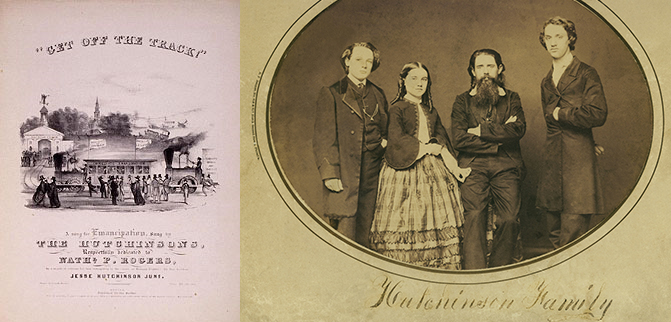
One of the most influential reformist musical groups of the time was the Hutchinson Family Singers, a traveling vocal quartet from New Hampshire. Known for their tight vocal harmonies, the Hutchinsons regularly performed songs supporting abolition, temperance, and other progressive causes. Their concerts blended entertainment with activism, reaching diverse audiences through their public performances in churches, lecture halls, and political gatherings.
The Hutchinsons often borrowed musical elements from the popular genres of the time, including minstrelsy, to connect with broader audiences. For example, their anti-slavery anthem, “Get Off the Track!,” featured abolitionist lyrics set to the tune of Dan Emmett’s minstrel hit, “Old Dan Tucker.” Setting abolitionist lyrics to a familiar minstrel tune gave their message a familiar, accessible sound, even as it recontextualized a tune initially associated with racial caricature.
Similarly, other abolitionist songs drew inspiration from Harriet Beecher Stowe’s landmark novel Uncle Tom’s Cabin, which depicted the brutality of slavery in the American South and became one of the best-selling and most influential books of the 19th century. Songs like “The Ghost of Uncle Tom” and “The Death of Little Eva” translated the novel’s characters and storylines into a musical form to advocate for the end of slavery.
The temperance movement, which sought to curb or eliminate alcohol consumption, inspired a wave of parlor songs, particularly aimed at middle-class women and families. These songs often depicted alcohol as both a personal vice and a source of domestic ruin, linked to poverty, abuse, and the breakdown of the family unit. Notable examples include “Lips That Touch Liquor Shall Never Touch Mine,” which presents sobriety as a measure of romantic worthiness; “Father’s a Drunkard and Mother Is Dead,” a poignant narrative of child abandonment and grief; and “Girls, Wait for a Temperance Man,” a cautionary song warning women about the dangers of marrying men who drank.
These songs expressed and reinforced the widely held belief that women had a special moral role in society as protectors of the home and agents of moral reform. Music provided women with a culturally acceptable way to participate in social movements while also strengthening reformist networks and ideologies.