Chapter 8: Broadway and Musical Theater
Rhapsody in Blue
Album/Year Released
Premiered 1924
Artist/Composer
George Gershwin (1898–1937), composer and pianist: Paul Whiteman Orchestra (premiere 1924)
Genre/Style
Symphonic jazz; orchestral jazz
Song Form
Blues with extended form: combination of 12-bar blues and tango-style sections
Rhapsody in Blue was composed by George Gershwin in 1924 and premiered by Paul Whiteman’s orchestra at Aeolian Hall in New York. Commissioned for a concert titled An Experiment in Modern Music, the work aimed to present jazz elements in a symphonic setting and introduce concert audiences to the burgeoning style. Gershwin, trained in both classical and popular traditions, sought to bridge these worlds by combining the structural and harmonic sophistication of orchestral music with the rhythms, improvisatory gestures, and tonal inflections of jazz. At the time, jazz was associated with dance halls, vaudeville, and small ensembles and was considered popular or “low-brow” music. Gershwin’s work was one of the earliest serious attempts to integrate its language into concert music or the “high-brow” musical milieu.
Before composing Rhapsody in Blue, Gershwin had experimented with integrating jazz and classical elements in his one-act opera Blue Monday (1922), which blended blues idioms with operatic conventions but achieved only modest success. Paul Whiteman, intent on “making a lady out of jazz” and presenting a distinctly American concert program, was intrigued by Gershwin’s innovative approach. He commissioned Gershwin to compose the rhapsody, encouraging him to weave jazz into a broader orchestral framework. Gershwin later recalled that the inspiration for Rhapsody in Blue came to him during a train journey, where he imagined the piece as a “musical kaleidoscope of America”—capturing the nation’s diversity, energy, and vibrant urban spirit.
One of the work’s most iconic features is the opening clarinet glissando—a glissando is a musical technique in which the player slides smoothly between two notes, producing a continuous, sweeping sound. In this case, the clarinet executes a dramatic upward sweep spanning about 17 notes, a flourish first performed by Ross Gorman in rehearsal. The glissando bridges the clarinet and piano textures and establishes a jazz-inflected timbre that recurs throughout the composition. The piano serves as both a melodic and orchestral instrument, with passages featuring ragtime stride, comedic sections, and Tin Pan Alley song-plugger techniques, all drawing from Gershwin’s familiarity with contemporary popular styles. Sections of the rhapsody display wide-ranging harmonic exploration, with key modulations through B♭, E♭, A♭, D♭, G♭, B, and E, while the central section is in C major. These shifts often center on the blues scale and incorporate blue notes, further contributing to the piece’s jazz character.
Rhapsody in Blue also relies on motivic development. Musicologist David Schiff identifies five primary themes and a sixth tag, many introduced in the first fourteen measures. The "Glissando theme" and the "Train theme" recur throughout, appearing both in orchestrated sections and piano solos, and illustrate Gershwin’s use of motivic interrelatedness.Rhythmic variety, including rubato and syncopation, together with influences from ragtime, Cuban "clave" rhythms, and jazz idioms, creates the work's rich texture and sense of forward momentum. The orchestration uses both traditional symphonic instruments—strings, winds, brass, and percussion—and vernacular instruments such as saxophones, banjo, and accordion to reinforce the jazz or popular character of the work.
Structurally, Rhapsody in Blue functions as a rhapsody featuring a single extended movement with contrasting sections and improvisatory passages written into the score. The premiere featured Gershwin as piano soloist, accompanied by Ferde Grofé’s innovative orchestration for jazz band. The work typically runs around fifteen minutes and fifty-four seconds and is scored for a rich array of instruments, including solo piano, two flutes, two oboes, two clarinets, bass clarinet, two bassoons, three horns, three trumpets, three trombones, tuba, timpani, and a diverse percussion section (bass drum, cymbals, glockenspiel, gong, snare drum, triangle), as well as strings.
Through its integration of jazz and classical elements, its varied piano styles, blues-based themes, and flexible, rhapsodic structure, Rhapsody in Blue exemplifies Gershwin's distinctive synthesis of popular and concert music idioms. The piece offers a dynamic framework in which piano and orchestra interact across a spectrum of rhythmic, harmonic, and timbral colors, embodying the spirit of American musical innovation.
“I Got Rhythm”
Album/Year Released
Premiered 1930 in Girl Crazy
Artist/Composer
George Gershwin (1898–1937), composer
Ira Gershwin (1896–1983), lyricist
Genre/Style
Broadway/jazz standard; Tin Pan Alley popular song
Song Form
32-bar AABA
“I Got Rhythm,” composed by George Gershwin with lyrics by Ira Gershwin for the 1930 Broadway musical Girl Crazy, quickly became a central work in American popular songwriting. The show also produced enduring standards such as “Embraceable You” and “But Not for Me.” From its debut, “I Got Rhythm” attracted attention for its rhythmic drive and distinctive harmonic design, qualities that later made it especially appealing to jazz musicians. George Gershwin wrote the melody before the lyrics, and Ira Gershwin remarked that the tune’s rhythmic intensity and wide melodic range made it difficult to set to text. Even so, the song was readily taken up by jazz singers and instrumentalists and remains a regular part of the jazz repertoire.
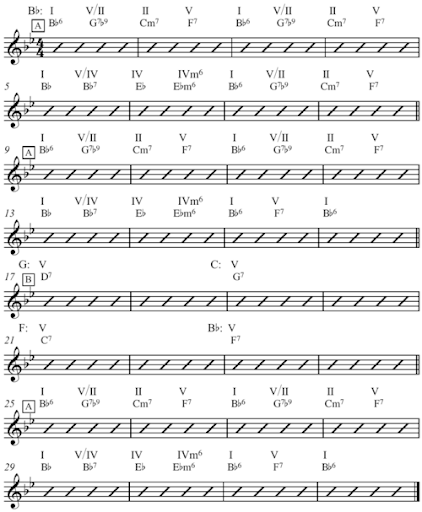
The song is structured around a 32-bar AABA form, although some early performances featured a 34-bar chorus before the form was standardized. In this layout, the A sections present the primary melody and recurring harmonic pattern, while the B section, or bridge, introduces contrast before the return of the final A section. A chord consists of two or more pitches sounded together, and a chord progression is the sequence of chords through which a piece's harmony unfolds.e In “I Got Rhythm,” this progression became known as “rhythm changes,” a harmonic framework widely used in jazz composition and improvisation.
Because of its clear form and adaptable harmony, rhythm changes became one of the most common foundations for jazz improvisation, especially during the swing and bebop eras. Musicians frequently composed contrafacts using these changes. Well-known examples include Charlie Parker and Dizzy Gillespie’s “Anthropology,” Duke Ellington’s “Cotton Tail,” Charlie Christian’s “Seven Come Eleven,” Dizzy Gillespie’s “Salt Peanuts,” and Thelonious Monk’s “Rhythm-a-Ning.” One of the earliest documented jazz recordings to employ rhythm changes outside of Gershwin’s original song appears in Sidney Bechet’s 1932 recording of “Shag.”
“I Got Rhythm’s” AABA structure, repeating chord cycles, and contrasting bridge demonstrate how a stable harmonic design can support both memorable melodic writing and extended improvisation.