Chapter 10: Bluegrass
“Blue Moon of Kentucky”
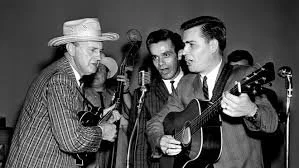
Album/Year Released
Recorded 1947
Artist/Composer
Bill Monroe and the Bluegrass Boys
Bill Monroe (mandolin, vocals)
Genre/Style
Bluegrass
Song Form
Binary Form AB
“Blue Moon of Kentucky,” recorded by Bill Monroe and the Bluegrass Boys in 1947, is an early example of bluegrass music and helped establish many of the genre's conventions. Bluegrass developed in the 1940s in the Appalachian region of the United States. It drew inspiration from African American musical traditions such as blues and jazz, and from North European ballads and dance tunes. Unlike contemporary country, bluegrass was performed exclusively on acoustic instruments, with an emphasis on technical virtuosity.
Some sources trace “Blue Moon of Kentucky’s” origins to Jimmie Rodgers’ “Roll Along, Kentucky Moon,” a similar waltz recorded about 15 years earlier. The resemblance to Jimmie Rodgers' earlier recording demonstrates the song’s connection to earlier folk and country traditions. The song is in triple meter (3/4), giving it a lilting waltz rhythm with a strong first beat followed by two lighter beats. It follows a verse-chorus form, where each verse is sung to the same melody and the B section introduces new melodic content to contrast with the verse. The verse-chorus structure also leaves space for instrumental fills between vocal lines.
Monroe sang lead in a high tenor range, giving the melody a bright, piercing quality often described as the “high and lonesome sound,” which became a signature characteristic of bluegrass vocals. Supporting him, other band members provided close harmonies that emphasized the melody without ornamentation, creating the tight, consonant ensemble singing for which the Bluegrass Boys became known.
Instrumentally, Monroe’s mandolin plays a central role. He uses it to provide offbeat “chop” chords for rhythmic drive and to interject melodic fills between vocal phrases. The other acoustic instruments—fiddle, guitar, banjo, and upright bass—complement this texture, creating a full, percussive sound. Monroe’s thumb technique on the mandolin also anticipates a version of Travis picking, alternating bass notes with melodic or chordal motion in the higher strings. Over time, “Blue Moon of Kentucky” became widely recorded, including notable versions by Elvis Presley and Alan Jackson, and it is recognized as the official bluegrass song of Kentucky.
“Foggy Mountain Breakdown”

Album/Year Released
Recorded 1949
Artist/Composer
Flatt & Scruggs:
Earl Scruggs (banjo), Lester Flatt (guitar, vocals)
Genre/Style
Bluegrass
Song Form
Instrumental with repeated thematic sections (rondo-like)
“Foggy Mountain Breakdown,” recorded by Flatt & Scruggs in 1949, is a bluegrass banjo instrumental that shows the genre’s rhythmic drive and technical precision. The piece features Earl Scruggs’ three-finger banjo technique, also called Scruggs-style picking. In Scruggs-style picking, the thumb, index, and middle fingers pluck the strings rapidly with picks while the pinky and ring fingers brace against the banjo head. The three-finger picking technique lets the banjo provide rhythm, harmony, and melody at once, with melody notes woven among rolling arpeggios. The music is syncopated and can include subtle swing or shuffle inflections, even at fast tempos.
The song is organized in repeated thematic sections, somewhat like a rondo, a musical form where a main theme alternates with contrasting episodes. These sections allow for instrumental variation and solos, a common feature in bluegrass breakdowns. All instruments may play the theme together and then take turns performing individual breaks. The recording captures the interaction between banjo, fiddle, mandolin, and guitar, making evident both the ensemble’s coordination and individual technical skill.
The recording includes the G-run, a characteristic ending pattern typically played on the guitar in bluegrass music. The G-run is a short melodic flourish used to conclude phrases and as a basis for improvisation. In this recording, it appears in the accompaniment, adding forward motion and signaling phrase endings.
Bluegrass, the genre of the song, developed in the 1940s in the Appalachian region of the United States. It draws from African American blues and jazz, as well as European folk music, and is typically performed on acoustic instruments like banjo, mandolin, fiddle, guitar, and upright bass. Unlike older string-band styles, bluegrass emphasizes individual instrumental breaks and virtuosic playing within an ensemble.
The piece also gained recognition outside of recordings. Its driving tempo and energetic texture made it suitable for film, most notably in the car chase sequences of Bonnie and Clyde (1967). It has since been used in other media to evoke rural landscapes or fast-paced action.