Chapter 27: Funk Music
“Funky Drummer”
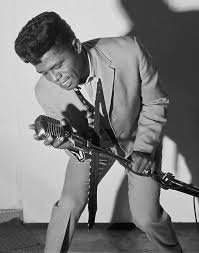
Album/Year Released
1970 (Single, also on album: In the Jungle Groove)
Artist/Composer
James Brown
Genre/Style
Funk
Song Form
Extended vamp
“Funky Drummer,” recorded by James Brown in November 1969 and released as a single in 1970, is built almost entirely on an extended vamp, or repeating musical figure or section, that places rhythm at the center of the musical experience. Set in duple meter (4/4) and centered on D minor, with brief motion through C major, the track avoids verse–chorus contrast. The song is often divided into Parts 1 and 2 (as on the original 45 RPM single), with the second part featuring the iconic drum break and a different, more prominent guitar riff. Harmony stays static, letting rhythmic detail and ensemble precision carry the music forward. The groove is driven by Clyde Stubblefield’s drum pattern, which uses steady sixteenth-note subdivisions articulated through hi-hat, syncopated snare accents, ghost notes, and subtle internal variation. Instead of pushing toward melodic development, the groove sustains momentum through microscopic changes in articulation and timing.
The famous drum break arrives late in the recording after James Brown cues the band with his request to “give the drummer some.” In this eight-bar unaccompanied passage, Stubblefield does not abandon the groove for virtuosic display. Instead, he retains the core rhythmic idea, showing how funk treats the groove as the primary expressive material. Guitar, bass, organ, and tenor saxophone play short, improvised, repeating rhythmic licks layered around the drums, often stressing “the one,” the emphatic downbeat that Brown insisted on as the anchor of the groove. Brown’s vocals appear intermittently and serve a directive, conversational role such as announcing "Give the drummer some" before the drum solo.
Formally, the recording unfolds as a continuous process rather than a sequence of contrasting sections. On the original single, the performance was divided into Parts 1 and 2. The second half features the drum break and a slightly altered guitar figure, but the underlying vamp remains constant. After the break, the ensemble returns to the original groove and closes with a reprise of the drum pattern and a fade-out.
Although “Funky Drummer” was not a major commercial hit at the time of its release, its rhythmic emphasis proved enormously influential. Stubblefield’s drum break became one of the most frequently sampled passages in recorded music, generating a foundational element of early hip-hop production in the 1980s and continuing to appear across rap, pop, and electronic styles.
“September”
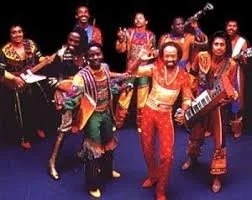
Album/Year Released
1978 (album: The Best of Earth, Wind & Fire, Vol. 1)
Artist/Composer
Earth, Wind & Fire
Maurice White, Al McKay, Allee Willis
Genre/Style
Funk, Soul
Song Form
Verse–chorus with instrumental interludes and bridge
Released in 1978 on The Best of Earth, Wind & Fire, Vol. 1, “September” exemplifies Earth, Wind & Fire’s blend of disco, funk, and soul in a lively, well-crafted arrangement. Maurice White, Al McKay, and Allee Willis wrote the song to add new material to the compilation. Though it began as a bonus track, it quickly became a pop hit, reaching the top ten and becoming one of the band’s most famous songs. The song’s rich production, repeating harmonies, and tight playing show that disco could be both danceable and musically interesting, using jazz, soul, and funk influences without losing clarity or energy.
Set in duple meter (4/4), the song is driven by a steady four-on-the-floor bass drum pattern associated with disco, while funk-inflected bass, guitar, and horn parts add internal motion. The groove unfolds over a repeating two-bar harmonic loop in the key of A major. Formally, the song follows a verse–chorus design, with instrumental extensions based on the verse progression, followed by a bridge and a closing section that merges the chorus and coda into a repeated fade. Rather than building toward a single climactic moment, the arrangement sustains energy through layering, rhythmic consistency, and melodic repetition.
Rhythm section parts interlock as Verdine White’s bass line moves in syncopated patterns tightly aligned with the kick drum, while rhythm guitar uses light, percussive strumming and short, staccato figures, including octave-based riffs. Early in the track, keyboards outline the harmony, joined by a cowbell marking quarter notes and layered guitars that establish the groove before the vocals enter. The horn section plays a central structural role, delivering sharply articulated, syncopated figures that recur as melodic signposts and often answer the vocal lines through call-and-response phrasing. These horn lines draw on jazz and soul arranging practices while maintaining the clean rhythmic profile expected of disco-oriented production.
“Flashlight”
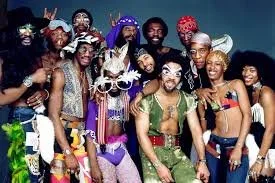
Album/Year Released
1978 (album: Funkentelechy vs. the Placebo Syndrome)
Artist/Composer
Parliament
George Clinton, Bernie Worrell
Genre/Style
P-Funk; funk
Song Form
Vamp-based form with verse–chorus elements
“Flashlight,” released in 1978 on Funkentelechy vs. the Placebo Syndrome, stands at the center of Parliament’s late-1970s output and illustrates the P-Funk aesthetic. P-Funk, short for Parliament-Funkadelic, refers to both the collective of bands led by George Clinton and a stylistic approach within funk that favors extended grooves, theatrical concepts, dense vocal layering, and heavy use of electronic instruments. Instead of focusing on song-by-song narrative closure, P-Funk recordings frequently function as components of a larger fictional universe, blending dance music with humor, Afrofuturist imagery, and studio experimentation. “Flashlight” closes the album’s storyline, where the band defeats the anti-funk character Sir Nose D’Voidoffunk by forcing him to dance.
The track is set in duple meter (4/4) and unfolds through a vamp-based form with verse–chorus elements, relying on repetition rather than harmonic motion for momentum. Harmony stays largely static, a common funk practice that puts rhythmic interaction and timbre above chord changes. The groove is anchored by a synthesizer bass line instead of a traditional electric bass. Bernie Worrell created the bass line using multiple Minimoog synthesizers. The Minimoog, a monophonic (one note at a time) analog synthesizer introduced in the early 1970s, lets performers manipulate sound through voltage-controlled oscillators, filters, and envelopes. Unlike electric bass, it can produce sustained tones, smooth pitch bends, and a thick, rounded low end. Worrell uses these qualities to compose a bass line that moves chromatically while staying tightly locked to the rhythm.
The Minimoog line serves as the bass foundation, melodic hook, and sonic signature. It was originally conceived for Bootsy Collins, who declined to play it on bass guitar, so Worrell realized it electronically. The resulting line ascends and descends chromatically with a strong sense of swing and articulation, giving the groove both weight and flexibility. Collins plays drums on the track, while Catfish Collins adds rhythm guitar with short, percussive figures that reinforce the pulse. Layered percussion, including handclaps and auxiliary sounds, thickens the rhythmic texture without distracting from the central groove.
Vocals in “Flashlight” operate as part of the rhythmic fabric rather than as a dominant melodic layer. George Clinton’s lead lines are surrounded by stacked background vocals, chants, and studio effects, with reportedly dozens of vocal tracks layered into the mix. The stacked vocal parts use repetition, call-and-response gestures, and short rhythmic phrases such as the “da da da dee da da da” chant, which Clinton adapted from a dance chant he had heard at a social gathering. The form advances via shifts in density, texture, and energy rather than through clear-cut sectional contrast, allowing the groove to remain continuous while still feeling dynamic.