Chapter 24: Country Rock & Southern Rock
History of American Pop Music: Chapter 24
The Byrds: Sweetheart of the Rodeo
Jackson Browne & Geffen Records
The Eagles Transition to Rock: On the Border and One of These Nights
Chapter 24: Introduction
In the late 1960s and 1970s, two related but distinct styles—country rock and Southern rock—brought American rock and roll back into contact with one of its early sources: the mixture of country and western music with rock and roll. That connection had been easy to hear in the 1950s, especially in rockabilly, where country singing and guitar playing mixed with rhythm and blues. By the early 1960s, the rockabilly sound had faded from the mainstream, and country elements became less common in rock. Psychedelic rock, Motown, and the British Invasion filled the airwaves, while twang and honky-tonk storytelling seemed increasingly distant from contemporary rock culture.
By the end of the decade, West Coast musicians were bringing those sounds back, especially in and around Los Angeles. Country rock grew from this renewed interest, mixing country instruments and vocal styles with contemporary rock songwriting. A standard rock lineup of electric guitar, bass, and drums could be joined by pedal steel guitar or dobro. Pedal steel bent and sustained notes into a smooth, mournful glide, while the dobro added a brighter metallic sound. Mandolin and fiddle also appeared on rock recordings. The country influence could be heard in the vocals as well. Singers borrowed techniques such as yodeling and sliding between notes, sometimes stretching vowels or using the plain, straight tone associated with older country singing. These techniques brought the sound and phrasing of country music directly into rock songs.
Los Angeles became a center for country rock, and many musicians involved in the style had come through the folk revival. California country music provided another source. Buck Owens and the Bakersfield sound offered a harder-edged alternative to polished Nashville country, built around bright Telecaster guitars and close duet harmonies. The Byrds moved deeply into country music on Sweetheart of the Rodeo (1968), recording in Nashville and using pedal steel, fiddle, and banjo throughout the album. Gram Parsons joined the Byrds during this period and continued mixing country with rock in the International Submarine Band and the Flying Burrito Brothers. Other Los Angeles musicians worked in the style in their own ways. Buffalo Springfield and Poco brought country sounds into folk rock, while Michael Nesmith and Linda Ronstadt explored similar territory in their solo work. Neil Young carried country influences into much of his music, and the Eagles later brought the style to a large rock audience. Bob Dylan’s late-1960s Nashville recordings offered another example of a folk-rock musician working directly with country musicians and recording practices.
Southern rock developed mainly in the American South and had a heavier sound drawn from blues, soul, country, and jazz. The music often gave electric guitars and extended instrumental passages more room. Several lead guitarists might trade phrases or play harmonized lines, and songs could open into long improvisations. Some groups also used two drummers, which gave live performances a denser rhythmic foundation. The lyrics often dealt with Southern places, everyday life, regional identity, and working-class experiences, while some musicians adopted outlaw or anti-establishment images. The Allman Brothers Band, Lynyrd Skynyrd, the Marshall Tucker Band, and ZZ Top developed different versions of the style, drawing from African American blues, soul, and jazz alongside country and other Southern traditions.
Country rock and Southern rock shared musical ancestry, yet each developed its own sound. Musicians in both styles returned to sounds that had been present near the beginning of rock and roll and adapted them for the 1970s. Country music became a source that rock musicians could draw from in different ways, from the steel guitars and harmonies of Los Angeles to the blues-based guitar work of Southern bands.
Bob Dylan’s Nashville Albums
Many musicians who turned toward roots-oriented rock in the late 1960s had come through the folk revival, which already drew heavily from older American musical traditions. Bob Dylan connected that folk background with rock and, later, country music. Over the course of the decade, his music moved from acoustic folk to electric rock before taking on a stronger country sound. His recordings from the late 1960s brought country instruments and vocal styles into songs that still grew from his earlier work as a folk and rock songwriter.
By the mid-1960s, Dylan had moved from acoustic folk into electric rock on albums such as Highway 61 Revisited (1965) and Blonde on Blonde (1966). After a motorcycle accident in July 1966, he stopped touring and spent much of 1967 in Woodstock, New York, where he recorded informally with the musicians who later became The Band. Many of the recordings eventually appeared on The Basement Tapes (1975). The sessions moved away from the dense electric sound of Dylan’s previous albums. Instead, Dylan and The Band played in a loose, stripped-down style that drew from older folk songs and country music as well as blues and gospel. The informal sessions began a period in which Dylan turned more directly toward older American song traditions.
This musical approach carried into John Wesley Harding (1967), which Dylan recorded in Nashville with a small group of musicians. The arrangements were sparse, relying mainly on acoustic guitar, bass, drums, and restrained accompaniment. His songwriting changed as well. Songs such as “All Along the Watchtower” unfold through short scenes filled with biblical language and characters whose identities and motives remain unclear. The compact narratives differ from the longer topical songs of Dylan’s early folk career and the surreal, densely written songs of his mid-1960s albums. Combined with the spare instrumentation, they gave John Wesley Harding a quieter sound that drew Dylan closer to folk and country.
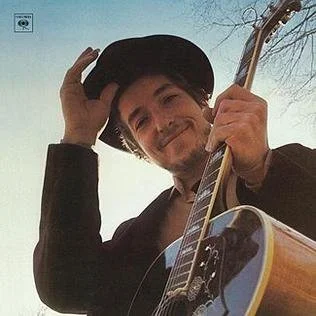
Country music became more explicit on Nashville Skyline (1969). Dylan returned to Nashville and worked with musicians experienced in country recording sessions, adding pedal steel guitar to an instrumental lineup that included guitars, piano, organ, and drums. On “Lay Lady Lay,” the pedal steel moves around a relaxed rhythm that would have been familiar on contemporary country records. Dylan changed his singing as well, using a smoother voice that differed noticeably from the nasal delivery associated with his earlier recordings. The change made Nashville Skyline sound even further removed from the electric rock of Highway 61 Revisited and Blonde on Blonde.
The album’s opening track made Dylan’s connection with country music especially clear. He recorded “Girl from the North Country” as a duet with Johnny Cash, revisiting a song that had first appeared on The Freewheelin’ Bob Dylan in 1963. The original recording belonged to Dylan’s acoustic folk period; the 1969 version placed the same song in a Nashville country setting beside one of country music’s established performers. Reworking an older song in this setting connected Dylan’s folk past with the direction his music had taken by the end of the decade.
Dylan’s Nashville recordings showed folk and rock musicians how country music could fit within contemporary songwriting. Pedal steel, country rhythms, and Nashville musicians could be incorporated into songs without requiring musicians to leave their folk or rock backgrounds behind. Dylan soon moved in other musical directions, including the personal songwriting of Blood on the Tracks (1975) and the Christian music he recorded near the end of the decade.. The period from John Wesley Harding through Nashville Skyline nevertheless helps explain how country sounds entered late-1960s rock. Dylan’s movement between folk, rock, and country also provides a direct connection between the folk revival and the country-rock musicians who followed.
The Byrds: Sweetheart of the Rodeo
By the late 1960s, the Byrds had already moved through several musical styles. They first became known for folk-rock recordings of songs by Dylan before moving into psychedelia on tracks such as “Eight Miles High” (see Chapters 21 and 22). As their psychedelic period continued, country sounds began appearing more often in their music.
Younger Than Yesterday (1967) and The Notorious Byrd Brothers (1968) mixed the Byrds’ folk-rock background and psychedelic experimentation with elements drawn from country music. “Change Is Now” moves between psychedelic textures and country-style guitar playing, while “Wasn’t Born to Follow” pairs a relaxed country feel with psychedelic studio effects. “Old John Robertson” goes further into country territory through its fiddle and country-style guitar. Country music was therefore already becoming part of the Byrds’ sound while the band was still associated with psychedelia.
For the Byrds, the move toward country was already underway before Dylan’s Nashville recordings could provide an example for other rock musicians. Their experiments in 1967 and early 1968 led directly into Sweetheart of the Rodeo (1968), where country music moved from one element within the Byrds’ sound to the main musical basis of the album.
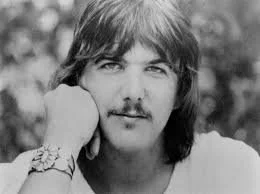
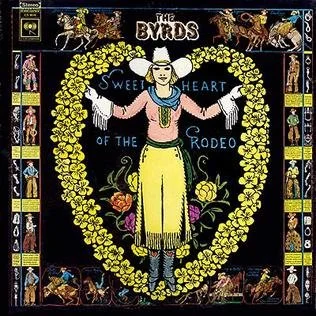
Gram Parsons joined the Byrds in early 1968 and brought with him a deep interest in country music. His arrival pushed the band further in a direction it had already begun exploring, leading to the much more concentrated country sound of Sweetheart of the Rodeo (1968). The album included songs by Parsons alongside material by Bob Dylan, Woody Guthrie, Merle Haggard, and other writers, drawing from both contemporary country and older American song traditions. Country instrumentation runs throughout the record, especially pedal steel guitar, while the Byrds’ vocal harmonies and rock background remain audible. “You Ain’t Going Nowhere” combines the group’s familiar harmonies with pedal steel, while “One Hundred Years from Now” places Parsons’s country songwriting within a rock arrangement. Sweetheart of the Rodeo sold modestly when it was released, but its combination of country instrumentation and rock remained available as a model for musicians working between the two styles in the years that followed
Parsons stayed with the Byrds for only a few months. Later in 1968, he and bassist Chris Hillman formed the Flying Burrito Brothers and continued the direction heard on Sweetheart of the Rodeo. With the Burritos, Parsons had more room to write songs around country conventions while still drawing from rock. Pedal steel and fiddle appeared alongside electric guitars and drums, and close vocal harmonies connected the music to both country duets and Parsons’s work with the Byrds. The group’s songs also drew heavily from honky-tonk, giving the music a harder country sound than much of the country rock developing elsewhere in Los Angeles.
After leaving the Flying Burrito Brothers, Parsons continued mixing country and rock on his solo albums GP (1973) and Grievous Angel (1974). The arrangements moved among country, honky-tonk, gospel, and bluegrass while leaving room for electric guitar and keyboards. Emmylou Harris (see Chapter 23) became his principal vocal partner during these sessions. Her clear harmony voice often sits closely against Parsons’s lead, giving songs such as “We’ll Sweep Out the Ashes in the Morning” and “Love Hurts” the sound of a country duet.
Parsons died in 1973, before Grievous Angel was released. His career had been brief, but it connected several stages in the development of country rock. He joined the Byrds as they were moving further into country music, pursued that direction with the Flying Burrito Brothers, and then continued it in his solo recordings with Harris. Across those projects, Parsons treated country as the basis of his songwriting and performance rather than an occasional sound added to rock. His recordings circulated among later musicians interested in working across the same country-rock boundary.
The Laurel Canyon Scene
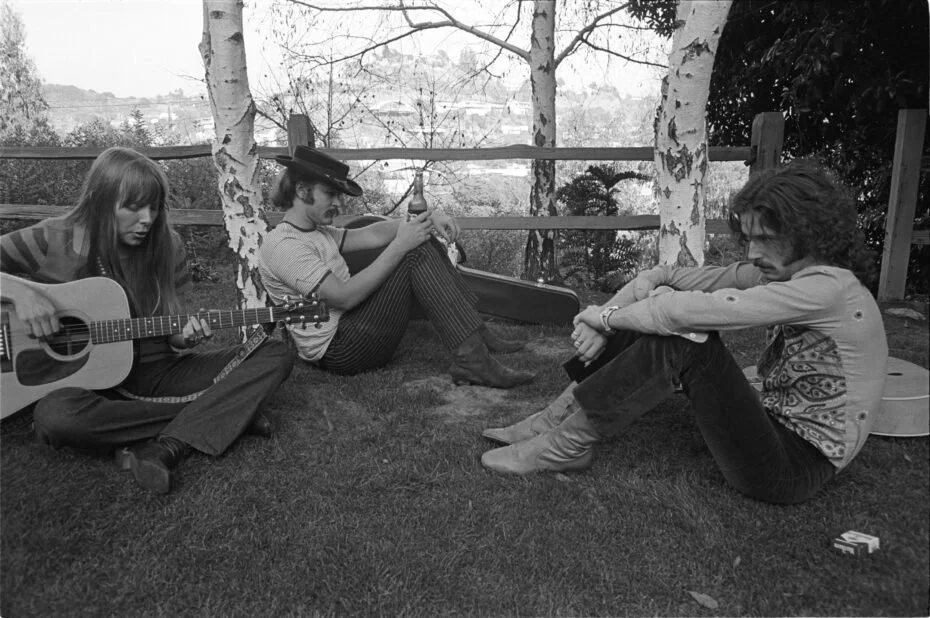
The Byrds’ turn toward country rock took place within a closely connected Los Angeles music scene, where folk, rock, pop, and country musicians regularly crossed paths. Laurel Canyon, a neighborhood in the Hollywood Hills, became one of the main gathering places for this community. Its winding roads and relatively modest houses offered some privacy while keeping musicians close to Hollywood’s clubs and recording studios. By the late 1960s, musicians were living near one another, visiting each other’s homes, exchanging songs, and playing together informally. Residents and frequent visitors included members of the Byrds and Buffalo Springfield, along with Gram Parsons, Cass Elliot, Joni Mitchell, Frank Zappa, Jim Morrison, Carole King, Neil Young, and Linda Ronstadt. James Taylor, Jackson Browne, JD Souther, Judee Sill, Ned Doheny, and Bonnie Raitt were also connected to the surrounding singer-songwriter community. Future members of the Eagles passed through the same network, as did Micky Dolenz and Peter Tork of the Monkees.
Much of this interaction happened outside clubs and recording studios. Cass Elliot’s house became a regular gathering place, sometimes called the “Laurel Canyon embassy.” Musicians and actors came to parties that could continue through the night, with drugs often present alongside the music and conversation. The house also functioned as an informal meeting place where musicians played new songs for one another and found people to work with. Collaborations could grow from friendships or chance encounters rather than formal arrangements made through record companies. Elliot kept her home open to people in the scene, making it one of the places where the social and musical sides of Laurel Canyon came together.
Many musicians in the Canyon had come from the 1960s folk revival and kept its interest in acoustic instruments and lyrics centered on the individual singer. By the end of the decade, their songs increasingly dealt with private relationships, uncertainty, loneliness, and attempts to understand oneself. The change came during a difficult period in American life, with the Vietnam War and political violence affecting the optimism associated with the earlier counterculture. Some musicians moved away from the direct protest songs of the folk revival and wrote more often about personal experience. The move toward inward-looking songwriting represented a reframing of countercultural idealism within the "Me Decade" of the 1970s. Ideas about freedom and alternative ways of living remained in the music, though they were increasingly expressed through individual lives and relationships.
The rise of the singer-songwriter grew naturally from this environment. Musicians such as Joni Mitchell and James Taylor often performed songs with relatively sparse arrangements that placed the voice and lyrics near the front of the recording. Bob Dylan’s songwriting remained an important reference, while acoustic recordings by the Beatles offered another example of how quieter instrumentation could work within popular music. Listeners often treated singer-songwriter material as autobiographical because the performer appeared to speak directly about personal experiences. That impression separated the style from the deliberately constructed stage characters used by performers such as David Bowie and Alice Cooper.
The apparent intimacy of singer-songwriter music was still a form of artistic presentation. Songs were written, arranged, recorded, and marketed within the commercial music industry, and performers made choices about which parts of themselves to reveal. Even so, smaller arrangements and conversational lyrics could give listeners the feeling of hearing something private. Laurel Canyon was well suited to this kind of intimate songwriting because much of its musical culture developed through close personal contact. Musicians heard songs in houses before hearing them on records and carried friendships and informal collaborations into the studio. The personal character associated with 1970s singer-songwriters grew from both the subjects of their songs and the social world in which much of that music was created.
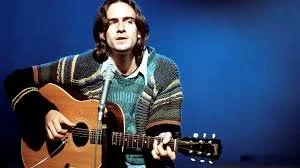
James Taylor became closely associated with the singer-songwriter sound that came out of the Laurel Canyon scene in the early 1970s. In 1968, he signed with the Beatles’ Apple label and released his self-titled debut later that year. The album did not chart, but it included “Carolina in My Mind,” an early example of the personal songwriting and understated arrangements that would characterize much of his later work. After moving to Warner Bros., Taylor reached a much larger audience with Sweet Baby James (1970), which climbed to number 3 in the United States and number 6 in the United Kingdom. “Fire and Rain,” the album’s best-known song, drew from Taylor’s experiences with addiction, psychiatric treatment, and the death of a friend. Its acoustic arrangement keeps the attention on his voice and lyrics, giving the song the direct, personal quality associated with the emerging singer-songwriter style.
Taylor continued to find commercial success with Mud Slide Slim and the Blue Horizon (1971) and One Man Dog (1972). His biggest U.S. single during this period came from another Laurel Canyon songwriter. Taylor recorded Carole King’s “You’ve Got a Friend” for Mud Slide Slim, with King playing piano on the track, and his version reached number one in the United States in 1971. Their collaboration grew from a close musical friendship in Los Angeles and connects two different paths into the singer-songwriter movement.
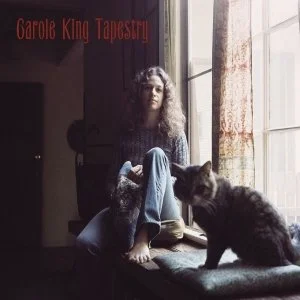
King arrived in Los Angeles with a career that had begun far from Laurel Canyon. During the 1960s, she and her husband and songwriting partner Gerry Goffin worked in New York’s Brill Building pop industry, writing songs for other performers. Their songs included “Will You Love Me Tomorrow” for the Shirelles, “The Loco-Motion” for Little Eva, and “Up on the Roof” for the Drifters. The Brill Building system generally separated the songwriter from the performer: King and Goffin wrote the material, while singers and groups recorded it for the pop market.
After King and Goffin divorced in 1968, she moved to Los Angeles with her two daughters and began developing a career in which she performed her own material. She formed the short-lived group the City with bassist Charles Larkey and guitarist Danny Kortchmar, releasing Now That Everything’s Been Said in 1968. The album sold poorly, but it placed King behind the microphone and piano rather than keeping her primarily behind the scenes as a songwriter. Working in a small group also brought her into the informal network of musicians developing around Laurel Canyon.
King became especially close with Taylor and Joni Mitchell, and those relationships carried into the studio. Taylor played guitar and sang backing vocals on King’s first solo album, Writer (1970). Their musical exchange continued as King worked on Tapestry (1971), with both Taylor and Mitchell contributing to the sessions. King recorded her own version of “You’ve Got a Friend” for the album, while Taylor recorded his version around the same period.
Tapestry brought King’s earlier experience as a pop songwriter together with the more personal performance style associated with Laurel Canyon. On songs such as “It’s Too Late,” she sings about the end of a relationship in conversational language, accompanied by arrangements that leave considerable space around her voice and piano. The album spent fifteen weeks at number one in the United States. King was now performing songs under her own name for the same mass audience she had once reached by writing for other singers. Her move from the Brill Building to Los Angeles shows how the singer-songwriter model changed the relationship between writing and performing: the person composing the song could also become the voice through which listeners encountered it.
Crosby, Stills, and Nash
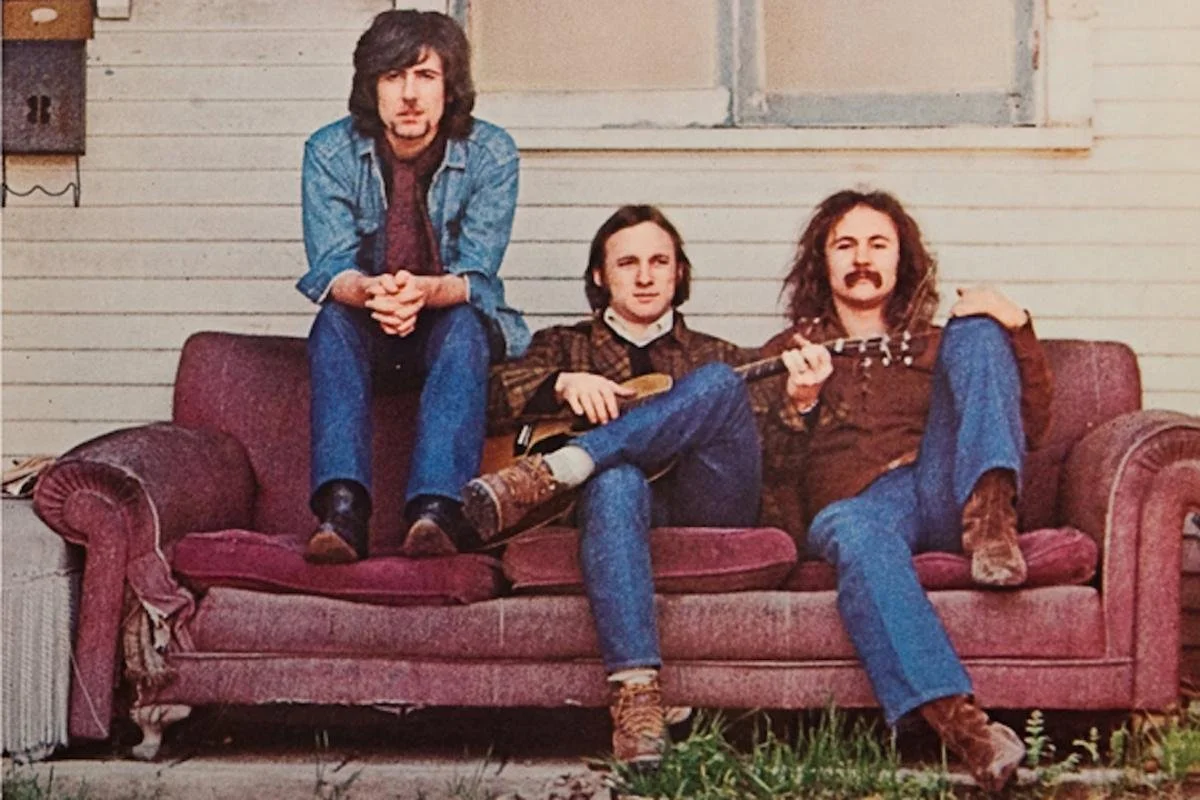
Although the term singer-songwriter usually refers to solo performers, Crosby, Stills & Nash brought a similar emphasis on personal songwriting into a group setting. Formed in 1968, the trio brought together David Crosby of the Byrds, Stephen Stills of Buffalo Springfield, and Graham Nash of the Hollies. Each arrived with experience as a songwriter and vocalist, allowing the group to move between individual voices while relying on close three-part harmony as its most recognizable sound. Because all three had already belonged to successful bands, Crosby, Stills & Nash was soon described as a “supergroup”—a band formed by musicians who had established careers elsewhere.
Their formation also grew directly from the social world of Laurel Canyon. Crosby, Stills, and Nash began singing together informally in 1968, with accounts placing an early gathering at Cass Elliot’s home. They quickly discovered that their voices fit together: Crosby’s middle harmonies filled the space between Stills and Nash, creating a blend that was difficult to reproduce when any one voice was removed. Informal singing among friends soon developed into a new group, showing how the relationships formed around Laurel Canyon could carry directly into professional collaborations.
Crosby had recently left the Byrds after several years of growing tension within the band. As a founding member, he had contributed to their vocal harmonies and increasingly experimental songwriting, but disagreements over musical direction and his behavior strained his relationship with the other members. Those tensions became especially visible at the 1967 Monterey Pop Festival, where Crosby joined Buffalo Springfield onstage and used part of the Byrds’ performance to speak at length about subjects including the Kennedy assassination. The Byrds fired him later that year. His departure had consequences for both groups discussed here: Crosby became more involved with musicians around Laurel Canyon, while the opening in the Byrds helped bring Gram Parsons into the band as it moved further toward country music.
Stills and Nash brought different musical backgrounds to the new trio. Stills had worked across folk and rock in Buffalo Springfield and was comfortable moving between acoustic and electric guitar, while Nash came from the tightly arranged British pop of the Hollies. Their differences allowed several kinds of songwriting to coexist within the same album. The three members could write separately and then use their vocal blend to give the songs a shared identity.
Their self-titled debut, Crosby, Stills & Nash (1969), put that mixture into practice. “Suite: Judy Blue Eyes”, written by Stills about his relationship with Judy Collins, moves through several sections while keeping the group’s harmonies at the center. “Helplessly Hoping” uses a much quieter arrangement, with acoustic guitar supporting closely interwoven vocal lines. Stills handled much of the instrumental work on the album, including bass and keyboards, while Dallas Taylor played drums. The resulting sound continued aspects of the Byrds and Buffalo Springfield while giving more space to acoustic arrangements and the individual songwriting of Crosby, Stills, and Nash.
Neil Young joined the group in 1969, reuniting him with his former Buffalo Springfield bandmate Stills and expanding the trio into Crosby, Stills, Nash & Young. Young brought songs that often used heavier electric guitar and a rougher vocal delivery. His presence gave the group more room to move between quiet acoustic performances and extended electric playing. That range can be heard on Déjà Vu (1970), where the members again contributed songs with distinct personalities. Young’s “Helpless” uses a slow, spare arrangement, while Stills’s “Carry On” moves into a more electric setting. Nash’s “Our House” draws from domestic life, while Crosby’s “Déjà Vu” uses an unusual structure and shifting vocal parts. The album could sound cohesive because the group’s harmonies connected songs written largely by four independent songwriters.
That same flexibility allowed CSNY to respond quickly to political events. On May 4, 1970, Ohio National Guard troops fired on students protesting the expansion of the Vietnam War into Cambodia at Kent State University, killing four students and wounding nine. Photographs of the shootings circulated widely, and Neil Young wrote “Ohio” soon afterward. CSNY recorded the song within weeks of the shootings and released it that summer.
“Ohio” uses direct language rather than the personal storytelling heard in much of the group’s other work. Young names Nixon in the lyrics and repeatedly returns to the deaths at Kent State, while Stills’s electric guitar gives the recording a tense, abrasive sound. The group’s harmonies take on a different function as well. Instead of creating the intimacy heard on songs such as “Helplessly Hoping” or “Our House,” the voices sound increasingly urgent as the song continues. “Ohio” showed that CSNY’s personal, songwriter-centered music could also respond directly to political events when the members chose to do so.
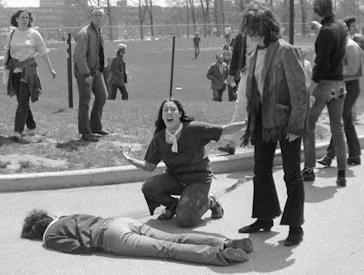
Although some AM stations refused to play “Ohio,” the song received substantial airplay on FM radio and circulated quickly after its release. The song drew on a tradition associated with folk musicians such as Woody Guthrie and Pete Seeger, who had written directly about current political events, but brought that tradition into the electric sound and mass audience of early-1970s rock.
CSNY’s success did not produce a stable working relationship. By the early 1970s, disagreements over songwriting, leadership, and personal relationships made it difficult for the four musicians to work together for long periods. They had formed as established songwriters with separate musical identities, and each continued to pursue his own career alongside the group. By 1971, CSNY had splintered, with the members releasing solo albums and working together in different combinations. They reunited periodically for recordings, tours, and political events, but the group never settled into the continuous album-and-tour cycle followed by many rock bands. Even during its brief initial run, CSNY developed a recognizable sound built around close vocal harmony, interweaving acoustic and electric guitars, and songs that could move between private experience and direct political commentary.
Neil Young
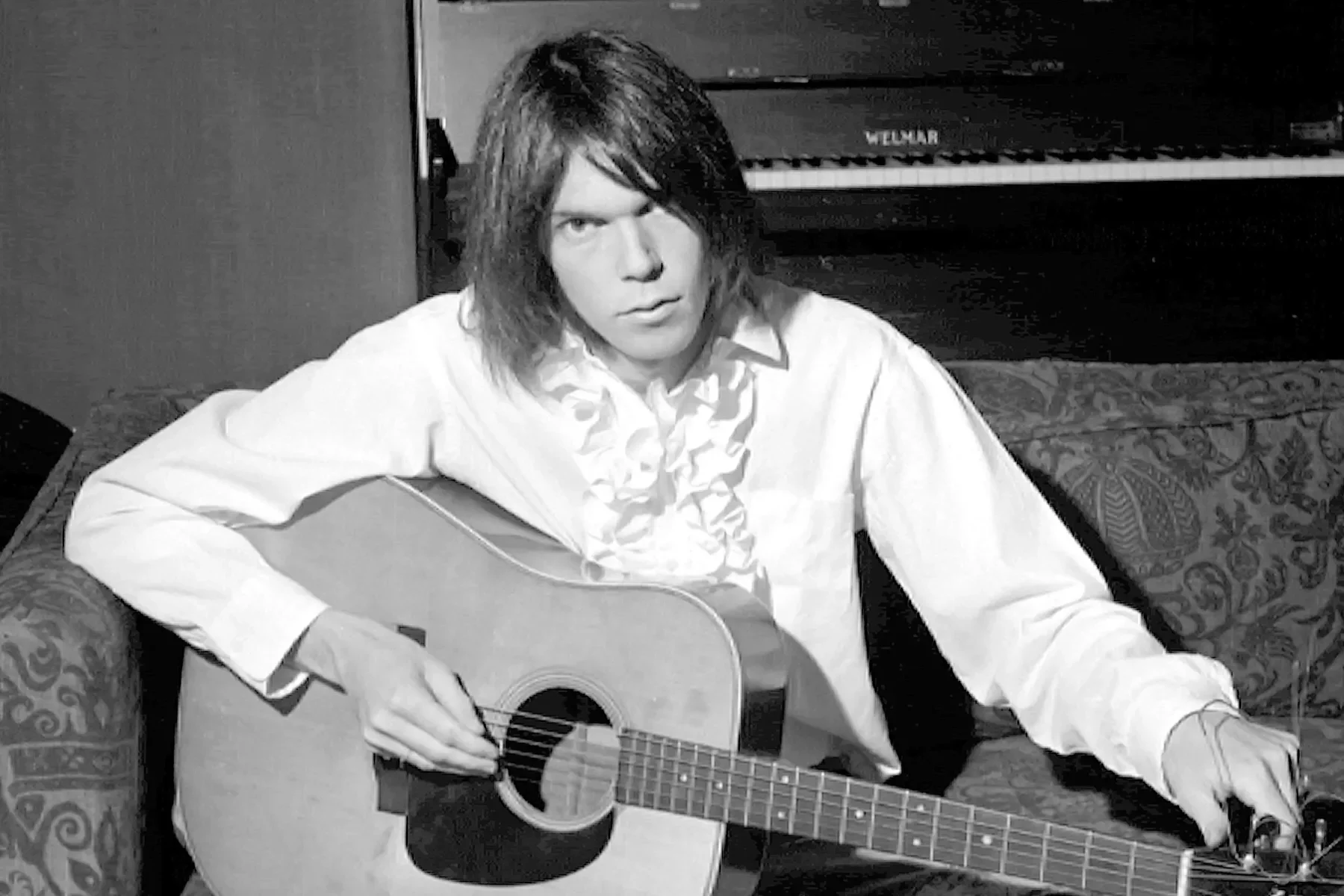
Alongside his work with CSNY, Neil Young developed a solo career that moved freely between country-influenced acoustic music and loud, distorted rock. That contrast had already appeared during his years with Buffalo Springfield, but it became more pronounced after the group broke up in 1968. Young could build one recording around acoustic guitar and a restrained vocal, then turn to extended electric-guitar passages and feedback on another. Rather than choosing between these approaches, he continued returning to both throughout his career.
Young explored the heavier side of his music with Crazy Horse, a group formed with guitarist Danny Whitten, bassist Billy Talbot, and drummer Ralph Molina. Their first album together, Everybody Knows This Is Nowhere (1969), was recorded in about two weeks and included “Cinnamon Girl,”“Down by the River,” and “Cowgirl in the Sand.” Young reportedly wrote all three while ill with a fever. “Down by the River” and “Cowgirl in the Sand” stretch across long instrumental sections in which Young’s guitar moves over the band’s steady, repetitive rhythms. The playing is loose and sometimes abrasive, with distortion and sustained notes left exposed rather than polished away. Decades later, musicians associated with grunge would draw from similar guitar sounds, and Young developed particularly close ties with bands such as Pearl Jam.
Soon after recording Everybody Knows This Is Nowhere, Young joined Crosby, Stills & Nash. His work with CSNY placed the two sides of his music within the same group: he could contribute quiet songs such as “Helpless” while also bringing a heavier electric-guitar sound to the band. His time with CSNY also produced “Ohio,” written in response to the 1970 Kent State shootings. Young continued recording his own music during this period, so his solo career and membership in CSNY developed alongside one another rather than as separate stages.
After the Gold Rush (1970) moved between acoustic and electric settings within a single album. Piano and acoustic guitar carry much of the record, while electric guitar appears more forcefully on several tracks. “Don’t Let It Bring You Down” uses a spare arrangement beneath Young’s imagery of urban isolation, while “Only Love Can Break Your Heart” draws more closely from folk and country. The title track is built largely around piano and Young’s high, fragile vocal. Moving among these different settings allowed Young to use country and folk sounds without giving up the electric rock he played with Crazy Horse.
The album’s “Southern Man” turns back toward a harder electric sound for a direct attack on racism in the American South. Young invokes cotton fields, white mansions, shacks, crosses, and violence to connect the history of slavery with racism that continued after emancipation. The “Southern man” addressed in the song functions less as an individual character than as the target of Young’s accusation. When he repeatedly asks when the South will “pay them back,” the question points toward a history of wealth built through slavery and the absence of restitution for those who suffered under it. The tense guitar playing reinforces the anger of the lyrics, giving the song a harsher sound than much of the album around it.
Young moved further into country music on Harvest (1972), recorded partly in Nashville with a group of session musicians who became known as the Stray Gators. Pedal steel and acoustic guitar are prominent throughout the album, and Linda Ronstadt and James Taylor contributed backing vocals. “Heart of Gold,” built around acoustic guitar and harmonica, reached number one on the U.S. singles chart. Its success brought Young’s quieter country-rock sound to a much larger audience.
The country sound of Harvest did not replace Young’s work with Crazy Horse. He continued returning to distorted guitar, extended solos, and loose ensemble playing while also recording quieter material rooted in folk and country. The contrast became one of the most recognizable features of his music. His acoustic recordings connected him closely to the singer-songwriters and country-rock musicians of the early 1970s, while his work with Crazy Horse offered a rougher form of electric rock that later guitar bands could readily draw from.
Jackson Browne & Geffen Records
Jackson Browne became part of the Los Angeles songwriting community in the late 1960s, although he had begun writing songs years earlier. As a teenager, he wrote “These Days,” which Nico recorded for her 1967 album Chelsea Girl. He also wrote material recorded by Southern California musicians, including the Nitty Gritty Dirt Band. These early connections placed Browne within a network of songwriters and performers who frequently exchanged material and worked on one another’s recordings.
One of Browne’s closest connections was with Glenn Frey, who lived in the apartment above him in Echo Park before forming the Eagles. Browne had begun writing “Take It Easy” but had become stuck while finishing the song. Frey heard him working on it and helped complete it, and the Eagles recorded the finished version as their debut single in 1972. The collaboration linked Browne directly to the country-rock musicians developing around Los Angeles and shows how easily songs could move between writers and performers within the scene.
Browne began recording under his own name with his self-titled debut in 1972. Songs such as “Doctor, My Eyes” and “Rock Me on the Water” placed his voice and lyrics within arrangements that drew from folk and rock without becoming densely produced. His later albums, including For Everyman (1973), Late for the Sky (1974), and The Pretender (1976), continued his interest in relationships and the uncertainties of adult life. Musicians from the same Los Angeles circle regularly appeared on these recordings. David Crosby and Graham Nash, for example, sang harmony vocals on The Pretender, while members and associates of the Eagles appeared elsewhere in Browne’s work.
Browne’s career was also closely connected to Asylum Records, founded by David Geffen in 1971 and managed with Elliot Roberts. The label grew out of many of the personal and professional relationships that already connected musicians around Laurel Canyon and the wider Los Angeles scene. Its early roster included Browne and Judee Sill, while Joni Mitchell and Linda Ronstadt also became associated with Asylum during the 1970s. JD Souther moved through the same circle of writers and musicians. The boundaries between these careers were often loose: musicians wrote together, sang harmony on one another’s records, shared instrumentalists, and passed songs between projects. Browne’s relationship with Frey continued after the Eagles formed, and his albums regularly brought familiar members of the Los Angeles scene back into the studio together. As the informal community around Laurel Canyon became increasingly connected to record labels and management companies, many of the friendships that had begun in apartments and living rooms continued as working relationships inside the recording studio.
Joni Mitchell
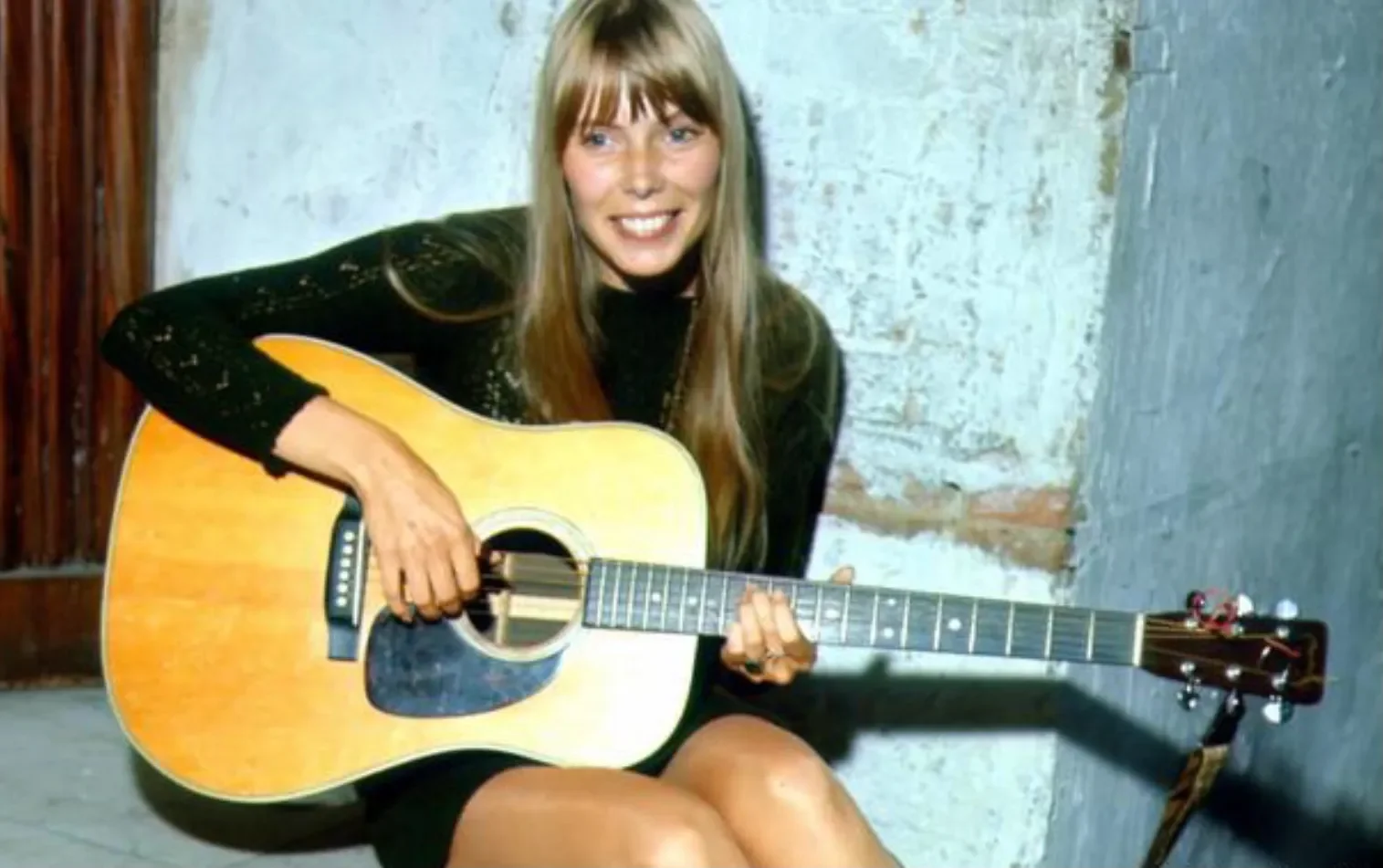
Joni Mitchell is widely regarded as one of the foremost singer-songwriters of the late 20th century. Over a career spanning more than four decades, she produced sixteen original studio albums, a collaboration with jazz musician Charles Mingus, and numerous live and compilation recordings. Lyrically and musically, Mitchell has come to represent a self-reflective intellectual bohemianism that grew out of the 1960s folk revival, youth protest movements, and the sexual revolution. Her work frequently records a woman’s perspective on social change and personal freedom, exploring the opportunities and contradictions of her era.
Born Joan Anderson in Alberta, Mitchell grew up an only child in small prairie towns. Formal piano lessons discouraged improvisation, and a bout of polio in 1953 left her with a weakened left hand, prompting months of convalescence, which nurtured her imagination. By her teens, she was immersed in folk, jazz, and classical music, showing early talent in visual art and poetry. She adopted the spelling “Joni” for its visual impact and cultivated a dual persona as both fashionable and rebellious, performing in coffeehouses and developing early ties to folk music networks.
Mitchell attended the Alberta College of Art in 1963 before moving to Toronto to pursue a career as a folk singer. In 1965, she gave birth to a daughter, whom she placed for adoption—a formative experience that prompted her to begin writing songs seriously. She married Chuck Mitchell and performed as a folk duo in Detroit, but left the marriage by 1967. After moving to New York, she gained recognition as a solo artist, touring Canada and the United States and connecting with influential figures including Judy Collins and Leonard Cohen. A meeting with David Crosby led to her relocation to Los Angeles, where she secured a recording contract with Warner Bros.
Mitchell’s early albums established her as a critical figure in the California singer-songwriter movement. Song to a Seagull (1968) and Clouds (1969) display intricate guitar work and poetic lyrics, while Ladies of the Canyon (1970) contains classic tracks such as “Big Yellow Taxi” and “Woodstock.” Blue (1971) remains a benchmark of confessional songwriting. Later works, such as Court and Spark (1974) and her collaboration with Charles Mingus, illustrate her evolution toward more jazz-inflected, harmonically adventurous music, unveiling both her artistic maturity and her ability to navigate the demands of a rapidly changing music industry.
Mitchell frequently used unique alternate guitar tunings. Rather than the standard E-A-D-G-B-E, she tuned her strings to a variety of pitches, enabling unconventional chord voicings, resonances, and harmonic textures. These tunings allowed her to compose complex, open, and often modal harmonies that reinforced the emotional and lyrical nuance of her songs. Her guitar work became both melodic and textural, directly supporting the expressive range of her vocals and lyrics.
Her use of innovative guitar tunings accompanied her shift from 1960s folk performance to 1970s studio songwriting. While 1960s folk emphasized communal storytelling and social commentary, the 1970s audience demanded personal, emotionally sophisticated music. Mitchell’s alternate tunings, intricate harmonies, and jazz- and art-music influences enabled her to bridge these eras, maintaining folk sensibilities while adopting the introspection, technical innovation, and studio possibilities of the 1970s. Mitchell’s harmonic language is highly sophisticated, employing modal mixtures, extended triads, suspended chords, and multiple tonal centers.
Mitchell’s lyrics are celebrated for their poetic craft, thematic density, and stylistic range. She assumes multiple narrative voices, from naïve or conversational to philosophical or world-weary, probing themes of love and independence, spiritual inquiry, social nonconformity, and self-realization. Her music covers a range of styles, including torch songs, confessional monologues, travel vignettes, character portraits, and social critique, often blending personal reflection with wider cultural commentary.
On a larger scale, Mitchell’s work typifies the transition of 1960s folk into the introspective singer-songwriter movement of the 1970s. From 1966–72, her music retained traces of folk influence while developing intricate melodic and harmonic structures. Iconic songs from this era—including “Both Sides, Now,”“California,” and“Woodstock”—exemplify her early synthesis of vulnerability, poetic insight, and musical invention. The intimate intensity of Blue remains a touchstone for many listeners and songwriters.
The Eagles
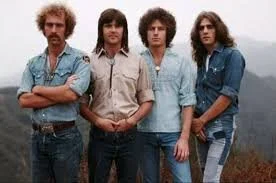
The same network that connected Jackson Browne, Asylum Records, and the musicians around Laurel Canyon also provided the setting from which the Eagles formed. By the early 1970s, Los Angeles had a large circle of songwriters and country-rock musicians who shared songs, appeared on one another’s recordings, and moved between touring bands. The Eagles brought several members of that circle into a permanent group.
The Eagles formed in Los Angeles in 1971. Glenn Frey (guitar, vocals) and Don Henley (drums, vocals) were Midwestern transplants who had become involved in the Los Angeles music scene after moving west. They were joined by Bernie Leadon (guitar, banjo, vocals), a veteran of the Flying Burrito Brothers with direct ties to the country rock of Gram Parsons, and Randy Meisner (bass, vocals), formerly of Poco. Each member brought a different connection to the country, folk, and rock music circulating around Los Angeles, while all four could contribute lead or harmony vocals.
Linda Ronstadt provided an important connection between them. Before forming the Eagles, all four musicians worked with her, performing live and contributing to sessions for her self-titled 1972 album. Playing behind Ronstadt gave them experience working together and helped develop the ensemble playing and vocal harmonies that they would soon use in their own band. Frey also had a close songwriting relationship with Jackson Browne, while Leadon and Meisner connected the new group directly to the Flying Burrito Brothers and Poco. The Eagles therefore grew from relationships that were already well established within Los Angeles country rock.
Their self-titled debut, Eagles (1972), introduced a carefully arranged mixture of country and rock built around close vocal harmonies and narrative songs. Frey and Henley increasingly took leadership roles within the group, although the original lineup still drew heavily from the different musical backgrounds of all four members. Their first single, “Take It Easy,” also carried Frey’s earlier connection with Browne into the new band. Browne had written much of the song but became stuck after the line about standing on a corner in Winslow, Arizona. Frey contributed to the unfinished section and helped complete the song, which the Eagles then recorded as their debut single.
Musically, “Take It Easy” shows how the Eagles combined their different influences. Ringing electric guitar chords establish the opening before another guitar begins imitating the sliding sound of pedal steel. Frey sings the lead with a slight country inflection, and the other members enter in high harmony. Their vocal arrangements drew from groups they admired, including the Beatles and the Beach Boys, with the close harmony of the Everly Brothers providing an especially strong country-pop precedent. As the song continues, additional vocal parts gradually thicken the arrangement, and banjo adds a more direct country sound. The instrumental break returns to the steel-guitar effect, placing country phrasing within an electric rock arrangement.
The structure of “Take It Easy” is similarly careful beneath its relaxed performance. The song uses a repeating verse form, but each verse contains three eight-bar sections with changes in the chord progression. Those internal changes give the verses movement even as the larger form repeats. The arrangement develops in the same way, becoming fuller as new voices and instruments enter. Its road imagery and references to Winslow, Arizona, fit naturally with the easy-moving rhythm, giving the song the open-road character that became closely associated with the Eagles’ early music.
Other songs on the debut showed how far the group could move within that basic sound. “Witchy Woman” uses blues-influenced minor-key harmonies and a darker vocal performance, while “Peaceful Easy Feeling” returns to gentler guitar lines and close harmony. The songs gave the Eagles several ways of working within country rock while keeping the arrangements concise enough for mainstream radio.
For their second album, Desperado (1973), the Eagles organized much of the material around the mythology of Old West outlaws. The songs presented gunfighters and people living outside conventional society, while the band used those characters to think about its own relationship with fame and the music industry. Frey explained the connection in a 1973 interview:
“It has its moments where it definitely draws some parallels between rock-and-roll and being an outlaw. Outside the laws of normality, I guess. I mean, I feel like I’m breaking a law all the time. What we live and what we do is kind of a fantasy.”
The album artwork carried the same idea into the band’s public image. On the front cover, the Eagles appear dressed as Old West gunslingers. The back cover takes the idea further, showing the band bound and apparently dead alongside Jackson Browne and JD Souther. Producer Glyn Johns, manager John Hartmann, members of the road crew, and others stand above them as the victorious posse. The photograph reenacted images associated with the capture of the Dalton Gang. Casting people from the Eagles’ own professional circle as the posse gave the image another layer: the musicians played the outlaws while managers, producers, and crew members became the people who had captured them.
The Eagles’ interest in the outlaw appeared around the same time that Willie Nelson, Waylon Jennings, Kris Kristofferson, and other country musicians were challenging the Nashville recording system. The Los Angeles and Nashville versions of the outlaw shared some imagery, but they came from different circumstances. In Nashville, outlaw country involved musicians seeking greater control over recording and production and resisting parts of the established studio system. The Eagles continued to make carefully produced records within the Los Angeles music industry. Their outlaw characters gave them a way to write about independence and their uneasiness with the demands surrounding success. The image of the outlaw could therefore work differently in country and rock even when musicians were drawing from the same Western mythology.
The Desperado sessions also changed the working relationships within the Eagles. Henley and Frey began writing together much more frequently, co-writing eight of the album’s eleven tracks. Their partnership produced “Tequila Sunrise” and the title song, “Desperado,” both of which remained part of the band’s repertoire. As Henley and Frey supplied more of the material, they also gained greater influence over song selection, production decisions, and the subjects the band pursued. Leadon and Meisner remained important instrumentalists and vocalists, but the balance of creative authority was moving toward Henley and Frey.
Desperado reached number 41 on the Billboard 200, below the commercial performance of the debut. Even so, the sessions established a working pattern that the Eagles continued to use. Henley and Frey were now writing much of the band’s material together, and the album gave them more room to develop characters and connected narratives across a record. Songs such as “Desperado” would remain in the group’s live repertoire long after the Old West concept itself had been left behind.
The Eagles Transition to Rock: On the Border and One of These Nights
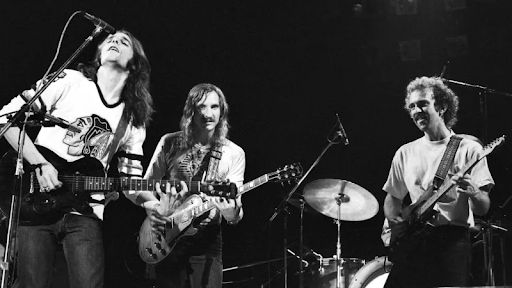
With their third album, On the Border (1974), the Eagles began moving beyond the country-rock sound that had dominated their first two records. Henley and Frey wanted a stronger rock sound, and electric guitars became more prominent in the arrangements. The title track, “Already Gone,” and “James Dean” all use a heavier electric-guitar sound than much of the band’s earlier material. The change was gradual, however, and country instrumentation remained an important part of the album. Bernie Leadon continued to play banjo, pedal steel, and acoustic guitar, keeping country sounds present even as the band placed more weight on electric rock.
The Eagles’ first number-one single came from the quieter side of the album. “Best of My Love” uses acoustic guitars, pedal steel, and the close vocal harmonies heard throughout their earlier work. Its success meant that the band’s move toward harder rock occurred at the same time that one of its most country-influenced recordings was reaching its largest audience. On the Border therefore catches the Eagles between two sounds: the country-rock sound of the original lineup remained audible, while electric guitars were taking a larger place in their recordings.
Part of that change came through the addition of guitarist Don Felder. The Eagles brought Felder into the On the Border sessions to play slide guitar on “Good Day in Hell,” and he soon became a full member of the group. Having Felder alongside Leadon gave the band another electric guitarist and allowed the arrangements to use more prominent lead-guitar parts. By One of These Nights (1975), the harder sound introduced on On the Border had become much more noticeable.
The songs on One of These Nights still moved between styles. The title track reached number one, while “Too Many Hands” gave Felder and Leadon considerable space for electric-guitar work. Randy Meisner took the lead vocal on “Take It to the Limit,” which he co-wrote with Henley and Frey. The song reached number four in the United States and became the Eagles’ only single with Meisner singing lead. “Lyin’ Eyes” stayed closer to country rock, using acoustic guitar and country-style guitar parts beneath another narrative lyric. It won the Grammy Award for Best Pop Vocal Performance by a Duo, Group or Chorus, while One of These Nights received a nomination for Album of the Year.
The album reached number one in the United States and began a run of four consecutive Eagles albums to reach the top of the chart. At the same time, disagreements over the band’s musical direction were becoming harder to resolve. One of These Nights was the final Eagles album to include Bernie Leadon. His background lay heavily in bluegrass and country, and he had supplied much of the banjo, pedal steel, and country guitar that characterized the original lineup. As Henley and Frey pushed for a stronger rock sound and gained more control over the band’s direction, Leadon became increasingly dissatisfied. He left the Eagles in 1975.
Leadon’s departure left the Eagles without one of the musicians most closely associated with their country sound, but it also gave the band an opportunity to reconsider what it wanted from a second guitarist. By 1975, the move toward harder rock was already underway, and the Eagles turned to Joe Walsh, a longtime friend whose background suited that direction. Walsh had played with the James Gang before establishing a successful solo career, and his guitar playing came more directly from blues and hard rock than Leadon’s country and bluegrass background. His arrival altered the instrumental possibilities available to the band at a time when electric guitar was taking a larger place in its music.
Walsh joined Don Felder to give the Eagles two guitarists comfortable with distortion, sustained solos, and heavier electric arrangements. The pairing allowed them to trade lead parts and play harmonized guitar lines, a technique that would become increasingly prominent in their recordings. Leadon’s departure also meant that banjo and pedal steel no longer occupied the same place in the group’s regular instrumental lineup. The Eagles had been moving gradually in this direction since On the Border; with Walsh in the band, the change became much easier to hear.
Walsh also brought a different personality to the group. His reputation for late-night partying and practical jokes followed him on tour, where stories of destroyed hotel rooms, overturned furniture, and elaborate pranks became part of the Eagles’ life on the road. Accounts from the period describe him arriving at sessions in costume or trading spontaneous guitar passages with Felder. His unpredictable behavior could add to the tensions already present within the group, while his musical relationship with Felder gave the Eagles a new electric-guitar pairing just as they began work on Hotel California.
The personnel change came as the Eagles were reaching an enormous record-buying audience. In early 1976, the band released Their Greatest Hits (1971–1975), collecting songs from its first four albums. The compilation eventually received a certification of 38 million units in the United States and has been credited with worldwide sales of roughly 42 million copies. For many years it competed with Michael Jackson’s Thriller for the title of the highest-certified album in the United States; Thriller moved ahead after Jackson’s death in 2009 before Their Greatest Hits regained the higher U.S. certification in 2018. Those sales came before the Eagles released Hotel California, the album on which the Felder-Walsh guitar pairing and the band’s move toward harder rock would become much more pronounced.
Hotel California
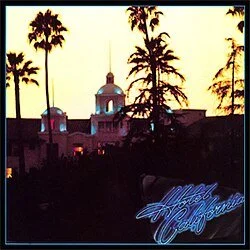
The arrival of Joe Walsh completed a musical change that had been underway since On the Border. When the Eagles began recording Hotel California in 1976, the country instruments associated with Bernie Leadon had become less prominent, while Don Felder and Walsh gave the band a two-guitar lineup capable of a much heavier sound. Henley and Frey were changing as songwriters as well. The open roads and Western characters of the earlier albums gave way to songs about people surrounded by money and pleasure who find themselves dissatisfied or trapped by what they have acquired. Hotel California brought those musical and lyrical changes together.
Walsh supplied the starting point for “Life in the Fast Lane.” During a rehearsal, he played a guitar exercise that caught Frey’s attention, and the riff became the basis of the song. Its repeated figure gives the recording a nervous momentum, with the bass and drums locked closely beneath the guitars. Henley and Frey wrote the lyrics around a couple whose wealth gives them access to drugs, parties, expensive cars, and constant stimulation. Their lives accelerate until pleasure begins to look more like compulsion. The music follows the same course. The riff keeps pressing forward, leaving little sense of rest as the characters lose control of the life they once enjoyed.
The title track approaches similar concerns through a stranger and more ambiguous story. Don Felder first developed the chord progression and recorded an instrumental demo, which Henley and Frey later used as the basis for the lyrics. “Hotel California”, credited to all three, begins with Felder’s 12-string guitar before Henley enters as a traveler driving through the California desert. He stops at an inviting hotel, but details that initially seem luxurious gradually become disturbing. The people inside are surrounded by champagne and expensive possessions, yet the narrator discovers that leaving is far more difficult than entering. By the final verse, the hotel has become a place whose guests are caught inside the pleasures that attracted them.
The lyrics prompted numerous interpretations after the song became popular, including claims that the hotel referred to Satanism or an actual building. Henley later gave a more grounded explanation. On 60 Minutes, he described the song as being about “the dark underbelly of the American Dream” and excess in America. California provided an especially useful setting for that idea because the Eagles themselves had experienced the enormous wealth and celebrity available within the Los Angeles music industry. The line “You can check out any time you like, but you can never leave” turns the hotel into a trap: its guests have gained access to the life they wanted and discovered that success carries its own demands.
The recording saves its longest instrumental passage for the end. After Henley’s final line, Felder and Walsh begin a guitar exchange lasting roughly two minutes. At first, each guitarist takes a separate lead phrase and the other responds. The distinction between the parts gradually narrows until the two guitars begin playing harmonized lines together. They eventually settle into the repeating arpeggio pattern that carries the recording through its fade-out. The coda makes audible what Walsh’s arrival had changed within the Eagles. Felder and Walsh could function as separate lead players and then join into a tightly arranged two-guitar part, giving the band a heavier sound without abandoning the precision of its earlier recordings. Readers of Guitarist magazine voted the passage the greatest guitar solo in a 1998 poll, and “Hotel California” received the Grammy Award for Record of the Year in 1978.
The album does not remain at the intensity of its title track. “New Kid in Town” returns to the softer side of the Eagles’ sound, with close harmonies and restrained guitar accompaniment. Its subject, however, belongs to the same world as “Hotel California.” The song follows someone enjoying public attention while already sensing that another person will eventually take his place. Fame becomes temporary and conditional, dependent on remaining interesting to an audience that is always ready to move on. “Life in the Fast Lane” takes the same anxiety into harder rock, following people who have acquired the pleasures associated with success and can no longer control their appetite for them.
The concerns running through these songs had become familiar to the Eagles by 1976. Only a few years earlier, the members had been backing Linda Ronstadt and playing clubs around Los Angeles. They were now touring arenas, selling millions of records, and working within an increasingly demanding business operation. Hotel California was therefore written by musicians who had already experienced much of the world their songs described. Their treatment of fame was less about reaching it than about what happened after it arrived.
Success also increased the pressure inside the band. The Hotel California tour required months on the road, while substance use and disagreements over performances made existing tensions harder to manage. Randy Meisner became especially unhappy with the touring schedule and his role within the group. Disputes over his reluctance to sing “Take It to the Limit” as an encore added to the conflict, and he left after the tour in 1977. Timothy B. Schmit, who had previously replaced Meisner in Poco, replaced him again in the Eagles.
The new lineup recorded The Long Run (1979), but the album took far longer to complete than the Eagles had expected. Henley and Frey remained at the center of the band, while disagreements among the members continued during recording and touring. By 1980, those tensions had reached the point where the Eagles stopped working together. Their final concert that year became especially contentious after an argument between Frey and Felder carried onto the stage into a physical confrontation.
The Eagles remained apart until 1994, when they reunited for Hell Freezes Over and a corresponding tour. Their original 1970s run had lasted less than a decade, but the sound changed considerably within that period. The early records grew from Los Angeles country rock, with Leadon’s banjo and pedal steel sitting beside the group’s close harmonies. By Hotel California, Felder and Walsh’s electric guitars occupied much of that space. Henley and Frey’s writing changed alongside the instrumentation, moving from travelers and outlaws toward characters dealing with the consequences of wealth and celebrity. Hotel California captures the Eagles at the point when those changes had fully come together—and when the success surrounding the band was beginning to make continued collaboration increasingly difficult.
Southern Rock
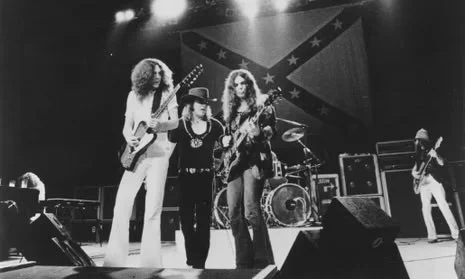
While country rock developed largely through the Los Angeles music scene, another meeting of country, blues, and rock was taking place in the American South. By the late 1960s and early 1970s, bands from Georgia, Florida, and other Southern states were developing what came to be called Southern rock. The style drew heavily from musical traditions that had long existed in the region, especially blues and rhythm and blues, while country and gospel were also present. Some groups added the extended improvisation associated with jazz. Electric guitars usually occupied more space than they did in West Coast country rock, with bands using multiple guitarists, extended solos, and longer instrumental passages. Southern identity also entered the music through lyrics, stage personas, and references to the places where the musicians had grown up.
The relationship between Southern identity and rock music was already complicated before Southern rock developed as a recognized genre. Creedence Clearwater Revival (CCR), for example, became closely associated with Southern sounds and imagery despite coming from Northern California. John Fogerty sang in a stylized accent and wrote about bayous, riverboats, small towns, and working-class life. “Born on the Bayou” places its narrator in a Louisiana setting, even though Fogerty had not grown up there. “Proud Mary” centers its imagery on a riverboat traveling along the Mississippi, while “Green River” turns memories of rural recreation into an imagined Southern landscape.
CCR’s music drew from blues and early rock and roll, and the band’s relatively spare arrangements differed from the psychedelic experimentation common in late-1960s San Francisco. The Southern settings in Fogerty’s songs gave that stripped-down music a particular geography, even though the geography was partly invented. His South came from records, popular imagery, and musical traditions rather than his own upbringing. CCR therefore offers an example of how strongly Southern sounds had become associated with ideas about roots, rural life, and working-class experience in American rock. A California band could adopt those sounds and images and still be heard by listeners as distinctly Southern.
The association had a long musical history behind it. Rock and roll itself had developed partly from Southern blues, rhythm and blues, gospel, and country music during the 1940s and 1950s. Elvis Presley recorded in Memphis, Little Richard came from Georgia, and many of the musicians who helped establish early rock and roll came from the South. During the 1960s, however, many of rock’s most visible scenes developed elsewhere. Detroit had Motown, while Los Angeles and San Francisco became major centers for folk rock and psychedelia. New York remained an important center of the recording business, and British bands from Liverpool and London had gained enormous audiences in the United States after the British Invasion. Memphis and Muscle Shoals continued to produce major soul and rhythm-and-blues recordings, but the South was less commonly treated as the center of contemporary rock culture.
Southern rock developed within that situation. Bands such as the Allman Brothers Band and, later, Lynyrd Skynyrd made their Southern origins explicit rather than constructing an imagined South from elsewhere. Their music drew from many of the same blues and country traditions that had fed early rock and roll, but they adapted those sources to the longer performances and louder electric sound of late-1960s and 1970s rock. The Allman Brothers Band, for instance, combined blues-based songs with extended improvisation and two lead guitars, while later Southern rock groups developed their own versions of the style.
Race made the genre’s regional identity more complicated. White Southern musicians drew extensively from African American blues, soul, gospel, and rhythm and blues, traditions that were inseparable from the development of rock and roll itself. At the same time, Southern rock was often marketed and understood as an expression of white Southern identity during a period when the meaning of that identity was being contested after the civil rights movement. The music could therefore carry regional pride while depending heavily on African American musical practices. That tension would become especially visible as Southern rock grew during the 1970s and bands differed in how they presented the South, its history, and their own place within it.
The Allman Brothers Band
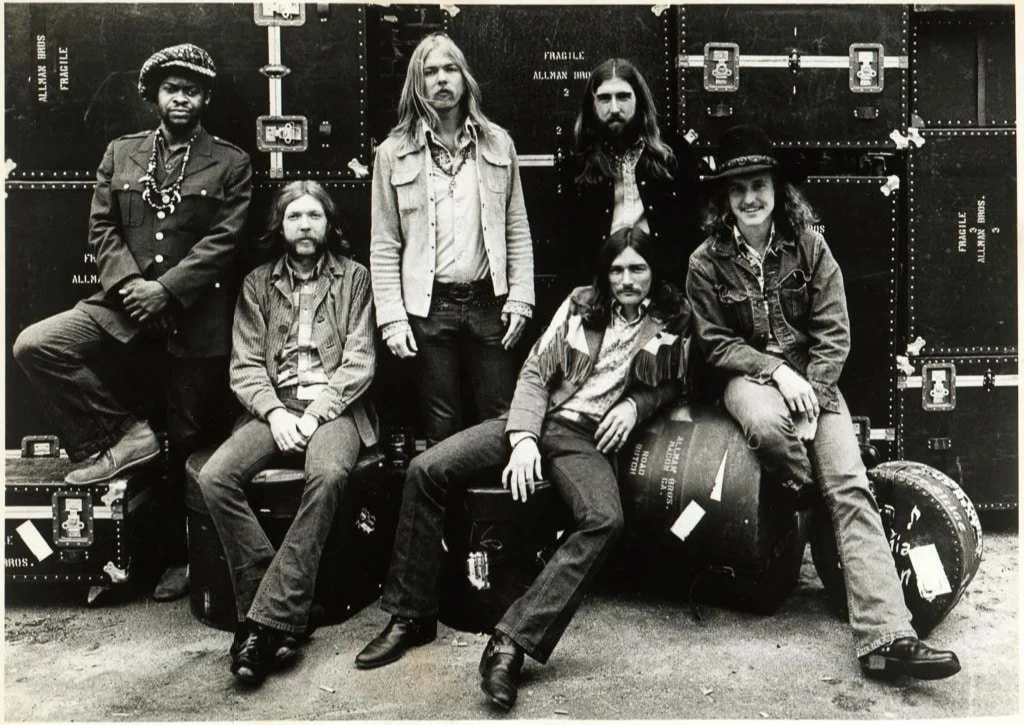
The Allman Brothers Band was one of the earliest groups to come out of the developing Southern rock scene. Formed in Macon, Georgia, in 1969, the band grew around brothers Duane Allman (guitar) and Gregg Allman (vocals, organ, piano), who had spent much of the 1960s playing together in Florida-based groups. Guitarist Dickey Betts and bassist Berry Oakley joined them, along with drummers Jaimoe Johanson and Butch Trucks. With two lead guitarists and two drummers, the Allmans had a lineup that gave them unusual freedom to stretch songs into long instrumental passages while keeping the ensemble full and rhythmically active.
Duane had already developed considerable studio experience before the band formed. At FAME Studios in Muscle Shoals, Alabama, he recorded with performers including Wilson Pickett and Aretha Franklin, working alongside musicians steeped in Southern soul and rhythm and blues. He continued doing session work after the Allman Brothers formed and played with Eric Clapton on Derek and the Dominos’ Layla and Other Assorted Love Songs in 1970. Duane was especially known for his bottleneck slide guitar technique. He used the slide to sustain notes and glide between pitches, often phrasing his lines almost like a singer rather than treating the guitar simply as an accompaniment instrument.
Dickey Betts gave Duane another lead guitarist with whom he could exchange ideas. At times, the two traded short solos every two measures, a practice sometimes called “trading twos.” Elsewhere, they joined together on harmonized guitar lines or moved in and out of one another’s solos. Jazz was another important source for the band’s improvisational approach. Jaimoe had worked with soul and R&B performers and brought a strong interest in jazz to the group. His playing fit naturally beside the steadier foundation provided by Butch Trucks. With two drummers, one could maintain the underlying pulse while the other added accents and rhythmic variations around it. The arrangement gave the band enough rhythmic flexibility to extend a performance without losing its sense of direction.
The Allmans’ self-titled debut in 1969 already contained many of these ideas, but the group developed them further onstage. Their arrangement of Blind Willie McTell’s “Statesboro Blues” turned an older blues song into a setting for Duane’s slide guitar and the full ensemble. The choice of material also makes the band’s relationship with African American blues easy to hear. Blues songs were part of their regular repertoire, and blues forms provided a starting point from which the musicians could move into longer instrumental passages.
Gregg Allman’s “Whipping Post” gave them a less conventional rhythmic framework. Much of the song moves in a compound 12/8 feel, with four main beats divided into groups of three eighth notes: “1-and-uh, 2-and-uh, 3-and-uh, 4-and-uh.” The opening bass riff is organized in 11/8, leaving the measure one eighth note shorter than the listener might expect. That uneven pulse gives the riff its unsettled quality before the song moves into the broader 12/8 groove. The contrast between the two meters creates tension without interrupting the momentum of the performance. In concert, the band could use that framework as a point of departure for much longer improvisations.
The Allmans developed much of their music through live performance. Songs that lasted only a few minutes in the studio could expand considerably onstage as the musicians traded solos and responded to one another. At Fillmore East (1971), recorded during concerts at New York’s Fillmore East, captured that side of the band. The studio version of “Whipping Post” lasts less than six minutes; on At Fillmore East, it runs for more than twenty. The musicians move through guitar solos and quieter passages before finding their way back to the song’s main material. Rather than reproducing the studio recording, they use its basic structure as something they can leave and return to.
The album’s version of “Statesboro Blues” works in a similar way. Duane’s slide guitar enters almost immediately, answering Gregg’s vocal before opening into longer guitar passages. Betts and Duane alternate between separate leads and harmonized parts, while Jaimoe and Trucks continually adjust beneath them. The performance remains recognizably blues, but the musicians treat the form with the freedom of a jazz group, listening and reacting as the arrangement develops.
The band changed suddenly after At Fillmore East. Duane Allman died in a motorcycle accident in October 1971 at the age of twenty-four. The remaining members decided to continue without immediately replacing him with another guitarist. Just over a year later, Berry Oakley died in another motorcycle accident in Macon, only a few blocks from the site of Duane’s crash. Within thirteen months, the band had lost two members of its original lineup.
The surviving musicians continued recording, though the absence of Duane and Oakley inevitably changed how the group worked. Pianist Chuck Leavell joined and gave the band another instrumental voice capable of taking long solos alongside Betts’s guitar. Betts also assumed a larger songwriting role. On Brothers and Sisters (1973), his “Ramblin’ Man” moved more directly toward country and became the band’s largest pop hit. Gregg Allman’s “Southbound” stayed closer to the blues, using a 12-bar progression as the basis for another extended instrumental performance. Brothers and Sisters sounds different from the Duane-era recordings, but the musicians continued treating blues and country forms as material they could open up through improvisation.
By the mid-1970s, disagreements within the group made it increasingly difficult to continue, and the Allman Brothers Band broke up in 1976. Different versions of the band reunited in later years, with Gregg Allman and Dickey Betts continuing to play major roles in the group. During the early 1970s, however, the Allmans had already developed a musical model that other Southern bands could adapt. Multiple lead guitars and extended improvisation became common features of Southern rock, while the Allmans’ use of blues showed how older Southern musical forms could support the louder, longer performances of 1970s rock. Lynyrd Skynyrd, the Marshall Tucker Band, and the Charlie Daniels Band would each use parts of that model differently.
Lynyrd Skynyrd
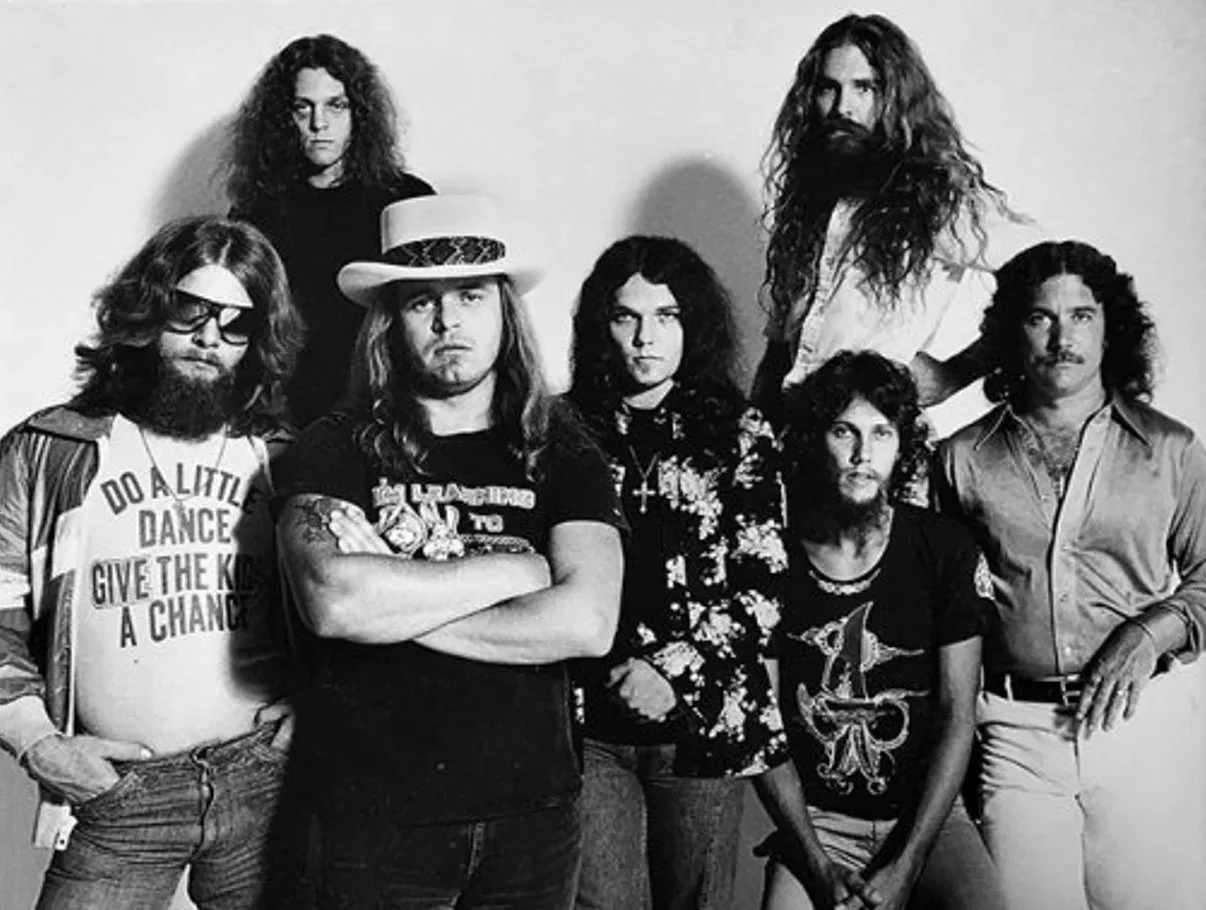
The Allman Brothers Band provided an early model for Southern rock, but Lynyrd Skynyrd took the music in a harder and more direct direction. Formed in Jacksonville, Florida, the band took its name from Leonard Skinner, a high school gym teacher remembered for enforcing rules against long hair. The deliberately misspelled name carried the sort of defiance that later became part of Lynyrd Skynyrd’s public image. By the time the band recorded its first album, the lineup included Ronnie Van Zant (vocals), Gary Rossington and Allen Collins (guitars), Ed King (guitar and bass), Billy Powell (keyboards), and Bob Burns (drums).
Once King moved from bass to guitar, Lynyrd Skynyrd had three guitarists across the front of the band. Rossington, Collins, and King divided rhythm and lead parts among themselves, sometimes joining on harmonized lines and elsewhere building songs from several guitar figures moving around one another. The arrangement gave Lynyrd Skynyrd a dense electric sound without requiring the long improvisations favored by the Allman Brothers. Van Zant preferred compact songs built around memorable riffs and direct lyrics, though the band could open those structures into much longer performances onstage. The result was a version of Southern rock that worked particularly well on FM radio while still leaving room for the guitar playing expected from the genre.
Van Zant’s writing was just as important to that sound. He often wrote in plain, conversational language and populated his songs with recognizable characters: drifters, drinkers, musicians, and people whose bad decisions eventually catch up with them. His Southern accent and references to the region made geography part of the band’s identity in a way that had been less pronounced with the Allman Brothers. As Lynyrd Skynyrd’s audience grew, that identity became inseparable from larger arguments about what Southern pride meant in the years after the civil rights movement.
The question was complicated by the music itself. Southern rock depended heavily on African American blues, rhythm and blues, gospel, and jazz, yet the genre was increasingly associated with images of white Southern rebellion. Confederate flags appeared around Southern rock concerts, and the “Southern rebel” became part of the way some bands were presented to audiences. The Allman Brothers offered a particularly clear example of the musical connections involved: Jaimoe Johanson was a Black drummer whose experience with R&B and interest in jazz strongly influenced the group’s sound. Southern rock musicians were drawing from traditions created within Black communities while performing in a region still dealing with the recent history of segregation.
Lynyrd Skynyrd confronted that history most directly in “Sweet Home Alabama.” Released in 1974, the song began partly as an answer to Neil Young’s “Southern Man” (1970) and “Alabama” (1972). Young had written bluntly about racism in the South. In “Southern Man,” images of cotton, white mansions, shacks, and racial violence lead to the question, “Southern Man, when will you pay them back?” The song treats the history of slavery and white supremacy as a debt that the South had yet to settle.
Van Zant disliked the way Young addressed the entire region. His answer came directly: “Well, I hope Neil Young will remember / A Southern man don’t need him around anyhow.” The line sounds confrontational, but the relationship between the musicians was less hostile than the song suggests. Van Zant admired Young’s music and sometimes wore a Neil Young T-shirt onstage. His objection was directed more toward what he considered Young’s sweeping judgment of Southerners. “Sweet Home Alabama” begins from that defensive position, insisting that attachment to the South could exist alongside criticism of its history.
The song becomes harder to read when Van Zant turns to Alabama governor George Wallace. “In Birmingham they love the governor,” he sings, followed immediately by backing voices chanting “boo, boo, boo.” Wallace had built his national political career around resistance to desegregation, and Birmingham had become internationally associated with the violence surrounding the civil rights struggle. Martin Luther King Jr. led a major campaign there in 1963, and images of police dogs and fire hoses being used against demonstrators circulated around the country. Placing Wallace and Birmingham together therefore brought the song directly into the politics of segregation, even though Wallace governed from Montgomery.
Van Zant then moves abruptly from Wallace to Watergate: “Now we all did what we could do / Now Watergate does not bother me / Does your conscience bother you?” The shift broadens his argument beyond Alabama. The lines can be heard as asking why the South should be judged through Wallace when the rest of the country had its own political corruption to answer for. They can also sound evasive, since Nixon’s Watergate scandal did not answer Young’s criticism of Southern racism. Much of the argument over “Sweet Home Alabama” comes from this passage because the song never tells the listener exactly how Wallace is supposed to fit into its defense of the South.
Van Zant later said that he did not support Wallace and pointed to the “boo, boo, boo” as evidence. He stated, “Wallace and I have very little in common. I don’t like what he says about colored people.” Producer Al Kooper understood “We all did what we could do” as a reference to opposing Wallace, and journalist Al Swenson likewise argued that critics had treated the song’s politics too simply. Decades later, however, co-writer Ed King gave a different account. In 2009, he described the song’s original intent in terms more sympathetic to Alabama and Wallace, suggesting that even the people who wrote “Sweet Home Alabama” did not interpret its politics in the same way.
The song reached the U.S. Top 10 and became closely associated with Southern pride. For some listeners, that pride could mean affection for home and resentment toward outsiders who reduced the South to its worst history. For others, the same chorus sounded uncomfortable beside the song’s references to Wallace and its defense against Young’s criticism. The recording leaves room for both reactions, which helps explain why arguments about its meaning have continued long after the circumstances that produced it.
If “Sweet Home Alabama” displayed Lynyrd Skynyrd’s ability to compress its sound into a radio single, “Free Bird” showed what the band could do when it allowed a song to expand. The opening moves slowly, with Van Zant singing over a restrained arrangement before the tempo changes and the guitars take over. Collins plays the principal solo while the other instruments maintain the progression beneath him, and the second half becomes an extended instrumental release after the quiet first section. Live performances could stretch the song considerably further.
The band later dedicated “Free Bird” to Duane Allman in concert, connecting Lynyrd Skynyrd’s most expansive song to the guitarist whose work had helped establish the Southern rock guitar tradition. The relationship between the two bands is easy to hear even though they organized their music differently. The Allmans often allowed an entire performance to develop through improvisation; Lynyrd Skynyrd usually kept tighter control over the song itself and saved the extended playing for particular sections. “Free Bird” gave Lynyrd Skynyrd space for both tight song structure and extended instrumental playing within the same recording. The song charted twice during the 1970s, and requests for it eventually became so common that shouting “Free Bird!” turned into a running joke at concerts by other performers.
By the middle of the decade, Lynyrd Skynyrd was touring extensively and had opened for the Who as its audience grew beyond the South. The original band’s career ended suddenly on October 20, 1977, when its chartered plane crashed in Mississippi. Ronnie Van Zant, guitarist Steve Gaines, and backing vocalist Cassie Gaines died, along with assistant road manager Dean Kilpatrick and the plane’s two pilots. Several other members of the band and crew were seriously injured.
Street Survivors had been released only three days earlier. The album reached number five on the Billboard 200, the highest position of Lynyrd Skynyrd’s original run. The surviving musicians pursued other projects in the years after the crash. In 1987, Lynyrd Skynyrd returned with Ronnie Van Zant’s younger brother Johnny as lead singer.
The Allman Brothers and Lynyrd Skynyrd ended up offering two distinct models for the Southern rock bands that followed them. Lynyrd Skynyrd took the multiple-guitar sound in a tighter direction, using riffs and narrative songwriting to make Southern rock work within the length of a radio single, then opening the music up when a song such as “Free Bird” called for it. Van Zant also placed Southern identity much closer to the center of the lyrics. With “Sweet Home Alabama,” that choice brought the band into arguments about race, regional pride, and who had the right to speak for the South—arguments that proved far harder to resolve than the musical differences between Lynyrd Skynyrd and the bands that came before them.
ZZ Top
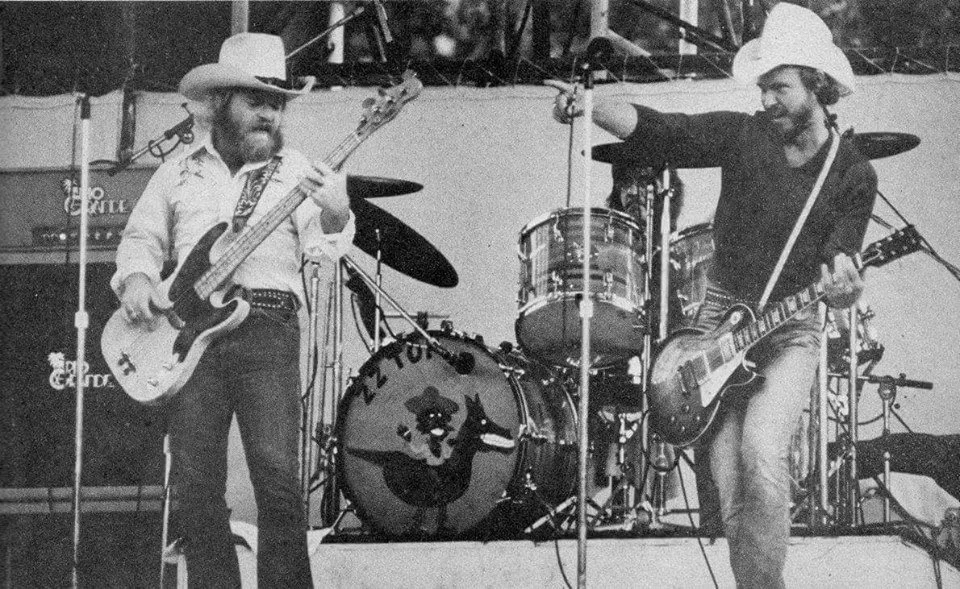
The rise of Southern rock was not confined to Georgia and Florida. In Texas, ZZ Top drew from many of the same blues traditions as the Allman Brothers and Lynyrd Skynyrd but developed them within the stripped-down format of a three-piece band. Their music was built around Billy Gibbons’s electric guitar, backed by Dusty Hill on bass and Frank Beard on drums. Texas also gave the band much of its subject matter and public personality, though ZZ Top usually approached regional identity with humor and exaggeration. Songs about local places, sexual misadventures, and larger-than-life characters allowed them to sound distinctly Texan without adopting the outlaw posture common elsewhere in Southern rock.
The band began in Houston around Gibbons, who had previously played in the psychedelic group Moving Sidewalks. In 1968, the group opened several shows for the Jimi Hendrix Experience, giving Gibbons an opportunity to hear Hendrix at close range. His early exposure to psychedelic rock remained audible in his use of feedback, distortion, and sustained guitar tones, even as his playing moved increasingly toward electric blues. When Gibbons joined bassist Dusty Hill and drummer Frank Beard, both formerly of the Dallas group American Blues, ZZ Top had the lineup that would remain together for the next five decades.
ZZ Top’s First Album (1971) introduced many of the elements the band would continue using throughout the decade. Gibbons played with a heavily amplified blues tone, while Hill and Beard kept the rhythms relatively spare. The lyrics already contained the sexual jokes and double meanings that became common in the band’s writing. The album attracted limited attention when it appeared, but ZZ Top continued developing the same basic sound rather than moving toward the extended improvisation of the Allmans or the three-guitar arrangements of Lynyrd Skynyrd.
Their connection to Texas became especially pronounced as their audience grew. Songs referred to local places and characters, while the band’s album art and stage presentation drew from Southwestern imagery. Texas was often treated with affection and exaggeration at the same time. ZZ Top could present itself as unmistakably Texan, without treating regional identity with the seriousness heard in some other Southern rock. Humor gave the band room to play with the image rather than simply announce pride in it.
“La Grange,” released on Tres Hombres (1973), brought these elements together. The song refers to the Chicken Ranch, a well-known brothel near La Grange, Texas, and builds much of its music from a repeating blues figure. Gibbons begins with a restrained guitar riff and half-spoken vocal before the arrangement opens into a louder electric section. The song stays close to blues form even as the amplification and guitar tone place it firmly within 1970s rock. Its subject is local and slightly comic, allowing ZZ Top to write about Texas without turning the song into a declaration of regional identity.
The blues connection is equally clear in “Tush,” from Fandango! (1975). Built around a 12-bar blues progression, the song moves quickly through a repeated guitar riff while Hill sings the lead vocal. The title works as a double entendre, typical of the band’s preference for sexual humor. Gibbons’s slide guitar keeps the connection to earlier blues guitar styles audible within the heavier electric arrangement. Where the Allman Brothers often used blues as the starting point for long improvisations, ZZ Top tended to compress the form into short songs organized around a single memorable riff.
By the end of the 1970s, that combination of blues and Texas imagery had become closely associated with the group. After several years of recording and touring, ZZ Top took an extended break. During that period, Gibbons and Hill independently grew the chest-length beards that later became inseparable from their appearance. Frank Beard, despite his surname, did not follow them. The coincidence fit easily with the band’s existing sense of humor, and their appearance became increasingly theatrical when they returned.
The music changed as well. During the early 1980s, Gibbons became interested in synthesizers, drum machines, and the production techniques appearing in contemporary pop. Rather than discarding the blues riffs at the center of ZZ Top’s earlier records, the band began placing them inside electronic rhythms and more tightly controlled studio arrangements. That combination reached a large audience with Eliminator (1983).
Songs such as “Gimme All Your Lovin’” still depend on the kind of guitar riffs ZZ Top had used throughout the 1970s, but synthesizers and programmed rhythms give the recordings a different surface. “Legs” moves even further toward electronic production while keeping Gibbons’s guitar at the center. MTV became important to the band during this period. Their videos turned the beards, sunglasses, customized cars, and spinning fur-covered guitars into recurring jokes, giving ZZ Top a visual identity that matched the exaggeration already present in its music.
The electronic production of the 1980s eventually became less prominent, and during the 1990s ZZ Top returned more often to guitar-centered blues rock. The basic musical relationship among the three members remained familiar despite the changes in production. Gibbons continued building songs from blues riffs while Hill and Beard supplied the rhythmic foundation beneath him. Across those changes, Texas remained a recurring setting and source of humor in the band’s music. ZZ Top presented Southern identity through local stories and an exaggerated public persona, giving the Southern rock of the 1970s a distinctly Texan version that could survive the move from blues clubs and rock radio into the MTV era.
Chapter 24: Conclusion
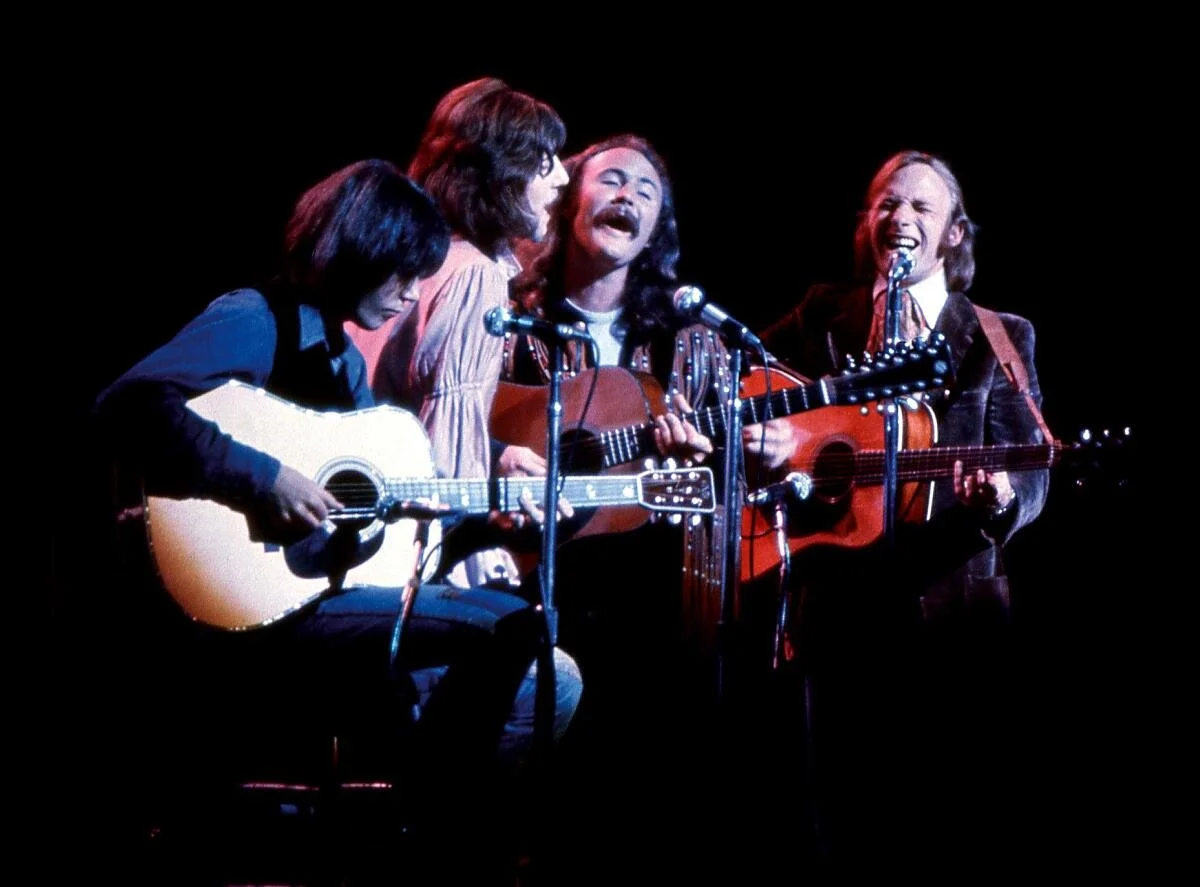
By the 1970s, country music had found its way back into American rock, but the musicians who drew from it did not arrive at the same sound. Country rock and Southern rock developed from overlapping musical traditions while following different regional paths. In Los Angeles, musicians associated with country rock drew from country instrumentation, close vocal harmony, and the folk revival, eventually producing the polished country-rock sound heard in artists such as Linda Ronstadt and the Eagles. Neil Young and Jackson Browne moved through the same musical community while taking the style in different directions.
Southern rock developed from a different set of regional connections. The Allman Brothers Band drew heavily from blues and jazz, using multiple lead guitars and long improvisations to open songs beyond their studio forms. Lynyrd Skynyrd turned the multiple-guitar sound into tighter, riff-driven songs while placing Southern places and identity more directly into its lyrics. In Texas, ZZ Top worked with a smaller three-piece lineup, reducing electric blues to compact riffs and approaching regional identity through local stories and humor. These bands were grouped under the same Southern rock label, but they did not follow a single musical formula.
The genre’s relationship with Southern identity also carried tensions that were impossible to separate from the region’s history. Southern rock musicians relied heavily on African American blues, rhythm and blues, gospel, and jazz while performing for audiences that often associated the genre with white Southern pride. Lynyrd Skynyrd’s “Sweet Home Alabama” made those tensions especially visible, as its defense of the South against Neil Young’s criticism became entangled with arguments over George Wallace, segregation, and what regional pride could mean after the civil rights movement. Southern identity in the music could therefore be affectionate, defensive, or politically ambiguous depending on the performer and the song.
Country rock faced different questions. Its musicians were less concerned with presenting a single regional identity and more often moved between established musical communities. Folk singers recorded with Nashville musicians, country players joined Los Angeles rock bands, and singer-songwriters worked alongside performers whose backgrounds stretched from bluegrass to pop. As the 1970s continued, those exchanges could lead toward the country sound of Harvest, the polished rock of the Eagles, or the personal songwriting associated with Laurel Canyon.
By the end of the decade, neither country rock nor Southern rock sounded much like a single genre with fixed boundaries. The Eagles had moved from banjo and pedal steel toward the electric guitars of Hotel California, while ZZ Top would soon carry its blues riffs into the electronic production of the 1980s. The Allman Brothers and Lynyrd Skynyrd had already shown how differently Southern musicians could approach blues-based rock. What connected these musicians was their continued use of country, blues, and other older American musical forms as working material for contemporary rock. Those combinations continued in later country rock, alternative country, and guitar-based rock long after the 1970s had ended.
Chapter 24: Further Reading
Allen, Michael. "'I Just Want to Be a Cosmic Cowboy': Hippies, Cowboy Code, and the Culture of a Counterculture." The Western Historical Quarterly 36, no. 3 (2005): 275.
Avila, Eric. Popular Culture in the Age of White Flight: Fear and Fantasy in Suburban Los Angeles. Berkeley: University of California Press, 2004.
Ballinger, Lee. Lynyrd Skynyrd: An Oral History. New York: Crown, 1999.
Brant, Marley. Freebirds: The Lynyrd Skynyrd Story. New York: Billboard Books, 2002.
Doggett, Peter. Are You Ready for the Country: Elvis, Dylan, Parsons and the Roots of Country Rock. New York: Atria Books, 2001.
———. Crosby, Stills, Nash & Young. New York: Atria Books, 2019.
Crosby, David., and Carl Gottlieb. Long Time Gone: The Autobiography of David Crosby. New York: Doubleday, 1988.
Downing, David. A Dreamer of Pictures: Neil Young, the Man and His Music. London: Omnibus Press, 1994.
Einarson, John. Desperados: The Roots of Country Rock. New York: Cooper Square, 2001.
Fawcett, Anthony, and Henry Diltz. California Rock, California Sound: The Music of Los Angeles and Southern California. Los Angeles: Reed Books, 1978.
Freeman, Scott. Midnight Riders: The Story of the Allman Brothers Band. New York: Crown, 1995.
Griffin, Sid. Gram Parsons: A Music Biography. Pasadena: Fretwater, 1985.
Hundley, Jessica, and Polly Parsons. Grievous Angel: An Intimate Biography of Gram Parsons. New York: Da Capo, 2005.
Hoskyns, Barney. Waiting for the Sun: A Rock 'n' Roll History of Los Angeles. New York: Backbeat Books, 2009.
Kubernik, Harvey. Canyon of Dreams: The Magic and the Music of Laurel Canyon. New York: Sterling, 2012.
Mather, Olivia Carter. “Taking It Easy in the Sunbelt: The Eagles and Country Rock's Regionalism.” American Music 31, no. 1 (2013): 26–49.
——— “‘Regressive Country’: The Voice of Gram Parsons.” In Old Roots, New Routes: The Cultural Politics of Alt.Country Music, edited by P. Fox and B. Ching, 154–74. Ann Arbor, MI: University of Michigan Press, 2008.
———. “Cosmic American Music”: Place and the Country Rock Movement, 1965–1974. PhD diss., University of California, Los Angeles, 2006.
Mercer, Michelle. Will You Take Me as I Am: Joni Mitchell's Blue Period. New York: Continuum, 2009.
Meyer, David. Twenty Thousand Roads: The Ballad of Gram Parsons and His Cosmic American Music. New York: Villard, 2008.
Odom, Gene., and Frank Dorman. Lynyrd Skynyrd: Remembering the Free Birds of Southern Rock. New York: Billboard, 2002.
Olson, Ted. “Hippie Hootenanny: Gram Parsons and the Not-Quite-Nashville Cats.” Journal of Country Music 20, no. 3 (1999): 26–36.
Shapiro, Marc. The Long Run: The Story of the Eagles. London: Proteus, 1995.
Sonenberg, Daniel. “Who in the World She Might Be”: A Contextual and Stylistic Approach to the Early Music of Joni Mitchell. PhD diss., CUNY, 2003.
Weller, Sheila. Girls Like Us: Carole King, Joni Mitchell, Carly Simon—and the Journey of a Generation. New York: Free Press, 2008.
Whitesell, Lloyd. The Music of Joni Mitchell. Oxford: Oxford University Press, 2008.
Zimmer, Dave. Four Way Street: The Crosby, Stills, Nash, and Young Reader. Cambridge, MA: Da Capo, 2004.
Zimmer, Dave, and Henry Diltz. Crosby, Stills, and Nash: The Biography. Cambridge, MA: Da Capo, 2008.