Chapter 2: American Popular Music in the Nineteenth Century Pt.1
Table of Contents
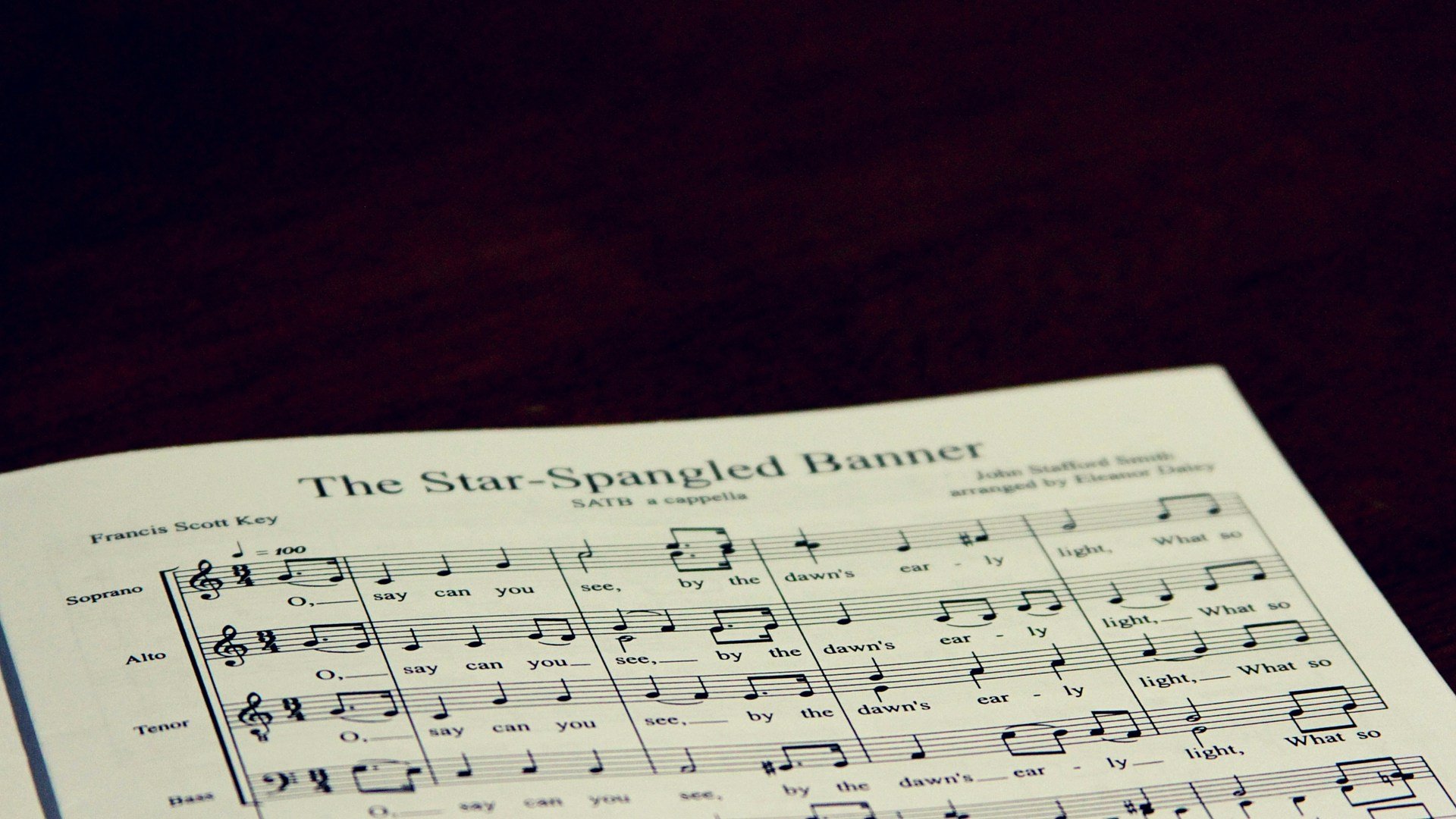
“The Star Spangled Banner”
Album/Year Released:
Text written 1814; Melody composed c. 1770s
Artist/Composer
Lyrics: Francis Scott Key (1779–1843)
Melody: John Stafford Smith (attributed), “To Anacreon in Heaven”
Genre/Style
Patriotic song; broadside ballad;
Song Form
Strophic (repeated verses), no refrain
“The Star-Spangled Banner” began as a four-verse poem written by Francis Scott Key in September 1814, following his witnessing of the American flag still flying over Fort McHenry after a British naval assault during the War of 1812. Originally published under the title “Defence of Fort M’Henry,” the text circulated quickly in printed newspapers and was soon matched with the melody of “To Anacreon in Heaven,” a popular British song commonly attributed to composer John Stafford Smith.
The song circulated initially as a broadside ballad, a common vehicle for political commentary and public expression in the eighteenth and early nineteenth centuries. Broadside ballads were inexpensive, single-sheet prints containing lyrics meant to be sung to familiar tunes rather than newly composed music. They were distributed in public spaces such as taverns, streets, and meeting halls and depended on a shared musical knowledge of those present. In this context, “The Star-Spangled Banner” was intended less as a formal musical composition than as a participatory text designed for communal performance.
By setting new lyrics to an existing melody, the anthem exemplifies contrafactum, a widespread practice in early American musical culture. Contrafacta allowed texts to circulate at a time when access to printed music was limited and musical literacy varied widely. Because “To Anacreon in Heaven” was already well known, singers could immediately perform Key’s poem without learning new music, which in turn, accelerated its adoption and dissemination.
Musically, the song is strophic, meaning that all four verses are sung to the same melody, with no refrain or chorus. This structure places emphasis on the unfolding narrative of the lyrics rather than on musical variation, a common feature of Anglo-American song traditions in which melodies were reused across multiple texts. The melody’s unusually wide range—extending beyond an octave—has made the song famously difficult to sing, particularly for amateur performers, and has contributed to its reputation as one of the most technically demanding national anthems.
Over the course of the nineteenth century, the song gradually became associated with patriotic ceremonies, military events, and public commemorations, though it was one of several songs—alongside “Yankee Doodle” and “Hail, Columbia”—used to express national identity. Although widely recognized throughout the nineteenth century, “The Star-Spangled Banner” did not become the official national anthem of the United States until 1931. Its association with public ceremonies gradually expanded in the late nineteenth and early twentieth centuries, particularly within military contexts. The song’s connection to sporting events began during World War I, when heightened nationalism encouraged public displays of unity. One of the most cited moments occurred during the 1918 World Series, when the song was performed during the seventh-inning stretch as a tribute to American soldiers. The positive public response helped establish the anthem as a regular feature at baseball games, and its use soon spread to other sports.
“De Camptown Races”
(also known as “Gwine to Run All Night” or “Camptown Races”)

Album/Year Released
Published February 1850
Artist/Composer
Stephen Foster (1826–1864)
Genre/Style
Minstrel song; American folk/Americana
Song Form
AB Form (Verse-Refrain)
“Camptown Races,” composed by Stephen Foster and published in 1850, became widely known through performances by Christy’s Minstrels. Written for the blackface minstrel stage, the song quickly gained popularity in nineteenth-century American popular culture and remains one of Foster’s most recognized works.
The lyrics describe a horse race in the fictional town of Camptown, Pennsylvania—a location Foster likely passed near while attending school in the region. The song depicts transient laborers betting on the race, a pastime both common and morally contested at the time. Repeated references to the “Camptown ladies” introduce ambiguity, hinting at marginal or socially stigmatized roles, possibly including prostitution, without specifying them. Musicologist Richard Crawford wrote in America's Musical Life that the song closely resembles fellow minstrel songwriter Dan Emmett's "Old Dan Tucker", and suggests that Foster used Emmett's piece as a model.
Foster’s text is written in exaggerated dialect, including spellings such as “de” and “gwine,” reflecting the minstrel convention of writing in imperfect African American Vernacular English rather than authentic African American speech. Though Foster is sometimes portrayed as more sympathetic than other minstrel composers, the song remains embedded in the racialized stereotypes and social hierarchies of the minstrel tradition.
The song also features call and response, a musical structure in which a leader (the caller) presents a phrase or musical idea, and a group (the responders) answers with a repeated or contrasting phrase. In Camptown Races, the soloist delivers the narrative in each verse (the call), while the ensemble answers with the famously repeated “Doo-dah! Doo-dah!” This structure reinforces the song’s rhythmic energy and memorability but also mirrors African-derived performance practices, even as minstrel shows distorted and commercialized them for white audiences.
The simplicity of the refrain and the contrast between solo verses and ensemble responses made the song especially effective in live performance. Beyond the stage, the melody circulated widely, reused for new lyrics in informal settings. Over time, it became a staple of American cultural memory, appearing in film, television, and cartoons such as Looney Tunes and used in elementary school classrooms as a learning aid and nursery rhyme. While its musical appeal endures, the song’s legacy is inseparable from the racialized context of its creation, reflecting both African American musical influence and the appropriation inherent in minstrelsy.