Chapter 22: Psychedelic Rock Pt.2
“Eight Miles High”
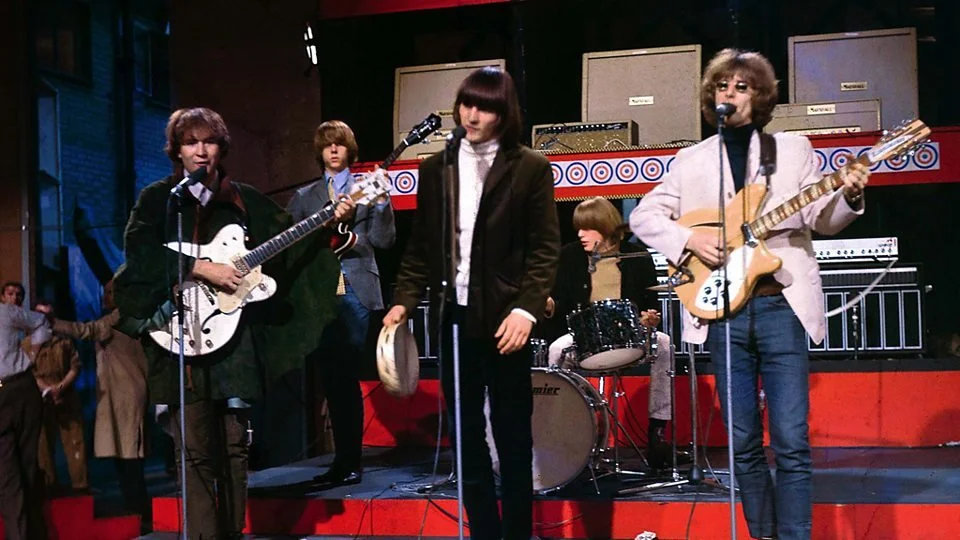
Album/Year Released
1966 (album: Eight Miles High)
Artist/Composer
The Byrds
Gene Clark, Jim McGuinn, David Crosby
Genre/Style
Psychedelic rock; folk rock
Song Form
Strophic with extended instrumental section
“Eight Miles High,” released in 1966, is often called one of the first psychedelic rock songs. Its sound comes from Roger McGuinn’s 12-string electric guitar, reverb-heavy vocal harmonies, and a steady, repeating bass line that gives a sense of both suspension and movement. The song uses a 4/4 meter and a strophic structure, but the structure is often broken up by long instrumental sections. Band members Roger McGuinn and David Crosby said the band’s main ideas were about flight, freedom, and movement, which are clear in “Eight Miles High.” The lyrics tell the story of the band’s 1965 flight to London and their tour in England, but the song was banned from many U.S. radio stations because people thought it referred to drug use, a double entendre that Crosby later confirmed.
A lot of the song’s mood comes from musical ideas inspired by Indian classical music. In Indian music, a raga is a melodic system based on a set group of notes, certain melodic patterns, and a particular mood. Instead of using quick chord changes, a raga develops slowly over a steady background, focusing on long notes, repetition, and the exploration of melodies.
The Byrds use these ideas in “Eight Miles High.” The bass plays a repeating ostinato that acts as a drone, which is a note that stays the same while the rest of the music changes above it. The song’s rhythmic and harmonic foundation lets the guitar and vocals use modal melodies, which makes the song feel less resolved and adds to its dreamy, hypnotic sound.
During the instrumental sections, the guitar plays long, improvised parts inspired by jazz saxophonist John Coltrane (”India”) and sitar player Ravi Shankar, whose music the band listened to on tour. There is no sitar in the song, but the 12-string guitar is played close to the bridge to create a tinny, ringing sound similar to a sitar. Mixing rock instruments with modal melodies, drones, and long improvisations led to raga rock, a style that brings elements of Indian classical music into rock. These qualities place the song at the crossroads of psychedelic experimentation and new ways of making rock music in the mid-1960s.
“Break on Through (to the Other Side)”
Album/Year Released
1967 (album: The Doors)
Artist/Composer
The Doors
Genre/Style
Psychedelic rock
Song Form
Verse-chorus with bridge
“Break On Through (To the Other Side)” was released in 1967 as The Doors’ debut single and opens their first album. The song is set in 4/4 meter and follows a concise verse–chorus layout, with short instrumental passages that draw attention to Ray Manzarek’s keyboards and Robby Krieger’s guitar figures. Its tonal language focuses on a minor key.
The verses are built on a rhythmic foundation drawn from bossa nova, a Brazilian style from the late 1950s that blends samba rhythms with jazz harmony and syncopated grooves. Bossa nova features a consistent pulse, layered accents, and bass lines that move smoothly rather than aggressively. In “Break On Through,” drummer John Densmore adapts this by playing a syncopated pattern with a clave-like rim click beneath a ride cymbal figure. The bass line follows a repeating pattern from this style and continues through much of the song.
This Latin-influenced feel dominates the verses. When the refrain arrives on the words “Break on through to the other side,” the groove shifts into a more forceful rock beat. The contrast between the bossa nova groove in the verse and the rock refrain reinforces the song’s dramatic arc, with the chorus delivering a sharper rhythmic attack that reflects the intensity of the lyrics.
Jim Morrison’s vocal delivery moves between swift, almost spoken declamation in the verses and more sustained melodic phrases in the refrain. His performance heightens the tension built into the arrangement, balancing rhythmic precision with a raw, confrontational tone. Although the lyrics suggest psychological and spiritual expansion, Elektra Records removed the word “high” from the original refrain to avoid radio censorship; the unedited version was later restored in archival releases.
Much of the band’s sound rests on Manzarek’s keyboard approach. He played bass lines on a Fender Rhodes piano bass with his left hand while his right hand played organ parts on a Vox Continental, allowing the group to function without a bassist. His organ interjections during instrumental breaks recall the phrasing of rhythm-and-blues and jazz players, drawing influence from figures such as Ray Charles, Stan Getz, and João Gilberto. Krieger’s guitar riff borrows from blues traditions associated with Elmore James and the Paul Butterfield Blues Band, further grounding the song in American blues practice even as it incorporates Latin elements.
“Good Vibrations”

Album/Year Released
1966 (released as a single)
Artist/Composer
The Beach Boys
Brian Wilson, Tony Asher and Mike Love
Genre/Style
Psychedelic pop; experimental rock
Song Form
multi-sectional
“Good Vibrations,” recorded in 1966 and released as a single on October 10, is regarded as one of the most ambitious and influential pop productions of the decade. Composed and produced by Brian Wilson with lyrics by Mike Love (and, in some versions, Tony Asher), the song was promoted as a “pocket symphony” for its episodic structure and studio ambition. Unlike conventional pop songs built around repeated verses and choruses, “Good Vibrations” unfolds through a sequence of contrasting sections, each featuring distinct melodic material, harmonic direction, rhythmic texture, and instrumental color. The track stays in 4/4 meter, but rhythmic variety comes from triplet inflections, syncopation, and slight changes in emphasis and texture, giving the music a dynamic, evolving quality.
Central to the song’s unique sound is the electro-theremin, an electronic instrument played with a sliding control rather than the hand proximity of a traditional theremin. Its gliding pitches and vocal-like tone create an ethereal, almost otherworldly effect that becomes the song’s signature timbre, evoking sensations of floating and vibration. Brian Wilson envisioned the instrument as articulating sounds “like a woman’s voice or like a violin bow on a carpenter’s saw.” Its entrance in the chorus, imitating the lyrics “I’m picking up good vibrations,” connects the electronic timbre to the song’s focus on sensation and perception. The electro-theremin, combined with conventional instruments such as Hammond organ, Fender bass, electric guitar, drums, and percussion, contributes to the dense, multilayered textures that characterize the piece.
Wilson conceived the recording as a modular composition, producing dozens of short, self-contained fragments, or “modules,” across more than 20 sessions in four Hollywood studios between February and September 1966. These segments were recorded with his bandmates and over 30 session musicians, using a wide range of instruments, including bowed cello and string bass, harpsichord, tack piano, piccolo, maracas, sleigh bells, jaw harp, and bass harmonica. Each fragment could be spliced together in the final assembly, allowing abrupt shifts in key, tempo, and instrumentation while maintaining a sense of continuity. Reverb decays and careful mixing concealed tape splices, resulting in a continuous musical narrative despite the experimental construction. The process was costly for the time, with production expenses estimated between $16,000 and $25,000, equivalent to several hundred thousand dollars today, making it the most expensive and time-consuming single pop recording of its era.
Harmonically, the song is highly fluid. The opening verse is in E♭ minor, featuring a descending chord progression (i–♭VIIadd6–♭VIadd6–V) layered with organ, melodic bass, percussion, and sustained piccolo lines. Despite its minor key, the verse keeps an airy, buoyant character, amplified by Carl Wilson’s light, triplet-based lead vocal. The chorus modulates to G♭ major, bringing in the electro-theremin and bowed cello triplets for a bright, floating contrast. Brian Wilson layered harmonies and non-lexical vocable lines across multiple sections, ascending in pitch with each repetition and often interweaving fugato-like counterpoints. Throughout the song, more than a dozen key changes occur, including dramatic jumps from G♭ to A♭ to B♭, leaving the tonal center intentionally destabilized and generating a sense of forward momentum and surprise.
“Good Vibrations” was developed alongside Wilson’s larger, unfinished Smile project, which aimed to expand the expressive range of pop music through modular recording, orchestral textures, and thematic experimentation. Many techniques Wilson refined for Good Vibrations, including modular tape assembly, unusual instrumentation, and advanced vocal layering, directly informed the ambitious goals of Smile. The song’s episodic design and experimental studio approach positioned the Beach Boys at the forefront of progressive pop and psychedelic experimentation, showing that commercial success could coexist with avant-garde studio innovation.
The track’s production drew inspiration from the coherence and dramatic effect of Phil Spector’s “Wall of Sound,” the emotional effect of Righteous Brothers recordings like “You’ve Lost That Lovin’ Feelin’,” and Wilson’s fascination with extrasensory perception and altered states of consciousness. Wilson described “Good Vibrations” as a work of advanced rhythm and blues, and its incorporation of classical instruments, especially the cello and electro-theremin, expanded the sonic vocabulary of pop music. The theremin became emblematic of the song’s experimental edge, providing a voice-like quality that supported both the psychedelic character and the focus on intangible sensations.
“Good Vibrations” advanced the idea of the studio as an instrument, demonstrating the feasibility of large-scale production in a pop single. Its combination of innovation, cost, and artistic scope made the track a landmark achievement in 1960s music, bridging experimental composition with mass appeal and influencing generations of progressive pop, psychedelic, and art-rock musicians.
“Purple Haze”
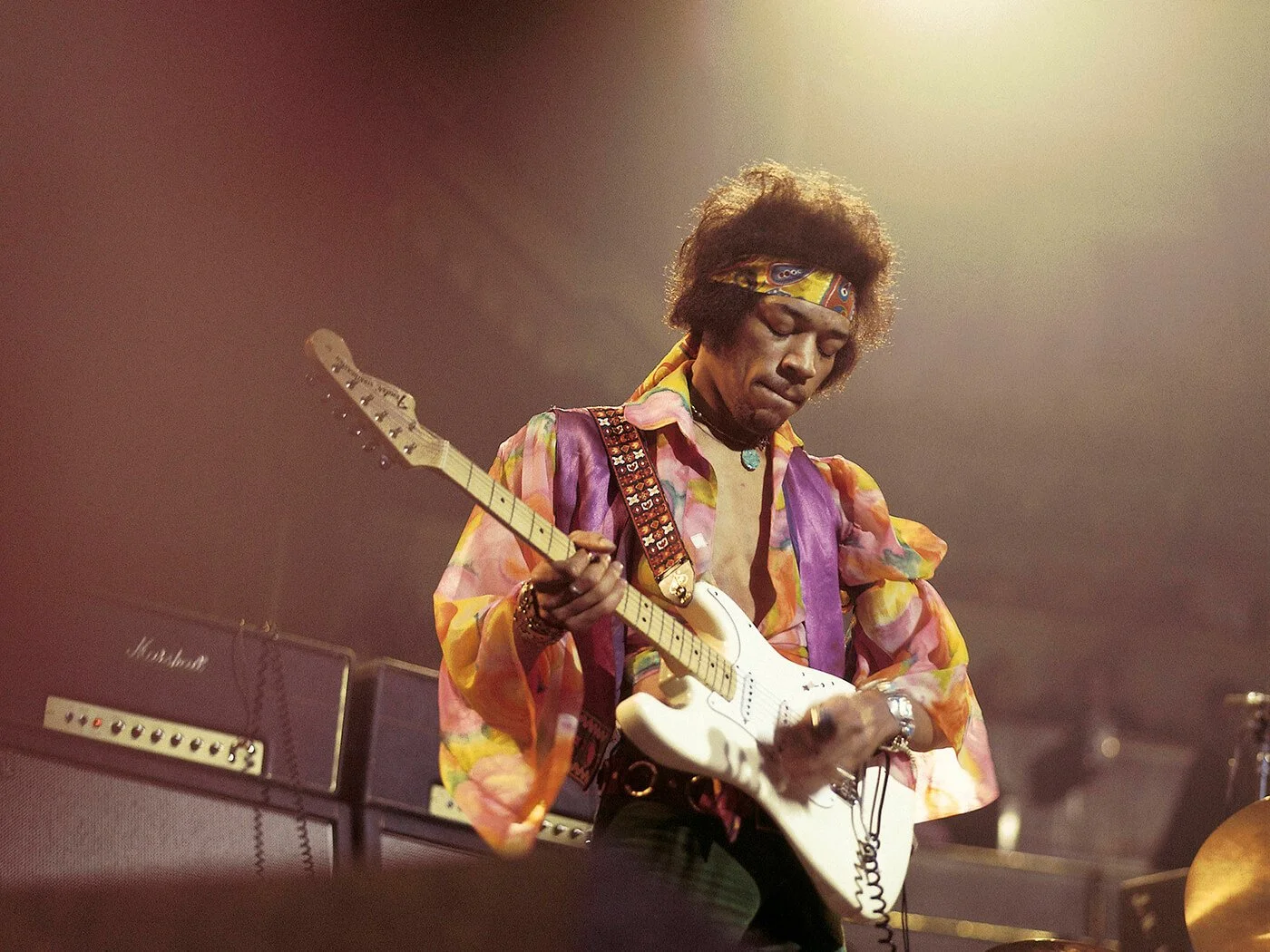
Album/Year Released
1967 (album: Are You Experienced)
Artist/Composer
The Jimi Hendrix Experience
Jimi Hendrix
Genre/Style
Psychedelic rock
Song Form
Strophic
“Purple Haze” appears on the North American release of Are You Experienced and demonstrates many elements associated with Hendrix’s recorded style: extreme amplification, feedback control, pitch bending using the vibrato arm, and creative use of effects hardware such as the wah-wah pedal and Octavia. Recorded in early 1967, “Purple Haze” became one of Jimi Hendrix’s most recognizable recordings. The song is set in 4/4 meter and built around a repeating guitar riff that appears in the verses, choruses, and outro. This riff anchors the track, while variations in guitar tone, articulation, and effects create contrast. Heavy distortion, feedback, and effects pedals contribute to the song’s psychedelic character.
The introduction features a dissonant tritone interval between the guitar and bass, historically labeled diabolus in musica, or the “Devil’s Interval,” which was viewed with suspicion during the Middle Ages. It was believed to be banned or avoided in sacred music for its dissonant sound until the Renaissance. Hendrix plays a B♭ on guitar against an E in the bass, creating immediate tension before the main riff enters. Once the groove is established, the verses rely on a compact three-chord progression: E7♯9, G, and A. The E7♯9 chord, often called the “Hendrix chord” because of his repeated use, was drawn from rhythm and blues and jazz practice and later became closely associated with Hendrix’s style. The song centers on E and draws heavily from the E minor pentatonic collection. Hendrix’s chord voicings are unconventional; he often uses his thumb to fret bass notes on the sixth string, allowing his other fingers to create altered or incomplete chord structures. The guitar solo expands on the verse harmony and is based mainly on the E minor pentatonic scale, with expressive bends, vibrato, and sustained tones. Noel Redding’s bass generally tracks the root motion of the chord progression, occasionally inserting passing tones for momentum. Mitch Mitchell’s drumming combines a steady backbeat with active fills that respond to vocal phrasing and guitar gestures. Together, bass and drums create a flexible rhythmic foundation that supports Hendrix’s phrasing rather than driving strict patterns.
Texturally, the track is guitar-centered. Distortion and overdrive remain present throughout. During the solo, Hendrix uses the Octavia pedal, designed by Roger Mayer, which doubles the guitar signal an octave higher, producing a piercing, overtone-rich sound. The Octavia effect, combined with fuzz distortion, contributes to the song’s Eastern-leaning color, which some listeners associate with raga-inspired phrasing.
The structure of “Purple Haze” unfolds in several distinct sections. The song begins with an introduction featuring a tritone-based figure which immediately establishes tension before the main riff takes over. The first verse is followed by the main riff, and this structure repeats in a second verse, after which Hendrix launches into a guitar solo containing blues-based improvisation, the E minor pentatonic scale, and the creative use of Octavia and fuzz effects. The third and final verse returns before the song closes with an outro, bringing back the main riff and layering it with sustained feedback and effects for a dramatic conclusion.
The lyrics are commonly interpreted as referencing altered perception, though Hendrix himself described the song as a love story. Vocally, Hendrix delivers the text in a conversational, slightly aloof tone that contrasts with the instrumental track's intensity. Live performances frequently extended the solo and featured visual theatrics—such as playing the guitar with his teeth or behind his back—though these gestures did not alter the musical content itself.
The distorted guitar tone, its interaction with feedback, the central riff's role in organizing the form, the contrast between the tightly structured verse sections and the more fluid guitar solo, and the return of the introductory material during the bridge and outro all contribute to the song's distinctive psychedelic character.