Chapter 1: Important Musical Terms
Chapter 1: Introduction

Before we dive into the historical and cultural development of American popular music, it is important to establish a foundational understanding of how music works. This chapter provides the basic vocabulary we will use to analyze, describe, and better appreciate the songs and styles covered in later chapters. By learning how to discuss musical terminology such as rhythm, melody, harmony, form, and other musical elements, we can more clearly express what we are hearing and why it matters.
This shared language allows us to break down songs not just by the minutia of genre or style, but by how they are broadly constructed and how these musical elements function. It helps us answer questions like:
What makes a song catchy?
Why does one chord progression feel uplifting while another feels melancholy?
How do artists use rhythm and repetition to shape our emotional response?
These tools are especially important when comparing musical trends across decades, exploring stylistic innovations, and understanding how music has both shaped and reflected American life.
Whether you are a lifelong fan of pop music wanting to learn more about what you are hearing or have extensive experience in musical analysis, these concepts will help you listen more deeply, articulate your impressions more clearly, and recognize the craft behind the music that surrounds us every day. With this foundation in place, we can now turn our attention to the musical elements themselves, beginning with tempo, the aspect of music that gives it pace and motion.
Tempo
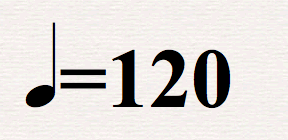
Tempo refers to the speed or pace at which music is performed, typically measured in beats per minute (BPM). Tempo shapes a song’s energy, mood, and sense of movement. In pop music, a common tempo is around 120 BPM, though tempos can vary widely depending on the genre and emotional tone of the song. It may remain steady or shift within a piece to create dynamic contrast and emotional impact. Tempo markings often use Italian terms, especially in classical contexts. Although these terms remain useful across musical styles, popular music generally uses BPM markings to indicate tempo (see fig. 2).
Largo (40–60 BPM) is very slow and is often used in solemn or reflective pieces, as heard in Pink Floyd’s“Wish You Were Here” (60 BPM).
Adagio (66–76 BPM) is slow and expressive, exemplified by Adele’s “Someone Like You.” (68 BPM).
Andante (76–108 BPM) suggests a walking pace and is common in folk-influenced songs like Stone Temple Pilots’ “Interstate Love Song” (85 BPM)
Moderato (108–120 BPM) indicates a moderate tempo, frequently used in rock and indie music, such as Journey’s “Don’t Stop Believing” (119 BPM).
Allegro (120–168 BPM) is fast and lively, typical of upbeat pop and dance tracks like “Reptilia” by The Strokes (~158 BPM)
Presto (168–200+ BPM) is very fast, often found in punk and electronic genres, as in Green Day’s “Basket Case”(~175 BPM).
The Beat, Rhythm, and Meter
The Beat
The beat is the steady, underlying central pulse that forms the rhythmic foundation of the music. It is what we naturally tap our feet to and what gives the music its sense of timing and momentum. In contemporary music, the term "beat" can carry multiple meanings. In genres such as hip-hop, pop, or EDM, it often refers to the instrumental backing track, particularly the drum loop or rhythm pattern that drives the song. However, in a wider musical sense, the beat refers to the consistent pulse that anchors a piece of music.
Rhythm
Rhythm is the systematic arrangement of musical sounds and silences, principally based on duration and periodic stress. It is how music is organized in time and involves the duration and timing of individual notes and rests. While the beat is regular and unchanging, the rhythm can vary and shift to create syncopation, groove, and complexity. A single piece of music typically has a single consistent beat, with many rhythmic patterns layered on top. Together, beat and rhythm form the backbone of a song's feel and flow.
Meter
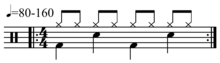
Meter refers to how beats are grouped into repeating units, typically in twos, threes, or fours.These groupings are indicated by the time signature, such as 4/4, which is the most common in pop music (see fig.4). A measure or bar is one unit of this grouping. The downbeat is the first beat in each measure, often emphasized to help organize the rhythm of the music.
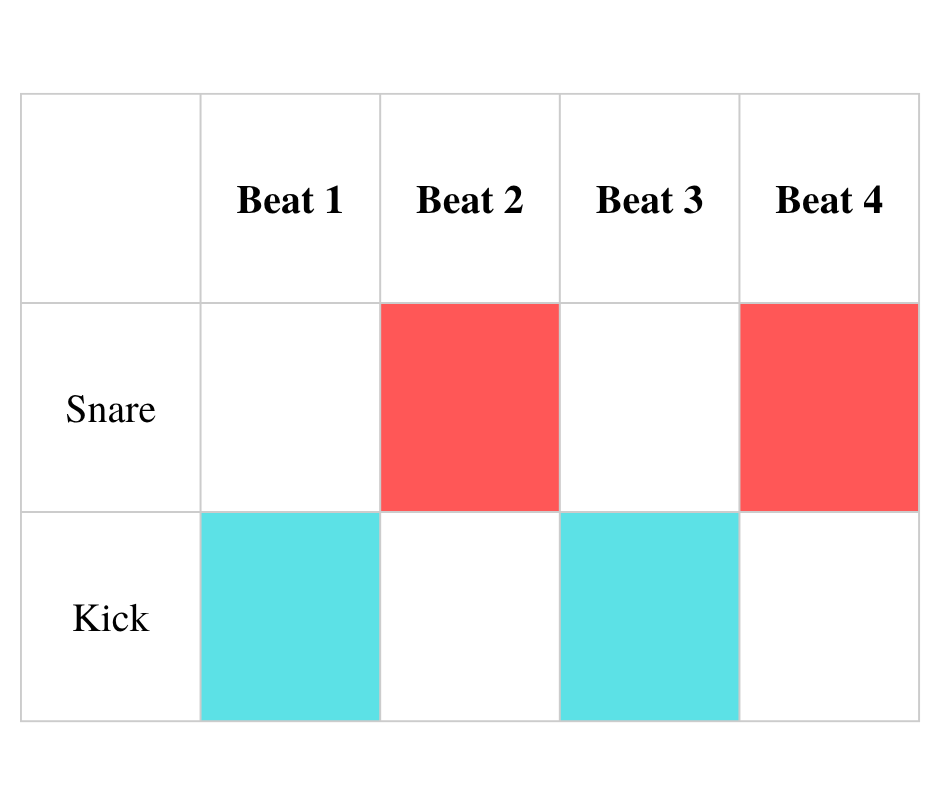
In 4/4 time, the most common time signature in popular music, each measure contains four beats, counted as "1 2 3 4." The first beat (the downbeat) is usually the strongest, while beats 2 and 4 are often accented to create a backbeat feel. A classic example of 4/4 time is "Billie Jean" by Michael Jackson. In this song, the bass drum hits on beats 1 and 3, the snare hits on beats 2 and 4, and the hi-hat maintains a steady subdivision throughout. Below is a visual diagram showing how the beats fall in a measure of 4/4 using the chorus of "Billie Jean" by Michael Jackson.
While 4/4 is the most prevalent time signature in popular music, other meters are used to create specific expressive effects or stylistic identities. Meter organizes beats into regular repeating patterns, each grouping giving the music a distinct rhythmic feel. The most common groupings are in duple (2 beats per measure), triple (3 beats), or compound meter (where each beat is subdivided into smaller pulses).
3/4 time groups beat into threes, counted as "1 2 3,” creating a circular, swaying rhythm often associated with waltzes. In pop and folk ballads, it adds a gentle, flowing motion. Norah Jones' "Come Away With Me" is a modern example of a song that uses this triple meter.
6/8 time is a compound duple meter—it has two main beats per measure, but each beat is subdivided into three smaller pulses (counted as "1-2-3 4-5-6"). This creates a lilting, rolling rhythm that can feel both energetic and graceful. Queen’s "We Are the Champions" uses 6/8 to build emotional intensity and momentum.
More complex meters like 5/4 or 7/8 are uncommon in mainstream pop but are hallmarks of progressive rock, jazz, and experimental music, where rhythmic unpredictability is a defining feature. Dave Brubeck’s "Take Five" is a classic example of jazz in 5/4 time, with five uneven beats per measure, creating a distinctive off-kilter swing that challenges standard rhythmic expectations.
To count 5/4, musicians often break it into smaller groupings, such as 3 + 2 or 2 + 3, which helps organize the beats in a way that feels more natural. For example, you might count it as “1 2 3, 1 2” or “1 2, 1 2 3,” depending on the phrasing.
To count 7/8, you divide the seven eighth notes into groupings such as 2 + 2 + 3 or 3 + 2 + 2, often felt as “1 2, 1 2, 1 2 3.”
While rare, these meters do occasionally appear in popular music. The Gorillaz song “5/4” uses a consistent 5/4 meter, and Rush’s “Tom Sawyer” features a prominent 7/8 section during the instrumental bridge (around the 1:36 mark). These irregular groupings give the music a jolting or propulsive feel that contrasts sharply with more regular meters like 4/4. Understanding how different meters are organized—whether simple (like 4/4 or 3/4) or irregular (like 5/4)—can deepen your ability to follow a song’s rhythmic flow. It reveals how musicians manipulate time and pulse to create contrast, tension, or groove across different genres.
Syncopation and Groove
Syncopation
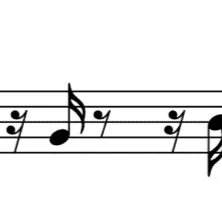
Syncopation occurs when the expected rhythmic pattern is intentionally disrupted by placing emphasis on the weaker beats or the spaces between beats, often called offbeats. In most Western music, we expect the strongest beats to fall on the first and third beats of a four-beat measure, with secondary accents on the second and fourth beats. Syncopation shifts the emphasis to unexpected places, such as the "and" between beats (e.g., "1-and-2-and..."), creating surprise, tension, and rhythmic complexity. This technique gives the music a sense of forward motion or swing, keeping the listener engaged by breaking the beat's regularity.
You can hear this syncopation clearly in Ed Sheeran's" Shape of You," where the syncopated synthesizer riff and woodblock hits in the intro land ahead of or between the main beats. This offbeat placement propels the groove forward and gives the track its signature rhythmic drive. Similarly, OutKast’s "Hey Ya" features vocal phrasing that slightly falls off the beat. For example, the first syllable of the word “around” and the word “me” in the first verse are syncopated, landing in unexpected places that push against the groove and enhance the song’s rhythmic bounce.


Groove
Groove refers to the cumulative rhythmic feel generated by the dynamic interaction and interlocking patterns of the different instruments in the rhythm section, especially the drums, bass, guitar, and keyboards. Groove comes from musicians' subtle timing choices, whether slightly ahead of, slightly behind, or perfectly aligned with the beat. This creates what musicians often describe as the pocket, the sweet spot where all the rhythmic elements come together tightly.
Groove is often what makes a song feel good in the body. It is what makes you want to nod your head, tap your foot, or get up and dance. Genres like funk, jazz, R&B, hip-hop, and reggae often place groove at the center as a primary expressive element.
Stevie Wonder’s "Superstition" is a masterclass in groove. The clavinet (a piano-like instrument) delivers a choppy, syncopated riff that hooks the ear, while the bass plays a punchy, syncopated line that both mirrors and contrasts the clavinet. The drums maintain a steady, tight backbeat on beats 2 and 4, anchoring the syncopated elements. Meanwhile, the horn section punctuates the groove with rhythmic stabs that accentuate off-beats. The result is a layered, infectious rhythm where syncopation and groove work together.
Pitch & Melody

Melody is a sequence of single notes that creates the main tune of a piece. It is the part of the music we are most likely to remember, sing, or hum. A melody is shaped by both rhythm and pitch, giving it a particular contour or shape as it moves through time. Pitch refers to the highness or lowness of a musical sound. Pitches are organized into scales, and when arranged in sequence, they form melodies. In pop music, melody is often a central expressive element, combining rhythm, pitch, and phrasing to give a song its emotional and musical identity. In essence, melody = rhythm/meter + pitch.
An example of a memorable melody is "Love Me Do" by The Beatles. The verse melody is simple and repetitive, staying within a narrow range of pitches and following a clear rhythmic pattern. The vocal line primarily moves stepwise, which means it moves between notes that are next to each other in the scale, like moving up or down one step at a time, rather than jumping over several notes. This creates a smooth and connected flow. For example, the phrase “Love, love me do” features a gentle rise and fall that is easy to sing and instantly recognizable. This melody’s phrasing is short and conversational, often emphasizing the strong beats, which makes the song especially catchy and accessible to listeners.
Texture
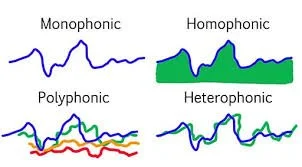
Texture describes how musical parts are layered and how they interact at any given moment, forming the overall sound texture of a piece. Instead of focusing on the tone color of individual instruments or voices, texture addresses the relationships between musical lines: how many are present, whether they move together or independently, and how melody, harmony, and rhythm are organized across those layers. Listening for texture helps us hear the structural roles these sounds play within the music.
A monophonic texture consists of a single melodic line with no harmonic accompaniment. This melody may be performed by one voice or instrument or by multiple performers in exact unison, but only one pitch stream is present. Because no chords or counter-melodies appear, the listener’s attention is directed entirely toward the melody’s rhythm and contour. A clear pop example occurs at the opening of Queen’s “We Will Rock You,” where Freddie Mercury sings alone while hand claps and stomps provide rhythmic support without introducing pitched harmony. Even when additional voices join later, the texture remains monophonic because all performers sing the same notes of the same melody rather than creating harmony.
Heterophonic texture arises when multiple performers present the same melody simultaneously but with small variations in rhythm, timing, or ornamentation. The melody remains unified, yet the slight differences create a loosely layered effect. This texture is most often found in vocal performances by pop music groups. In Destiny’s Child’s “Survivor,” from approximately 2:25 to 2:48 during the chorus, the singers perform the same melodic line while Beyoncé’s lead vocal is subtly varied through rhythmic emphasis and embellishment. The voices are neither fully harmonized into different chord tones nor perfectly synchronized in unison, producing a heterophonic texture built from one shared tune.
Polyphonic texture involves two or more independent melodic lines simultaneously, each with its own rhythmic shape and contour. No single line functions solely as accompaniment; instead, the melodies exist and interweave. A well-known pop example appears in the closing section of the Beach Boys’ “God Only Knows’’ from about 2:10 to the end of the song. In this outro, multiple vocal lines enter successively, each singing a distinct melody that overlaps with the others. Because these lines move independently rather than forming synchronized chords, the texture is clear polyphonic.
Homophonic texture consists of a primary melody supported by harmonic accompaniment, with the accompanying parts reinforcing the harmony rather than competing melodically. This is the most common texture in pop music. In John Lennon’s “Imagine,” Lennon’s voice presents the melody while the piano moves in block chords beneath it. The piano does not introduce an independent melody; instead, it supports and strengthens the harmonic foundation, making the texture clearly homophonic.
Homorhythm is a specific type of homophonic texture in which all voices or instruments move together rhythmically, changing pitches at the same time. This creates a tightly unified, chordal sound in which rhythm and harmony are inseparable. In Prince’s “Nothing Compares 2 U,” at the end of each verse and on the line “Nothing compares to you” in the chorus, the background vocals and accompanying instruments align rhythmically with the lead vocal on the song’s signature motif. These parts articulate the lyrics and chord changes together, forming stacked harmonies that move in rhythmic unison and create a distinctly homorhythmic texture.
Keys and Scales
Key Signatures
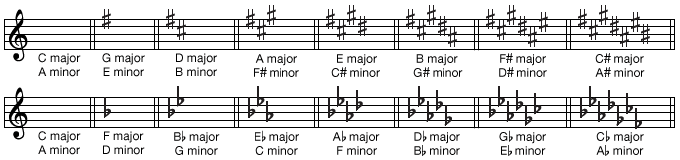
The key signature defines the key of the song, or the tonal center or "home" note around which the melody and harmony are organized. A key signature is written as a set of sharps (#) or flats (b) placed at the beginning of each staff line in written music that indicates which notes are to be consistently raised or lowered throughout a piece. For example, a key signature with one sharp usually indicates the key of G major or its relative minor, E minor. Understanding the key signature is essential for musicians to know which notes will sound “correct” in the context of the song.
Scales
A scale is a series of pitches arranged in ascending or descending order within the framework set by the key signature. Scales provide the raw material for both melodies and harmonies. The two most common types of scales in Western popular music are major and minor.
Major scales typically have a bright, happy, or triumphant sound. Their sequence of whole and half steps creates a sense of stability and optimism. Songs like “Happy” by Pharrell Williams and “CAN'T STOP THE FEELING!” by Justin Timberlake use major scales to evoke upbeat, energetic moods.
Minor scales generally convey a more somber, introspective, or emotional atmosphere. Their pattern of intervals creates tension and depth, often associated with sadness or longing. For instance, “Slow Dancing in a Burning Room” by John Mayer uses a minor scale to support its reflective, melancholic lyrics.
Harmony and Chords

Musical harmony occurs when two or more notes are played simultaneously. Chords, typically comprising three or more notes, are the primary means of creating harmony. They can be major, conveying brightness or happiness, or minor, often imparting a more somber or introspective tone.
A chord progression is a sequence of chords that creates musical movement and forms the harmonic foundation of a song. One of the most prevalent progressions in popular music is the I–V–vi–IV sequence, used in countless hits like "Let It Be" by The Beatles and "With or Without You" by U2. These Roman numerals represent chords built on different steps of the scale, with uppercase letters (like I, V, and IV) indicating major chords and lowercase letters (like vi) indicating minor chords. In this case, the chords come from the first, fifth, sixth (minor), and fourth steps of the scale.
Another popular variation is the vi–IV–I–V progression, often called the "minor variation" because it begins on the minor vi chord, giving it a more emotional, melancholic tone. This version appears in songs like “All of Me” by John Legend.
The roots of these progressions trace back to Western classical harmony, where certain chord sequences were established as pleasing and stable through centuries of musical practice, especially during the Baroque, Classical, and Romantic periods. The use of tonic (I), dominant (V), and submediant (vi) chords reflects a longstanding harmonic framework designed to create tension and resolution, which are essential elements that guide the emotional flow in music.
In the 20th century, as popular music developed from blues, folk, and early rock, these harmonic patterns were adapted for new genres. For example, the I–V–vi–IV progression rose to prominence because of its multifunctionality and historical familiarity, allowing songwriters to compose memorable melodies over a reliable harmonic base. Its simplicity also makes it accessible to musicians of all levels, contributing to its widespread use in both professional and amateur music-making.
The cultural ubiquity of this chord progression was memorably highlighted by the Australian comedy group Axis of Awesome in their 2008 viral performance “Four Chord Song’’. In the medley, they humorously interwove dozens of hit songs from genres including pop, rock, and country, all built on the same four-chord sequence. Their performance showed the progression’s range and status as a basic harmonic template that has shaped popular music over multiple decades.
Understanding these harmonic structures deepens our appreciation of how composers use familiar patterns to evoke specific emotions and connect with listeners. The historical grounding of these progressions shows how popular music both inherits and transforms musical traditions, linking contemporary songs to centuries of harmonic practice.
Modulation

In popular music, the choice between major and minor scales plays a crucial role in shaping a song’s emotional tone. Artists often shift between these scales and tonalities to add contrast and highlight changes in mood. One powerful tool for creating emotional movement is modulation, which is the act of changing the key within a song. Modulation can introduce variety, heighten intensity, or offer a sense of lift, and it is frequently used to make a final chorus feel more energetic or climactic.
For example, "My Girl" by The Temptations modulates up a whole step from C major to D major after the instrumental bridge (1:50), infusing the final chorus with a brighter, more celebratory feel. As we will explore further, this kind of upward modulation was a signature technique in Motown songwriting, where The Temptations were a defining act.
Though less common, downward modulation can also be an effective songwriting tool. In "Uptown Girl" by Billy Joel, the song shifts from E major to C major during the bridge, four semitones lower (0:39). This unexpected change provides tonal contrast and introduces a fresh emotional color before returning to the chorus's familiar tonality.
Modulation can also create contrast by shifting between major and minor tonalities. In "While My Guitar Gently Weeps" by The Beatles, the verses are in A minor, giving them a somber, introspective tone, while the chorus shifts to A major, offering a fleeting sense of uplift and release (0:51). This interplay enhances the emotional and spiritual aspects of the song and underscores the lyrics’ bittersweet tension.
These kinds of key changes, whether upward, downward, or between major and minor, do more than add variety. They serve as structural and emotional pivot points, helping to maintain listener interest and deepen a song’s expressive impact.
Timbre
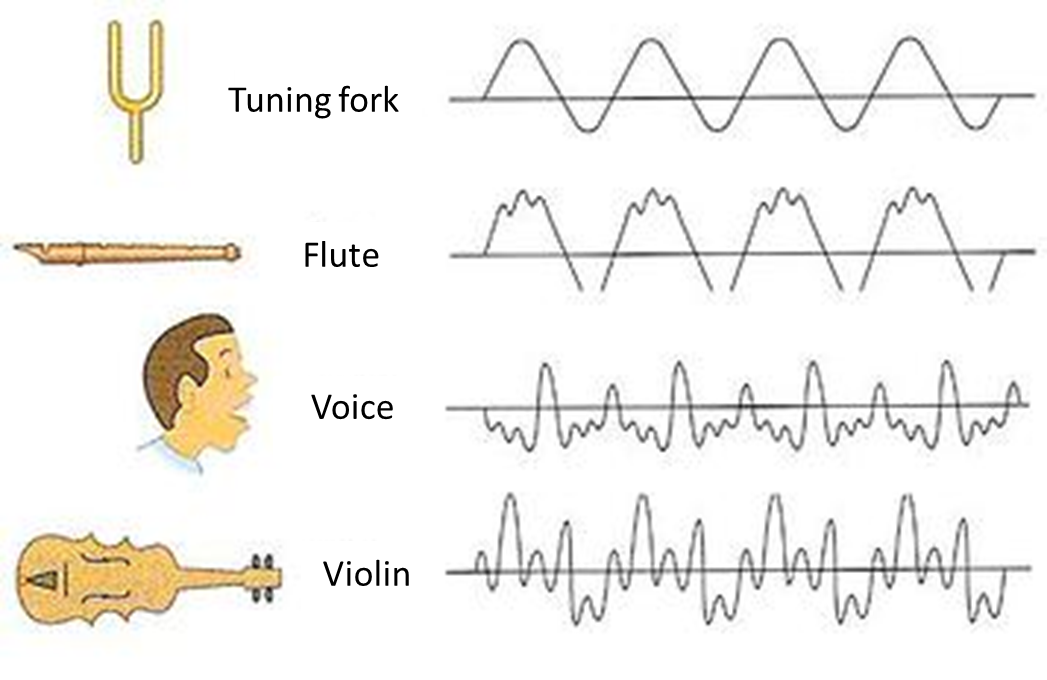
Timbre (pronounced "tam-ber") refers to the tone color or unique quality of a musical sound. It is what allows us to distinguish one instrument or voice from another, even when they play or sing the same pitch at the same volume. For example, a piano and a violin playing the same note sound distinctly different because of their timbre.
Timbre is determined by a number of factors, including the instrument's construction, the performer's technique, and any electronic processing used during production. At the core of timbre is a sound’s frequency content. Every musical sound consists of a fundamental frequency—the main pitch that we perceive—and a series of overtones or harmonics that vibrate above it. The fundamental note is the lowest and most prominent vibration, determining the pitch we recognize, such as A, C, or G. Frequencies are measured in hertz (Hz), which refers to the number of vibrations per second. For instance, the note A above middle C vibrates at 440 Hz. Overtones, which occur at whole-number multiples of the fundamental frequency, add depth, richness, and brightness to a sound. The particular combination and intensity of these overtones give each instrument its distinctive tone.
The material and construction of an instrument also play a major role in shaping timbre. For example, the wooden body of an acoustic guitar produces a warm resonance, while the metal tube of a trombone gives it a brassy, bold tone. Performance techniques—such as vibrato, strumming versus fingerpicking, or adding vocal rasp—can drastically alter a sound’s color. Additionally, studio effects, including reverb, distortion, equalization, and autotune, can greatly shape the final sonic character. For instance, the use of heavy autotune in Cher’s “Believe” or the eerie, layered synth textures in Billie Eilish’s“bad guy” show how electronic processing adds to the song’s timbre.
In pop music, timbre is essential for identifying a track’s style, emotional tone, and atmosphere. A fingerpicked acoustic guitar might suggest intimacy or nostalgia, while a growling synth bass can evoke tension or urgency. Timbre not only establishes a song’s sonic identity but also guides the listener’s emotional response. Learning to recognize and describe timbre gives deeper insight into a song’s production and expressive impact.
Hooks/Motifs

Hooks, motifs, and riffs are essential tools in popular music that shape a song’s identity and memorability. Each serves a distinct function, but all rely on repetition to make musical ideas feel familiar and meaningful. A hook is a short, catchy musical or lyrical idea that grabs the listener’s attention. It might appear in the chorus, the intro, or even as a repeated phrase in the lyrics or melody. Hooks are often the most recognizable and repeatable parts of a song, designed to stick in the listener’s memory after just one hearing. A motif is a small musical idea—melodic, rhythmic, or harmonic—that recurs throughout a song. Motifs give structure and order. They are often repeated with variation, helping to develop the larger musical narrative while strengthening its identity. A riff is a short, repeated motif or figure in the melody or accompaniment of a musical composition. Riffs often serve as the rhythmic and melodic backbone of a song. "Smoke on the Water" by Deep Purple is built around one of the most iconic guitar riffs in rock history. The riff, played on an overdriven electric guitar, opens the song with a simple yet powerful motif. This riff acts as both the hook and a motif, providing the song’s central identity. The repetition of the riff grounds the entire track and gives it its driving energy.
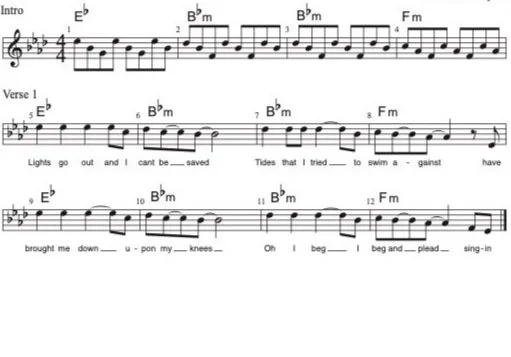
“Clocks” by Coldplay showcases clear examples of riffs, hooks, and motifs that shape its memorable sound. The song features a hypnotic piano riff that serves as its musical backbone. Built from broken chords (Eb, Bb, Fm), the riff is played in a steady arpeggiated rhythm with syncopated accents that create a feeling of continuous motion. Though harmonically simple, the way the piano loops throughout gives the track its signature vibe. This repeating phrase functions as both a riff and a hook, immediately grabbing the listener’s attention and strengthening the mood of the song.
In addition to the piano, the rhythm of the vocal melody in the verse also repeats, acting as a motif that further embeds the song’s themes in the listener’s memory. After the verse, the wordless “ooh” vocal section functions as another hook. This repeated soaring vocal line creates a moment of lift that contrasts with the more introspective verses. Together, the piano riff, the recurring vocal motif, and the emotive vocal hook use repetition to create the distinctive sound that characterizes “Clocks.”
At the core of all three elements—hooks, motifs, and riffs—and what makes the hooks in "Smoke on the Water" and "Clocks" so effective is repetition. Repetition gives music its staying power and makes the idea feel intentional, emotionally meaningful, and worthy of attention. A common compositional tool used by songwriters is to introduce an idea, repeat it, vary it, and then return to it. This cycle reinforces musical identity and legitimizes the musical idea.
To keep this in mind, remember this simple mantra:
Repetition legitimizes.
Repetition legitimizes.
Repetition gives legitimacy.
Repetition legitimizes.
Song Forms
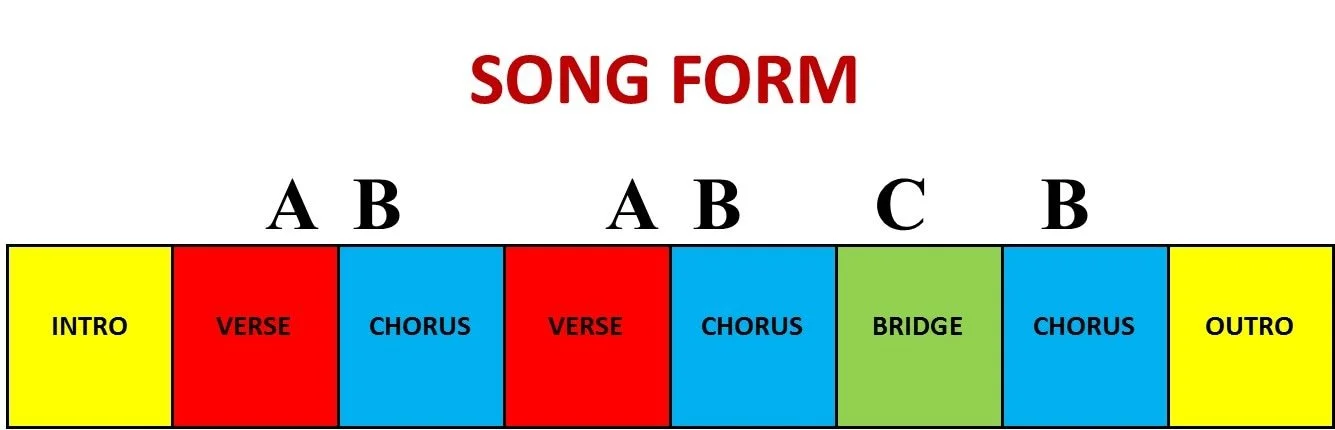
Form refers to the structure of a musical composition or performance, outlining how a song is organized into distinct sections. The verse typically features different lyrics each time it appears, though the melody often remains the same. Verses tell the story or develop the song’s theme. The chorus, by contrast, is the part of the song that is repeated multiple times, usually with the same lyrics and melody. It often delivers the main message or emotional core and is designed to be catchy and easy to sing along with. One of the most common song forms in popular music is the verse-chorus form, in which verses alternate with a repeating chorus. The verse develops the narrative or theme, while the chorus delivers the emotional or lyrical core. A well-known example is "California Girls" by The Beach Boys.
The bridge serves as a contrasting section, typically appearing after the second chorus and leading into the final chorus. It provides a break from the repetition of verse and chorus and helps heighten emotional intensity or shift perspective. An example of an effective bridge can be found in "We Are Young" by Fun., where the bridge introduces a dramatic tonal and lyrical shift before returning to the chorus (2:33).
Songs may also include additional sections that frame or enhance the core song structure. An intro sets the tone and mood at the beginning of a song. It can be instrumental or vocal and often introduces the main melody, rhythm, or theme, as heard in the guitar intro of Nirvana’s "Smells Like Teen Spirit." The pre-chorus appears between the verse and chorus, building anticipation with a change in rhythm or harmony. An example can be found in Neil Diamond’s "Sweet Caroline," where the pre-chorus (“Hands, touchin’ hands/ Reachin’ out,/touchin’ me, touchin’ you” at 0:44) ramps up energy before the chorus hits.
The post-chorus follows the chorus and often repeats or reinforces a hook, extending the emotional intensity or catchiness. Rihanna’s "Umbrella" features a memorable post-chorus with the repeated "ella, ella, eh, eh, eh" hook (1:18). An outro closes the song, either by repeating earlier material, introducing a new idea, or fading out. The Beatles’ "Hey Jude" has one of the most famous outros in pop history, with its extended “na-na-na” refrain (3:09).
Analysis - “Riptide” Song Form
The song"Riptide" by Vance Joy follows a relatively standard pop structure, with common sections like the verse, pre-chorus, chorus, and bridge, and repeated choruses at the end to create a strong, memorable conclusion. However, it also includes a less common section, an interlude. An interlude is a short instrumental passage that connects two larger sections of a song. It can offer a moment of pause or reflection, often resetting the listener’s attention before a new section begins. In "Riptide," the interlude consists of a two-bar ukulele solo that separates the second chorus from the bridge.
What follows is a full breakdown of the song form with timestamps:
Intro (0:00 – 0:10): A brief instrumental introduction led by ukulele, establishing the rhythmic and tonal mood of the song.
Verse 1 (0:10 – 0:29): Introduces the lyrical content and the storytelling tone of the song.
Pre-Chorus (0:30 – 0:39): Builds energy and tension, leading into the chorus.
Chorus (0:39 – 0:57): The song’s central hook and emotional high point, featuring a catchy, repeated melody and lyrics.
Verse 2 (0:58 – 1:16): Continues the narrative introduced in Verse 1 with new lyrics.
Pre-Chorus (1:17 – 1:26): Repeats the rising tension and melodic setup for the chorus.
Chorus (1:27 – 1:45): Repetition reinforces the hook and emotional tone.
Interlude (1:45 – 1:50): A two-bar ukulele solo. This brief instrumental break functions as a palate cleanser before the bridge.
Bridge (1:50 – 2:17): Provides contrast in both melody and lyrical content. This section typically explores a different perspective or emotional depth.
Chorus (2:18 – 2:36): Returns to the main hook, grounding the listener after the bridge.
Chorus (2:36 – 2:54): A second repeat of the chorus continues to drive the song toward its climax.
Chorus (Outro) (2:54 – 3:24): The final chorus is extended and used as the outro, bringing the song to a close while reinforcing its most memorable material.
Analysis - “Walking on a Dream”
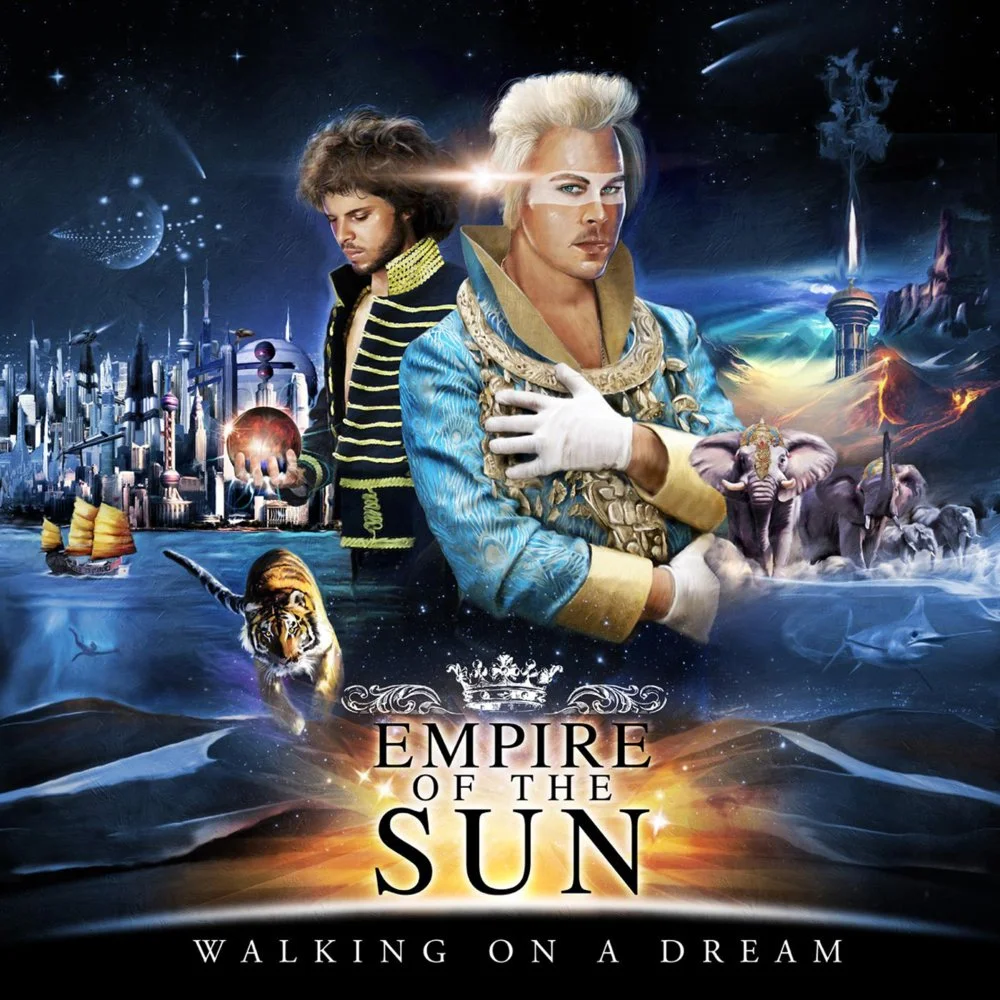
“Walking on a Dream” by Empire of the Sun demonstrates how multiple musical elements can function as hooks, repeated features that catch the listener’s ear and make a song memorable. This example brings together all of the musical elements discussed in this chapter, including form, hooks, chord progressions, melodies, timbres, and repetition, showing how they work collectively to shape the emotional and stylistic impact of a pop song.
One of the most prominent hooks of the song is the repeated synth line. This line, which plays the song's chord progression, repeats throughout much of the track, forming a sonic signature that immediately identifies the song. Its shimmering, slightly detuned synth tone with a glossy retrofuturistic texture renders it particularly striking, and the synth's timbre becomes a hook.
The chord progression also plays a major role in the song's catchiness. It repeats the sequence from Db to Ab, then from Ab to Eb, with no variation, anchoring the song in a stable harmonic loop that buttresses its surreal mood. In this case, the chord progression functions as a harmonic hook engaging the listener into the hypnotic mood of the track.
The melody mirrors this sense of repetition, with phrases that recur in both the verses and choruses, creating cohesion across the song’s structure. The verse features a melody centered on a single pitch, relying heavily on rhythm for its interest. The pre-chorus introduces a faster-paced melodic line that builds tension and momentum. This tension is released in the chorus, where the melody lifts into a higher, more airy register, offering a sense of emotional release and openness. The contrast between the tighter, rhythm-driven pre-chorus and the soaring chorus adds dynamic shape to the song and makes the chorus melody stand out as a vocal hook.
Together, these parts of repetitive synth motifs, a looping chord progression, dynamic melodic contours, evocative timbres, and structured form interact to create a track that appears both consistent and captivating from beginning to end. This example illustrates clearly how a pop song can use musical building blocks in creative and interconnected ways to create a memorable pop song.
Below is a full breakdown of the song form with timestamps:
Intro: 0:00 - 0:15
Verse 1: 0:15 - 0:30
Pre-Chorus: 0:30 - 0:45
Chorus: 0:45 - 1:00
Post-Chorus: 1:00 – 1:15:
Verse 2: 1:15 - 1:30
Pre-Chorus: 1:31 - 1:45
Chorus: 1:46 – 2:02
Repeated Chorus: 2:03 – 2:16
Post-Chorus: 2:16 – 2:31
Bridge: 2:31 – 2:45
Chorus (repeated): 2:46 – end
These concepts will serve as tools that help you listen more closely and think more clearly about how music works. As you move through this book, refer back to this chapter whenever you encounter unfamiliar language or want to sharpen your understanding of how sound shapes meaning in American popular music. Think of this vocabulary as a toolkit that will grow more familiar and useful as we explore the music and meaning of American popular music together.