Module 1: Introduction and Musical Concepts
Now that we have some general guidelines around what we might mean by “music” in the west, let’s talk about ways to describe or interpret what you hear.

Timbre
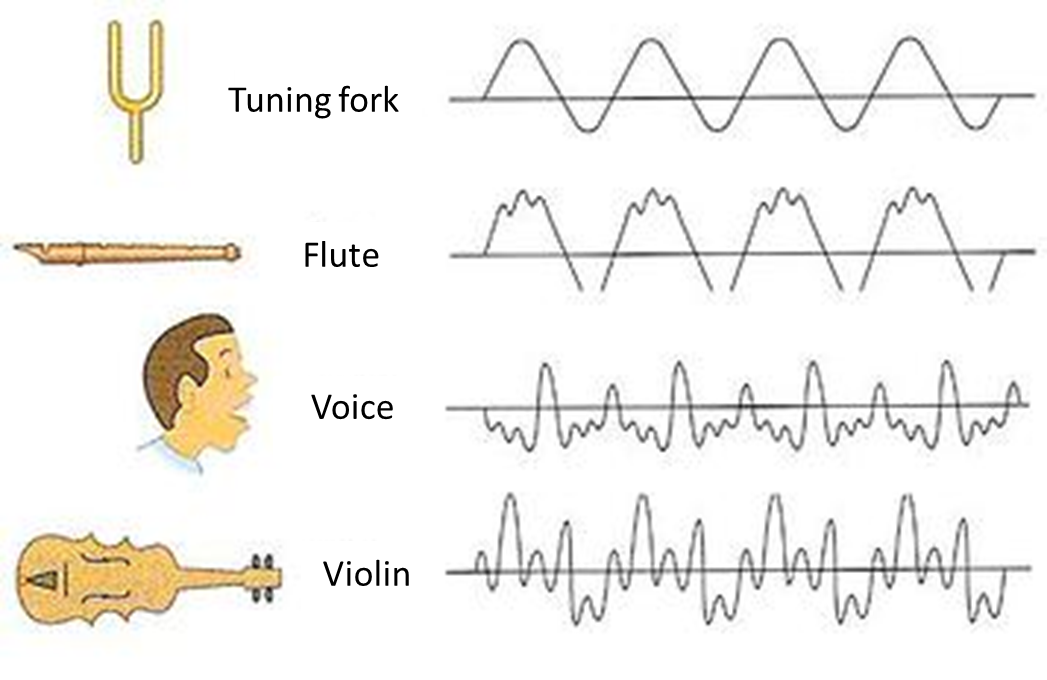
Timbre (pronounced "tam-ber") refers to the tone color or unique quality of a musical sound. It is what allows us to distinguish one instrument or voice from another, even when they play or sing the same pitch at the same volume. For example, a piano and a violin playing the same note sound distinctly different because of their timbre.
Timbre is determined by a number of factors, including the instrument's construction, the performer's technique, and any electronic processing used during production. At the core of timbre is a sound’s frequency content. Every musical sound consists of a fundamental frequency—the main pitch that we perceive—and a series of overtones or harmonics that vibrate above it. The fundamental note is the lowest and most prominent vibration, determining the pitch we recognize, such as A, C, or G. Frequencies are measured in hertz (Hz), which refers to the number of vibrations per second. For instance, the note A above middle C vibrates at 440 Hz. Overtones, which occur at whole-number multiples of the fundamental frequency, add depth, richness, and brightness to a sound. The particular combination and intensity of these overtones give each instrument its distinctive tone.
The material and construction of an instrument also play a major role in determining timbre. For example, the wooden body of an acoustic guitar produces a warm resonance, while the metal tube of a trombone gives it a brassy, bold tone. Performance techniques—such as vibrato, strumming versus fingerpicking, or adding vocal rasp—can drastically alter a sound’s color. Additionally, studio effects, including reverb, distortion, equalization, and autotune, can greatly alter the final sonic character. For instance, the use of heavy autotune in Cher’s “Believe” or the eerie, layered synth textures in Billie Eilish’s “bad guy” show how electronic processing adds to the song’s timbre.
Sergei Prokofiev's Peter and the Wolf (1936) was composed to introduce listeners to the distinct timbres of the orchestra by assigning each main character to a different instrument or instrumental group. Peter is represented by the bright strings, the bird by the light and fluttering flute, the duck by the nasal-sounding oboe, the cat by the smooth, velvety clarinet, the grandfather by the deep bassoon, and the wolf by the dark French horns. As you listen, notice how each instrument's unique tone color helps portray the personality of its character. Even if you cannot yet identify every instrument by name, you can hear clear differences between the warm resonance of the strings, the airy quality of the flute, the reedy sound of the oboe, the mellow clarinet, the rich bassoon, and the bold, brassy horns. Those differences in tone color are examples of timbre, the unique quality of a musical sound that allows us to distinguish one instrument from another, even when they play the same pitch.
Texture
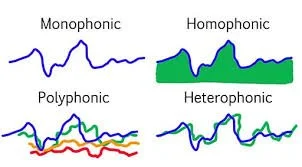
Texture describes how musical parts are layered and interact at any given moment, creating the overall sonic fabric of a piece. Instead of focusing on the tone color of individual instruments or voices, texture addresses the relationships between musical lines: how many are present, whether they move together or independently, and how melody, harmony, and rhythm are organized across those layers. Listening for texture helps us hear the structural roles these sounds play within the music.
A monophonic texture consists of a single melodic line with no harmonic accompaniment. In monophonic texture, the melody may be performed by one voice or instrument or by multiple performers in exact unison, but only one pitch stream is present. Because no chords or counter-melodies appear, the listener’s attention is directed entirely toward the melody’s rhythm and contour. A clear pop example occurs at the opening of Queen’s “We Will Rock You,” where Freddie Mercury sings alone while hand claps and stomps provide rhythmic support without introducing pitched harmony. Even when additional voices join later, the texture remains monophonic because all performers sing the same notes of the same melody rather than creating harmony.
Heterophonic texture arises when multiple performers present the same melody simultaneously but with small variations in rhythm, timing, or ornamentation. The melody remains unified, yet the slight differences create a loosely layered effect. Heterophonic texture is most often found in vocal performances by pop music groups. In Destiny’s Child’s “Survivor,” from approximately 2:25 to 2:48 during the chorus, the singers perform the same melodic line while Beyoncé’s lead vocal is subtly varied through rhythmic emphasis and embellishment. The voices are neither fully harmonized into different chord tones nor perfectly synchronized in unison, producing a heterophonic texture built from one shared tune.
Polyphonic texture involves two or more independent melodic lines simultaneously, each with its own rhythmic shape and contour. No single line functions solely as accompaniment; instead, the melodies exist and interweave. A well-known pop example appears in the closing section of the Beach Boys’ “God Only Knows’’ from about 2:10 to the end of the song. In the song’s outro, multiple vocal lines enter successively, each singing a distinct melody that overlaps with the others. Because these lines move independently rather than moving in synchronized chords the texture is clearly polyphonic.
Homophonic texture consists of a primary melody supported by harmonic accompaniment, with the accompanying parts reinforcing the harmony rather than competing melodically. Homophonic texture is the most common texture in pop music. In John Lennon’s “Imagine,” Lennon’s voice presents the melody while the piano moves in block chords beneath it. The piano does not introduce an independent melody; instead, it supports and strengthens the harmonic foundation, making the texture clearly homophonic.
Homorhythm is a specific type of homophonic texture in which all voices or instruments move together rhythmically, changing pitches at the same time. The interaction of these rhythmic patterns creates a tightly unified, chordal sound in which rhythm and harmony are inseparable. In Prince’s “Nothing Compares 2 U,” at the end of each verse and on the line “Nothing compares to you” in the chorus, the background vocals and accompanying instruments align rhythmically with the lead vocal on the song’s signature motif. These parts articulate the lyrics and chord changes together, forming stacked harmonies that move in rhythmic unison and create a distinctly homorhythmic texture.
Summary

Now that we’ve explored the foundational elements of music—melody, harmony, timbre, and texture—we can begin to see how these building blocks work together in a real-world context. Lesson 2 moves from theory to practice, showing how these concepts shape the sound and emotional impact of a song. By listening closely and analyzing these elements, we can understand not just what makes the song work, but how its musical design evokes mood, style, and emotional resonance.